Private Key Wallet Risk Mitigation With Scroll Wallet 2026

A private key is the cryptographic secret that proves ownership of a crypto wallet. It generates the public address you share, signs transactions, and cannot be recovered if lost, making its protection the core security challenge. Scroll Wallet stores the key in a secure enclave, splits the seed across devices, and automates safe recovery steps.
A private key is a 256-bit alphanumeric secret that hands you sole command of your crypto and lets you sign transactions. In plain language it's the master password for your wallet-whoever holds it moves the funds, and there's no "forgot-my-password" button.
Under the hood the key appears as a 64-character hex string, forged by cryptographic algorithms that make guessing it akin to finding a needle in an infinite haystack. When you spin up a wallet, that key spawns a public key through a one-way math trick. The public key becomes your address, safe to share. No one can reverse-engineer the private key from it, yet anyone can verify a signature you produce with just the public key. The result? Proof of ownership without ever exposing the secret.
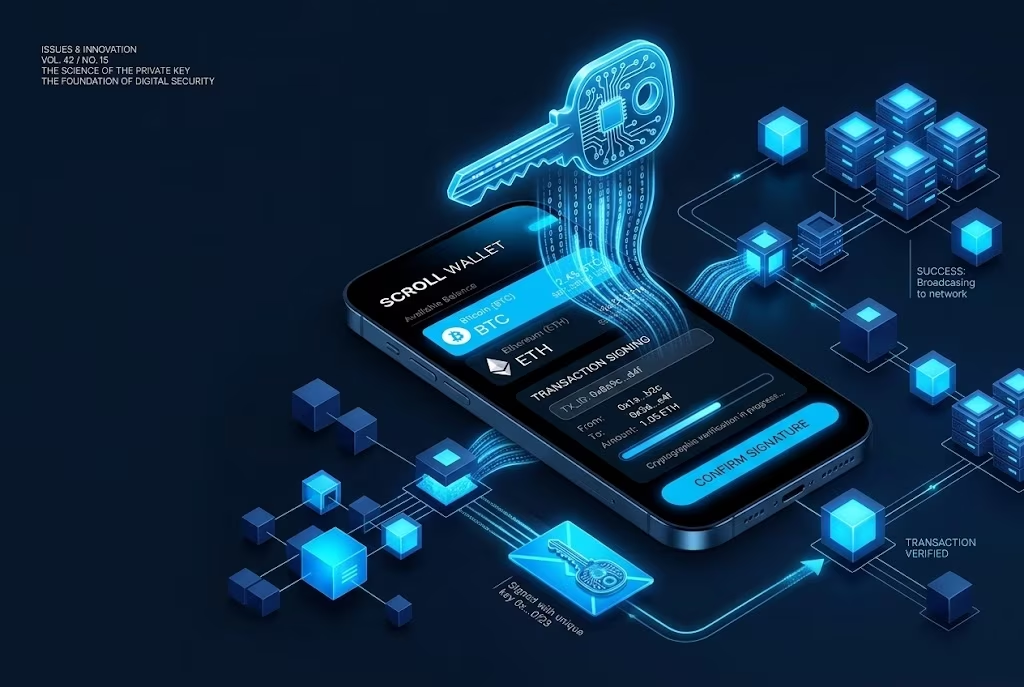
In Scroll Wallet the private key lives encrypted on your device-never on our servers, never in transit. Signing a transaction happens locally; only the signature rockets to the network. This design puts the entire security burden on how you guard the key. As BTC Direct explains, the 256-bit hex backbone is the math that makes this possible. Lose the key, lose the cash. Hand it over-even to support-and you hand over the vault. With wallet hacks getting craftier every day, treating the private key as your most valuable secret isn't a suggestion; it's the only way to stay in control.
Scroll Wallet's private key lets you sign transactions and lock down every asset, so only you hold the reins across any chain.
The private key is your ultimate proof of ownership. You wield it to sign transactions-whether you're moving tokens or hopping over an L2 bridge, Scroll Wallet assembles the data, stamps your key, and spits out a cryptographic signature. Nodes on the chain match that signature to your public key, never laying eyes on the secret. No middlemen, no leaks. That's how you hand-pick which moves get the green light and authorize transactions while you access blockchain resources safely. 2026's fragmented network is a phishing minefield; one careless click and the vault snaps shut. Our self-custody model throws automated risk screens and a razor-sharp UI at you, but the golden rule stays-never share the key or seed phrase. Lose it, and the door stays locked forever; no rescue team on standby.
Lock it up right:
Our transparent infrastructure double-checks every step, building trust without the hype. Dive deeper in our guide on self custody wallet practices and stitch your assets into Scroll's ecosystem with confidence while we keep the L2 engine humming.
In Scroll Wallet, your private key stays securely on your device, generating cryptographic signatures for transactions without ever exposing it to the network. This protects against phishing and exploits common in 2026's multi-chain environments.
Compare private key storage methods to choose the right balance of security and convenience for your assets. Scroll Wallet integrates with hardware options for enhanced protection in multi-chain environments.
| Method | Pros | Cons |
|---|---|---|
| Hardware Wallet | Offline in tamper-resistant device, phishing resistance, isolated signing | Physical theft, supply-chain attacks |
| Cold Storage | No network exposure (paper, air-gapped), full user control | Physical damage, loss, slow recovery |
| Encrypted Cloud | Convenient backups, multi-device access | Online attack surface, provider reliance, single-point failure if compromised |
Source of data: Streamflow Finance - Details hardware wallet, cold storage, and encrypted cloud methods with their security pros and cons.
Crypto losses usually trace back to human slip-ups, not broken code - and every one of them can be avoided. Research shows the biggest culprits are phishing scams, leaked private keys and sloppy seed-phrase handling. These aren't flaws in the blockchain itself; they're security gaps that appear before any coin ever touches the chain.
The seed phrase is the crown jewel of your crypto life - the 12-to-24-word password that opens every wallet you own. Hand it over, and the thief walks away with everything. Yet people keep repeating the same blunders: snapping screenshots, dumping the phrase into cloud drives or email, typing it into look-alike sites when panic spikes, reusing passwords across exchanges and inboxes. Crowdfund Insider reports that private-key leaks and phishing were the top causes of crypto theft in Q3 2024. A digitally stored phrase is a magnet for malware and hackers - it's like leaving the front door wide open.
The antidote is simple and old-fashioned: keep the phrase offline. Write it on paper, or on a dedicated metal wallet, and lock it away. Double-check every word, every order. Store copies in separate fire-proof spots - one in a home safe, another in a safety-deposit box. Redundancy means a single loss won't lock you out. Better yet, commit the phrase to memory.
Private-key security decides which wallet wins the race. Analysts at a16z Crypto warn that the next two years will turn key protection into the ultimate competitive edge, as self-custody risks, phishing scams and wallet exploits surge. In Scroll Wallet we take that warning to heart: your private keys never step outside our hardened enclave, giving you control without handing them over to the internet.
The on-chain jungle of 2026 isn't forgiving-multi-chain bridges, a splintered L2 landscape, endless attack vectors. How many wallets have already slipped? Coinbase, OKX, and countless others have shown the cost of a leaked key. Scroll counters the chaos by generating keys in a hardware-grade secure enclave and signing transactions offline. No data leaves the box, no surprise leaks. Our UI walks you through every detail, double-checking before the signature-human error trimmed, transparency amplified.
Use Scroll safely: back up your seed phrase on paper, never on a cloud drive. Enable multi-signature for high-value holdings-one key compromised, the vault stays shut. Shun suspicious sites, keep firmware fresh, and remember: a compromised device can still bite, but our architecture isolates the damage. The result? A wallet that feels more like a vault than a convenience store, with brand trust and automation stacked in your favor.
The global crypto wallet market is expanding rapidly. In 2023, the market was valued at approximately $9.95 billion, with projections reaching $74.52 billion by 2032. This growth reflects increasing adoption of self-custody solutions and the rising complexity of on-chain environments that require reliable wallet infrastructure.
| Year | Market Size (USD) |
|---|---|
| 2023 | $9.95 billion |
| 2032 | $74.52 billion |
Data source: SNS Insider - Confirms the 2023 market size of $9.95 bn and the 2032 forecast of $74.52 bn for crypto wallets.
"`
Non-custodial walletsin the U.S. navigate a maze of FinCEN's Bank Secrecy Act rules, where the line between custodial and non-custodial services decides the compliance burden. FinCEN classifies most crypto firms as Money Services Businesses (MSBs), demanding Form 107 registration within 180 days and a full AML program. Then, in April 2024, it yanked the December 2020 proposal that would have imposed KYC on non-custodial wallet holders-a rule the industry called impossible because those wallets never collect personal data. Who imagined a wallet that never sees your name could be forced to "know" you?
The distinction boils down to control. If you accept and move crypto on behalf of users, you become an MSB with AML, record-keeping, SAR and CTR obligations. If you simply provide software that users run on their own devices, the direct requirements evaporate-at least for now. FinCEN's 2019 guidance already warned that Virtual Asset Service Providers-exchanges, ATMs-must obey the Travel Rule, swapping KYC data between parties. In 2024 the agency widened AML and CFT duties to cover certain investment advisers, tightening the net around every crypto-related activity.
For wallet providers, the playbook now reads: assess unhosted-wallet risk, manage third-party exposure in line with BSA, and align with FinCEN's 2024 AML/CFT priorities that spotlight ransomware, cybercrime and geopolitical sanctions. As Latham & Watkins notes, the regulatory tide keeps shifting, reshaping how MSB registration and SEC guidance affect wallet operations. The bottom line? A non-custodial wallet isn't subject to KYC-yet any service that moves or holds assets for users instantly becomes a money transmitter and triggers full MSB compliance. The real test isn't branding; it's the functions you actually perform.
2026's security frontier packs TEE, zero-knowledge wallets, and split-key design to shield private keys from phishing, exploits and cross-chain threats. You're staring at a maze of L2 shards, bridge hacks and tangled contracts. Scroll Wallet stitches the pieces together: TEE locks computation inside hardware cages, keeping data encrypted even while it's being processed; zero-knowledge proofs confirm a transaction without spilling a single byte of detail. Our split-key scheme shreds the private key across isolated modules, so neither your phone nor a server ever sees the whole thing-exploit-proof by design.
Need a vault that feels like a fortress yet works like a coffee machine? Signing a multi-chain move? Scroll taps cold-storage trends, borrowing hardware isolation tricks, then wraps them in zero-knowledge magic that proves ownership without flashing balances. Bridge crossings become a click-away, thanks to TEE-guarded signatures that cut out the error-prone manual steps that phishers love. Ledger's 2024 report shows U.S. users sprinting toward cold storage and hardware wallets; we're delivering that promise worldwide, no fluff attached.
Trust isn't a slogan-it's baked into every attested TEE call and every split-key recovery that demands multi-factor consent. Sure, TEE leans on silicon quality, and zero-knowledge adds a whisper of latency for monster-size trades, but our L2-tuned engine smooths the bumps. Enable split-key at onboarding, let the UI run risk checks automatically, and let Scroll's open ledger be your Web3 bedrock. The result? Fewer attack vectors, clearer navigation, and a crypto journey that finally feels safe in 2026.
If your private key slips into the wrong hands, your crypto disappears in an instant. A breach means irreversible loss, turning wallet security into the bedrock of any self-custody plan. Scroll Wallet fights back with industry-grade encryption, isolated storage, and a fully auditable codebase, staking its claim as a dependable guardian in today's threat landscape.
2026 has turned phishing into an art form-malicious scripts masquerade as innocuous links, exploits hide behind familiar UI elements. How do we stay ahead? By encrypting the key right on the device, demanding multi-factor authentication, and sealing transaction signing inside a secure enclave. The result? A dramatically shrunk attack surface, and even a rogue script can't pry the key out.
The multi-chain explosion and a patchwork of L2 solutions make asset management feel like juggling knives. Scroll Wallet cuts through the chaos, offering a single pane that automatically routes transactions through vetted bridges while preserving end-to-end cryptographic proofs. Every bridge call is exposed for audit, so you can verify trust without sacrificing ease.
To squeeze the most security out of Scroll Wallet, follow these practical steps: