
Crypto Wallet Private Key Risk Solved By Scroll Wallet 2026
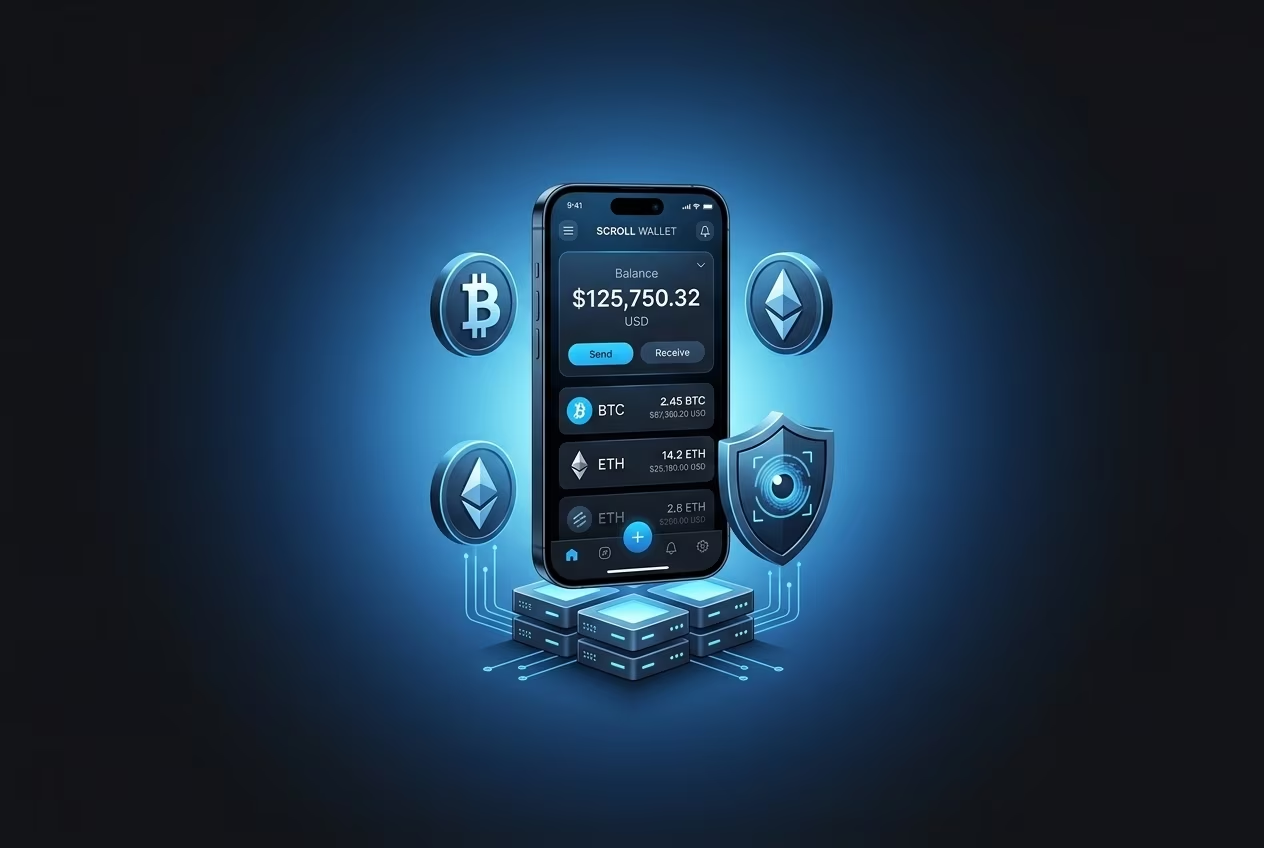
An Ethereum private key is a 256-bit secret that mathematically controls every asset associated with its address. Scroll Wallet stores this key only on your device, never transmits it, and uses the phone's secure enclave to sign transactions, so you retain full ownership while minimizing exposure to phishing or malware.
Your private key signs a transaction by forging a proof only you can create, while never exposing the key itself. When you fire off a transaction on Ethereum, the wallet hashes every piece-nonce, gas price, limit, recipient, amount, data-through Keccak-256, then runs that digest through ECDSA with your private key. The result? Three numbers-r, s and v-glued together as a signature. That signature says "I approved this" and guarantees the payload stayed untouched, all without ever leaking the key. Nodes pull your public key from the signature, match it to the sender address, and the transaction passes.
Elliptic-curve cryptography does the heavy lifting. Your private key is a random 256-bit secret you alone own. Signing applies a one-way operation to the hash, binding the signature to both the key and the exact transaction data. Change a single byte and the signature collapses. A hacker can't swap the recipient, tweak the amount, or mess with gas-any tampering renders the signature useless. As MEXC Crypto Pulse explains, a private key signs an Ethereum transaction by generating an ECDSA signature over the Keccak-256 hash of the RLP-encoded transaction data, guaranteeing authenticity and integrity.
In real life you never touch this math. Your wallet-be it Scroll Wallet or any other-does the signing behind the scenes the moment you click "Confirm". It grabs the stored private key, applies it to the transaction hash, spits out the signature, and pushes the signed payload to the network. Validators check the signature against the public key; if it checks out and you have enough ether, the block includes it. The golden rule: the private key never leaves your device, never travels over the wire. Only the irreversible signature lands on-chain. Even a man-in-the-middle can see the data but can't forge a signature or steal funds without the key.
When you choose a crypto wallet, you're making a decision that affects your security, control, and cost. Here's how the three main types compare across what matters most.
| Wallet Type | Security | Control | Cost |
|---|---|---|---|
| Hardware Wallet | Highest - private keys stored offline on secure chip | Full - you control keys and recovery phrase | $50-$200 one-time |
| Software Wallet | Lower - keys on internet-connected device, vulnerable to malware | Full - you control keys (non-custodial) | Free |
| Custodial Wallet | Lowest - third party controls keys; exposed to exchange hacks | None - exchange controls your assets | Free or low-cost + trading fees |
The core difference comes down to who holds your private keys. With a non custodial wallet, you own them. With custodial wallets, an exchange does. This determines everything: your risk, your responsibility, and your freedom to move funds without permission. For the strongest protection, Ledger Academy confirms that hardware wallets are the gold-standard for protecting private keys.
Your privatekey becomes a fatal flaw when exposed, stored insecurely, or weaponized by social engineers, wiping out assets in self-custody wallets. In the chaotic 2026 multi-chain arena-L2s splintered, bridges popping up like mushrooms-phishing and wallet exploits explode. Scroll Wallet builds rock-solid, verifiable infrastructure, but the onus stays on you: guard your seed phrase, never reveal your key, because blockchain offers no second chances.
First, storage sins. Do you really trust an unencrypted file on a cloud drive? Malware loves those open doors, and experts flag this as the top leakage route. Seed phrase security demands cold, encrypted vaults-hardware devices or Scroll's multi-signature shield. Social engineers lurk in every inbox, coaxing you to spill secrets; Ledger Academy tallies billions lost to such scams each year. That's why Scroll automates risky flows, sniffs out suspicious transactions, and forces you to think twice before you click. Ditch screenshots, ditch digital notes-one compromised gadget equals total loss.
Malware and device hijacks amplify the danger. Remember the Windows-based attacks that ripped keys from Coinbase and OKX users? Trojans slipped in, siphoned private data, vanished. Scroll Wallet counters this with crystal-clear UX, on-chain transparency, and real-time risk alerts-no blind approvals. Your playbook: generate keys offline, double-check every dApp call, lean on our automated safeguards, audit permissions regularly. The result? Sharply cut exposure, firm control-no hype, just tools for the brutal reality of 2026. Ledger Academy backs these claims with hard data on losses from lax storage and phishing.
If your private key leaks, your funds disappear-Scroll Wallet tolerates no exceptions. The Flashbots 2024 report warns that even ecosystems with high trust can be hijacked by malicious npm packages masquerading as SDKs, siphoning mnemonics and private keys through Telegram bots. We built Scroll Wallet around that warning: developers lose wallets via subtle compromises, so you must own and defend your keys with ironclad discipline. In 2026, L2 fragmentation and phishing storms are the norm; our architecture forces every signature to stay on your device, never wandering through bridges or third-party relays.
Ever downloaded a "Flashbots SDK" that turned out to be malware? Those attacks hide in UPX-packed binaries, linger in the registry, and snatch browser-stored keys. Scroll Wallet fights back with phishing-resistant MFA, hardware-key integration, and biometric checks-physical proof that a password alone isn't enough, echoing U.S. federal standards. We route transactions through a private mempool, akin to Flashbots Protect RPC, keeping them out of front-running bots and away from costly gas failures. The result? Transparent, private flows across tangled multi-chain landscapes.
Want to stay safe in 2026? Generate keys offline, lock them behind a YubiKey or fingerprint, and steer clear of npm packages that copy names like flashbot-sdk-eth. Scroll Wallet never holds your assets; every signature is yours to verify, slashing self-custody risk while our verifiable L2 backbone builds confidence. Keep hot-wallet balances low, watch for odd activity, and let our UX guide seamless bridges-practical defense without empty promises.
Follow these steps in Scroll Wallet to generate, store, and back up your private key securely against 2026 threats like phishing and L2 exploits.
US regulation separates private-key ownership from custodial financial services. A user who holds a private key for personal self-custody is not acting as a custodian for someone else, while hosted wallets and exchanges may trigger money transmission, AML, and reporting obligations.
The practical rule for wallet users is to keep clear records, understand when an exchange or fiat on-ramp becomes involved, and avoid treating self-custody as a way to ignore tax or sanctions duties. Scroll Wallet keeps key control local, but users remain responsible for lawful use and transaction documentation.
For private-key security, the strongest compliance posture is operational clarity: separate personal wallets from custodial services, document transfers, verify counterparties when using regulated platforms, and never give a recovery phrase to a service claiming it can validate legal status.
The Ethereum wallet market reached $4.2 billion in 2024. Hardware wallets generated about 45% of revenue, while software wallets remain mostly free.
| Metric | Value |
|---|---|
| Market Valuation (2024) | $4.2 billion |
| Hardware Wallet Revenue Share | ~45% |
| Hardware Wallet Prices | $30 - $200+ |
| Software Wallet Prices | Free / Low-cost |
Source of data: Zion Market Research - Confirms the 2024 market valuation of $4.2 billion and hardware wallet revenue share of about 45 %.
TEEs, Account Abstraction and zk-Rollup flip private-key handling upside-down, swapping brittle EOAs for programmable smart-contract accounts. You hold the keys, but no single point can knock you out. Phishing attacks? L2 chaos? These trends bite back. In Scroll Wallet we mash non-custodial ideas with a TEE-backed hardware enclave, so your keys never touch the chain and only zero-knowledge proofs can vouch for them.
Account Abstraction makes every Scroll Wallet address a smart contract, wiping out the classic seed-phrase nightmare. Need a rescue? Call in guardians, tap a fingerprint, or let a token cover the fee. Bridge across chains on autopilot-no more manual juggling. Flashbots already warned that 2024 saw a surge in non-custodial wallets, TEEs and abstraction; we take that playbook and strip away the hype, leaving raw, verifiable infrastructure.
Our zk-Rollup bundles transactions off-chain, then slaps a snappy ZK-SNARK proof on top, keeping your keys hidden while proving everything checks out. Self-sovereign identity? Check. L2 hopping? Smooth. Still, keep guardians in the loop and enable 2FA-no system can erase phishing entirely. Scroll Wallet gives you a clear roadmap: spin up a smart account, name trusted recoverers, and cross bridges with confidence.
Scroll Wallet stores your private keys offline, giving you true self-custody backed by open-source code and zk-Rollup security on Scroll's Ethereum L2. You generate a seed phrase on the device itself, so we never see it. Phishing? Gone. Centralized hacks? Shrink. In 2026's tangled multi-chain jungle, your assets stay where you put them. This offline model dodges online attacks while our private key security follows the toughest isolation standards.
Every line of our code is public, letting you audit the whole thing-trust built on transparency, not hype. L2 fragmentation and bridge bugs? We've seen them, we've learned from them. Integrated with Scroll's zk-Rollup, the wallet shoves transactions off-chain for lightning speed and pennies-low fees, then locks the proof on Ethereum without ever exposing your keys. iOS or Android, you tap, you sign, you stay anonymous-no personal data harvested, just your device doing the work.
To stay safe, write down the seed phrase on paper, store it away from the internet, and lock your phone with biometrics. The app streamlines the flow, but the responsibility stays with you: lose the paper, lose the funds. Start with a tiny transfer, watch it settle, then go bigger. This self-custody playbook makes Scroll Wallet a solid foundation for any on-chain hustle in today's complex setups.
Own the private key, own the crypto. In 2026, self-custody still beats every centralized promise. Phishing? Bridge hacks? Wallet exploits? Scroll Wallet hands you the reins and strips away the usual headache of key management.
We built Scroll Wallet for a world where every chain talks to every other. By pulling the private key out of the app layer and sealing it in a hardware-backed enclave, we shrink the playground attackers love. L2 bridges and cross-chain swaps-no longer a soft spot. Each audit, each update, drives this principle home.
Secure storage? Think layers, not a single lock:
Follow the playbook, and Scroll Wallet's clean UX and automated risk-mitigation do the heavy lifting. Your crypto's resilience hinges on how you treat the keys-store them right, and the ecosystem stays solid.