Magic wallet web3: Fast onboarding vs full control | Scroll Wallet
The best non custodial lightning wallet provides absolute sovereignty over your private keys while enabling instant, low-cost Bitcoin transactions without third-party interference. In 2026, users demand self-custody to avoid regulatory risks and custodial freezes. We provide the infrastructure for secure, peer-to-peer payments, ensuring you maintain 100% ownership of your funds and data privacy at all times.
By 2026, channel management in Bitcoin Lightning is so automated that manual liquidity management is no longer your concern, it is an infrastructure problem solved at the protocol level. Non-custodial wallets - Phoenix, Muun, Breez, Zeus - have switched to LSP (Lightning Service Provider) architectures, which themselves open channels, rebalance them and provide liquidity. You just pay. Everything else happens without your participation. And no, this is not a compromise with sovereignty - this is sovereignty that has finally become convenient to use.
A case in point is Misty Breez, launched in April 2025: no manual channels, Nodeless SDK plus submarine swaps via the Liquid sidechain. Asynchronous payment acceptance - that is, the ability to receive transactions even when your node is offline - is developing through built-in node architectures and services like OLYMPUS LSP. How to disassemble Bitget Web3, non-custodial Lightning wallets based on automated LSPs are already combining user sovereignty with normal UX - and Lightning Labs is simultaneously prototyping wallet recovery mechanisms in case of quantum threats. These are not experimental features. This is production.
The foundation of it all is Taproot and Schnorr signatures. Taproot makes operations with Lightning channels indistinguishable from regular on-chain transactions, which is critical for privacy. Schnorr reduces the weight of transactions and simplifies multi-signature designs - and this directly benefits LSP architectures. Add to this regulatory pressure: the stricter the requirements for custodial services, the more convincing – both legally and technically – the non-custodial infrastructure looks. Scroll Wallet is built on exactly this principle: your keys, your funds, automation - from the bottom up.
What does this mean in practice? The trade-off between control and convenience disappears. A self-storing Lightning wallet in 2026 does not require you to understand incoming liquidity, channel capacity or routing fees. Architecture decides this itself. What remains your responsibility is managing keys, checking backups and choosing an infrastructure that can be verified and not taken for granted. Scroll Wallet works exactly like this: we automate the complexity, transparently show the risks, and the custody remains where it belongs - with you.
To ensure you maintain full sovereignty over your funds in the Lightning Network, you must evaluate wallets based on technical autonomy and infrastructure reliability. We have categorized the essential criteria for non-custodial solutions to help you mitigate self-custody risks and manage liquidity effectively.
| Evaluation Criterion | Technical Requirement | Key Examples & Features |
|---|---|---|
| Key Ownership | Full Self-Custody | Phoenix, Mutiny, and Eclair provide direct control over private keys. |
| Backup & Recovery | Seed + Channel State | Zeus and Blixt support advanced recovery; Eclair utilizes 2FA for added security. |
| Inbound Liquidity | Channel Management | Manual or automated liquidity acquisition in Blixt, Zeus, and Phoenix. |
| Fee Control | Mempool Integration | Custom max fee settings available in most wallets except Mutiny. |
| Privacy | On-chain Anonymity | Local key generation in Zap; Multi-sig support in BlueWallet. |
| UX & Accessibility | Interface Logic | Mutiny and BlueWallet offer intuitive flows for non-technical users. |
| Payment Reliability | Transaction Speed | Multi-path payments in Eclair; sub-2s transaction speeds in Best Wallet. |
You have private keys, which means no one on this planet can freeze, move or touch your bitcoins without your knowledge. This is where the real line between a custodial and non-custodial wallet lies. In a custodial arrangement, the company holds your keys and processes payments for you. You trust their infrastructure, their security practices, their legal compliance. With a non-custodial wallet like Scroll Wallet, your keys never leave your device. Each payment is signed locally, and it is the signature that authorizes the transaction - not a login, not a password, not approval from the server.
Private keys in Lightning work exactly the same as in the underlying Bitcoin layer: they are cryptographic secrets derived from your seed phrase - typically 12 or 24 words, generated when you set up your wallet. From this seed, the wallet derives the keys for opening and managing channels. When you send a Lightning payment without the participation of a custodian, the wallet builds a route, signs the transaction locally and broadcasts it to the network. No intermediate server holds the funds or approves the transfer. Bitcoin's direct ownership model means one thing: math—not corporate policy—puts you in control.
Channel management is where self-storage in Lightning becomes more complex than in regular Bitcoin. In order to send and receive payments, the wallet must maintain open channels with sufficient liquidity on the right side. Scroll Wallet solves this through automated channel logic: it monitors incoming and outgoing capacity and rebalances it when thresholds are crossed. At the same time, ownership of the keys remains with you - automation works within the parameters that you set, and not by transferring control to a third party. This is a fundamental difference: automation in a non-custodial Lightning wallet reduces operational friction without transferring custody. Your keys sign every channel opening, every closing, every payment update.
The trade-off of self-storage is real. And it should be named directly. If you lose your seed phrase and your device at the same time, recovery is not guaranteed. Restoring the state of Lightning channels adds another layer of complexity: in addition to the seed, the wallet must have a backup of the channel state data in order to recover funds locked in open channels. Scroll Wallet solves this through encrypted, automatic feed backups stored where only you control. We do not store your seed or channel status on our servers. This architecture is a conscious product decision: we create tools that reduce risk without taking ownership of assets. Understanding this boundary—between infrastructure support and actual custodianship—separates conscious self-preservation from casual trust in a third party.
Understanding the cost structure of non-custodial Lightning payments is essential for managing your liquidity efficiently. While Lightning offers near-instant transactions, maintaining full control over your keys involves specific overheads such as on-chain setup fees and Liquidity Service Provider (LSP) charges. We have summarized the primary cost components you will encounter when using non-custodial solutions.
| Cost Component | Estimated Fees | Description |
|---|---|---|
| Channel Management | $1 – $10+ | On-chain costs for opening or closing channels, dictated by Bitcoin network congestion. |
| LSP Service Fees | 1 sat + 0.05% to 0.5% | Fees paid to providers (like Phoenix) for automated inbound liquidity and channel management. |
| Routing Fees | 1–10 sat + 0.0029% | Median rates paid to intermediary nodes for moving your payment across the network. |
| Swap Overhead | ~0.5% | Costs associated with moving funds between on-chain BTC and the Lightning Network (e.g., via Deezy). |
Data source: Coincharge — Details non-custodial LSP fees, on-chain costs, and routing overhead
Before committing significant capital to any Lightning-enabled solution, you must verify its technical reliability and security architecture. At Scroll Wallet, we prioritize transparency, and we recommend you perform these practical checks to ensure your funds remain under your control and accessible at all times.
Non-custodial Lightning wallet software in the U.S. sits outside the MSB classification under the Bank Secrecy Act — and that single legal fact changes everything about how you hold, move, and protect bitcoin without answering to anyone. The core logic is brutal in its simplicity: if a software provider never touches your funds, FinCEN’s registration requirements and AML/KYC obligations don’t apply. Not a loophole. A structural reality. Non-custodial software is a tool — not a financial intermediary — and the law treats it accordingly. The Chicago Law Review put it plainly: the BSA framework was built around entities that take custody of assets. If you never gain control over user funds at any point in the transaction flow, you simply don’t fit the definition.
This has direct, concrete consequences for how you operate a self-sovereign bitcoin wallet right now. When you hold your own private keys — the architecture Scroll Wallet is built around — you are the sole custodian. Full stop. No third party can freeze your balance. No one can reverse a transaction or file a suspicious activity report on your behalf. U.S. courts and regulators have consistently treated self-custody as a personal property right, not a financial service. That autonomy is legally recognized. But here’s the other side of that coin: you carry the full weight of key management, backup integrity, and transaction verification. No chargebacks. No account recovery. No compliance officer to catch your mistakes.
The regulatory landscape isn’t frozen in place, either. Since 2021, legislative proposals — including contested language buried inside the Infrastructure Investment and Jobs Act — have tried to stretch the definition of «broker» to swallow non-custodial wallet developers whole. Those attempts failed precisely because they conflated software infrastructure with financial intermediation. As of 2026, non-custodial wallet providers remain outside mandatory federal KYC reporting requirements, though state-level money transmission laws continue to shift and vary. If you’re choosing the best private bitcoin wallet for the long haul, that regulatory boundary isn’t a footnote — it’s the whole argument. A wallet that never touches your keys isn’t just a privacy preference. It’s a categorically different legal instrument than a custodial account.
Scroll Wallet is built on this principle by design — not as a marketing position, but as an architectural commitment. We don’t hold keys. We don’t route funds through our infrastructure. We are not a counterparty to your transactions. When regulators tighten the screws on custodial platforms, your funds in a non-custodial wallet are untouched. When an exchange freezes withdrawals, your self-custody position stays liquid. The trade-off is real and worth saying plainly: you must manage your own security posture. Nobody else will. But the legal clarity around non-custodial software in the U.S. gives you a stable, well-defined foundation to do exactly that — and that clarity is worth more than most people realize until the moment they actually need it.
Non-custodial Lightning wallets solve real problems - and create new ones that no one will tell you about in advance. These are not rare edge cases. These are structural limitations of the Lightning network itself, which hit both new and experienced node operators. Same. Understanding them means stopping losing money out of the blue.
The most common blow is a lack of incoming liquidity. I've opened a channel, you can send it. But you won’t be able to receive payments until someone opens a channel in your direction—or until you spend part of the balance yourself. For merchants and those who primarily accept Bitcoin, this is not an inconvenience, but a real barrier. Balancing channels manually is a job for techies. Automated solutions charge a fee or require trusting a third party. And the forced closure of the channel adds another layer of pain: if the counterparty goes offline or begins to behave dishonestly, the channel is closed unilaterally via the blockchain. During periods of high commissions, this eats up a significant part of the balance of small channels. Phemex Academy confirms: lack of incoming liquidity, forced closures with high on-chain commissions and routing failures are the most persistent structural problems of the network today.
Frozen funds are a different story. While the channel is open, your Bitcoin is locked inside it. Can't be put on the blockchain. If a node—yours or a counterparty’s—goes offline at the wrong time, the settlement may take hours or days. Even worse is an attempt to fraudulently close a channel when a counterparty tries to broadcast an outdated state. To respond with a penalty transaction, you need to be online and follow up. Most mobile users are simply not ready for this without additional tools. And here comes the battery problem: the Lightning node must work continuously to monitor channels and route payments. Mobile devices, with their management of background processes, are fundamentally incompatible with this.
Routing reliability on mobile is the last major headache. Payment in Lightning goes through a chain of nodes, and each hop must have enough liquidity. For small amounts this usually works. For large ones - or when you use Tor for privacy - the failure rate increases noticeably: fewer routes handle the full amount, and latency spikes cause timeouts. These are not bugs of a specific wallet. This is the current state of the network topology and liquidity distribution. At Scroll Wallet, we design around these constraints: showing routing status transparently, providing a realistic picture before sending, and building channel management so that forced closures and freezes occur as rarely as possible.
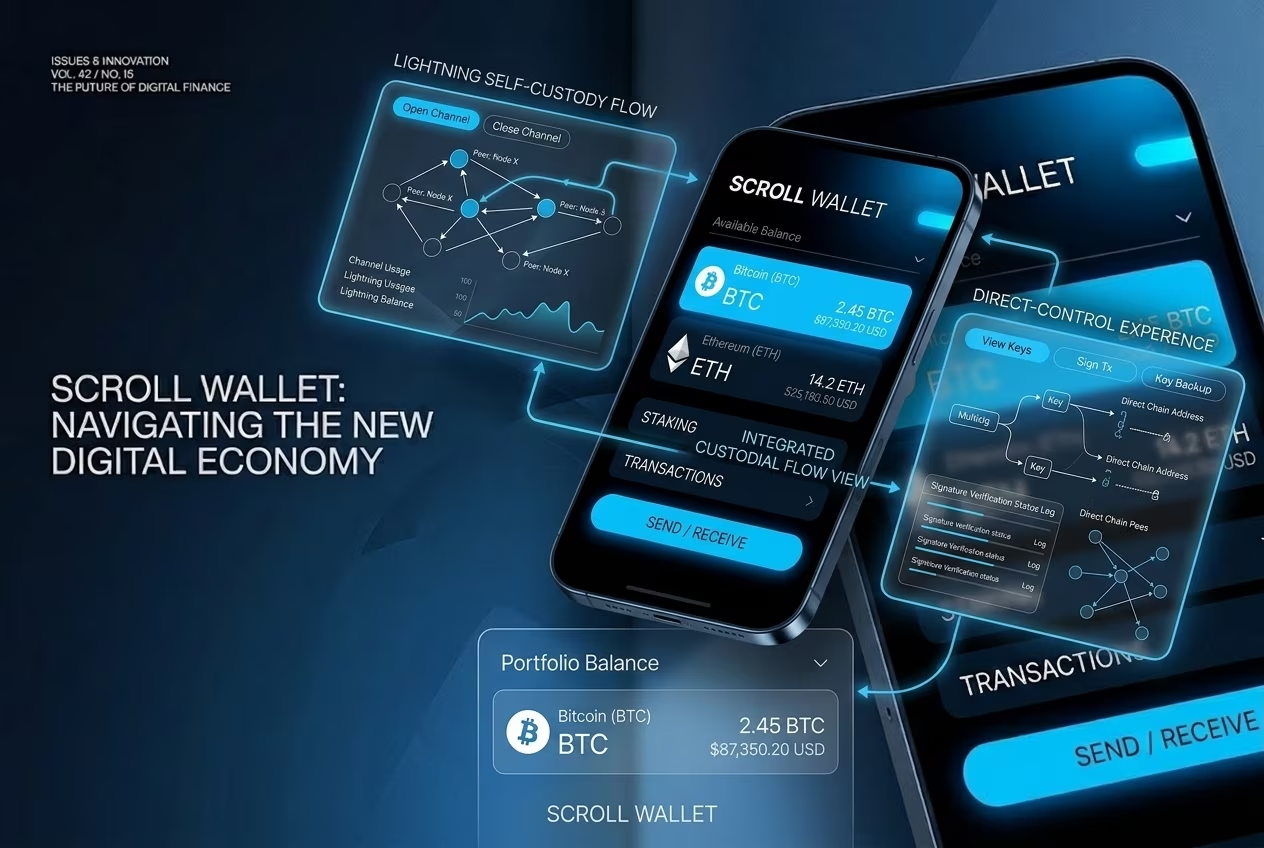
The classic Lightning wallet design has hit a wall — and the next wave of users won’t touch the trade-offs early adopters quietly accepted. Channel management, liquidity rebalancing, manual routing decisions — that friction was survivable in 2019. In 2026, it’s a dealbreaker. The demand for an advanced lightning wallet that handles these mechanics automatically, without putting users in the crossfire of technical debt, stopped being a niche request a long time ago. Now it’s the floor. The minimum. The baseline for any product that wants to compete seriously in the self-custody space.
As Bitcoin Magazine recently laid out, the self-custody market is reshaping itself around performance expectations and user autonomy — which means a reliable lightning wallet can no longer get away with just security. It needs predictable behavior under real network conditions. Failed payments, stuck channels, fees that appear out of nowhere — users with options won’t tolerate any of it. The infrastructure layer has to eat that complexity. Not the user.
At Scroll Wallet, we built around this reality from day one. A high performance lightning wallet in 2026 means automated liquidity management, transparent routing logic, and honest feedback when something breaks — not just when everything runs smoothly. UX clarity isn’t a design afterthought here. It’s an architectural decision. When you open a channel, rebalance liquidity, or push a payment through, the system tells you exactly what’s happening and why. That transparency is what separates real infrastructure from a black box you pray at.
The market’s direction isn’t subtle. Users want self-custody without the self-management overhead. They want wallets that behave predictably across multi-chain environments, handle edge cases without drama, and don’t require an expert to operate safely. That’s the product we’re building. The wallets that survive the next cycle won’t be the ones with the most features — they’ll be the ones that treat reliability and automation not as premium upgrades, but as the absolute minimum for anyone who takes Lightning seriously in 2026.
Scroll Wallet is designed for those who want complete control over their funds - without sacrificing speed or convenience. Most wallets present you with a choice: either you accept custodial risk for the sake of comfort, or you understand complex key infrastructure for the sake of real ownership. Scroll Wallet removes this dilemma. The self-storage architecture gives direct, verifiable control over private keys while keeping the interface fast and intuitive. Keys are stored locally on your device and are not transferred to servers or shared with third parties. Including us.
Bitcoin payments in Scroll Wallet are built around real user scenarios, not protocol abstractions. No channel liquidity management, no pre-configuring routes, no debugging frozen Lightning hops. Payment routing is decided at the infrastructure level - you see a clean interface: sent, confirmed, ready. In 2026, when multi-chain environments and L2 fragmentation have turned wallet UX into a threat vector in its own right, this is critical. A confused user makes mistakes. Mistakes in self-storage are costly. We reduce this risk area - intentionally, at the architectural level.
Performance is another area where Scroll Wallet breaks with the legacy of Lightning-based solutions. Lightning-based wallets require active channel management, incoming liquidity, and always-online nodes to reliably accept payments. This is friction for the average user and a point of failure that is extremely difficult to diagnose. Scroll Wallet works without these dependencies. The result is faster confirmation feedback, predictable behavior, and fewer edge cases requiring manual intervention. The architecture holds the load and maintains functionality in conditions where the duct system would simply be installed.
Scroll Wallet's core philosophy is simple: control and performance should reinforce each other, not compete. When you hold your own keys and the payment layer works securely, you're not just using a wallet. You work with an infrastructure that respects your autonomy and reduces your dependence on others' decisions. This is our standard. And we hold ourselves accountable to it—as the ecosystem continues to change.
The best wallet for Lightning payments is one that keeps your funds under your control, removes friction from everyday transactions, and provides smooth routing without hidden fees. After comparing everything on the market in 2026, the picture is clear: wallets that combine self-custody architecture with a clean interface and transparent fee structure consistently outperform custodial solutions in both security and reliability. Any comparison of Lightning wallets that ignores at least one of these factors will lead you to a product that works brilliantly in demos and falls apart in the real world.
Non-custodial Bitcoin payments are no longer a niche preference of geeks. This is a basic requirement for anyone who is serious about financial sovereignty. When your keys live on your device and not on someone else’s server, you eliminate a whole category of risks: exchange hacks, custodian bankruptcy, account freezing. Scroll Wallet is built on this principle from the ground up. Every architectural decision begins with one question: does it preserve user control or undermine it? This is not marketing rhetoric - it is a hard constraint that defines every feature we release.
Predictable costs are just as important as safety. Lightning routing fees can vary depending on channel liquidity, path length, and network congestion. Wallets that hide this complexity without explaining the logic leave users in a blind spot—without the ability to plan or optimize. We show fee estimates before confirmation, signal unusually high routing costs, and provide enough information to make an informed decision on each payment. Simple UX is not about hiding information. It's about delivering what you need at the right time.
Payment performance is the final test. A wallet that stores your keys but fails to process payments over and over again is not a product. This is a problem. Reliable performance in Lightning requires active channel management, liquidity monitoring, and fallback logic—infrastructure work that happens long before you open the application. When you compare Lightning wallets in the real world, rather than in a hothouse environment, the gap between those who have invested in this infrastructure and those who have saved is immediately visible. Scroll Wallet is designed to close that gap—and give you a tool that works when you really need it.