Crypto passphrase storage: Secure your digital assets | Scroll Wallet
Magic wallet web3 solutions simplify dApp access by replacing complex seed phrases with familiar email or social logins via Wallet-as-a-Service (WaaS) technology. While this infrastructure allows you to onboard in seconds without technical hurdles, it introduces a critical trade-off between immediate convenience and the long-term security of your private keys and digital sovereignty.
Choosing between an embedded solution like Magic Wallet and a native infrastructure like Scroll Wallet depends on your priority: instant onboarding or deep ecosystem integration. Understanding the custodial vs non-custodial wallet distinction is vital here, as both aim for non-custodial security while taking different paths toward user experience and key management.
| Feature | Magic Wallet | Scroll Wallet |
|---|---|---|
| Onboarding | Email, SMS, Social Login | Native L2 Integration |
| Custody Model | Non-custodial (Embedded) | Non-custodial (Direct) |
| Key Control | Passwordless Auth | Verifiable Infrastructure |
| Recovery | Email/Social Recovery | On-chain Mechanisms |
| Gas Model | Gas Abstraction Support | L2 Efficiency / Automation |
| Ideal Use Case | Consumer Apps & Games | Scroll Ecosystem & DeFi |
Scroll Wallet removes the main barrier of Web3: you no longer need to understand wallets to use them. Email login, login via Google, social profile - the user enters the dApp in exactly the same way as he enters any familiar website. No seed phrases. No browser extensions. Zero knowledge about crypto. This isn't an oversimplification - it's a different entry point that turns a casual visitor into an active user instead of losing them at the wallet setup screen.
Under the hood of all this is account abstraction. When a user authenticates via email or social media, Scroll Wallet deploys a smart contract wallet on their behalf: completely self-storing, but without leaving raw key management to the individual. Same architecture as ERC-4337 wallet, where the account logic lives in a smart contract rather than a traditional EOA. What does this mean in practice? Programmable recovery, session keys, gasless transactions - all without asking you to remember 12 words on the first day. For dApp developers, this directly affects the conversion of the funnel: onboarding ceases to be a separate quest to install a wallet.
Experts Magic.link we recorded the obvious: built-in onboarding with passwordless access and account abstraction sharply reduces the outflow precisely at the authentication stage - one of the most painful points in any Web3 product. Scroll Wallet works according to the same logic. The authentication layer is invisible to the user. The security layer is completely on-chain and verifiable. Social login is not about bypassing cryptography for the sake of convenience. This is a different route to the same ownership model, where the complexity is removed to the infrastructure layer rather than placed on the shoulders of the person who just wants to try the application.
For teams building on Scroll, this has a very specific dimension. A user who logs in via Gmail and completes the first transaction in 60 seconds is much more likely to return than someone who gave up at the “install MetaMask” step. Passwordless access also reduces phishing risks at the start - there is nothing to steal if the seed phrase does not exist. The compromise is fair: account recovery depends on the authentication provider and smart contract logic, and we talk about this openly. No promises of “friction-free security” - just a system where friction is placed in the right places, and not at the very threshold.
Seamless onboarding almost always comes with a hidden account: you lose control of the private key and are no longer the real owner of the wallet. When a product removes seed phrases, automates recovery, or embeds wallet creation into the application flow, it does this in one way: it transfers key management to a third party. This is the main trade-off between convenience and control. And you need to understand it before you decide where to store your assets.
Wallet-as-a-Service (WaaS) is the most overt example of this mechanic. As explains WhiteBIT Blog, WaaS is a centralized solution where the provider takes control of keys and infrastructure, directly cutting off the user from control over their own assets. In return, you get smooth onboarding, cloud recovery and zero risk of losing your seed phrase. Sounds good. But the security of your wallet now depends on systems, policies and the very fact of the existence of the provider. It will be hacked, regulators will restrict it, or simply close it - and access to funds will be at risk. WaaS-based custodial models often add institutional-grade insurance and protection, making them attractive to organizations. But for the private user, the ownership equation looks fundamentally different.
Built-in wallets work according to the same logic. When an app creates a wallet automatically—via social media, email, or OAuth—the private key is typically generated and stored within the app's infrastructure, not on your device. Recovery schemes like Ledger Recover work in a similar way: the key is broken up and distributed among trusted custodians, making recovery easier but creating dependency on external parties. Bottom line: what the outside looks like non-custodial wallet, in practice, it can work as a custodian - simply because you have never directly held the key in your hands.
At Scroll Wallet, we view this tradeoff as a design decision that should be made openly—not hidden behind slick UX. You must know exactly who controls your keys at every stage: during creation, during use and during recovery. Convenience features are valuable. But they must be built on top of a transparent ownership architecture, and not mask its absence. If you are evaluating any wallet in 2026, the first question is not “how easy is it to set up?” First question: who holds the private key and under what conditions can this access be revoked or lost?
Magic links and access to a wallet via email are not a convenient feature, but a structural hole that is incompatible with storing real assets. When access to your wallet depends on a link in your mailbox, you're not protecting the wallet—you're protecting the email. One phishing. One SIM swap. One data leak at your email provider and the attacker gains full control of the funds without even touching the private key. No theory. This is a vulnerability built right into the authentication architecture.
As documented Dfns, magic-link authentication has very specific weaknesses: phishing exposure, centralized recovery risk, wide attack surface. A convincing letter simulating a request to log into your wallet. Compromised mail server. Incorrectly configured link expiration window - any of this is enough for unauthorized access. No amount of UX polishing will close a single point of failure. Web3 security cannot be built on infrastructure designed for consumer web applications, not financial storage.
The centralized dependency problem makes things even worse. Wallet recovery via email requires that the third party - your email provider, magic-link service or both - operate smoothly, remain reliable and unaffected at all times. The service goes down. Changes policy. Sold and your path to recovery simply disappears. That is why wallet recovery mechanisms need to be assessed not only by convenience, but also by long-term reliability and independence from other people’s infrastructure. A secure web3 wallet should give you recovery tools that you control, not someone else's uptime metrics. At Scroll Wallet, we don't consider this a design compromise, but a hard default limitation. We also recommend studying how changing regulation of crypto wallets is shaping asset custody standards—and what that means for the tools you choose today.
The practical conclusion is simple and cruel. If your wallet sends a magic link for login or recovery, treat it as a hot wallet with limited trust. Small transactions please. Assets that cannot be lost - ever. Beyond this threshold, the authentication model matters as much as the security of the smart contracts under the hood. Scroll Wallet was designed based on this reality: verifiable recovery paths, minimal dependence on email flows - because the threat landscape of 2026 does not forgive architectural cutting of corners.
Understanding the economic trade-offs between developer-focused infrastructure and end-user costs is essential for choosing the right wallet strategy. While specific subscription tiers for 2026 vary by provider, the core difference lies in how gas sponsorship and account abstraction are handled. We prioritize transparency in how ERC-4337 smart accounts manage these flows to ensure a balance between developer flexibility and sustainable user fees.
| Economic Factor | Magic Wallet Approach | Scroll Wallet Approach |
|---|---|---|
| Gas Sponsorship | Developer-led paymasters | Native L2 optimization |
| User Transaction Costs | Variable (Relayer fees) | Direct L2 network gas |
| Infrastructure Focus | SDK & Auth services | Ecosystem-wide efficiency |
| Wallet Experience | Gasless (if sponsored) | Low-fee smart accounts |
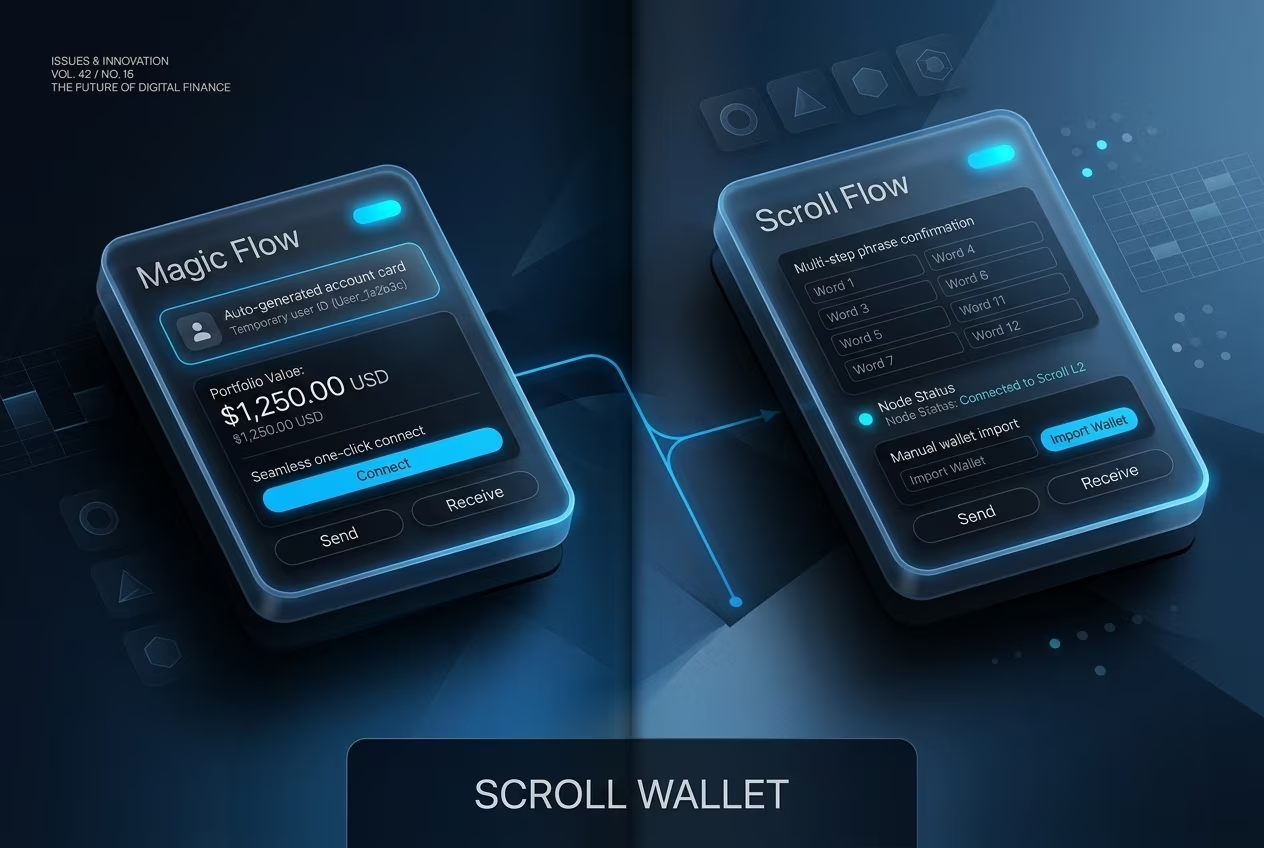
Under current US regulatory scrutiny, the custodial vs non-custodial wallet distinction is no longer a technical footnote — it’s the central compliance question that determines how your wallet gets classified, who carries the legal weight, and what rules govern every single transaction you make. The SEC and FinCEN have locked their focus on one thing: does the wallet provider actually control your funds, or are you just told that you do? If a provider can freeze your assets, reverse a transaction, or insert itself anywhere in the execution chain — congratulations, that provider just became a custodian. Maybe even a broker-dealer. That means licensing, capital reserves, and reporting obligations that would crush most Web3 teams before they hit their second funding round.
As SIFMA has made plain, regulatory pressure on custodial wallet characteristics and broker-dealer classification isn’t coming — it’s already here. And it reshapes how wallet abstraction gets built. When smart contract logic automates transaction signing, manages recovery keys, or delegates execution, regulators don’t see elegant engineering. They see intermediation. The boundary between «user-controlled» and «provider-controlled» stops being an architectural preference and becomes a legal exposure. At Scroll Wallet, we built our abstraction layer around one non-negotiable: verifiable user control at the protocol level. No single party — us included — holds unilateral authority over your funds. Full stop.
Recovery is where custodial risk hides in plain sight. Social recovery, cloud-based key backup — these sound like convenience features right up until a regulator notices that the recovery path runs through a provider’s server or requires provider approval. At that point, the wallet is functionally custodial, regardless of what the marketing copy says. The evolving landscape of crypto wallet regulations has made this explicit: recovery architecture is now a compliance variable. Not a UX choice. Scroll Wallet’s recovery model runs entirely on on-chain guardian logic — no off-chain key escrow, no recovery shares sitting on our servers, nothing that puts us between you and your funds.
Web3 authentication brings its own regulatory minefield. When a wallet functions as an identity layer — signing into dApps, authorizing data access, executing delegated transactions — and that authentication connects to asset movement, regulators may treat it as a financial service. The logic is brutal in its simplicity. Scroll Wallet cuts through this by separating authentication sessions from transaction authorization at the architecture level. You authenticate once with verifiable credentials. Every transaction still demands explicit, user-initiated signing. That separation isn’t a UX nicety. In a tightening regulatory environment, it’s the structural difference between a tool you actually control and a service that quietly controls you.
In the long run, who controls your keys controls your money — and no amount of slick UI changes that fact. Usability gets you started. Ownership keeps you protected. This isn’t philosophy — it’s architecture. When you choose between a custodial vs non-custodial wallet, you’re not splitting hairs over terminology. You’re deciding who can freeze your funds, who bends to a court order, and who holds the recovery path when everything goes sideways. A wallet with real key control gives you the same answer to all three: you do.
The market spent years chasing convenience. One-click onboarding, social logins, email recovery — these features lower the barrier to entry, and sure, that matters. But they also quietly insert a third party into your asset relationship. In 2026, with phishing attacks getting surgical and wallet exploits growing more sophisticated by the quarter, that dependency isn’t just a trade-off. It’s a measurable, documented risk. True ownership means your private keys never leave your device, your seed phrase is never transmitted, and no platform’s business decision can touch your balance. Scroll Wallet is built on this principle at the architecture level — not slapped on as a marketing layer after the fact.
As experts at Sidley Austin point out, regulatory frameworks are drawing an increasingly hard line between non-custodial interfaces and custodial structures subject to compliance oversight. That distinction shapes what a product can actually offer you — without triggering legal constraints that quietly limit your options. A self custody wallet that never touches your keys operates in a fundamentally different category. That separation shields you from platform-level risk and gives the product room to serve you without intermediary friction getting in the way.
Scroll Wallet was designed to make this control practical, not just theoretical. Multi-chain support, L2 compatibility, automated transaction flows — all of it built so you never have to choose between usability and ownership. The interface absorbs the complexity. The architecture preserves your authority. That’s the real market lesson: convenience is a feature, but key control is the foundation. Any wallet that can’t guarantee the second owes you transparency about what it’s actually selling — and you should factor that into every decision you make about where to hold value.
Choosing the right infrastructure depends on your specific needs for security, capital management, and how often you interact with decentralized applications. While Magic provides an excellent entry point for those new to the ecosystem, moving to a non custodial wallet like Scroll Wallet becomes essential as your requirements for ownership and security evolve.
Scroll Wallet is designed for those who want real asset ownership - without having to be a developer to avoid screwing it up. In 2026, the gap between wallets that look simple and those that actually are simple is no longer a matter of convenience. This is a security issue. Most interfaces don't remove complexity, they hide it. And while the user does not see what is happening - phishing attacks, exploits through approvals, multichain chaos - all this works against him. Scroll Wallet is built on the opposite principle: you understand what you are signing, what you are approving, and what will happen next - before you click “confirm”.
Non-custodiality is not a marketing slogan here. This is an architectural limitation. Private keys never leave your device, and no third party can freeze funds, redirect transactions, or gain access to your wallet. Dot. At the same time, we honestly admit: pure self-storage creates its own risks - lost seed phrases, errors in unsigned transactions, social engineering. That's why Scroll Wallet integrates smart accounts ERC-4337: programmable recovery, session key limits, transaction batching - all without abandoning the basic ownership model. You remain in control, but the system protects you from the most common mistakes.
As a secure wallet for dapps, Scroll Wallet enforces structured permission restrictions on every connection. When connecting to the protocol, the wallet shows exactly what is requested, flags non-standard approval patterns and limits the session area by default. Why is this critical? Because in 2026, most exploits don't come from broken cryptography. Users simply approve more than they intended. According to Sidley Austin, the regulatory environment increasingly supports non-custodial interfaces that do not exercise direct control over the user's assets - the very principle with which Scroll Wallet began, and which makes the product resilient as compliance requirements become more stringent in different jurisdictions.
The result is practical and concrete. You don't have to choose between convenience and control. Interaction with native Scroll dapps, bridging assets between L2 environments, managing multi-chain positions - all from one interface, where keys are stored locally and permissions are transparent. We do not claim that any wallet eliminates risk completely. Scroll Wallet reduces the margin for error, provides clear information at every decision point, and builds the infrastructure so that ownership remains yours - in every meaningful sense of the word. It is for this compromise that everything is optimized.
Zero friction gets users in the door — but if you want them to actually own what they’re doing on-chain, Scroll Wallet is where that story ends and real control begins. Magic and Scroll Wallet don’t compete. They solve completely different problems, at completely different moments in the user journey. Confusing them is how you make expensive product decisions.
Magic strips away every barrier: no seed phrases, no key setup, no mental overhead. For onboarding campaigns, consumer apps, users who’d bail the second they see a twelve-word phrase — that frictionless entry has genuine value. But there’s a structural cost buried underneath the smoothness. The user never holds their own keys. They’re dependent on Magic’s infrastructure to access their own assets. Low stakes? Acceptable trade-off. But the moment on-chain activity gets serious — real value, real complexity, real exposure — that dependency stops being convenient and starts being a liability.
Scroll Wallet was built around a different premise entirely: onboard without surrendering control. Multi-chain environments. L2 infrastructure. Cross-bridge asset management. Users can navigate all of it without handing custody to a third party or praying that some external service stays online and honest. In 2026, where phishing vectors are sophisticated, wallet exploits are routine, and L2 fragmentation is just the landscape you operate in — self-custody architecture isn’t a premium feature. It’s the floor. The easy web3 wallet with control sounds like a contradiction until you see how smart account design and stripped-down UX make it completely real.
So here’s the practical read: use Magic to pull users through the door, use Scroll Wallet to give them somewhere worth arriving. If you’re hunting for the best wallet for web3 apps that actually serve both newcomers and power users — the answer isn’t picking one tool. It’s knowing which tool owns which stage. Scroll Wallet is where the journey stops being onboarding and starts being ownership. Verifiable. Yours. No blind trust required.