Best Wallet for XVG: Why You Need Web3 Tech in 2026 | Scroll Wallet
A bluemove sui wallet provides direct entry to the leading NFT marketplace and AMM on the Sui blockchain for trading digital assets. By leveraging the Move language and parallel execution, we see users achieving near-instant finality for 2026-era dApps. This infrastructure supports seamless social logins and low-cost minting for creators and collectors alike.
Your wallet on BlueMove isn’t a passive storage unit — it’s the engine running every NFT trade, launchpad mint, DEX swap, and token transfer you execute on Sui, and if it stutters, you pay for it in gas. The goals are straightforward: hit «Connect Wallet,» get in within seconds, buy or sell NFTs, grab launchpad drops, run DEX swaps, move tokens. Wallets like Martian, Suiet, Nightly, Surf, Pontem, Petra, Rise, and Blocto all claim to handle this. The gap between claiming and delivering, though, is where real money gets lost — because how each wallet manages transaction signing, fee estimation, and dApp handshake protocols determines whether your session flows or fractures.
As Suipiens documents, wallets including Pontem, Martian, and Petra support the full BlueMove workflow — connection, NFT trading, launchpad participation, token transfers. That breadth matters. BlueMove isn’t a one-action platform. A single session might take you from browsing Sui NFT collections to listing an asset to swapping tokens without pause. A wallet that drops the dApp connection mid-flow? That’s not an inconvenience. Failed transactions still burn gas. Mistimed listings can cost you real money. And since self-custody is the baseline — you hold your private keys, nobody else — every signing error and every phishing attempt lands squarely on you.
The sharpest UX dividing line in 2026 is onboarding friction. Surf Wallet’s zkLogin eliminates the seed phrase entirely, cutting out the single most dangerous moment in wallet setup for new self-custody users — the point where seed exposure risk peaks. For everyone running standard wallets, that seed phrase remains the most critical piece of infrastructure you’ll ever manage. Treat it accordingly. On the cost side: if you’re evaluating wallets specifically for NFT activity, fee structure deserves as much scrutiny as the feature list. A low fee NFT wallet compounds its advantage fast — bidding, listing, and transferring at volume on an active marketplace like BlueMove turns small per-transaction savings into a meaningful edge.
US users keep landing on the same priority: minimal setup, reliable dApp access. Full stop. A Sui NFT wallet that demands five configuration steps before you can connect to a marketplace isn’t a feature-rich product — it’s a liability dressed up as software. As a wallet for Sui apps, the product has one job: own the complete transaction lifecycle — initiation, signing, broadcast, confirmation — without making you manually wrestle RPC endpoints or debug connection errors at 2am. We built Scroll Wallet around exactly this principle. Infrastructure should be invisible when it works. Transparent when it doesn’t. That means clear error messages, accurate fee previews, and a connection layer that holds steady across BlueMove’s trading, launchpad, and swap interfaces — no excuses, no dropped sessions.
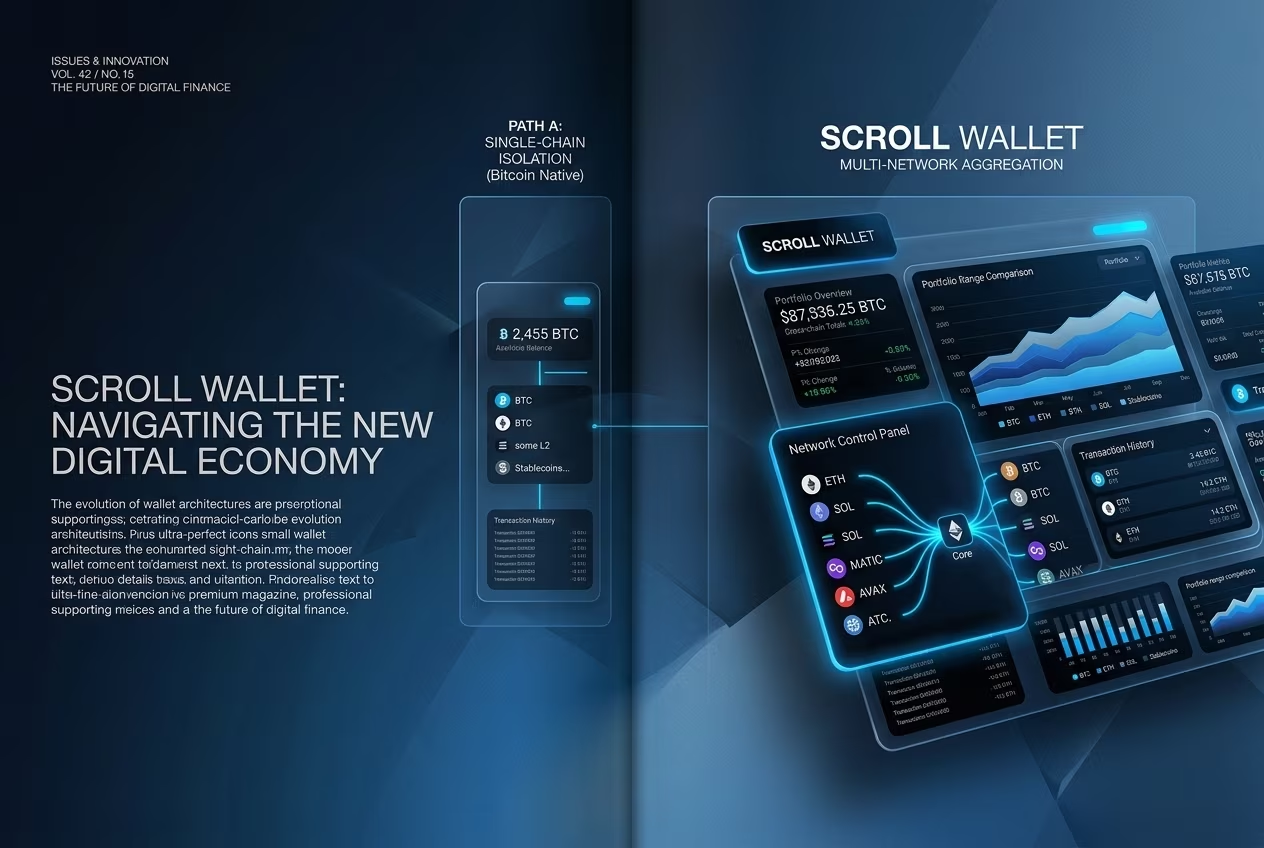
When you interact with the BlueMove marketplace on Sui or Aptos, your requirements are highly specific to those ecosystems, focusing on native speed and NFT minting. however, as you expand your activity, a multichain wallet 2026 becomes essential to manage assets across fragmented networks without losing control or security.
| Feature | BlueMove (Sui/Aptos) Needs | Broader Multichain Expectations |
|---|---|---|
| Onboarding | Connect wallet, no KYC | Easy wallet onboarding across L1/L2 |
| Network Support | Sui or Aptos specific | Universal (ETH, SOL, Scroll, etc.) |
| NFT & dApps | Minting, Twitter verification | Cross-network dApp & NFT access |
| Flexibility | Single-chain transfers | Cross-chain bridging & portfolio control |
| Infrastructure | Native speed/security | Flexible wallet experience & interoperability |
The Sui wallet solves one problem perfectly - to quickly drag you into the Sui ecosystem - but it is precisely this narrow confinement that turns into a hard ceiling as soon as activity goes beyond the boundaries of one network. At the start it works. You manage Sui assets, interact with native DeFi protocols, sign transactions without unnecessary headaches. A narrow script is a narrow tool. But Web3 in 2026 will not remain narrow. Never.
Friction begins the moment you need to transfer assets across chains, log into Ethereum L2, or reach a protocol that lives on another network. One ecosystem wallet instantly drives you into a fragmented work flow: one for Sui, another for EVM, a third for Aptos or Solana. Each new wallet is another seed phrase under guard, another interface to study, another point of attack. Cognitive load increases exponentially. Risks too. It is fragmentation that pushes people into dangerous compromises: reusing keys, insecurely storing phrases, trusting untested bridge interfaces. Understanding security of multichain wallets becomes not an option, but a necessity.
This is the structural problem that a flexible wallet solves. One interface - several ecosystems. No juggling of tools. Fewer points of failure. And, what is critical, a complete picture of your on-chain position: not only what is in Sui, but also everything else scattered across the networks. This visibility decides. Especially in an environment where L2 fragmentation and bridge exploits are not horror stories, but regular news items.
At Scroll Wallet, we built the product around this reality, not against it. Sui wallet is the entry point, not the end. Anyone who needs only Sui today will demand more tomorrow: new chains, new protocols, fine control over how assets move between environments. Designing for this growth from the very beginning means not forcing the user to migrate a setup, re-verify on each platform, and accept security compromises for access to a broader ecosystem. Architecture must grow with use. Don't limit it.
Understanding the cost structure of the BlueMove marketplace is essential for maintaining efficient capital flow within the Sui ecosystem. While the network offers high-speed transactions, you must account for fixed marketplace fees and the variable costs associated with cross-chain movement. Managing these assets requires a focus on nft wallet security to protect your holdings from the risks inherent in fragmented multi-chain environments.
| Cost Component | Fee / Impact | Details |
|---|---|---|
| Marketplace Fee | 2% | Deducted from property value; redistributed to MOVE/SUI stakers. |
| Creator Royalties | Variable | Paid to creators from the sale price before the seller receives funds. |
| Network Gas | Minimal | Sui and Aptos infrastructure enables low-cost, high-speed trading. |
| Hidden Friction | High | Bridge fees and wallet fragmentation (Sui/Martian) add complexity and cost. |
Three problems plague BlueMove and similar tools on Sui with enviable consistency: spam NFTs that drop into wallets, aggressive and unpredictable security requests, and unstable wallet integration that breaks exactly when it is most critical. These are not rare cases. This is a systemic problem that everyone who tries to work properly with assets on the Sui network faces. Do you want to understand what to trust from this infrastructure? First, figure out where the roots of pain come from.
On Sui Developer Forum, where technical complaints and reviews of ecosystem incidents settle, spam NFTs take first place in terms of frequency of mentions. The mechanics are simple and cynical: attackers mint cheap tokens and airdrop them en masse to active addresses. The user tries to hide or burn this garbage - and launches an approval flow, which opens access to real assets. This is not a BlueMove bug. This is a network level attack. But it is the wallet that is responsible for filtering, marking and isolating unverified assets - by default, without exception. A secure sui wallet has no right to consider an incoming unverified token as neutral data.
Integration problems look different, but are no less annoying. Handshake between BlueMove and third-party wallets regularly crashes without any error messages - the transaction is stuck in an indeterminate state, and it is not clear whether it went through or not. Security requests appear chaotically: they either block legitimate actions, or remain silent where they should be shouting. This is a direct threat to the user’s self custody wallet. It is impossible to develop reliable transaction signing habits if the system behaves differently from session to session. In Scroll Wallet, the sequence of prompts is not the desire of the UX designer. This is a strict requirement. Every confirmation request should be predictable, readable, and limited to exactly the action you authorize—not a byte more. If you want to understand how NFT security intersects with wallet architecture, see low fee NFT wallet takes an honest look at the trade-offs between low fees and true asset protection.
All of these complaints point to the same root cause: tools designed for speed and minimal fees defer security architecture until problems become public. By that point, users had already assumed all the risk. A secure sui wallet in 2026 does not have the luxury of adding security as a feature on top of the finished product. This is the foundation. Spam filtering, stable authorization requests, reliable integration are not premium options. This is the minimum bar for any infrastructure that asks you to store real money in it.
Before connecting your assets to an NFT marketplace like BlueMove, you must ensure your wallet provides the necessary infrastructure for secure and efficient Web3 access. Use this checklist to evaluate if your current setup meets the technical standards required for 2026 on-chain environments.
Scroll Wallet is not an upgrade of BlueMove, it is a paradigm shift: from living in one ecosystem to full control over several networks at the same time. BlueMove copes with its task - it confidently lowers the threshold for entering Sui. But as soon as you go beyond the perimeter of one network - to L2, bridges, cross-chain protocols - it turns out that the tool simply was not designed for this. It was not “modified” for complexity. It was not originally built for it.
The main argument against an ecosystem wallet is the risk of fragmentation. In 2026, the average active Web3 user works on three or more networks. An ecosystem wallet in this scenario means: separate interfaces, separate seed phrases, separate confirmation flows for each environment. This simultaneously increases the attack surface and cognitive load. How an alternative to depending on the ecosystem wallet,Scroll Wallet brings all these interactions under a single, verifiable infrastructure layer. According to Scroll.io, the platform provides a formal architecture designed specifically for a broad wallet infrastructure - product solutions here reflect a multi-chain reality, rather than the convenience of a single network.
In practice this means access to a wider wallet toolkit without loss of self-custody and transparency. Scroll Wallet doesn't hide your keys or pass transactions through opaque intermediaries. Every interaction remains auditable. The architecture reduces the risks of phishing and exploits - and they have become noticeably more sophisticated in 2026. For those who started with BlueMove and are now expanding their activity on the blockchain, this transition is not a abandonment of what worked. This is an admission of a simple fact: multichain wallet 2026 requires infrastructure built initially for this scale.
The UX argument is no less weighty. Ecosystem wallets are optimized for one environment - the interface, gas abstractions, confirmation flow are tailored to the logic of a specific chain. If you go beyond its limits, the experience degrades. Fast and predictable. Scroll Wallet was built on the assumption that you will work across multiple L2s, interact with bridges, and manage assets in disparate environments—so the interface and automation layers reflect this reality. Widespread wallet control is not a feature bolted on the side. This is a fundamental design decision that separates an infrastructure tool from a user-friendly but highly specialized application.
If you are a US user accessing BlueMove through a non-custodial wallet like Scroll Wallet, please know that personal liability is not an option, but a default legal reality. The IRS treats every NFT transaction as a taxable event. Every purchase. Every sale. Each exchange on BlueMove generates a profit or loss that you are required to declare - regardless of whether the activity is through a centralized exchange or directly through a wallet on the blockchain. Scroll Wallet doesn't store your assets, but that also means that no middleman files reports for you. You are your own accountant.
When you manage assets across multiple networks—moving tokens between the Ethereum mainnet, Scroll L2, or any other chain across a bridge—each transfer may have its own tax consequences. Asset bridging is not always “just a transfer.” In a number of interpretations, it qualifies as the disposal of the original token. US tax regulations in this area remain frankly crude as of 2026, and the burden of tracking the underlying value, timestamps and transaction hashes rests entirely with you. Scroll Wallet displays transaction data in a readable format - but we do not provide tax advice or integrate tax reporting tools by default. Export your transaction history and work with a qualified crypto tax professional.
BlueMove is a decentralized marketplace. It doesn't collect KYC data or issue 1099 forms to US users. But this doesn't reduce your legal obligation - on the contrary, it increases your operational risk if you don't report yourself. Scroll Wallet gives you complete visibility into your activity. Visibility is not the same as compliance. Record the price of every NFT purchased, every sale, every commission paid: the IRS has the right to request this data, and the lack of a centralized platform with ready-made records will not be recognized as a valid reason. The non-custodial model protects your sovereignty over your assets. It does not protect you from tax liability.
Regulatory risks for specific collections are a separate story. A number of NFTs and tokenized assets may be subject to additional regulation depending on their structure. Assets resembling securities that offer profit sharing or are promoted with investment expectations are in a gray area that the SEC has been actively examining since 2024. Scroll Wallet does not check assets for compliance with regulatory requirements before you interact with them - this is architecturally impossible in a non-custodial system. What we provide is a transparent, auditable record of your actions on the blockchain. This is the foundation of any defensible compliance position. Before moving large sums of money through BlueMove or any other decentralized marketplace: understand what exactly you are buying, document the reason for the purchase, and keep records that can withstand scrutiny.
Users come to Web3 through Sui - for low commissions and normal UX - but sooner or later they run into a multi-chain reality, where a multi-chain wallet ceases to be an option and becomes the only working tool. In 2026, TVL Sui is in the range of $800M–$900M, and stablecoin volume is around $528M. Behind these numbers are Sui Stack 2026, gasless transfers via USDsui, institutional adoption with ETFs on US exchanges and bank custody. Such an ecosystem grows users quickly. Too fast for one network. You start with Sui because it works. And then you discover: NFTs are on Ethereum, DeFi positions are on L2, gaming assets are on zkrollup wallet. This is not a bug. This is the market in its current state.
Cross-chain access has long ceased to be a privilege for advanced users. This is a basic need. NFT traders moving between Sui and Ethereum marketplaces, DeFi participants driving liquidity through L2 bridges, gamers with assets on multiple rollups - they all solve the same operational problem: switching between wallets is slow, error-intensive and creates a real security hole. Every time you copy a seed phrase or connect to an unfamiliar interface, you open a window for attack. As noted Scroll.io, it is the L2 infrastructure that allows wallets to reduce this friction without losing verifiability at the chain level. The architecture matters as much as the interface.
Scroll Wallet was built on one assumption: you will switch between networks not occasionally, but constantly - as a routine part of managing a real portfolio. The switching of networks here is obvious and auditable: you see which chain you are in, what assets are involved and what the commission structure is - before you sign anything. Not after. In an environment where Sui offers zero commissions on stablecoin transfers and primitives like Hashi expand multi-chain liquidity through Bitcoin lending, the cost of signing a transaction on the wrong network or through an unverified bridge is quite concrete and measurable. Scroll Wallet displays this information at the time of decision.
The transition from a single-chain strategy to a multi-chain strategy is accelerating. SuiPlay with gaming hardware, institutional custody integration, expansion of L2 ecosystems - all this simultaneously pulls users into more complex on-chain environments. What does this mean in practice? Your wallet infrastructure should scale with activity, not force you to juggle five separate tools for five separate networks. Scroll Wallet was created as a single control layer: one interface, verifiable connections, clear visibility of what you hold and where. Entry point - Sui. The destination is full multi-chain control. And the infrastructure for this transition must be ready before you need it.
BlueMove provides a working entry point into the Scroll ecosystem - but your infrastructure will outgrow a single online wallet faster than you think. If you transfer assets between networks, work with L2 protocols, or hold positions on several platforms at the same time, a monolithic wallet turns from a tool into a bottleneck. The question isn't whether BlueMove works. Works. The question is whether its ceiling matches where your on-chain activity is heading in 2026.
For beginners, a wallet focused on one ecosystem really helps: less complexity, fewer configuration errors. Fair advantage. But for experienced user, which walks through bridges, deploys contracts and tracks balances on multiple L2s simultaneously, the architecture must accommodate this complexity. Best wallet in this context, the one that maintains a multi-chain state without dancing with changing interfaces, re-importing keys and manually reconciling balances from disparate instruments. Scroll Wallet was built specifically for this operational reality - not as a list of features, but as a structural solution to how the product works in a fragmented on-chain environment.
Go to model universal wallet - this is not about convenience for the sake of convenience. It's about reducing points of failure in your workflow. Each additional interface is another surface for phishing, key leaks, or signature errors. Consolidating the wallet infrastructure into a single verifiable environment - one that supports Scroll natively and at the same time covers wide multi-chain activity - means reducing risks. Don't just improve the UX. If you want a structured look at how this architecture is evolving, analysis multichain wallet 2026 explains key design principles and what they mean for users in fragmented networks.
Access via BlueMove makes sense. It's a legitimate part of how users interact with the Scroll ecosystem right now. But the infrastructure around it—the wallet layer, the signature environment, the network coverage—determines how sustainable that access is in the long term. Think of your wallet choice as an infrastructure decision, not a default setting. Figure out which networks you actually use, what subscription flows you need, and whether your current network can scale with your activity. This is the frame we apply to every product solution at Scroll Wallet - and it is the one that will work for you as the on-chain environment continues to fragment and expand.