Sei Network Wallet: Secure Access and EVM Solutions | Scroll Wallet
Popular digital wallets now reach 65% of Americans, yet their dominance stems from aggressive pre-installation on smartphones rather than superior security features. While PayPal and Apple Pay lead market share, they rely on outdated Web2 banking rails. We provide a sovereign alternative through Scroll Wallet, utilizing zero-knowledge technology to ensure your financial assets remain under your direct cryptographic control.
When choosing a digital wallet in 2026, you must distinguish between market popularity and actual asset control. While centralized platforms dominate the payment landscape for convenience, the 600% surge in demand for hardware solutions like Trezor highlights a critical shift toward self-custody. Understanding the trade-offs between custodial convenience and crypto wallet security is essential for managing assets in an increasingly complex multi-chain environment.
| Wallet / Provider | Market Share / Popularity | Custody Model | User Control Level |
|---|---|---|---|
| PayPal | 82% (Online Payments) | Custodial | Low (Centralized) |
| Apple / Google / Amazon Pay | >25% each | Custodial | Low (Centralized) |
| Starbucks Pay | #2 in POS Transactions | Custodial | Limited to Ecosystem |
| MetaMask / Trust Wallet | High (Web3 Native) | Non-Custodial | Full (Self-Custody) |
| Ledger / Trezor | +600% Growth (Hardware) | Non-Custodial | Maximum (Cold Storage) |
The popularity of a wallet and its actual security are two different dimensions, and confusing them means playing Russian roulette with your assets. Tens of millions of users do not make an architecture reliable. The scale only means that the product knows how to sell itself. Not that your keys are really yours, that the update mechanism is transparent, or that the team will have time to react to an exploit before the funds disappear. The right question when choosing a wallet is not “how many people are using it,” but “what happens when something goes wrong.”
US Hot Wallet Market demonstrates this contradiction to its fullest extent. A strong brand is not synonymous with sustainability. Most widely used wallets operate on a custodial or semi-custodial model: the provider retains real control over your access. In a multi-chain environment with active bridge exploits and L2 fragmentation, this control turns into a vulnerability. Is your provider compromised? Made a bad decision to upgrade? Under regulatory pressure? Your funds are frozen - and the name on the application icon will not help here.
According to Electro IQ, the level of fraud around consumer digital wallets remains structurally high, with phishing, fake interfaces and social engineering accounting for a significant portion of losses. A revealing detail: these attacks disproportionately hit users of popular wallets. The attack surface is wider and the average user is less technically prepared. A secure wallet is not determined by the number of downloads. It is determined by how the key custodian is managed, how risks are communicated and whether the system gives verifiable control over assets - without the need to blindly trust a third party at every step.
At Scroll Wallet, we view the tension between popularity and security as a design constraint rather than a marketing issue. The architecture is built on one principle: you don't have to trust us to stay safe. Security must work at the protocol level. Transparent logic of smart contracts. No hidden update keys. A clear UX that shows the risks before signing a transaction - not after. We are not the largest wallet in terms of number of users. We are building an infrastructure where the rules are readable, the custodian model is clear, and your dependence on other people’s decisions is minimized constructively - and not reputationally.
A real digital wallet in 2026 is not recognizable by its logo or advertising promises - it is revealed in architectural decisions made long before you created an account. The bar has been raised. Seriously. Current standards require three measurable levels of trust: IAL (Identity Assurance Level) - identity verification through documents and biometrics; AAL (Authenticator Assurance Level) - multi-factor authentication at every login without exception; FAL (Federation Assurance Level) - cryptographic protection for the exchange of credentials. If a wallet cannot confirm compliance at all three levels, it simply does not play in the same league.
How experts figure it out Corbado, these levels are not an academic theory. They directly determine how resistant a wallet is to phishing, session hijacking, and credential theft. The zero-trust principle works on top of authentication: every interaction, every transaction request, every session is independently verified - no “trust by inertia” from previous actions. This narrows the attack surface at the level of architecture rather than interface cosmetics. Scroll Wallet is built precisely on this principle: a valid session does not mean a secure session. Each on-chain action is a separate verification event.
Key control is the most critical factor of trust. Dot. If you don't control the private keys, you don't control the assets - it's not a matter of preference, it's a structural fact. Next is the backup architecture: how recovery phrases are generated, stored and protected determines whether you can regain access without revealing yourself to a third party. Privacy is an equally pressing topic: a wallet with real protection does not log unnecessary things, does not stitch your on-chain identity between sessions, and supports verified pseudonyms where identity verification is needed without full disclosure. A detailed analysis of these solutions crypto wallet security will show how each layer affects your real risks.
Transparency is the final signal separating infrastructure from hype. A trusted wallet publishes its security architecture, discloses audit results, and is honest about its limitations—including what it cannot protect against. In a multi-chain environment with L2 fragmentation and active bridge exploits, zero risk does not exist. Nobody guarantees. What Scroll Wallet guarantees is that every design decision is documented, every trust assumption is explicitly stated, and every user has the information to soberly assess their own risks. Here's what modern standards look like in practice.
While mainstream digital wallets offer seamless interfaces, they operate on legacy payment rails that impose significant financial burdens on merchants and small businesses. When you use a digital wallet for daily use, the underlying transaction is processed as a standard card payment, carrying fees between 2% and 3.5%. For small businesses, these effective rates often climb to 3.2–4.0% once hidden charges like PCI non-compliance fees and chargeback costs are factored in. Understanding paypay crypto fees and traditional processing costs is essential for evaluating the true efficiency of your payment stack.
| Fee Category | Standard Rate (2025-2026) | Impact on Small Business |
|---|---|---|
| Online Transaction Fee | 2.6% — 2.9% + $0.10-$0.30 | Primary cost for e-commerce and mobile apps |
| Cross-Border (ACH) | $0.20 — $1.50 | Lower cost but rarely utilized by mainstream wallets |
| Hidden Operational Costs | 0.5% — 1.1% additional | Includes PCI compliance and chargeback management |
| Total Merchant Loss (2024) | $187.2 Billion | Record high fees paid globally for card processing |
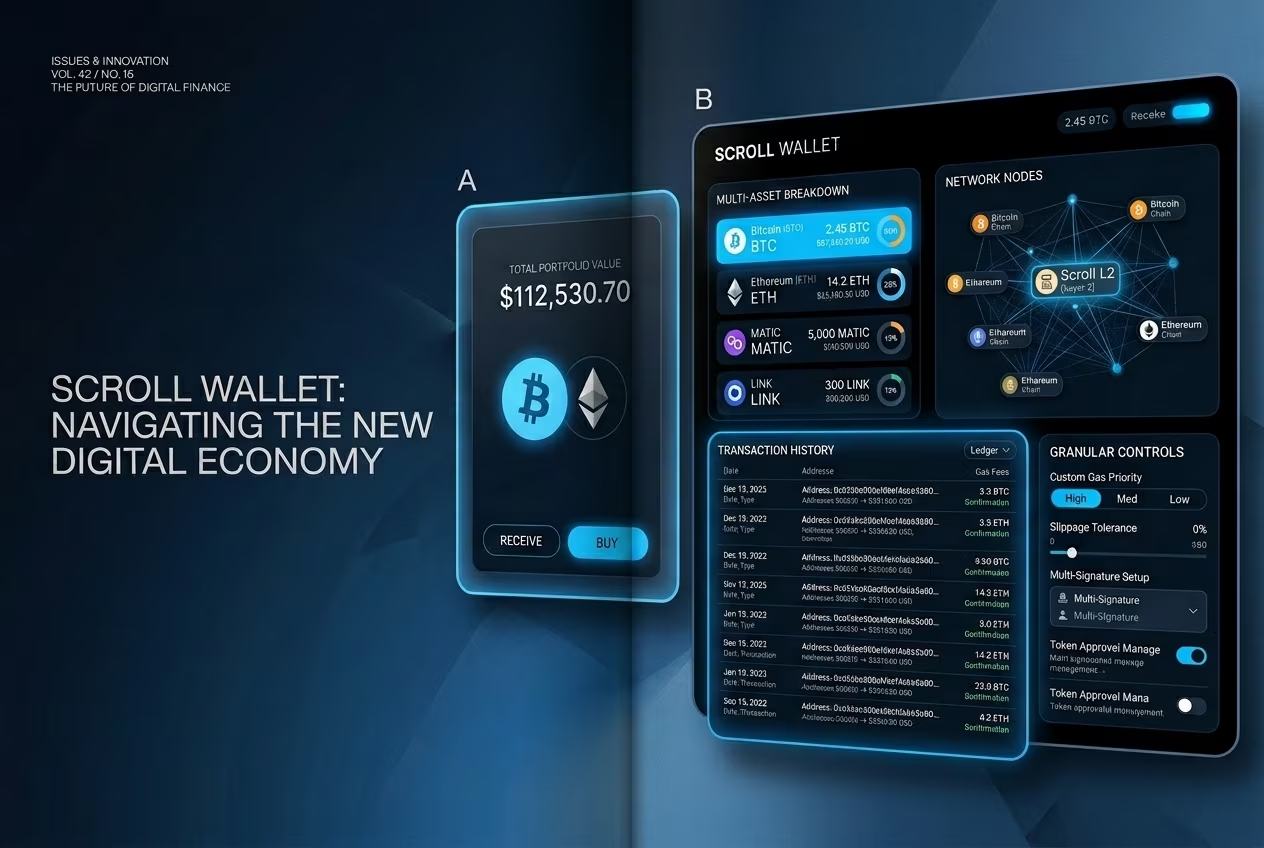
Regulatory standards are now the first wallet trust filter that needs to be checked before you invest a single dollar in a product. In the US, the legal landscape for digital wallets changed dramatically with the passage of the GENIUS Act in 2025: the law introduced mandatory licensing for stablecoin issuers and imposed new requirements on wallet infrastructure providers. How does it fix Latham & Watkins, this is not a cosmetic change - it is a structural shift: the American regulator has moved from informal recommendations to enforceable compliance standards. For the user, this means one thing: the reputation of a wallet is no longer measured by the beauty of the UI or the list of features. It is now measured by whether the product operates within a clearly defined legal perimeter.
Licensing and compliance requirements directly impact wallet adoption by weeding out products that cannot meet basic transparency standards. A wallet under regulatory supervision is required to maintain auditable records, disclose custodian schemes, and implement anti-fraud controls. These are not bureaucratic formalities. This is a structural protection that reduces your risks: exit scams, untested smart contract integrations, opaque commissions. In Scroll Wallet, the architecture was initially built to meet these standards - not bypassing them. For us, regulatory compliance is an infrastructure solution, not a marketing thesis.
Understanding how they work regulatory requirements for crypto wallets, allows you to soberly assess which products are built seriously and to last. In 2026, the multi-chain environment adds another layer of complexity: wallets operating over L2 networks, bridges and cross-chain protocols face increasing compliance issues that unregulated products simply ignore. Scroll Wallet runs on the Scroll network - zkEVM Layer 2 equivalent to Ethereum - where every transaction is verifiable on-chain and the underlying infrastructure is transparent in nature. This is not a promise of absolute security. This is a description of how the system is designed to minimize unverifiable risks.
When you evaluate a wallet, look deeper than the interface. Does the product have a disclosed legal entity? Is the custodial model documented? How has the provider responded to regulatory changes in your jurisdiction? In 2026, these issues weigh incomparably more than they did two years ago—because enforcement is no longer theoretical. Wallets that ignored compliance requirements in 2024 today face operational restrictions or freezing of user funds in regulated markets. Scroll Wallet's position is simple: we are building for the long-term user who needs a reliable and verifiable infrastructure - not for someone who values speed over responsibility.
In 2026, wallet architecture is the only reliable signal of trust, not brand recognition. The crypto landscape has changed radically. Multi-chain environments, L2 fragmentation, cross-chain bridges and increasingly sophisticated phishing attacks have finally buried the old logic. A familiar corporate name on a wallet's interface won't tell you anything about how private keys are managed, whether the signing logic is isolated, or how the wallet will behave when a malicious contract requests approval. These are engineering issues. They require engineering answers.
Why wallet popularity matters less and less is a lesson the industry continues to learn from its mistakes. Several of the most popular wallets have suffered from exploits, supply chain attacks, or silent permission leaks over the past three years—not because they were unknown, but because their architecture was built on assumptions that attackers eventually disproved. Popularity expands the attack surface. A wallet with millions of users is a more juicy target, and if the underlying logic for signing and key derivation is not verifiable, users simply cannot assess their real risks. In Scroll Wallet, architectural transparency is not a marketing feature for later. This is a basic requirement with no room for exception.
Wallet reputation, built on brand awareness, is a lagging indicator. It reflects past performance in a simpler environment: single-chain transactions, smaller asset volumes, less complex DeFi interactions. A user in 2026 simultaneously works on multiple networks, interacting with bridges, staking protocols, and NFT platforms within the same session. Each of these interactions carries its own risk vectors. As indicated Scroll Network in its recommendations for modern wallet security standards and self-storage protection, the infrastructure layer should be designed to handle this complexity—without leaving risk management entirely on the user's shoulders. This is a structural requirement, not a wish.
What this means in practice is that when you're evaluating a wallet, asking questions about market share or years of operation is a waste of time. Ask if the signature environment is isolated. Ask how the transaction simulation is implemented. Ask what happens when a connected dApp requests unlimited token approval. These are the criteria that determine real safety. Scroll Wallet is built around verifiable answers to precisely these questions - because in a fragmented, high-risk on-chain environment, architecture remains the only form of trust that does not break.
Scroll Wallet vs MetaMask, Trust Wallet and Coinbase Wallet - the difference is not in the interface, but in the architecture: who controls the keys, how transparent the signing process is and how the wallet copes with the reality of L2 infrastructure in 2026. Popular wallets were built for a different era - one network, simple token transfers, browser-based signature. All. Scroll Wallet was designed for the Scroll ecosystem from scratch: zkEVM transactions, multi-chain routing, bridge interactions - without manually setting up networks or fiddling with RPC endpoints. This is not a cosmetic difference. This directly impacts the number of steps in your workflow and the number of points where things can go wrong.
Regarding the custodial issue, Scroll Wallet works on a non-custodial model: private keys are generated and stored locally, there is no server with your keys. The basic principle is the same as MetaMask or Trust Wallet. But then the similarities end. Popular wallets leave you alone with phishing interfaces and rely on third-party extensions to assess risks. Scroll Wallet integrates transaction simulation and contract verification directly into the signing process. Before you click “confirm,” you see a human-readable transcript of what exactly the transaction does—not a hex string. As noted Scroll Network in security documentation, this layer of pre-executive transparency is one of the most effective tools for mitigating the risk of user-side exploits in complex DeFi and NFT environments.
Privacy and regulatory positioning are a different story. Popular wallets vary widely in how they handle RPC data, IP logging, and third-party analytics. Some of them send requests through a centralized infrastructure that writes metadata. Scroll Wallet routes transactions through an infrastructure aligned to the node architecture of the Scroll protocol itself—less third-party data collection. At the same time, you need to understand directly: on-chain activity is always public, not a single wallet will change this. The amount of off-chain metadata that is collected about you along the way is changing. If you want to figure out how regulation of crypto wallets shapes data processing requirements in 2026 - this context is critical when choosing the product you trust to sign.
When comparing Scroll Wallet directly to popular alternatives, the practical advantage is its specialization. Universal wallets work everywhere. This means that nowhere is truly optimized. If you work on Scroll - deploying contracts, interacting with zkEVM-dApps, moving assets through L2 bridges - a wallet built for this environment reduces friction, reduces configuration errors and reduces the space for accidental losses. Not marketing. This is a conscious product decision - and this is why comparing Scroll Wallet with popular wallets time after time gives the same answer for those who work seriously within this ecosystem.
Selecting a digital wallet in 2026 requires a rigorous evaluation of technical infrastructure and risk management. To ensure your assets remain under your control while maintaining accessibility across Layer 2 networks, follow this framework for choosing the right solution.
If you have more than a few hundred dollars in crypto in your hands, you depend on a custodial platform or work in several networks - switching to a self-custody wallet is not a matter of choice, but a structural decision that directly determines the security of your assets. Most popular wallets are custodial by default: a third party holds your private keys. For a casual trader who buys ETH once a month - okay. But for anyone with serious assets or complex on-chain activity, this model is a single point of failure. And in 2026, when phishing attacks and wallet exploits are breaking records, this point is no longer theoretical.
It is clear who will benefit from the transition to a non-custodial wallet. First, everyone who holds assets long-term: weeks, months, years — without the need to visit the platform every day. Second, users active on multiple networks or L2, where custodial platforms are constantly lagging in support or imposing withdrawal limits. Third, developers, DeFi participants, and NFT holders who interact directly with smart contracts and cannot afford to send every transaction through a centralized intermediary. According to the data hot wallet market in the USA, the share of users migrating from custodial solutions to self-custody is steadily growing — in parallel with the growth of on-chain complexity and the accumulation of security incidents at the platform level.
Scroll Wallet was created just for this transition. We designed the product around the reality that most users who switch from a popular wallet to a non-custodial solution face two problems. Worry about key management. And UX degradation. Scroll Wallet solves both, with structured onboarding, clear recovery flows, and a multi-chain interface that doesn't force you to manually track network configurations. You retain control of the keys while the product takes on the operational complexity that usually pushes people back to custodial platforms.
If you are a beginner who has only used exchange wallets so far, switching to self-custody requires preparation, not fear. The risk is not in self-custody itself. The risk is in transitioning without understanding seed phrase management, phishing vectors, and transaction signing. Scroll Wallet gives clear instructions on each of these steps. If you are an experienced user who already manages assets in several networks, the question is not whether to use a non-custodial wallet. The question is which one gives you a verified infrastructure, transparent architecture and UX that scales with your activity. This is the standard we set.
Choosing a reliable digital wallet is decided by three things - the security architecture, the key storage model, and how closely the wallet matches your actual online behavior - not popularity ratings. The number of downloads and activity on social networks indicate that it is widely used. But not about what will withstand a real attack. In 2026, with phishing, wallet exploits, and multi-chain complexity on the rise across the ecosystem, the gap between a “popular” and a “secure” wallet is larger than most users are willing to admit.
Self-preservation is the main variable in any choice. When you control your private keys, no third party can freeze, restrict or lose access to your funds. But self-storage also means full responsibility for operational security: storage of the seed phrase, device hygiene, transaction verification. Scroll Wallet is built on exactly this model: direct control over assets plus an infrastructure that eliminates the most common points of failure. Secure asset storage is not a feature that is checked off. It is the result of sequential decisions about how keys are generated, stored, and used.
Architecture should be the deciding factor when comparing wallets of the same security level. Check whether the wallet supports hardware signing, how it works in a multi-chain environment without unnecessary risk across bridges, and whether its transaction flow provides enough information to understand what exactly you are signing. A clean interface is not aesthetics. This is a risk reduction mechanism. When you read and understand a transaction before it is approved, the chance of approving something malicious drops dramatically. This is exactly how Scroll Wallet presents on-chain actions to the user - this is not an accident, but a design principle.
Popularity is a useful context, but it should be the last thing to check, not the first. Start with the storage model. Then evaluate the security architecture. Then - UX and compatibility with the ecosystem. If the wallet scores high on all three points, the adoption numbers will only confirm the choice - but will not replace it. Scroll Wallet was built to meet this standard: verifiable infrastructure, transparent trade-offs, and product logic built around how real users interact with Web3 in high-risk environments. The right wallet is one that keeps you in control without requiring you to be an expert to stay safe.