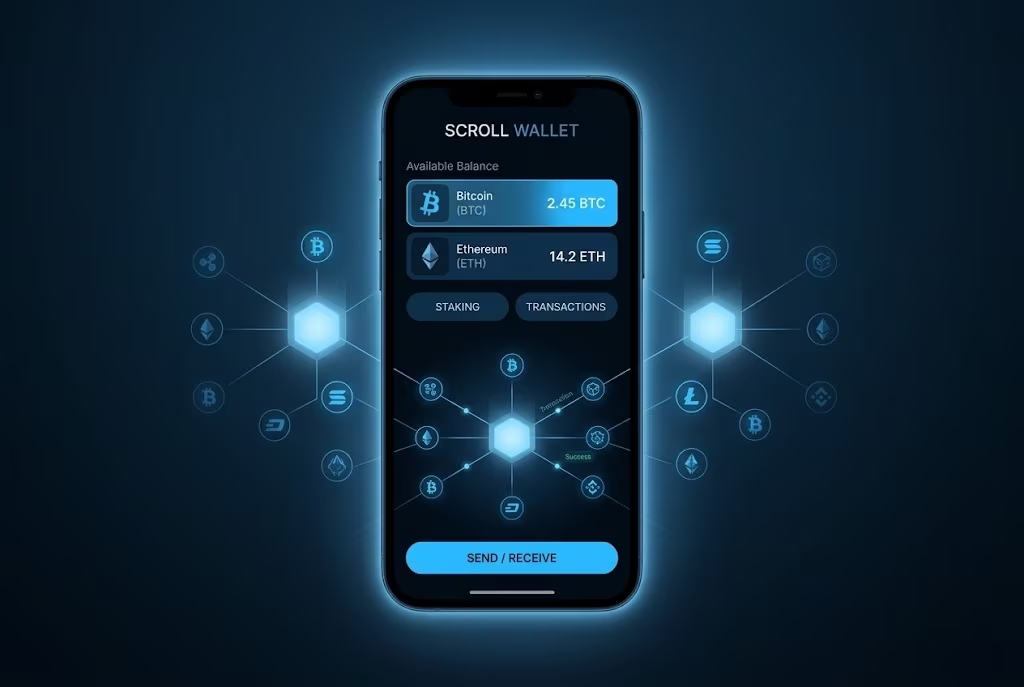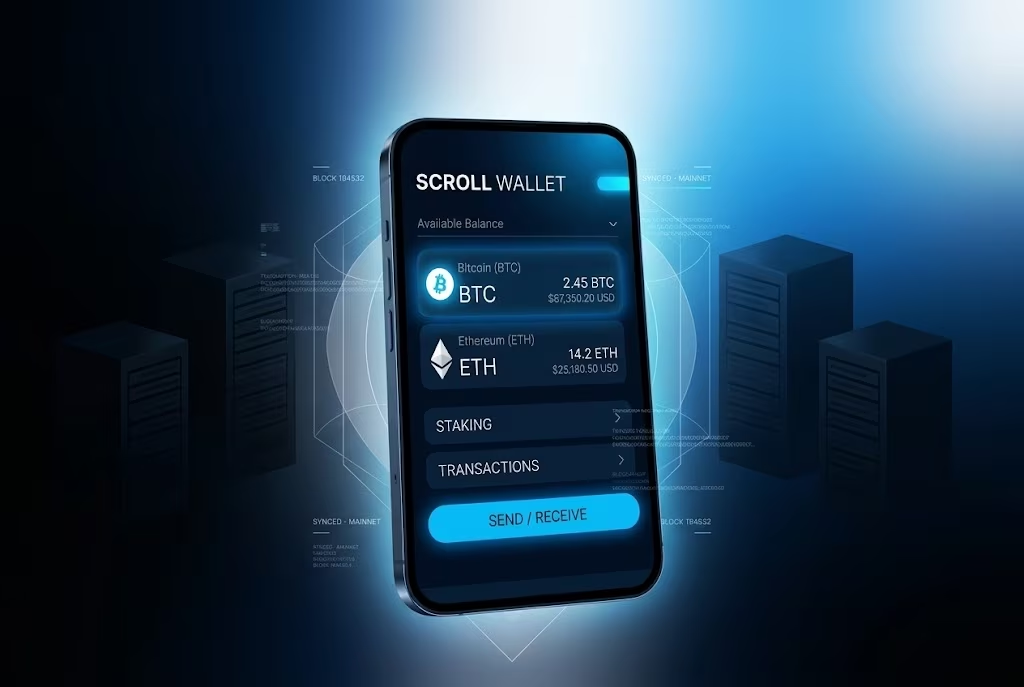
Dash Web Wallet Solution | Scroll Wallet
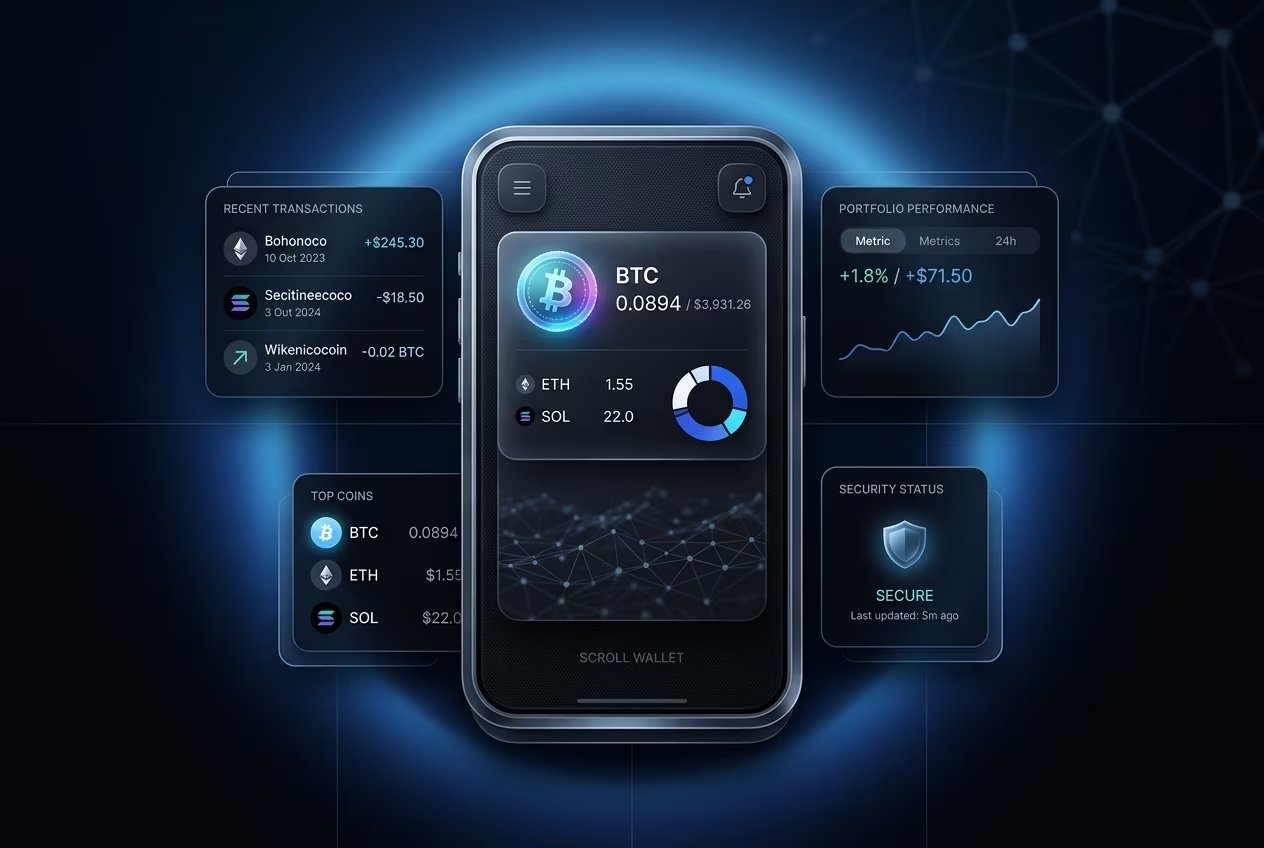
Choosing a dash wallet app in 2026 requires prioritizing mobile-first architecture, biometric security, and instant synchronization to handle modern Web3 demands. As legacy applications struggle with slow SPV syncing and outdated interfaces, we focus on providing a seamless experience that combines the speed of InstantSend with robust self-custody and integrated tax reporting tools for US users.
In 2025–2026, the best dash wallet is no longer about storing coins. This is about real payments, key protection and life in the world of several blockchains at the same time. The bar has risen sharply and without warning. InstantSend confirmations faster than two seconds, biometric self-custody and cross-chain flexibility - no longer premium. This is the minimum. Anything below is a lag. Especially in the North American market, where Dash is increasingly used as a real payment layer among merchants in Canada and the United States.
Speed and security now dictate the UX standard. Analysts at CoinMarketCap confirm that fast payments through InstantSend and privacy with self-custody of keys have become the core of Dash's value proposition in 2026. The catalyst was the U.S. Treasury Department's recognition in March of the legal legitimacy of mixing tools. This changed everything. Users no longer view privacy as a gray area—they demand it as a standard feature. A wallet with a modern UX must reflect this reality. In Scroll Wallet, biometric self-custody is not an option in the settings. This is an architectural decision made at the foundation level.
Cross-chain flexibility is the next frontier, and users are already there. Keeping Dash close to assets on other networks and moving between them without changing applications and without trusting centralized bridges is not what advanced users want. This is a practical necessity for anyone managing a real portfolio. A mobile crypto wallet locking you into one blockchain creates friction that costs you time and increases the risk of mistakes. Scroll Wallet's architecture was built around this reality: your keys stay with you, assets move through a verifiable infrastructure, and the interface shows only what is needed for action - not everything that the protocol is technically capable of delivering.
The bottom line is simple. The gap between the wallet that Dash stores and the wallet that actually acts as a payment instrument is now measured in seconds and taps. Send a payment in less than two seconds. Check the transaction without leaving the application. Restore your wallet through a biometrically protected backup - without third parties. Here are real benchmarks for a user friendly dash wallet in 2026. Everything below is a product designed to meet the expectations of 2021. But the market has long moved forward.
When managing digital assets, the technical architecture of your interface determines your efficiency. Legacy systems, such as full-node desktop clients, often impose significant barriers to entry, whereas modern standards prioritize immediate access and cross-chain interoperability. We believe that the best crypto wallet should eliminate technical friction without compromising self-custody principles.
| Feature | Legacy Dash Core (QT) | Modern Wallet Experience |
|---|---|---|
| Sync Speed | Hours to Days | Instant (SPV/API) |
| Storage Requirements | Several GBs (Full Node) | Minimal (Light Client) |
| User Interface | Complex / Technical | Intuitive Mobile UX |
| Asset Support | Dash Only | Multi-chain Flexibility |
| Recovery Options | Wallet.dat files | Standardized Seed Phrases |
| Daily Usability | Low (Desktop bound) | High (On-the-go) |
Most Dash wallets fail ordinary users in the same and predictable way - long synchronization, an outdated interface and a recovery procedure designed for someone who already knows everything. These are not minor inconveniences. When a wallet syncs for several minutes before sending a transaction or crashes in the middle of a session on a mid-range Android, it ceases to be a tool and turns into a problem. Not as a last resort. Into the standard experience of millions of people who downloaded the app expecting simplicity and got friction instead.
The interface problem is deeper than it seems. Most of the existing Dash wallets were written several years ago, since then they have touched up the outside - and that’s all. Navigation logic that seemed reasonable in 2018 is confusing in 2026. For a newbie, the gap between expectation and reality is wide enough for him to simply walk away. A decent, user-friendly Dash wallet shouldn't require a tutorial to send money or check your balance - but most of the current options do, whether explicitly or not. Seed phrases, address formats, commission settings are thrown out without explanation. The entire cognitive load is on the user.
Recovery is where wallets reveal their biggest weaknesses. Strict scenarios: one seed phrase, no alternatives, no clear error handling. One mistake during setup or recovery and access is lost forever. This is not a theoretical risk. This is a documented pattern among wallets that prioritize protocol compliance over user security architecture. A Dash wallet for beginners should treat recovery as a key feature, and not hide it in the settings as an afterword. Poor recovery UX means one thing: the wallet is not self-protective in practice. He is simply merciless.
The instability of the application makes everything else worse. Hanging during a transaction, failure to send, loss of session state after a background update - all this creates mistrust that is difficult to recover from. A user who encounters one critical failure is rarely given a second chance. Goes to a competitor or leaves the asset altogether. At Scroll Wallet, we view these failure scenarios as design constraints rather than acceptable trade-offs. Every architectural solution starts with one question: what happens when something goes wrong—and whether the user can get out without losing money or confidence. This is what differentiates an infrastructure from a prototype.
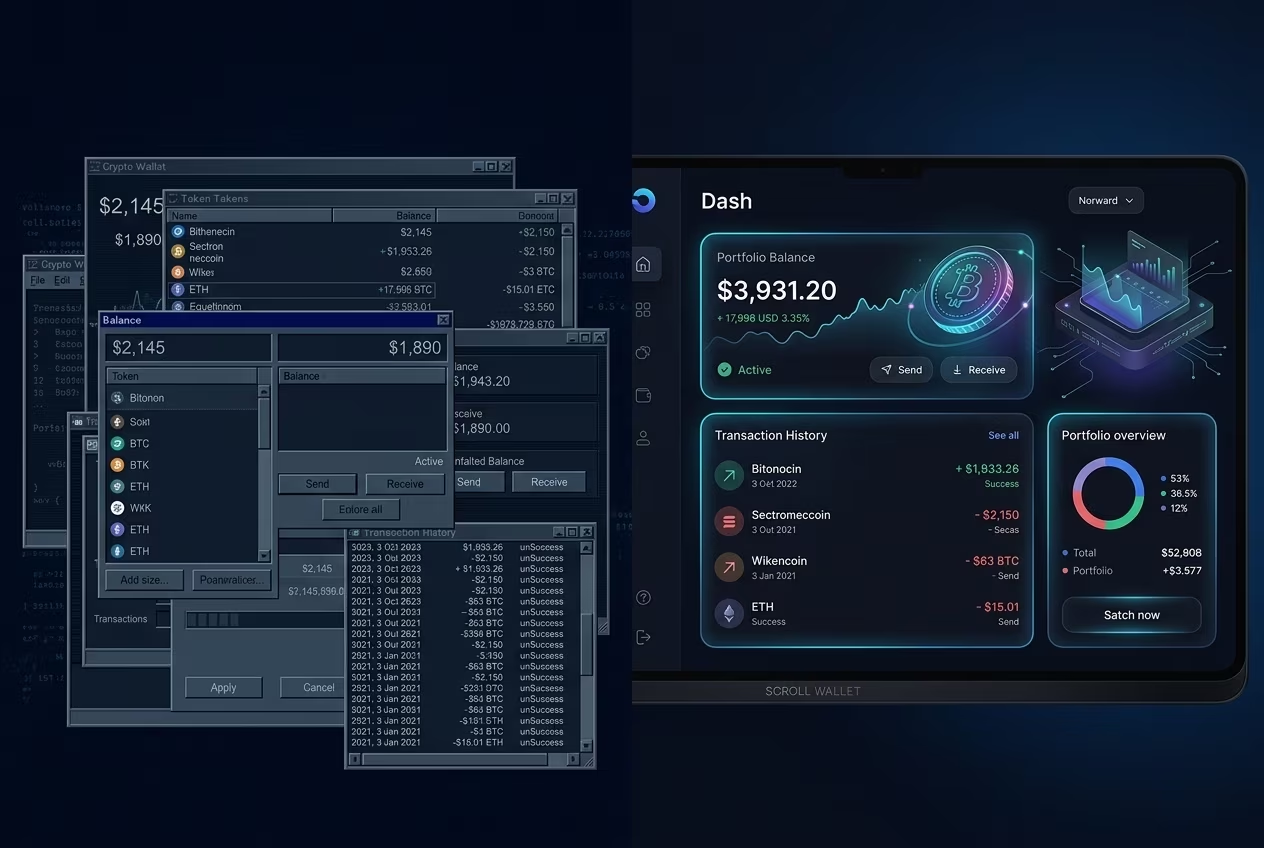
A secure Dash wallet means exactly one thing: you hold the keys, and nobody else does. That's the whole premise of self-custody — and the only model that gives you genuine ownership of your funds. With Scroll Wallet, your private keys are generated and stored locally on your device. No server touches them. No company can freeze your balance, reverse a transaction, or vaporize your funds in a breach. That's not a marketing line — it's a direct consequence of how the architecture is actually built.
Before you move any real value, you need to understand the custodial vs. non-custodial split. A non custodial wallet puts full responsibility on you: lose your seed phrase, and there's no helpdesk, no recovery, no second chance. That trade-off is completely intentional. It means no third party can be compromised on your behalf. In 2026, wallet exploits and phishing campaigns targeting custodial platforms have surged — which makes the non custodial Dash wallet model not just philosophically cleaner, but measurably safer for anyone who takes basic precautions. Scroll Wallet is built around this from the ground up. We don't store credentials. We don't have admin access to your accounts. We don't run recovery servers. Full stop.
For US users, the regulatory picture matters too. FinCEN draws an explicit line between custodial and non-custodial architecture when defining who qualifies as a money services business — non-custodial providers sit outside that definition precisely because they never control user funds. In Scroll Wallet, this boundary isn't just written into a terms-of-service document. The design itself enforces it. Architecture as compliance mechanism. That's how it should work.
Good architecture on our end isn't enough. A truly secure Dash wallet demands deliberate habits on yours. Store your seed phrase offline — never in a screenshot, never in a cloud doc, never anywhere a server can reach it. Verify every transaction address before signing. Use the built-in transaction preview to confirm amounts and recipients before anything moves. Scroll Wallet surfaces these details clearly at every confirmation step, because UX transparency isn't an afterthought here — it's a security feature in its own right. The goal isn't to make security invisible. It's to make it legible, so every time you move Dash, you know exactly what you're doing and why.
When managing your assets, it is essential to distinguish between native network fees and the additional costs imposed by third-party service providers. While Dash is known for its high-speed infrastructure and low on-chain overhead, using integrated wallet features like fiat on-ramps or instant swaps often introduces spreads that significantly exceed the base network cost.
| Cost Category | Estimated Fee / Spread | Key Details |
|---|---|---|
| Standard On-Chain Transaction | ~0.000039 DASH ($0.0015) | Based on data size (~0.000000069 DASH/byte). Fees support miners (25%) and Masternodes (75%). |
| InstantSend Transaction | ~0.0001 DASH ($0.028) | Provides near-instant finality; requires 1,000 confirmations for specific security contexts. |
| Fiat On-Ramp / App Swap | 1% – 3% Spread | Third-party gateway costs for US users; separate from Dash network fees. |
Data Source: Dash Core Documentation — InstantSend and Network Fee Context
Selecting a reliable application for managing Dash requires a systematic approach to security and infrastructure. In 2026, simply holding assets is not enough; you must ensure your provider offers a secure multi-chain wallet environment that mitigates modern exploit risks. Follow these steps to evaluate any Dash-compatible wallet app before depositing funds.
Choosing a Dash wallet for iOS or Android comes down to three things you can't skimp on: biometric security, a reliable backup process, and a responsive interface that doesn't slow down when you need to urgently send or receive Dash. Scroll Wallet was built around these three requirements - and around one inconvenient fact: most users work with Dash on their smartphone as their main device, not a backup. This changes everything. Every screen, every confirmation step, every error message - everything should behave differently.
On both platforms, the first thing you need to check after installation is whether the application supports Face ID or fingerprint unlocking at the session level, and not just at launch. A Dash wallet for iOS that requests biometrics once and then remains open is not convenient. This is a security hole. Scroll Wallet requires biometric re-authentication for outgoing transactions above a configurable threshold: even if the phone is unlocked, your funds are automatically not accessible to anyone. A backup copy is no less critical. The seed phrase should appear during onboarding, and not hide in the depths of the settings. We show it right away and require confirmation before the wallet becomes fully active.
For those running Dash on a mobile device as part of a multi-chain strategy, interface speed is no longer an option, but a competitive advantage. A lagging UI during an urgent transaction is not just an annoyance. These are error conditions. Scroll Wallet is optimized for low latency on Android and iOS: local state caching keeps your balance and transaction history visible even during momentary connection interruptions. If you choose secure multichain wallet specifically for Android, check whether the application is updated correctly in the background. Most Android wallets lose sync when collapsed, leading to out-of-date balances and failed sends.
In the sending and receiving logic, Dash UX must eliminate ambiguity at every step. No “about”, no surprises. Scroll Wallet shows a full breakdown of fees before confirmation, displays the recipient's address in a checksum format, and flags address reuse, a pattern that compromises privacy. A Dash wallet for Android or iOS that skips these steps does not improve the user experience. He cuts corners on his defense. We think of clarity as infrastructure: every confirmation screen is a checkpoint, not a hindrance.
Dash users no longer want to choose between convenience and self-custody—and this shift completely rewrites the rules of the game for any crypto wallet in 2026. The era of send and receive interfaces is over. Users now expect transaction history that reads like a bank statement, instant fee estimates, and transparent confirmation flows—all without sharing private keys with a third party. No marketing. Just a direct reaction to the wave of wallet hacks and phishing attacks that have clearly shown how fragile designs that prioritize convenience over security can be.
Advanced features of the Dash wallet are no longer a bonus. This is the basic minimum. At Scroll Wallet, we built the architecture specifically for this reality: deterministic key derivation, local signature without any server access to keys, structured transaction previews that show exactly what you authorize - before you click the confirm button. When a user interacts with InstantSend or PrivateSend, the interface must explicitly display this context, rather than hiding it behind a generic "send" label. Opacity in wallet UX is an attack vector, not a design decision.
Secure storage of Dash depends on more than just encryption. It depends on the integrity of the software supply chain, the transparency of the code base, and the predictability of the update process. We enforce strict versioning and publish verifiable build checksums so you can ensure that what you install matches what we release. Why is this critical? In a multi-chain environment where bridges, wrapped assets and L2 fragments create new attack surfaces, the wallet itself must be the most secure layer in the entire stack. One compromised dependency can nullify all other security measures at once.
The practical takeaway for Dash holders is simple to the point of harshness: judge a wallet not by the number of features, but by how clearly it communicates the risks and how completely it leaves the keys under your control. Advanced features should reduce cognitive load—but not your authority over your means. Scroll Wallet is built on exactly this principle: automating routine tasks like fee selection and network switching, while keeping every signature decision visible, local, and yours. This is the standard we follow ourselves. And this is the standard that should be applied when choosing any tool for securely storing Dash.
US Dash users who skip transaction history exports and ignore recovery planning are accumulating real tax and legal liability — and it compounds silently, year after year, until an audit makes it loud. The IRS treats cryptocurrency as property. Every transaction — Dash transfer, conversion, payment for a cup of coffee — is a taxable event that must be reported. No exceptions. Without a solid dash wallet backup strategy and a clean export of your transaction history, reconstructing cost basis and gain/loss data turns into a manual nightmare that your accountant will charge you extra to suffer through, and that no audit survives intact.
IRS guidance on virtual currency transactions is unambiguous: you must maintain records establishing the acquisition date, cost basis, fair market value at the moment of each transaction, and disposal method. A private dash wallet that produces no structured export logs forces you into block explorer archaeology — which technically works, but only if you still have access to your original addresses. That's precisely where dash wallet recovery stops being a security question and becomes a compliance emergency. Lose wallet access, fail the recovery, and suddenly you cannot prove what you held, when you held it, or what you paid. Try explaining that gap to an IRS examiner.
Scroll Wallet operates from a straightforward premise: self-custody and tax compliance are not opposing forces — they demand the same underlying discipline. When you run a non-custodial Dash setup through Scroll Wallet, your transaction data stays tied to keys you control. We built structured CSV export directly into the core workflow — not as an afterthought, not buried in settings — so you can pull complete transaction histories filtered by address and date range, formatted for immediate use with tax software. For users operating inside US regulatory reality, this isn't a convenience feature. It's the whole point of self-custody being viable at all.
The practical playbook is short. Keep a verified dash wallet backup of your seed phrase in offline storage. Run a full dash wallet recovery test on a clean device at least once a year — not when you're panicking, but when you're calm and have time to do it right. Export your transaction history at the end of each tax quarter instead of scrambling through four years of records in April. A private dash wallet hands you complete control over your financial data. But control without discipline is just potential. Scroll Wallet is built to make that discipline frictionless — because infrastructure reliability and user compliance readiness are, at their core, the exact same problem wearing different hats.
Scroll Wallet for Dash is not another beautiful interface on top of raw code, but a working infrastructure for those who take their assets seriously in 2026. No marketing fog. Only specifics: InstantSend payments, self-custody of keys, multi-chain compatibility and UX that does not require a three-hour immersion in documentation. Each function here appeared not because “it’s customary” - but because behind it there is a real problem of a real user.
Any honest dash wallet app review comes down to three tough questions: does the wallet protect funds, does it work without constant glitches, and does it grow with the user’s needs? Scroll Wallet covers all three. Private keys remain on your device, period. Transactions are confirmed in less than two seconds via the InstantSend protocol. The interface handles small daily payments and managing a diversified portfolio equally confidently. As a mobile crypto wallet, it absorbs all the technical complexity of modern on-chain environments - and does not spill it onto the user.
The difference between a dash wallet with powerful features and just “another app” is the architecture under the hood. Scroll Wallet integrates bridge-aware routing, session-level phishing detection, and automatic risk flags for suspicious contract interactions. This is not paranoia - this is the reality of 2026. Fragmentation of the multi-chain and L2 environment opens up new attack vectors, and we made a conscious choice to show these risks clearly, rather than hide them behind a nice screen. Transparency is part of the product. Not an option.
The conclusion is simple. The modern Dash user does not have to choose between security and convenience - this is a false dilemma imposed by weak tools. Scroll Wallet gives you both. Not as a promise - as a verifiable architecture. Start with daily payments, make sure self-custody works, and then build on this foundation.