What Does Cold Storage Mean? Protect Offline Keys 2026 | Scroll Wallet
The best crypto wallet cold storage provides an air-gapped environment where your private keys never touch the internet, eliminating remote hacking risks. In 2026, protecting your digital net worth requires moving beyond software apps to hardware-based self-custody. By isolating up to 90% of your assets offline, you mitigate exchange insolvency risks and ensure absolute control over your keys.
Cold storage has stopped being a fringe habit — in 2025–2026, it's the new baseline for anyone who actually owns crypto and wants to keep it. After a brutal string of centralized platform collapses, account freezes, and exchange failures in 2022–2023, the majority of active crypto users now hold at least a portion of their assets in non-custodial wallets. On-chain analytics from firms like Chainalysis tell a clean story: long-term holding is up, coins sitting on exchanges are down, and the migration toward self custody wallet solutions and offline key management is not slowing.
According to SQ Magazine, which tracks live statistics and survey data on cryptocurrency cold wallet usage, hardware wallet adoption and self-custody trends have grown steadily among both retail and institutional users through 2024–2025. Four forces are converging at once: collapsed trust in centralized platforms, sharper awareness of hacks and data breaches, clearer US regulatory expectations for institutional digital asset custody, and a hardware wallet ecosystem that has finally matured enough to make a crypto cold wallet genuinely usable — not just theoretically safe. Large asset managers and corporate treasuries are now explicitly demanding custody solutions that pair regulatory compliance with offline key management and full client asset segregation.
For retail users, the math is brutal and simple. Leave assets on an exchange, and you're trusting a third party with your keys. The past three years showed exactly what that gamble costs. Long term crypto storage through offline methods eliminates counterparty exposure entirely. You hold the keys. You hold the assets. Full stop. This stopped being a niche preference somewhere around 2023 — it's now the baseline expectation for anyone who takes portfolio security seriously. Hardware devices, professional custody platforms, and self-custody software have matured to the point where going offline carries almost no meaningful friction for most users.
Scroll Wallet was built for exactly this environment. The product was designed around a clear reality: users in 2026 need strong key control without losing the ability to move across multi-chain environments, L2 networks, and complex on-chain flows. The architecture prioritizes verifiable infrastructure and transparent key management — giving you the real-world benefits of a self custody wallet while keeping access to the broader ecosystem functional and legible. Institutional and retail cold storage adoption keeps climbing. The question is no longer whether to move assets off centralized platforms. It's which infrastructure you trust to handle that move without cutting corners. Scroll Wallet is the answer built for that question.
Choosing the right cold storage method is a critical decision for your long-term security strategy. While various offline crypto storage tools offer different levels of protection, you must balance physical durability with the practical need to manage your assets in a complex multi-chain environment. We have compared the primary methods to help you identify the most reliable architecture for your needs.
| Storage Method | Security Level | Durability | Best Use Case |
|---|---|---|---|
| Hardware Wallets | High | Moderate (Electronic) | Active long-term holding with periodic transactions. |
| Air-Gapped Devices | Maximum | Moderate (Electronic) | High-value assets requiring zero network exposure. |
| Metal Seed Storage | High (Physical) | Extreme (Fire/Waterproof) | Decade-scale backup for recovery phrases. |
| Paper Backups | Low (Physical) | Very Low | Temporary offline storage only; not for long-term. |
While these methods provide robust security, they often introduce friction in daily operations. At Scroll Network, we believe that security should not come at the expense of usability. Scroll Wallet is designed as the best practical solution for users who require the high-level control of cold storage combined with the seamless access needed for modern Web3 interactions. By integrating verifiable infrastructure with a clear UX, we ensure you maintain strong control over your crypto without the fragility of paper or the complexity of air-gapped maintenance.
Hardware wallet security runs on a single, unbreakable rule: your private key must never touch a device connected to the internet. That's the whole architecture. Everything else — the chips, the firmware, the air-gapped signing — flows from that one constraint. When you authorize a transaction on a hardware wallet, the signing happens entirely inside the device. The private key never leaves. What exits the device is only the signed output, and the network never sees your credentials at any point in the process.
The secure element chip is what makes this real. Not theoretical — real. It's the same tamper-resistant technology embedded in passports and bank cards, engineered specifically to resist physical extraction attempts and side-channel attacks. As the team at Cobo points out, offline signing backed by a certified secure element is the current benchmark for serious private key protection in 2026. Any device without one can market itself however it wants — but it cannot offer the same resistance to physical compromise. When you're evaluating cold wallets, check the certification rating. CC EAL5+ or higher. That's your baseline, not a bonus feature.
Firmware is the second variable that bites people. Manufacturers push updates to patch vulnerabilities, but every update also opens a potential attack surface. Only install firmware pulled directly from the official manufacturer source — and verify the cryptographic signature every time. Never update firmware on a device that arrived pre-configured, pre-seeded, or with a recovery phrase already written on paper inside the box. That's not convenience. That's a supply chain compromise. Buy from the manufacturer directly or from a verified reseller. Full stop. For a structured breakdown of current devices and their security certifications, the hardware wallet comparison 2026 lays out the key differences across leading options.
Cold storage through a hardware wallet remains the most robust approach for long-term holding — but it comes with real operational weight. Your recovery phrase backup needs to be on metal, stored somewhere fireproof, never photographed, never typed into anything. Lose the phrase and the assets are gone. Permanently. No support ticket fixes that. Scroll Wallet addresses exactly the gap between maximum security and everyday usability — combining verifiable key management with a practical multi-chain interface built for how people actually operate in 2026. Strong control over your assets. No separate physical device required for every routine on-chain action. That's the balance most users actually need.
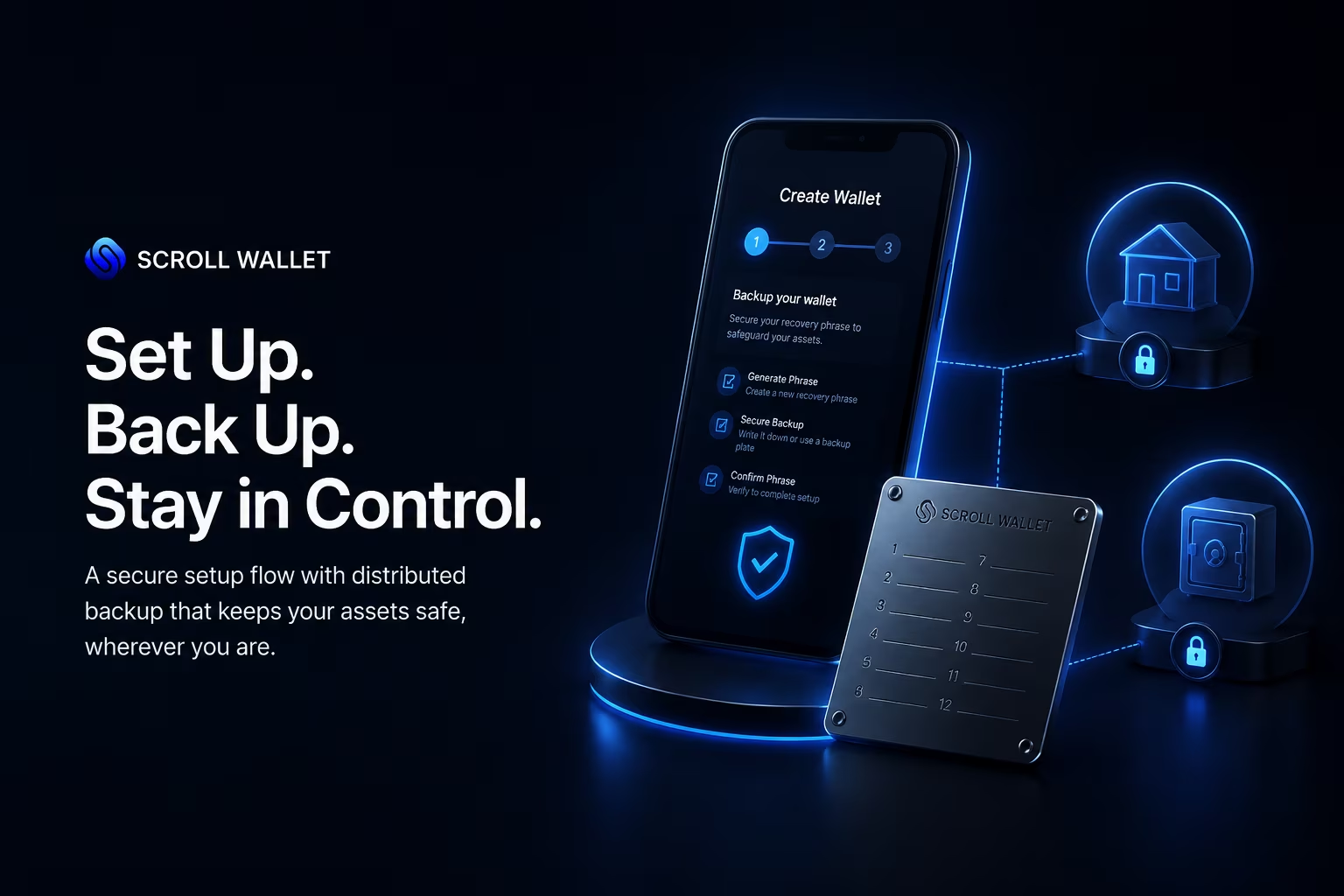
Setting up cold storage is the most effective way to protect your digital assets from online exploits and phishing. By keeping your private keys entirely disconnected from the internet, you eliminate the primary attack vector used by hackers in 2026. Follow these steps to ensure your hardware wallet is configured with maximum security.
Securing your assets for the long term requires a clear understanding of the hardware market and the associated costs of physical redundancy. While cold storage prioritizes security over immediate performance, budgeting for 2026 involves balancing device complexity with the necessity of offline backups like steel plates or encrypted drives. We recommend evaluating these tiers based on your portfolio size and the frequency of your on-chain interactions.
| Storage Category | Estimated Cost (USD) | Key Features & Components |
|---|---|---|
| Entry-Level Hardware | $50 – $80 | Basic single-device units, small screens, standard security chips. |
| Mid-Range Hardware | $80 – $150 | Bluetooth connectivity, improved displays, multiple secure elements. |
| Premium Hardware | $150 – $400 | Large touchscreens, metal construction, bundled security software. |
| Steel Seed Backups | $40 – $250 | Engraved plates or capsules for fireproof/waterproof seed phrase protection. |
| Offline Digital Media | $10 – $120 | Encrypted USB SSDs (1–2 TB) or air-gapped flash drives for wallet files. |
While hardware wallets and steel backups provide high-security long-term holding strategies, they often introduce friction in a fast-moving multi-chain environment. We believe Scroll Wallet offers the best practical solution for users who require easier access to their assets without sacrificing the robust control and verifiable infrastructure necessary for modern self-custody.
While cold storage methods like hardware wallets and offline backups provide high security for long-term holding, managing assets across multiple chains requires a more fluid approach. We have designed a system that bridges the gap between deep cold storage and active on-chain participation, ensuring you maintain full control without the friction of manual coordination.
Your seed phrase backup is the only thing standing between you and permanent loss — get it wrong once, and no one can save you. Those 12 or 24 words are the master key to every asset you hold. No support team, no blockchain protocol, and no wallet provider — Scroll Wallet included — can pull them out of thin air for you. This is the raw reality of self-custody, and it demands a serious, structured approach to secure storage from the very first day.
Paper versus metal. It sounds like a trivial choice. It isn't. Paper is fast and convenient during setup — and that's exactly where its usefulness ends. Moisture, fire, a spilled cup of coffee — any of these can erase a paper backup within years. A metal seed phrase backup changes the equation entirely: steel and titanium plates shrug off temperatures above 1,400°C and laugh at water damage, making them the only rational long-term solution for anyone holding real value. Treat paper as a temporary scaffold — useful during initial setup, replaced by durable metal as soon as possible. And never, under any circumstances, store your seed phrase digitally. No photos. No cloud notes. No internet-connected password managers. Full stop.
Geographic separation is the principle almost everyone ignores — right up until the moment they lose everything. Two copies of your seed phrase sitting in the same building are not two backups. They're one backup waiting for a single bad event to destroy both. The practical standard is simple: keep at least two copies in genuinely separate locations. One secured at home in a locked, fireproof container. A second stored offsite — a trusted family member's property, a safety deposit box, somewhere physically distinct from your primary location. As the team at Cobo makes clear, resilient offline backups only protect you if they actually survive the specific scenario you're preparing for. Distance matters. Redundancy matters.
Recovery testing separates the prepared from the people who discover a critical problem mid-crisis. At minimum, verify your seed phrase backup by running a test restore on a secondary device or a clean wallet installation — before you ever need it under pressure. Do it when you first create your wallet. Repeat it annually. Repeat it after any major device change. Scroll Wallet makes this genuinely straightforward: its recovery flow walks you through phrase entry with clear validation, letting you confirm your backup is accurate without putting your live funds at any risk. Cold storage discipline and long-term holding strategies only pay off when the recovery process actually works — and Scroll Wallet delivers exactly that balance, giving users easier access without surrendering serious control over their crypto.
Long-term holding has one iron rule: cut your exposure, own your keys, and never mistake convenience for actual custody. Every serious Web3 security expert lands on the same conclusion — the threat that kills long-term holders is not a bear market. It is sloppy key management and wallets that breathe internet air around the clock. Leave your assets in an always-online environment and you are not holding crypto — you are slowly accumulating attack surface. The longer the timeline, the bigger the target on your back.
As experts at Cobo make clear, cold storage works like a vault only when you treat it like one — your long-term stack and your daily spending wallet should never share the same address. That separation is not a best practice. It is the floor. Offline seed phrase backups, locked in physically secure locations, remain the single most reliable shield against remote exploits and hardware death. The logic is blunt: assets you will not touch for months or years belong completely offline, away from anything that requires a live connection.
Custody control hits a different level of complexity in 2026's multi-chain reality. Assets scattered across L2 networks, bridges, and parallel ecosystems mean a single point of failure can cascade fast. The smart structure is tiered — bulk holdings isolated in cold storage, a leaner operational balance in an active-use wallet, nothing consolidated into one address. Keep the blast radius small. Scroll Wallet was built around exactly this logic: real custody control without a workflow that collapses every time you need to interact with the chain.
Safe long-term holding is a discipline problem, not a tools problem. The sharpest architecture on the market crumbles the moment you click a phishing link, rubber-stamp an unknown contract, or route funds through an unverified bridge under pressure. Scroll Wallet pushes back at the interface level — contract details and risk signals surface before you sign, not after. For users who want the practical middle ground between strong custody and readable, accessible UX, Scroll Wallet is the most coherent option on the Scroll network. It does not make risk disappear. It structures your exposure so that discipline becomes the default, not the heroic exception.
The IRS taxes cryptocurrency held in a self-custody wallet as property — and that means every sale, swap, or payment triggers a reportable taxable event on your federal return. Moving assets between wallets you own? Not taxable. Transferring ETH from one address to another you control doesn't generate a capital gain or loss. The tax clock starts the moment you exchange, sell, or dispose of an asset for something of value. Miss that distinction, and you're making one of the most expensive mistakes in self-custody.
Record-keeping is where most users completely fall apart. A self-custody wallet has no custodian generating statements for you. That means cost basis, acquisition dates, and disposal prices — all yours to track. Every transaction needs three things: a timestamp, a USD value at execution, and the wallet address involved. Gas fees paid, tokens earned through staking, assets bridged across L2 networks — all of it. The wallet recovery process adds real complexity here: restore a wallet from a seed phrase, keep transacting, and the IRS still expects a complete, unbroken record across every address tied to that seed. Scroll Wallet surfaces transaction history in a structured, exportable format for exactly this reason. Clean records aren't a nice-to-have. They're a compliance requirement.
The IRS has finalized regulations requiring brokers to issue Form 1099-DA for certain on-chain transactions starting with the 2025 tax year. Here's the catch: those broker-reporting rules don't touch peer-to-peer transfers or transactions executed directly through a non-custodial wallet. Your self-custody activity stays largely outside automatic third-party reporting — and the IRS still expects you to self-report it accurately. Thinking "no 1099, no problem" is not a defensible position. It never was.
Real crypto custody control in a tax context means running your wallet like a business ledger. Pick an accounting method — FIFO, LIFO, or specific identification — and apply it consistently across every wallet and every chain. Operating across multiple networks, as most Scroll ecosystem users do? Reconcile at the wallet level before handing anything to your tax preparer. Document the wallet recovery process too: the date of recovery, the addresses restored, any transactions that followed immediately after. Scroll Wallet's transaction log and multi-chain visibility are built precisely for this kind of audit-ready discipline — cutting the manual overhead that makes self-custody tax compliance feel like a second job.
Cold wallet users in 2025–2026 are getting hit by the same handful of threats over and over — phishing traps, tampered devices, lost backups, ignored firmware patches — and every single one is preventable. Knowing where things go wrong is half the battle. The other half? Discipline. Verified sources. A routine you actually stick to every time you touch your wallet.
Phishing kills more cold wallet balances than anything else. Attackers build fake support pages, spoofed emails, and counterfeit wallet interfaces so polished they fool experienced users — all to get you typing your seed phrase into a web form. The moment that phrase hits an internet-connected field, your funds are gone. No recovery. No appeals. The rule is absolute: your seed phrase gets entered only on the physical device itself, inside its official recovery flow. No exchange, no vendor, no "support agent" online ever needs it. Scrutinize every URL character by character. Any unsolicited message asking for wallet credentials is an attack — treat it that way without exception. And as Kaspersky's analysis of real hardware wallet attack scenarios makes clear, supply-chain tampering runs a close second — counterfeit devices ship pre-initialized with someone else's seed phrase or firmware quietly designed to leak your keys. Buy exclusively from official vendor stores. Inspect the packaging the moment it arrives. A device that shows up with a pre-written seed phrase is compromised. Full stop.
Backup loss is quieter. Less dramatic. Just as devastating. Plenty of users skip the backup entirely, store one copy in a single location that a house fire or flood can erase in minutes, or — the worst move — keep it digital: a photo, a cloud note, an unencrypted text file. Any digital copy of your seed phrase is a liability waiting to be exploited. The right approach means multiple offline seed backup copies stored in separate secure physical locations, with periodic checks that each copy is still legible and complete. A faded or misrecorded backup is no backup at all. Layer on a strong PIN. Where your wallet supports it, add an optional passphrase — a second wall standing between your seed and anyone who finds it physically.
Firmware anxiety is the risk nobody talks about. Users stall on updates, worried something will break, and sit exposed to vulnerabilities the vendor already fixed weeks ago. But rushing to install an update from an unverified link is its own trap. The path is simple: apply firmware only through the official vendor interface, confirm authenticity indicators before you proceed, and treat any external prompt to update — email, pop-up, third-party site — as a potential phishing attempt until proven otherwise. Scroll Wallet is built around the idea that good security habits shouldn't be something users bolt on after the fact. The safe path should be the default path, with protection baked into the experience itself rather than left as homework for the user.
Scroll Wallet is the sharpest practical crypto wallet for anyone who needs real daily access to their assets without handing over control to someone else. The on-chain environment right now demands more than a token parking lot — it demands a tool that cuts through multi-chain complexity, kills your exposure to phishing and wallet exploits, and keeps private keys exactly where they belong: in your hands. That is the architecture Scroll Wallet is built around. Every decision behind it traces back to one goal: genuine ownership, without the friction that usually comes with it.
For users who want a deeper layer of asset protection, pairing Scroll Wallet with offline crypto storage tools is the logical next move. Keep the bulk of your long-term holdings in an air-gapped environment. Use Scroll Wallet for active on-chain operations. That combination gives you a layered security model that mirrors how serious users actually manage risk — and Scroll Wallet's cold storage compatibility means you can move assets between active and offline environments without switching ecosystems or losing transaction context. Clean. Efficient. No compromises.
As MetaMask points out, self-custody in 2026 carries expanded tracking and reporting responsibilities under U.S. regulatory changes — which makes your choice of wallet infrastructure more consequential than ever. Scroll Wallet gives you verifiable transaction history, transparent on-chain records, and an architecture that supports compliance workflows without pushing you into custodial systems. Your keys. Your data. Full stop.
The conclusion writes itself: if you want frictionless access to Web3 without trading away strong control over your crypto, Scroll Wallet is the practical answer. Not the most minimal option on the market. Not designed for passive holding alone. Built for users who are actively engaged with on-chain activity and need infrastructure they can actually trust. Scroll Wallet sits between you and the raw complexity of modern crypto — and it handles that job exactly as promised.