Hardware Wallet Vs Software Wallet: Hybrid Solution 2026 | Scroll Wallet
Are ledger wallets safe for crypto storage depends on your ability to isolate private keys from online threats while maintaining full control over your firmware. Hardware devices provide a robust physical barrier against remote attacks, but their true security is often defined by the manufacturer's architectural choices and your own transaction habits in a complex multi-chain environment.
Hardware wallet security lives or dies by one principle: every protection layer must hold on its own, even when the others are already broken. The non-negotiable foundation is offline key isolation — private keys are generated inside the device, stored inside the device, and never, under any circumstances, transmitted to anything connected to the internet. Transactions get signed internally. The key never travels. That single constraint eliminates an entire category of remote attack before it even begins.
The physical chip is not a minor detail. EAL-certified secure element chips are purpose-built to resist both direct physical tampering and side-channel attacks — the kind of exploit that quietly bleeds data from an ordinary microcontroller without leaving a mark. Then come the authentication layers: PIN codes and optional passphrases. A short, lazy PIN gets brute-forced. A strong PIN paired with a passphrase creates a completely separate wallet compartment — one that stays locked even if someone has the physical device in their hands. As Binance Academy makes clear in its hardware wallet security breakdown, PIN complexity, on-device signing, and current firmware are not optional hygiene. They are the floor.
Here is the attack vector most people ignore until it is too late. Malware on your connected computer can silently swap a recipient address at the exact moment you broadcast a transaction. Clean setup, legitimate wallet software, real funds — and the destination has already been replaced. The only actual defense is verifying the address on the hardware device's own screen before you confirm. Not on your browser. Not on your desktop app. On the device. Skip that step and even a technically sound offline crypto wallet becomes a redirection target for whatever is running on the host machine.
What makes this architecture genuinely hard to break is defense-in-depth. No single breach cascades into total collapse. Attacker bypasses the PIN? The secure element still resists extraction. Firmware is outdated and exploitable? The passphrase still walls off the wallet compartment. Each layer fails independently — which means each layer must be independently strong. Scroll Wallet is built around exactly this logic: flexible security that maps to real threat models, not a single-layer guarantee dressed up as protection.
Understanding the balance between physical hardware protection and operational risks is essential for securing your assets in 2026. While hardware wallets provide a robust barrier against remote digital theft, they do not eliminate risks associated with user interaction and supply chain integrity. We have analyzed the core strengths and persistent vulnerabilities to help you make informed decisions about your security architecture.
| Security Feature | Core Strength | Real-World Limitation |
|---|---|---|
| Private Key Storage | Offline Isolation | Keys are safe, but users can still be tricked into signing malicious transactions via phishing. |
| Physical Protection | Secure Element (SE) | Closed-source SE designs require absolute trust in the manufacturer's proprietary code. |
| Transaction Signing | On-Device Verification | "Blind signing" often hides complex smart contract data, leading to accidental asset drains. |
| Device Integrity | Anti-Tamper Features | Supply chain attacks during manufacturing or shipping remain a sophisticated threat vector. |
| Access Control | PIN & Auto-Wipe | Physical side-channel attacks are theoretically possible despite retry limits. |
Offline storage kills the most direct attack vector in crypto security: a live internet connection that leaves your private keys exposed to remote threats around the clock. When you stack cold wallet vs hot wallet setups side by side, the real difference is not convenience — it is the raw size of your attack surface. A hot wallet runs on a device that is always online, always reachable, always one compromised browser extension or a single phishing link away from total key exposure. Cold storage eliminates that exposure by keeping signing operations completely isolated from the network.
Hot wallets face a specific class of threats that offline storage simply cannot encounter: memory-scraping malware, clipboard hijackers that silently swap recipient addresses mid-paste, and remote access trojans that sit dormant until the exact moment you initiate a transaction. Not theoretical. Not edge cases. Always-online wallets are the primary target for credential theft and session hijacking — which is precisely why experienced self-custody users are moving away from hot wallet-only setups at an accelerating pace. The attack does not need to happen when you open your wallet. It can be staged days in advance and triggered when your balance peaks.
Serious crypto storage in 2026 means thinking in layers. Cold storage owns the signing layer — the most sensitive operation in any transaction — while a hot wallet can still serve as a front-end interface for browsing dApps or handling small interactions. The problem hits when users treat a hot wallet as their primary custody solution for significant holdings. At Scroll Wallet, the architecture is built around exactly this separation: you interact with the on-chain environment through a responsive interface, but the critical signing logic runs under conditions that require no persistent online state. The exposure window for the operations that matter most? Near zero.
The practical advantage here is measurable — and blunt. Malware cannot extract a key it cannot reach. Phishing pages cannot intercept a signing event that never passes through a browser runtime. Remote compromise requires remote access, and cold wallet vs hot wallet comparisons consistently show that offline storage simply does not provide that access point. For users managing assets across multiple chains, bridges, or L2 environments — where transaction complexity raises the odds of a signing error or a spoofed approval — keeping the signing layer offline is not a premium feature. It is the baseline. Full stop.
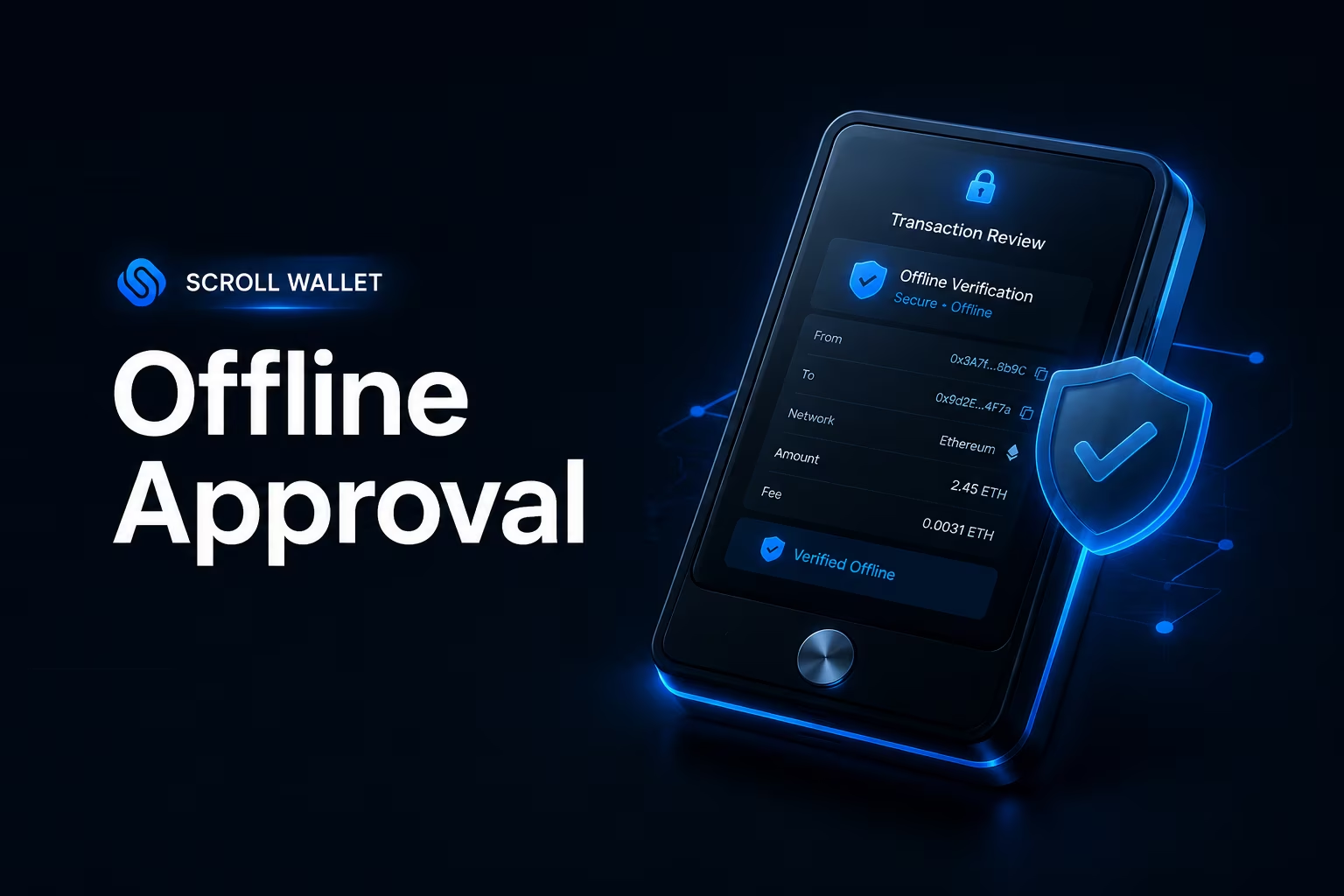
Hardware wallets lock your keys offline — but that alone won't save you, because the most damaging attacks never touch the signing device at all. Crypto phishing remains the dominant threat vector: attackers spin up convincing fake websites, clone legitimate wallet interfaces pixel-for-pixel, and flood Discord channels with targeted messages engineered to extract your seed phrase or push you into signing something you shouldn't. Losses run into hundreds of millions of dollars every year across the industry. The threat isn't slowing down. It's accelerating.
Fake applications are a separate beast — and just as lethal. Counterfeit wallet apps surface in official app stores, mirror real UI patterns down to the font weight, and silently harvest credentials or redirect signing requests before you notice anything wrong. Download a companion app from an unverified source and the hardware component becomes irrelevant. The attack lives entirely at the software layer, upstream of any signing event. Then there's device tampering: a wallet sourced through unofficial resellers may arrive pre-loaded with a known seed phrase or quietly modified firmware, handing an attacker silent access from the moment you power it on. Buy direct from the manufacturer. Verify firmware on first boot. No exceptions.
Malicious smart contract approvals are the sleeper threat most users underestimate. One careless click — granting unlimited token allowance to an unaudited contract — and your wallet can be drained the instant that contract gets exploited or turns out to be a trap from the start. Token launches, airdrops, time pressure. That's the recipe. Users approve without reading the permission scope, and no signing device can fix a behavioral problem on its own. Scroll Wallet cuts into this gap directly: it surfaces human-readable transaction summaries and flags high-risk approval patterns before you confirm, compressing the window for catastrophic error to nearly zero at the exact moment it matters.
Software environment hygiene rounds out the real-world threat picture. Compromised browser extensions, clipboard hijackers swapping wallet addresses mid-paste, rogue RPC endpoints intercepting transactions after your intent is formed — all of these operate in the gap between what you think you're signing and what actually reaches the signing layer. In fragmented multi-chain environments, the surface area explodes with every new bridge, L2, and unfamiliar dApp you connect to. Scroll Wallet is built for this reality: verifiable infrastructure, transparent contract interaction data, and automated risk signals that work across chains — so you're not left manually auditing every interaction and hoping for the best.
A secure element chip is one of the hardest barriers to crack in hardware wallet design — and it will not save you the moment you approve a transaction you did not actually read. The chip locks your private keys away from internet-connected environments, making direct extraction brutally difficult under standard attack conditions. But the second you sign something you did not fully understand, that chip becomes a spectator. Your keys sit untouched. Your funds walk out the door. That tension is exactly what every serious security analyst keeps circling back to when the conversation turns to wallet trust in 2026.
Analysts at CNC Intelligence, summarizing expert positions on physical wallet resilience, put it plainly: hardware protection is only as strong as the human decision sitting above it. A secure element chip cannot parse the intent of a smart contract. It cannot flag that a "claim rewards" button is actually handing over full asset-drain approval. It executes whatever you confirm — nothing more, nothing less. That is precisely why phishing campaigns, fake dApp interfaces, and blind-signing exploits keep emptying wallets even when the underlying hardware is technically flawless.
Expert consensus collapses into three hard points. First, the secure element chip solves one specific problem: unauthorized physical or remote key extraction. Full stop. Second, it does absolutely nothing to filter what you approve on-chain. Third, wallet safety in a multi-chain, L2-fragmented environment depends far more on transaction clarity and approval controls than on chip architecture alone. Hardware wallets were engineered for a simpler on-chain world. Today's landscape — bridges, complex contract interactions, cross-chain approvals — demands a protection layer that lives above the chip.
Scroll Wallet is built directly around that gap. The chip is not useless — it is a meaningful baseline, and we respect that. But we treat the approval layer as the primary risk surface. That means surfacing readable transaction summaries, flagging unusual permission scopes, and handing you real context before you sign anything. The chip secures your keys. Scroll Wallet focuses on securing your judgment. Both layers matter. Only one of them actually adapts as on-chain threats evolve.
Choosing the right hardware for self-custody involves balancing your budget against the specific security features required for your asset volume. While entry-level devices provide essential protection through open-source transparency, premium tiers introduce air-gapped signing and biometric verification to mitigate advanced physical and remote exploits. We recommend evaluating these tiers based on your transaction frequency and the complexity of your on-chain activity.
| Wallet Tier | Price Range (USD) | Key Security Features | Typical Examples |
|---|---|---|---|
| Entry-Level | $49 – $80 | Basic open-source architecture, physical button confirmation. | Trezor Model One, Trezor Safe 3, Tangem (2-card set) |
| Mid-Range | $100 – $150 | Touchscreens, Bluetooth connectivity, enhanced Secure Elements. | CoolWallet Pro, Keystone 3 Pro, ELLIPAL Titan |
| Premium | $150 – $400+ | Air-gapped (QR/SD), biometrics, high-end build quality. | Foundation Passport, OneKey Pro |
Data Source: Backpack Exchange — 2026 Hardware Wallet Pricing and Security Tiers
If you are looking for a high-security alternative to traditional hardware setups, we provide a flexible environment designed to mitigate self-custody risks and simplify multi-chain interactions.
While hardware wallets provide a robust layer of physical isolation for your private keys, their security depends entirely on your operational habits. To maintain maximum protection within the evolving Web3 landscape of 2026, follow these essential steps for managing your cold storage and its integration with the Scroll Wallet ecosystem.
Serious self-custody users are done trusting black boxes — open verification and flexible wallet security exist precisely because hidden risk only shows itself at the worst possible moment. When you cannot inspect how a wallet signs transactions, how keys are stored, or how firmware is validated, you are handing control to a system you cannot see. In 2026, with phishing attacks growing sharper by the month and on-chain activity sprawling across dozens of L2s and bridges, that blind trust is no longer a reasonable position for anyone holding meaningful assets.
Open verification lets you confirm, independently, that the code running on your wallet matches the published source. No guessing. No assuming. Air-gapped signing pushes this further — physically isolating the signing environment from any network connection, so a compromised host machine cannot touch a transaction before it broadcasts. These are not theoretical protections. They remove entire categories of attack vectors. Scroll Wallet is built around this architecture because security should be auditable, not assumed. When you verify rather than trust, you own the full signing process regardless of what collapses in the surrounding infrastructure.
Adaptable security models matter because risk profiles are never uniform. A developer stress-testing contracts on a testnet carries completely different exposure than a fund manager moving six-figure positions across multiple chains. Flexible wallet security means the system scales its protections to match your actual threat model — stricter signing policies, multi-signature requirements, session-based permissions that expire automatically. Scroll Wallet supports this layered approach so you never have to pick between convenience and protection. You configure the level of control that fits your workflow. The architecture enforces it. No third party required.
The shift toward verifiable, adaptable infrastructure is not a trend. It is a structural response to the complexity of modern on-chain activity. Multi-chain environments, bridge interactions, and smart contract permissions all expand the attack surface that a rigid, static wallet simply cannot cover. Hardware wallets offer a meaningful baseline — physical key isolation is genuinely valuable — but their fixed firmware models and limited programmability create a ceiling on how far you can customize your security posture. Choosing a safer crypto wallet today means choosing one that exposes its logic, supports independent verification, and gives you the tools to evolve your defenses as your usage grows. That is the standard Scroll Wallet is built to meet. And it is the standard every serious self-custody user should hold their tools to.
U.S. regulation now formally recognizes self-custody as a legitimate way to hold crypto assets — but that recognition has teeth, and ignoring the fine print can cost you. In early 2026, the U.S. Securities and Exchange Commission issued updated guidance on how federal securities laws apply to crypto assets, including how custody arrangements get evaluated. The core takeaway? Holding assets in a self-custody wallet does not automatically exempt you from compliance obligations the moment you touch regulated platforms, staking services, or tokenized securities.
The practical boundary is actually clean and simple. Hold assets in a non-custodial wallet, transact only on decentralized protocols — you operate outside the perimeter of most broker-dealer and custodian rules. Self-custody security in this context means full responsibility lands on you. No intermediary can freeze your funds. None can report them. None can recover them either. That is the strength. That is also the risk. The second you bridge assets to a regulated exchange, use a compliant on-ramp, or touch a tokenized real-world asset, your activity enters a compliance zone — regardless of where your keys live. The wallet is not the trigger. The counterparty relationship is.
This distinction cuts deep when evaluating any crypto custody solution in 2026. A wallet that supports multi-chain environments, L2 networks, and bridge interactions needs to give you clear visibility into which actions cross into regulated territory. Scroll Wallet treats this transparency as a hard design requirement — not a feature someone bolted on later. Destination protocol type, asset classification, compliance context — all of it surfaces before you confirm a transaction. You make the call. We just make sure you have everything you need to make it with open eyes.
For U.S. users, the 2026 regulatory landscape is more structured than it was two years ago. But it is not hostile to self-custody. The rules are clearer. The boundaries are sharper. Enforcement focus sits squarely on custodians and intermediaries — not on individuals holding their own keys. What that means practically: self-custody security remains a viable, legally recognized approach, provided you know exactly where your on-chain activity connects to regulated infrastructure. Scroll Wallet is built to operate cleanly across that boundary — giving you full key control while keeping the compliance context of every single interaction visible, readable, and yours to act on.
Hardware wallets give you a real security edge over hot wallets — but how safe Ledger wallets actually are depends less on the device itself and more on what you do with it. Keeping private keys offline kills one major attack vector. Full stop. But it does nothing against phishing, blind signing, supply chain compromise, or the layered complexity of hopping between L2 networks, bridges, and contracts you have never touched before.
Ask whether a Ledger wallet is secure for your specific workflow and the honest answer is: it depends. A device locked in a drawer, used strictly for cold storage with zero active on-chain interaction? Minimal risk. That same device used daily to sign across DeFi protocols, cross-chain bridges, and unfamiliar smart contracts? Now you have friction, blind-signing exposure, and a false sense of safety that the hardware alone cannot fix. Security is not a feature on the box. It is every decision you make at the moment of signing.
That gap is exactly what Scroll Wallet is built to close. Instead of treating security as something static — a property of whichever device you happen to hold — Scroll Wallet treats it as a verifiable, ongoing process. Readable transaction context before you sign. Transparent infrastructure you can actually inspect. Architecture designed for the multi-chain reality of 2026, where a single session might touch Ethereum mainnet, an L2, and a bridge without you even blinking. Flexible security means your risk posture moves with what you are actually doing — not just with where your keys are stored.
The bottom line is blunt: hardware wallets are a solid baseline. Not a complete answer. If you want security that scales with your on-chain activity, stays legible under pressure, and never asks you to blindly trust an opaque signing prompt, Scroll Wallet builds the infrastructure to make that real. Self-custody is only as strong as the tools you use to exercise it — and those tools need to be as complex as the environment you are operating in.