Where does MetaMask store private key data on your PC? | Scroll Wallet
Yes, MetaMask is a hot wallet because it maintains a constant connection to the internet to facilitate seamless interactions with decentralized applications and blockchain networks. This architecture prioritizes immediate accessibility for trading and minting but inherently exposes your private keys to online threats, requiring a strategic approach to digital asset security and risk management.
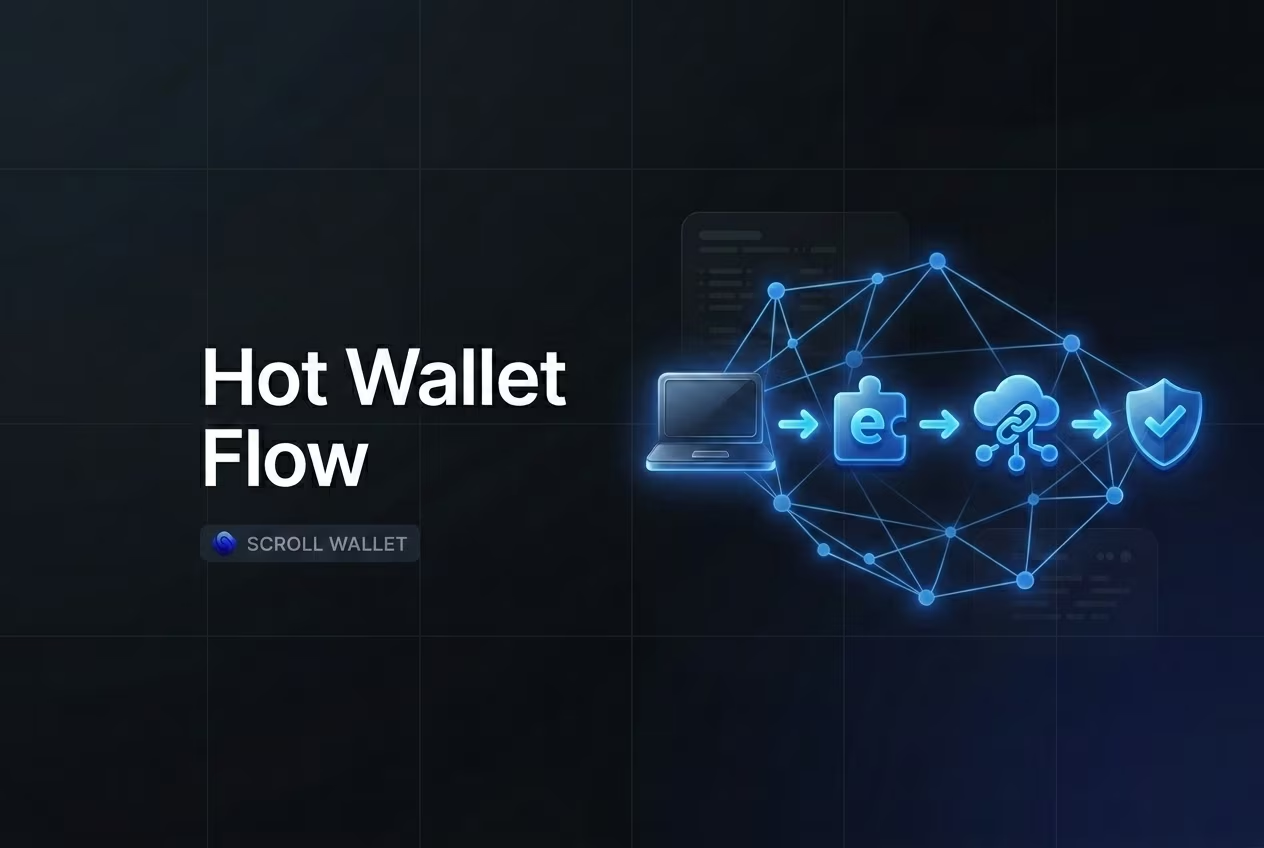
A hot wallet stays permanently wired to the internet; a cold wallet buries your private keys offline — and that single architectural choice determines everything about risk, speed, and real-world usability. When you open Scroll Wallet and sign a transaction in seconds, that's a hot wallet doing exactly what it was built to do. Keys accessible. Interface live. Network always within reach. That's the whole point — and the trade-off you accept every single time you connect.
What is a hot wallet, stripped to its technical core? Your private key — or a derivative of it — exists inside an environment that touches the internet. Full stop. That means a compromised device, a convincing phishing page, or one malicious smart contract interaction can potentially reach it. Cold storage flips the model entirely: the signing key lives on a hardware device or air-gapped machine that never sees a network. As the technical team at Chainstack makes clear in their breakdown of connected versus offline wallets, the real distinction isn't about which asset you hold — it's about where the private key gets exposed during the signing process. Cold storage closes that exposure window completely. The cost? Instant usability, gone.
The hot wallet vs cold wallet question is really a question about purpose. Hot wallets are built for motion — swapping tokens, hitting dApps, bridging across L2 networks, managing live positions. Cold wallets are built for stillness — holding assets you won't touch for weeks or months. In a multi-chain environment where users operate across Scroll, Ethereum mainnet, and a tangle of bridges simultaneously, a hot wallet like Scroll Wallet owns the operational layer. Cold storage owns the reserve layer. Most serious users run both, with hard rules about what moves where and when. No exceptions.
Cold storage explained without the jargon: generate a key offline, park it on a hardware device, bring it online only for the exact signing moment, then disconnect immediately. Nothing about that workflow supports daily DeFi activity — nor should it. Scroll Wallet exists for the opposite use case: fast, verifiable, multi-chain interactions where latency and friction carry real costs. We build the hot wallet layer to be as secure as an always-connected environment can reasonably allow — phishing detection, transaction simulation, clear risk signals baked in — but we're not pretending it replaces cold storage when long-term custody is the goal. Knowing which tool fits which job isn't advanced knowledge. It's the first decision every user should make before moving a single token.
Choosing between a hot wallet and a cold wallet involves a direct trade-off between immediate accessibility and maximum security. While hot wallets provide the speed necessary for daily on-chain interactions, cold wallets offer a physical air-gap to protect long-term reserves from remote exploits. We recommend a hybrid approach: use a hot wallet for active trading and a cold wallet for your primary savings.
| Feature | Hot Wallet (Software) | Cold Wallet (Hardware) |
|---|---|---|
| Connectivity | Always Online | Always Offline |
| Private Key Exposure | Stored on device/browser | Stored on physical chip |
| Transaction Speed | Instant / High | Manual / Slower |
| Security Level | Vulnerable to phishing/malware | Protected from remote attacks |
| Ideal Use Case | Daily trading & small amounts | Long-term storage & large holdings |
| Convenience | High (Mobile/Browser) | Low (Requires physical device) |
MetaMask keeps your private keys on device, full stop — they never touch a remote server, never leave your local environment, unless you manually export them yourself. Under the hood, a component called KeyringController handles all key material. In the browser extension wallet, your encrypted seed phrase and private keys sit in chrome.storage.local through a structure called this.store. Unlock the wallet, and the decrypted keys load into RAM via this.memStore — they exist only for the duration of your active session, then vanish the moment you lock up. The encrypted vault persists on disk. The working keys live in memory. Two separate realities, one architecture.
Mobile works differently, but the principle holds. On iOS, MetaMask leans on the system Keychain; on Android, it uses a combination of Android Keystore and SharedPreferences. Either way, a key derived from your password is required before anything gets decrypted. As WispWisp documents in their deep-dive on the KeyringController architecture, both the browser's chrome.storage.local vault and the mobile SecureKeychain storage confirm the same uncomfortable truth — MetaMask is a fundamentally local, hot wallet. Your keys never phone home. But they do sit on a device that's permanently wired to the internet. That distinction matters enormously.
Which brings us to the core trade-off. Because MetaMask runs hot, your private keys on device are always within arm's reach of the browser and the operating system — and that's precisely what makes dApp connectivity feel frictionless. Visit a decentralized application, and the browser extension wallet injects a Web3 provider directly into the page. The site requests a signature. Your keys sign locally. Only the signed transaction gets broadcast. The dApp never sees your private key. Clean, right? Except — if your device gets compromised through malware, a rogue browser extension, or a well-crafted phishing page, both the encrypted vault and the in-memory keys become live targets. This isn't a MetaMask flaw. It's the structural reality of every hot wallet ever built.
That reality should inform every decision you make about using a browser extension wallet or mobile crypto wallet for serious asset management. The one-click dApp signing experience carries a direct, non-negotiable dependency on the security of your local environment. At Scroll Wallet, we build on this same foundation of local key custody — then layer tighter controls around session management, transaction context, and live risk signals on top of it. Because knowing where your keys live isn't the finish line. It's the starting point. If you're holding real value on-chain, the question was never whether to use a hot wallet — it's how ruthlessly you limit its exposure surface.
MetaMask is beginner-accessible, but how safe it actually is depends almost entirely on you — not the software. As a non-custodial browser extension wallet, MetaMask hands you full control over your private keys. No company can freeze your funds. No one can reverse a transaction you didn't authorize. That independence is genuinely powerful — and genuinely dangerous if you don't know what you're doing. For anyone new to crypto wallet security, this is the one fact worth tattooing on your brain before you make a single move.
Here's the uncomfortable truth: most beginner losses on MetaMask aren't caused by software bugs. They come from entirely predictable human errors — sharing a seed phrase in a panic, blindly approving a malicious smart contract, or landing on a phishing site that looks pixel-perfect to the real thing. According to MetaMask's own security reporting, the threats hitting users hardest are phishing attacks and unauthorized token approvals — both of which exploit behavior, not code. The wallet itself is open-source and audited. It just can't protect you from your own decisions made inside it.
For beginners getting serious about crypto wallet security, three practices are non-negotiable — skip any one of them and everything else falls apart. First, your seed phrase goes on paper, stored offline. Not in a screenshot. Not in a cloud note. Not in a DM to yourself. Second, never approve token permissions on a site you didn't navigate to deliberately and verify yourself. Third, check the URL every single time before connecting your wallet — phishing domains are often one character off from the real address, and that one character will cost you everything. These aren't advanced precautions. They're the bare minimum for anyone using a self-custody wallet in 2026, when phishing infrastructure has become automated, scalable, and ruthlessly targeted.
So — is MetaMask safe for beginners? The honest answer is: it's exactly as safe as the environment you build around it. Out of the box, it has no built-in transaction simulation, no automatic revocation of risky approvals, no multi-layer authentication by default. More structured wallet products bake risk reduction directly into the user flow, so you don't have to manually catch every threat on your own. If you're new to self-custody, use MetaMask as your education — a hands-on way to understand how wallets actually work — while seriously researching which security features matter most for how you plan to use it.
Understanding the threat landscape is the first step toward securing your digital assets. While hot wallets offer convenience for daily on-chain activities, they are susceptible to specific attack vectors that require proactive defense strategies. We have categorized the primary risks and the corresponding technical measures you should implement to protect your funds.
| Security Threat | Risk Level | Practical Prevention Method |
|---|---|---|
| Phishing & Fake Alerts | Critical | Avoid clicking unsolicited links in emails or 2FA prompts; verify URLs for counterfeit login pages. |
| Malicious Smart Contract Approvals | High | Use revocation tools like ScamSniffer or revoke.cash to cancel unlimited token access. |
| Blind Signing | High | Enable EIP-712 human-readable signatures and use transaction simulation features. |
| iCloud Backup Exploitation | Medium | Disable cloud backups for sensitive wallet data to prevent credential phishing. |
| Seed Phrase Exposure | Critical | Never share recovery phrases; store them offline and avoid digital copies on infected devices. |
| Fake Browser Extensions | High | Only download software from official verified sources and check developer credentials. |
Securing a hot wallet requires a proactive approach to mitigate the risks of the modern on-chain environment. While we design Scroll Wallet to automate many safety checks, you must follow these essential steps to maintain the integrity of your MetaMask account and recovery phrase.
Hot wallets own the active crypto space — instant access, deep protocol reach, and zero hardware friction packed into one interface that cold storage simply cannot compete with when speed is the game. Need to execute a DeFi trade, claim a yield position, or bridge assets across L2 networks right now? A software crypto wallet is your only real option. Cold storage cannot move at the pace on-chain environments demand in 2026, where liquidity windows slam shut in seconds.
Fee structure is where most users get confused — and stay confused. Network gas fees are set by the blockchain itself, not by your wallet interface. But swap aggregation layers, service integrations, and card features? Those carry their own charges. As documented by the MetaMask Help Center, swap-related costs shift depending on operation type and live network conditions. The distinction matters more than people think: when you use an online crypto wallet, you pay the chain for raw execution and, separately, any platform for its routing convenience. Scroll Wallet puts those costs in front of you before you confirm — no nasty surprises, no balance shock after the fact.
The benefits of a hot wallet run much deeper than raw speed. A software crypto wallet hands you direct, permissionless access to DeFi protocols, NFT markets, DAO governance, and cross-chain bridges — all from one interface. That is precisely why adoption never shifted to hardware-only setups despite years of relentless security advocacy. Most active users juggle three to five networks at once. Running that complexity through a cold device creates workflow-breaking friction. An online crypto wallet cuts that friction entirely while keeping you in full control of your keys — as long as the architecture is non-custodial and your seed phrase never touches a server.
The trade-off is real. Do not minimize it. Because a hot wallet lives on an internet-connected device, it sits exposed to phishing attacks, malicious browser extensions, and compromised dApp front-ends. Not theoretical risks — wallet exploits and social engineering remain the top cause of fund loss heading into 2026. Scroll Wallet tackles this through transaction simulation, contract risk flagging, and explicit permission prompts before any approval gets signed. The goal was never to eliminate risk entirely — no wallet on earth can promise that — but to make every risk visible and every decision deliberate before you commit anything on-chain.
Hot wallets are built for action, not for safeguarding assets you intend to hold for years — and confusing the two is how people get wiped out. Every time a hot wallet touches the internet — signing a transaction, poking a dApp, bridging assets — it opens an exposure window. Small window. Real window. For daily trading, DeFi grinding, or gas management, that trade-off makes sense. For serious long-term holdings? It absolutely does not. No amount of slick UX changes the structural reality: any internet-connected wallet carries a fundamentally higher risk profile than a cold or hardware solution.
This is not abstract paranoia. Wallet exploits, phishing campaigns, and malicious contract approvals have drained billions across every major chain. The pattern never changes: users park too much value in hot wallets because it is convenient, and attackers know exactly where to look. The best wallet for security is the one that matches the storage method to the actual use case. Scroll Wallet is built around that principle — we treat the wallet as an active-use layer, not a vault. Holding assets for months or years requires architecture that reflects that reality. A hot wallet alone does not clear that bar.
Practically, the split is straightforward. Keep only what you need for near-term activity in your hot wallet — gas, pending trades, protocol interactions you plan to execute within days. Everything else moves to a colder layer. Long-term crypto storage demands a completely different threat model: no constant connectivity, no browser extension exposure, no approval surfaces sitting open to silent exploitation. Hardware wallets, air-gapped devices, multi-signature setups — all of these shrink the attack surface in ways software wallets structurally cannot replicate. Scroll Wallet integrates with these layers rather than competing against them. The goal is a complete security architecture, not a single point of control.
The discipline here has nothing to do with distrust of any specific product. It is about recognizing that crypto wallet risk scales directly with connectivity and approval surface. Scroll Wallet gives you the tools to manage active positions efficiently — but we are explicit about the limits of what any hot wallet should hold. Matching your storage method to your actual holding horizon is one of the highest-leverage security decisions you can make right now. And it costs exactly nothing to get right.
MetaMask is a self-custody wallet — it does not report your transactions to the IRS, does not generate tax forms, and does not track your cost basis. That burden is entirely yours. This flows directly from the non-custodial architecture: no third party holds your assets, so no third party files paperwork on your behalf. Every swap, transfer, bridge, or token sale you execute by signing wallet transactions is a taxable event under current US law. Every single one. The recordkeeping obligation lands squarely on your shoulders — not MetaMask's, not your broker's, yours.
In practice, this means maintaining your own transaction history across every chain you touch. MetaMask aggregates nothing for you. If you hit Ethereum mainnet, an L2 like Scroll, and a bridge in the same tax year, you are responsible for reconciling all three sets of records yourself. The MetaMask Help Center is explicit about it: users carry full tax obligations for their on-chain activity. The wallet is infrastructure — not a financial intermediary. That legal distinction has teeth. A custodial exchange like Coinbase issues a 1099. A non-custodial wallet like MetaMask or Scroll Wallet issues nothing.
The compliance gap is real — and it keeps widening. Multi-chain activity in 2026 means users are moving assets across L2s, hitting DeFi protocols, and signing transactions on multiple networks inside a single session. The volume of taxable events per user has exploded accordingly. Each interaction can trigger a capital gains calculation. Gas fees paid in ETH may qualify as deductible transaction costs — but only if you have records to back that claim. Third-party tools like Koinly, CoinTracker, or TokenTax can pull your wallet address and reconstruct your history, but they are only as good as the on-chain data they ingest. Garbage in, garbage out.
The custodial vs. non-custodial distinction is not a technical footnote — it is a compliance reality with real consequences. Scroll Wallet runs on the same non-custodial principle: we provide the interface and the infrastructure, but we do not hold your keys, we do not monitor your activity, and we file nothing on your behalf. What you gain is full control and genuine privacy. What you take on is full accountability. No shortcuts. If you are a US user, treat every on-chain action as a potential tax event from day one, keep tight records of acquisition dates and prices, and get a crypto-literate tax professional in your corner before you file. Self-custody is built for sovereignty — but sovereignty comes with the obligation to play by the rules of your jurisdiction.
MetaMask is a hot wallet — your private keys live in a browser connected to the internet, which makes it fast and convenient, but also structurally exposed to threats that cold storage never has to think about. That single fact should drive every decision you make about how much value you park there. MetaMask security hinges entirely on your browser environment, your device hygiene, and whether you've ever clicked "approve" on something you shouldn't have. The wallet itself controls none of those variables.
For active on-chain users — swapping tokens, hitting dApps, bridging across L2s — MetaMask works. But "works" and "safe by default" are two completely different things. Phishing sites, malicious contract approvals, clipboard hijacking — these aren't theoretical. They're hitting hot wallet users today. So the real question isn't whether MetaMask functions. It does. The question is whether it's the right tool for the amount of value you're moving and how often you're exposed to contracts you've never vetted before.
Hardware wallet pairing closes the most critical gap. Connect a Ledger or Trezor to MetaMask and your private key never touches the browser — signing happens on the device, physically isolated from whatever malware or malicious script might be lurking in your environment. That one architectural change eliminates the most common attack surface almost entirely. If you're holding serious assets and still signing everything through a software-only setup, that's not a security strategy. That's a risk configuration with a clean UI on top. Scroll Wallet is built around exactly this principle: the interface should be fast and readable, but the signing layer should be isolated from the network wherever possible.
Here's the honest bottom line — MetaMask is a legitimate entry point into Web3. It's not a complete long-term security solution on its own. If you're serious about self-custody in 2026, you need layered protection: a hardware device for signing, a wallet interface that shows you readable transaction data before you confirm anything, and a clear personal policy on what you approve and when. That's the standard Scroll Wallet builds toward. More importantly, it's the standard you should demand from any wallet before trusting it with real value.