Can You Send Bitcoins To PayPal? Direct Solution 2026 | Scroll Wallet
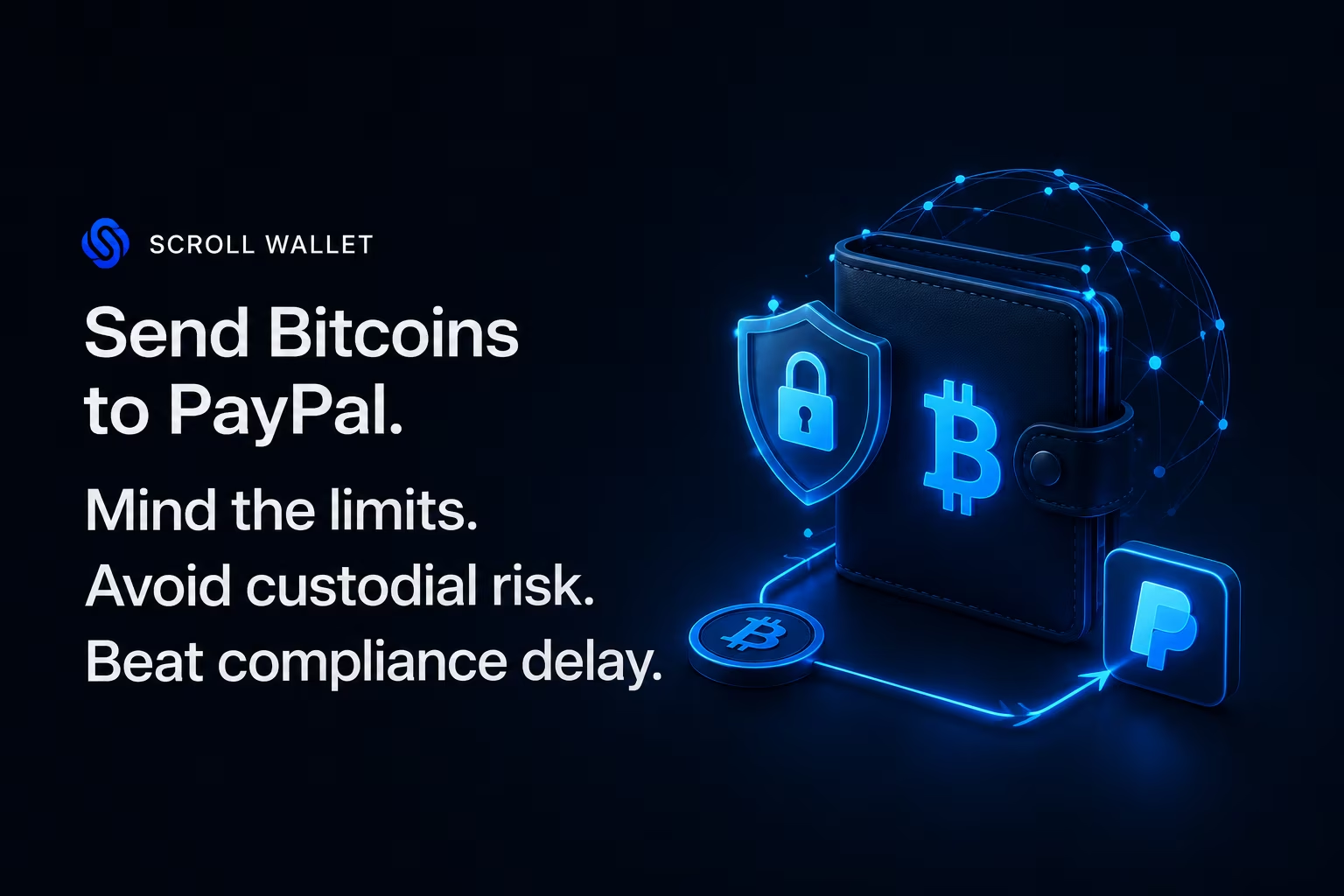
You can send Bitcoin to PayPal from external wallets, but the process is governed by strict custodial rules and a $25,000 weekly transfer limit. While the platform supports inbound BTC transactions, it enforces rigorous compliance checks that can delay funds for several days. Users must navigate a centralized environment where they do not control their private keys or transaction speeds.
PayPal holds your Bitcoin in a custodial account — you never touch the private keys until you deliberately push your crypto out to a self-custody address, and that single fact changes everything about how you should think about "owning" Bitcoin on the platform. You see a balance. You feel like you own it. But the Bitcoin sitting in your PayPal account? That's theirs, not yours — until you move it.
When you want to pull Bitcoin into PayPal from an outside source, the platform spins up a unique receive address for each transaction. Single-use, by design. Get the network wrong, skip a required memo field, fat-finger one character in the address — and the funds vanish. Permanently. PayPal cannot reach into the blockchain and pull them back. Nobody can. For outbound transfers, PayPal layers on identity verification before you can send BTC anywhere external. The transfer itself carries no PayPal fee — you absorb the Bitcoin network fee — but the floor is 0.001 BTC per send, and a rolling weekly ceiling of $25,000 USD caps your total movement. As PayPal Support US makes clear, the custodial flow governs everything: inbound address generation, outbound verification gates, and brutal compatibility requirements around external wallets.
Here's the uncomfortable truth about custodial platforms. They lower the barrier to entry — genuinely useful for newcomers — but the moment you move assets out, you face the exact same irreversible on-chain risks as any seasoned crypto user. The training wheels come off right when the stakes get real. PayPal supports BTC, BCH, ETH, LTC, and PYUSD for external transfers, but your crypto stays locked inside their system until you take deliberate, manual action to move it. It doesn't migrate on its own. It doesn't grow more accessible over time. It just sits there, behind their walls, under their rules.
Scroll Wallet exists precisely because those walls are a problem. PayPal's model is a closed loop — fixed limits, mandatory verification checkpoints, and a platform-level policy dictating what you can do with assets that are supposed to be yours. Scroll Wallet cuts the intermediary out entirely. Your keys, your assets, your control from the first moment — no weekly caps anchored to someone else's internal policy, no waiting for a platform to approve your own money moving. For anyone who wants transfers that are flexible, verifiable, and free from the structural constraints custodial platforms build in by design, self-custody through Scroll Wallet isn't just an alternative. It's the upgrade.
When choosing between a traditional fintech platform and a native Web3 infrastructure, you must weigh the trade-offs between centralized convenience and sovereign control. While PayPal provides a familiar interface, it operates as a custodial service where the platform retains ultimate authority over your assets and transaction data. In contrast, we designed Scroll Wallet as a non-custodial solution, ensuring you maintain exclusive access to your private keys and experience no artificial barriers when moving assets across the blockchain ecosystem.
| Feature | PayPal | Scroll Wallet |
|---|---|---|
| Custody Model | Custodial (Third-party) | Non-Custodial (Self-custody) |
| Private Key Control | Held by PayPal | Full User Control |
| Transfer Limits | Centralized Restrictions | No Protocol-level Limits |
| Conversion Fees | High (Spread-based) | Low (Network-based) |
| Privacy & KYC | Mandatory Identity Verification | Permissionless Access |
| External Flexibility | Limited to Approved Wallets | Full Multi-chain Compatibility |
PayPal's crypto support is real, narrow, and built around rules that will frustrate anyone expecting a genuine Bitcoin wallet. Inside the PayPal app, U.S. users can buy, hold, and sell BTC, ETH, LTC, and BCH — full stop. The catch is custody. PayPal holds the private keys. You hold a number on a screen. That is not the same thing, and the difference matters enormously once you try to actually move anything.
The restrictions snap into focus the moment you attempt a transfer. Moving Bitcoin out of PayPal to an external wallet address is not a simple, open operation — it runs through identity verification gates, eligibility checks, and hard limits on daily and per-transaction amounts. Not every user even gets access to the feature. The PayPal Legal Hub lays out exactly which actions are permitted, which require extra verification, and which are blocked outright. Worth reading before you assume anything is possible.
The deeper problem goes beyond transfer limits. PayPal's crypto environment is completely sealed off from Web3. No decentralized applications. No DeFi protocols. No cross-chain activity. The assets sit inside a regulated, custodial box engineered for fiat-adjacent transactions — not for on-chain work. If your goal is to move assets across chains, interact with protocols, or hold genuine self-custody, PayPal's architecture isn't just inconvenient. It's structurally incompatible with what you're trying to do.
That gap is exactly what Scroll Wallet is built to close. Direct asset control, flexible transfer logic, multi-chain compatibility — these aren't afterthoughts, they're the foundation. The confusion most users run into comes from expecting a payment platform to behave like a crypto wallet. Those are two fundamentally different products. Knowing which one you actually need is the only way to stop hitting walls.
To move Bitcoin to PayPal, you must navigate the interface between self-custody and a centralized fintech environment. While we prioritize the flexibility of Scroll Wallet for on-chain operations, transferring to PayPal requires strict adherence to their specific deposit protocols to avoid permanent loss of funds.
Bitcoin transfer fees answer to miners, not to whatever platform you're using — and that one fact alone makes small transfers a financial trap in most real-world scenarios. The moment you initiate a Bitcoin transaction, a miner fee gets attached to it. Non-negotiable. It's calculated in satoshis per byte of transaction data, and it moves with network congestion like a tide. During peak load, fees routinely clear $10–$20 per transaction. Do the math on sending $15 worth of Bitcoin. You're not transferring value — you're burning it.
Minimum transfer thresholds exist for exactly this reason. Most platforms enforce a floor somewhere between $10 and $50, because below that line the miner fee doesn't just bite — it devours. A small transfer can get deprioritized by the network entirely, sitting unconfirmed for hours, sometimes days. As CoinSpot points out, network fee behavior and conversion cost structures are the critical variables when evaluating any Bitcoin transfer route — especially when third-party platforms quietly stack their own processing margins on top of base miner fees.
Closed financial platforms make this worse. When a platform converts Bitcoin to fiat internally before processing your transfer, you absorb two costs simultaneously: the miner fee and a conversion spread — typically 1–3% — with zero transparency into the actual rate applied. Double cost. No visibility. This structure punishes small and mid-size transfers hardest. Scroll Wallet is built around the opposite principle: transfers route on-chain with full fee disclosure before you confirm anything. You see the exact Bitcoin transfer fees before the transaction is ever broadcast. No hidden conversion layers. No silent spreads.
The practical strategy for anyone weighing Bitcoin deposit options is blunt: batch smaller amounts into fewer, larger transfers when fees are elevated. Use a wallet that shows you real-time fee data instead of burying it. Scroll Wallet surfaces current network fee estimates at the moment you initiate a transaction, letting you choose between standard and priority confirmation speeds based on what the cost actually means to you. That kind of control simply doesn't exist inside closed-loop platforms, where fee logic is opaque, internal, and entirely on the platform's terms — not the open network's.
Understanding the technical boundaries of Bitcoin transfers is essential for protecting your assets. While standard peer-to-peer transactions are reliable, platform-specific restrictions and cross-chain incompatibilities can lead to delays or permanent loss. We have outlined the most common scenarios to help you navigate these risks effectively.
| Transfer Scenario | Likely Outcome | Technical Note |
|---|---|---|
| External Wallet Deposit | Success | Confirmed within minutes to hours depending on network congestion and fees. |
| PayPal Internal Transfer | Restricted | Limited to specific assets; direct external transfers are often blocked for most users. |
| Unsupported Asset Deposit | Permanent Loss | Sending non-Bitcoin assets to a Bitcoin address results in irreversible blockchain incompatibility. |
| High-Value Withdrawal | Delayed Processing | Increased security scrutiny may pause the transaction, though technical completion remains valid. |
| Scroll Wallet Transfer | Optimized | Broad asset support and fewer destination restrictions compared to legacy platforms. |
Compliance reviews are the real reason your crypto transfer on PayPal is sitting frozen — sometimes for a full 8 working days — and knowing the mechanics is the only way to plan around them. The moment you sell crypto or receive an inbound transfer, PayPal triggers mandatory AML screening and sanctions checks before a single dollar moves. Not optional. Not negotiable. Government regulations require every transaction above certain thresholds to be reviewed, and PayPal must complete that review within 72 hours on a clean case. Your account raises a flag? That window stretches.
Multiple conditions can throw your transfer into a hold. Unusual activity — patterns that break from your normal usage — tops the list of common triggers. Uncleared funds from a recent crypto purchase, a pending bank transfer, a first-time transaction at a new size: each one feeds the platform's automated risk scoring engine. According to PayPal US Help, holds tied to compliance reviews can stretch up to 8 days, while security reviews on withdrawals run anywhere from 2 to 72 hours depending on what tripped the wire. Large withdrawal amounts, a login from an unrecognized device, recent account changes — any one of these independently stacks a security review on top of the compliance check already in progress.
This layered review structure is a direct consequence of how custodial crypto platforms are built. PayPal holds your crypto on your behalf. You do not control the private keys. So every movement of funds runs through their internal compliance pipeline, no exceptions. PayPal's transfer limits are not just about dollar thresholds — they reflect the platform's risk tolerance at the individual account level. A user with a long, consistent history hits fewer friction points. Someone with irregular activity or recent account changes? Much rougher ride. The uncomfortable truth: you cannot reliably predict when a specific transfer will clear, because the review timeline depends on variables that are never fully visible to you.
Scroll Wallet operates on an entirely different architecture. You hold your own keys. There is no custodial compliance layer positioned between you and your assets. Transfers execute on-chain based on network conditions — not internal review queues. That does not mean zero friction; on-chain transactions carry their own confirmation times and gas costs. But the 2-to-8-day hold scenario that custodial platforms impose by design simply does not exist in a self-custody environment. If predictable, uninterrupted access to your crypto actually matters, the structural gap between custodial and non-custodial wallets is the single most important factor to evaluate before you decide where to keep your assets.
PayPal's custodial grip on Bitcoin is the whole story — and once you understand it, every restriction the platform imposes stops being a surprise and starts being inevitable. Hold Bitcoin inside PayPal and you are not holding Bitcoin. You are holding a ledger entry. PayPal keeps the private keys. You get a number on a screen. That single architectural fact cascades into everything: no external wallet transfers, no decentralized protocol access, every move you make filtered through compliance review, transaction limits, and eligibility rules that can change without your input.
The PayPal Legal Hub spells out the operational and legal boundaries in plain terms. Read it carefully and the picture becomes sharp fast. Custodial platforms are compliance-first by design — not by accident, not by negligence. That is a deliberate choice. But it means the moment your goal shifts from "I want price exposure" to "I want to actually move Bitcoin," the walls close in. Transfer windows. Geographic blocks. Identity verification thresholds. Platform-level freezes. These are not edge cases. They are built-in variables that will affect your funds at the worst possible time.
Non-custodial wallets shine hardest exactly where custodial systems break down. Control your own private keys and no policy document can delay your transfer. No approval layer. No account eligibility check. No dependency on whether a company's compliance team is having a busy week. Scroll Wallet is built on that principle directly — your assets connect straight to the blockchain, with no custodial layer inserted between you and the network. That is not a feature bullet point. That is the structural difference between owning Bitcoin and owning a claim on Bitcoin.
The conclusion experts keep landing on is blunt: custodial restrictions are a hard ceiling, and you will hit it. PayPal does one thing well — it onboards users who want crypto price exposure inside a familiar interface. Clean. Simple. Useful for that specific job. But move outside that narrow use case? Try to transfer Bitcoin across wallets, interact with Web3 infrastructure, or maintain real fund control in today's multi-chain environment — and custodial structure stops being inconvenient and starts being a genuine blocker. Scroll Wallet is built for the users who have already hit that ceiling and refuse to work around it anymore.
A crypto self-custody wallet is the only setup that gives you real Bitcoin control — no middleman holding your keys, no platform risk, no one who can freeze your funds at 2 AM on a Sunday. When you own your private keys, you are the sole authority. Full stop. No exchange suspension, no account review process, no third-party policy standing between you and your money. That is the foundational principle of Bitcoin wallet control, and it hits hardest in situations where speed, sovereignty, and censorship resistance are not optional extras — they are the whole point.
The clearest use case? Peer-to-peer Bitcoin transfers. Sending Bitcoin directly to another wallet address — a business partner, a developer getting paid for on-chain work, a counterparty in a DeFi protocol — a non-custodial wallet strips away every layer of friction a centralized platform loves to introduce. No daily limits imposed by someone else's compliance team. No identity verification gates on the receiving end. No settlement delays because a platform's processing queue decided your transaction could wait. The transaction hits the chain, the network confirms it, and that is the end of the story. Scroll Wallet is built around exactly this model: wallet-to-wallet transfers executing at the protocol level, not funneled through a managed account system that answers to its own rules first.
Self-custody gets even more critical when you are operating across multiple chains or touching smart contracts. The on-chain environment is fragmented — L2 networks, bridges, application-specific chains — and all of it requires a wallet that signs transactions natively without routing through a custodian that may not even support your target network. Custodial wallet? You are now on their integration roadmap. Waiting. With a non-custodial setup, you interact with any compatible network directly, no permission slip required. Scroll Wallet is designed for precisely this environment: multi-chain compatibility with user-held keys, so your Bitcoin wallet control extends across your entire on-chain footprint without asking anyone's approval at each step.
The trade-off deserves to be stated plainly, without sugarcoating it. Self-custody puts full responsibility for key management on you. No customer support recovery. No password reset. No insurance fund if your seed phrase disappears. This is not a Scroll Wallet quirk — it is the architecture of non-custodial systems by design, baked in at the foundation. What Scroll Wallet does provide is a clean, structured interface that actively reduces the operational risk of managing keys yourself: organized backup flows, transparent transaction signing, and zero hidden custody layers underneath. If you are ready to own that responsibility — genuinely own it — then a crypto self-custody wallet is not just a preference. It is the only configuration that delivers real Bitcoin wallet control, on your terms, with no asterisks.
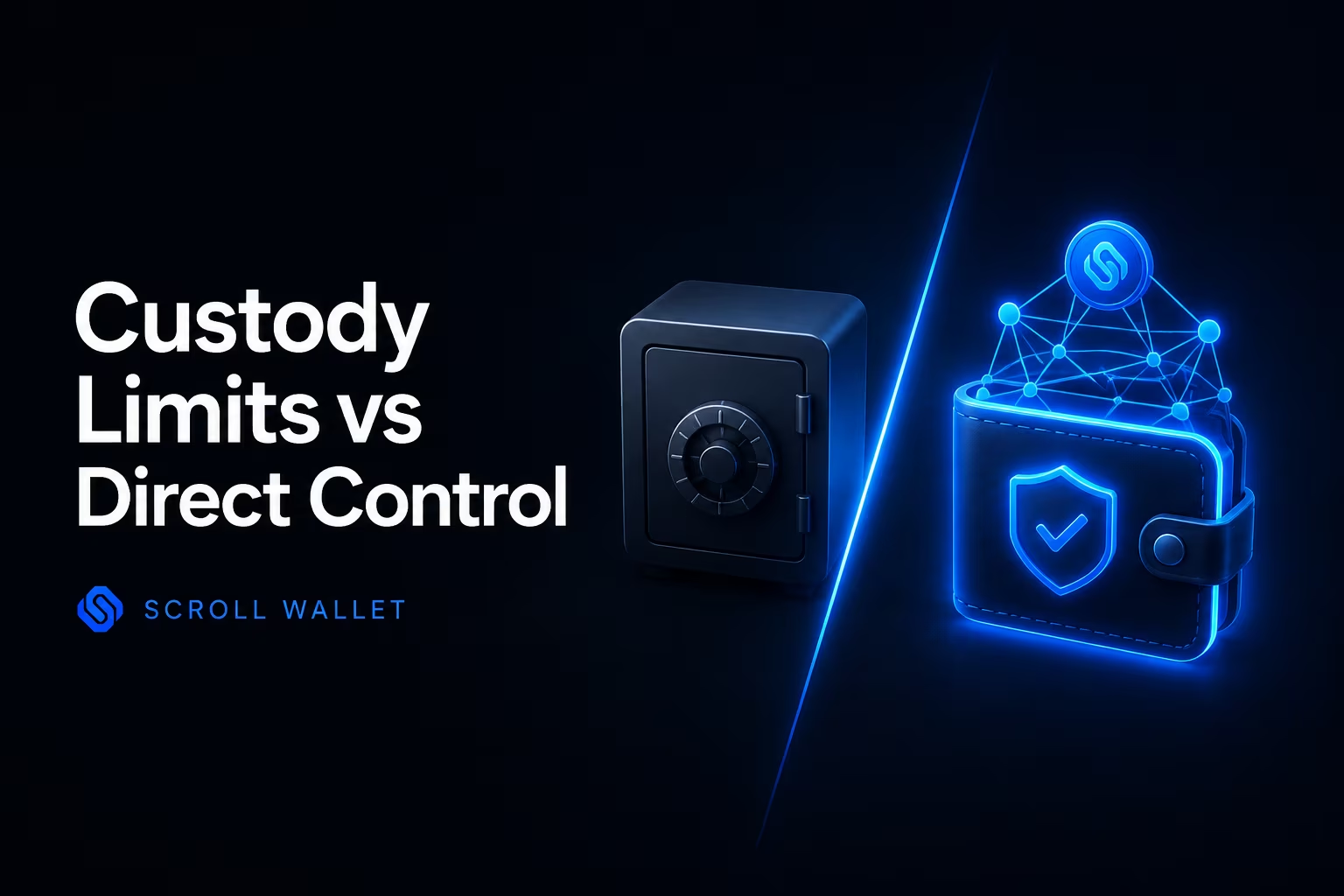
PayPal's Bitcoin functionality hits a hard ceiling fast — you can buy, hold, and sell within its walls, but the platform was architected for compliance, not for the kind of open, self-sovereign crypto experience most serious users actually want. Transfers to external wallets exist in select regions, sure. But they come loaded with eligibility gates, identity verification requirements, geographic restrictions, and a short list of supported assets. This isn't a bug. It's the product by design.
Here's the structural reality: PayPal holds your Bitcoin in a custodial setup. That means PayPal controls the private keys. Not you. Withdrawals to outside wallets are available only in certain countries, only for specific assets, and only once your identity checks clear. No cross-chain transfers. No Layer 2 support. No way to touch decentralized protocols directly from your balance. Every single action routes through PayPal's internal rails — which adds friction, removes optionality, and puts a wall between you and the actual blockchain.
For some users, that's fine. If you want exposure to Bitcoin as a financial asset inside a familiar, polished interface, PayPal delivers. Clean. Simple. Done. But the moment your needs expand — moving assets across chains, connecting to Web3 applications, maintaining real custody without an intermediary making decisions on your behalf — the architecture stops being a minor inconvenience and becomes the actual problem. Scroll Wallet was built for that exact situation: multi-chain by default, self-custody from day one, and a UX that doesn't bury complexity under a false sense of simplicity. The gap between these two tools isn't just technical. It's philosophical.
PayPal's crypto features work. Within a narrow, clearly defined box, they work well. But the box is the limitation. For anyone who needs real flexibility — direct on-chain access, transparent infrastructure, genuine asset control — that box becomes the defining constraint. Understanding exactly where those walls are isn't just useful context. In 2026, it's the only way to make a decision that actually matches how you use crypto.