Best Ravencoin Wallet: Secure Storage for RVN in 2026 | Scroll Wallet
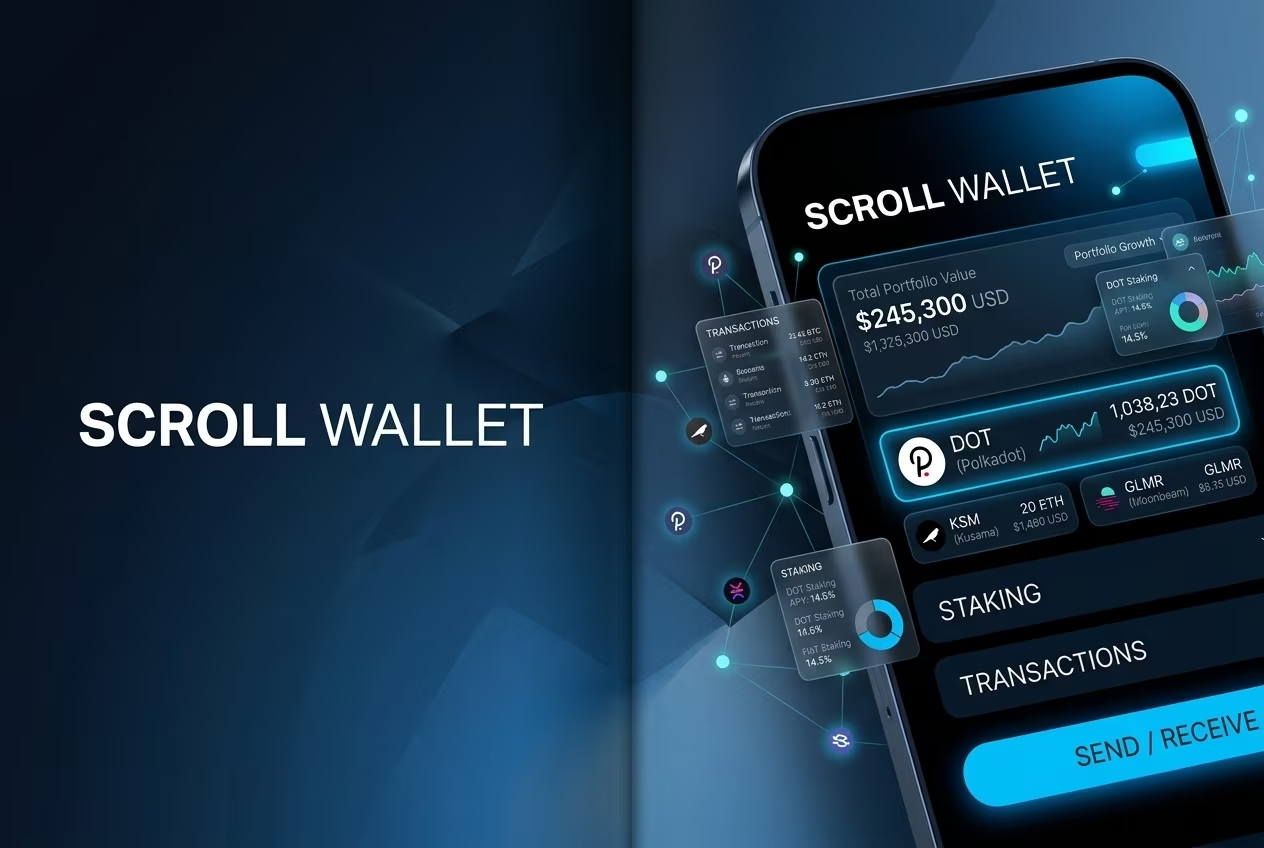
The best Polkadot wallet must provide a non-custodial gateway to the Substrate ecosystem while eliminating the technical friction of multi-chain management. As DOT holders in the USA face stricter security requirements, we prioritize verifiable self-custody and automated staking flows. Scroll Wallet replaces complex raw data with human-readable transactions, ensuring you maintain full control over your assets without navigating fragmented parachain interfaces.
DOT users are fleeing en masse from technical tools like Polkadot-JS to simple non-custodial wallets - because the convenience of the interface now directly decides whether a person will use on-chain functions at all or just give up. It's not a feeling, it's numbers. Nova Wallet: more than 80,000 active users per month. Mobile interface, staking, nomination pools, cross-chain transfers - and all this without the need to be a developer. Fearless Wallet and SubWallet follow the same path: intuitive design, zero extra steps, full control over your keys. No compromises. These are conscious product decisions - and they accurately reflect where the Polkadot ecosystem is heading in 2026.
The problem with old technical wallets was never security. The problem is the gap between what the user wants to do and what the interface allows him to do without error. Participating in governance, interacting with parachains, managing NFTs, accessing DeFi - each action requires several steps. When these steps are hidden in complex menus or require manual configuration, most people either get it wrong or just quit.CryptoPotato captures the same thing: wallets that will gain an audience in 2026 are those that combine simplicity with non-custodiality and staking. Nova Wallet with full staking stack and cross-chain support. Fearless Wallet with a clean interface and zero commissions. The signal is clear: people want a secure DOT wallet that does not require a developer degree to properly use.
At Scroll Wallet, we see this shift as a design requirement-not a trend. A wallet with self-custody of keys, which at the same time cannot guide you through cross-chain transfer or voting in governance, only solves the problem halfway. The on-chain environment of 2026 is fragmented: parachains, bridges, L2 infrastructure. Every touchpoint carries real risk. Phishing, incorrect address formats, failed transactions in complex multi-chain conditions are no longer rare cases. It's a routine. And the wallet UX is obliged to prevent it. We build flows that reduce the complexity of decisions without taking away control from the user. Because control without clarity is not security. This is vulnerability.
The biggest lesson from the 2026 Polkadot wallet landscape is simple: convenience and self-custody are no longer at odds. The wallets with the greatest reach are non-custodial, technically secure, and designed for people who want to manage DOT, vote in governance, and access DeFi without reading documentation. If you choose a wallet, ask yourself not only the question "does it store my keys?" Ask another: "does it help me use these keys correctly - every time, on every chain that I need." This is the standard we build to.
Choosing a Polkadot wallet requires evaluating how a provider handles self-custody, cross-chain complexity, and staking integration. In 2026, security and UX clarity are the primary benchmarks for protecting your DOT assets across parachains like Acala, Moonbeam, and Astar. We have compiled a comparison of the leading solutions to help you identify the infrastructure that fits your technical requirements.
| Wallet Name | Platform Type | Key Features | Best For |
|---|---|---|---|
| Nova Wallet | Mobile (iOS/Android) | dApp access via Metamask/Polkadot JS, 80k active users | Mobile-first users & beginners |
| SubWallet | Web / Browser | Supports 150+ networks, self-custody, nomination pools | Multi-chain power users |
| Talisman | Desktop / Web | Portfolio management, intuitive UX, staking support | Desktop asset management |
| Ledger | Hardware | Cold storage, emergency backup, hardware-level security | Long-term security (HODL) |
| Fearless Wallet | Mobile | Zero fees, advanced scam warnings, cross-chain transfers | Security-conscious traders |
Data source: CryptoPotato - Detailed comparison of Polkadot wallet features, staking, and security ratings
In any non-custodial DOT wallet, private key control is the only thing standing between you and a total loss - it decides whether you own your assets outright or just hold a promise from someone who might vanish tomorrow. With Scroll Wallet, your private keys are generated and stored exclusively on your device. No server holds a copy. No backend can push a transaction through without you. This architecture makes full asset ownership a technical reality, not a marketing slogan. When a centralized exchange freezes withdrawals or collapses overnight, your funds stay untouched - because they were never in that exchange's hands to begin with.
Seed phrase backup is where abstract ownership becomes something real and fragile. Your 12- or 24-word recovery phrase is the one and only mechanism that can restore access if your device is lost, destroyed, or stolen. Write it on paper. Store copies in at least two physically separate locations. Never photograph it. Never let it touch a cloud service. This isn't a precaution - it's the entire recovery model. There's no "forgot password" flow here. No support ticket. No second chance. Scroll's self-custody design places full responsibility for key material on the user from the moment the wallet is created. That responsibility cannot be outsourced, delegated, or undone.
Knowing how the architecture works means nothing if you don't understand what's actually hunting you. Phishing attacks targeting seed phrases have grown brutally sophisticated - fake wallet interfaces, malicious browser extensions, social engineering campaigns that impersonate support teams with alarming precision. Here's the blunt truth: Scroll Wallet has no support team that will ever ask for your seed phrase or private key. Ever. If someone contacts you claiming otherwise, you're already inside an attack. And when you're operating across Polkadot's multi-chain environment - parachains, bridges, cross-chain transfers - the risk surface multiplies. One malicious transaction approval on a single chain can send consequences rippling across every connected network.
The practical security baseline for any DOT wallet user collapses into three non-negotiable behaviors: confirm private key control never leaves your device, complete seed phrase backup before your first deposit, and verify every transaction destination address independently before signing anything. Scroll Wallet makes these steps visible and explicit - it doesn't bury them under abstraction. Full asset ownership only means something when you understand what it actually costs to maintain. The wallet builds the infrastructure. The security posture? That's built entirely by you.
Choosing a Polkadot staking wallet is not a routine setup, but a decision that directly determines how much control you have over your assets, how vulnerable you are to attack, and how efficiently you will collect rewards. Not all DOT-enabled wallets are created equal. Some sacrifice custody for the sake of convenience. Others give full self-custody, but hide the staking interface behind five layers of complexity. In 2026, as phishing attacks and exploits become more sophisticated, the gap between a well-designed wallet and a poorly protected one is measured in real losses - not hypothetical ones.
When evaluating a Polkadot staking wallet, keep four strict criteria in focus: self-custody of private keys, native staking support without third-party bridges, transparent selection of validators, and clear reward tracking. Self-custody means that your keys never leave the device and are not stored at a centralized service - this is not an option, but a prerequisite if you stake significant amounts of DOT. Native staking support is a direct connection to Polkadot's Nominated Proof-of-Stake (NPoS) system, without intermediaries that add counterparty risk. Transparency of validators is critical: your real income directly depends on who you nominate - their commissions, uptime history, presence of slashes. A wallet that hides this data or automatically selects validators without explanation robs you of the ability to make informed decisions. This is not a small thing. It's your money.
As Scroll notes, the design of a staking wallet should be built around user control and verifiable reward logic-not just a clean interface. It is this principle that underlies the approach to DOT staking in Scroll Wallet. Validator metrics are displayed directly during the nomination process. The estimated annual return is calculated based on the current network parameters. Unbonding periods - and on Polkadot they are 28 days - are shown explicitly before you confirm anything. 28 days is a real liquidity limitation. A wallet that doesn't report this until the transaction is confirmed is hiding important information from you. We consider this transparency a mandatory requirement for the product, not a bonus feature.
Beyond the basic mechanics of staking, look for wallets that operate in a multi-chain environment without forcing you to manage separate interfaces for each network. Polkadot's parachain architecture means that your DOT activity is increasingly intertwined with the assets and protocols of the wider ecosystem. A wallet that fragments this experience-requiring manual bridging, separate signature flows, or disparate reward dashboards-creates transaction costs and multiplies points of failure. When you stake DOT, you need a unified environment: bonded balance, active nominations, pending rewards, and unbonding queue, all in one place. It's not a matter of comfort. Fragmented UX in the context of staking is a risk factor.
Understanding the cost structure of the Polkadot network is essential for efficient DOT portfolio management. When you manage DOT assets, you encounter three primary fee components: a base fee for network inclusion, a length fee based on the transaction size in bytes, and a weight fee reflecting the computational complexity. We ensure transparency by utilizing interfaces that calculate these costs before you confirm any action, eliminating hidden service charges.
| Fee Component / Type | Estimated Cost (DOT/USD) | Description |
|---|---|---|
| Standard Transfer | 0.012 - 0.02 DOT | Typical network fee for a basic peer-to-peer transaction. |
| Average Network Fee | ~$0.60 | The mean cost across various transaction types on the relay chain. |
| Wallet Service Fees | $0.00 | Native interfaces like Polkadot.js do not add extra surcharges. |
| Fee Structure | Base + Length + Weight | The three-tier model used to calculate on-chain resource consumption. |
Usability isn't a nice-to-have feature anymore - it's the infrastructure layer that determines whether a wallet survives or gets abandoned mid-transaction. In 2026, with multi-chain routing, L2 fragmentation, and bridge interactions baked into everyday user flows, the gap between what wallets can technically do and what users can actually navigate keeps growing wider. Most wallets are built by developers, for developers. Meanwhile, the 20-to-55 demographic now makes up the majority of crypto participants - and they didn't come here to decode gas mechanics. When someone abandons a transaction because the interface left them guessing, that's not a UX problem. That's a security problem. Confusion breeds mistakes. Mistakes in self-custody are permanent.
The push for an easy to use wallet isn't about dumbing crypto down. It's about cutting the cognitive load that turns ordinary users into easy targets. Phishing works not because people are reckless, but because complex interfaces manufacture moments of uncertainty - and a malicious prompt slipped into that uncertainty looks completely plausible. A simple crypto wallet with clean transaction previews, readable addresses, and predictable confirmation flows eliminates those windows of doubt before they can be exploited. Scroll built its product philosophy around exactly this: simplifying complex crypto workflows isn't an aesthetic choice, it's a risk-reduction strategy.
A smooth wallet experience carries weight far beyond the interface itself. Every failed transaction, every cryptic fee structure, every ambiguous network selector - users don't blame the UI. They blame the protocol. They blame crypto. That's why at Scroll Wallet, UX architecture gets treated as infrastructure, full stop. Every flow is designed around a specific assumption: the user might be juggling multiple chains simultaneously, probably doesn't have deep gas intuition, and needs the system to surface only what actually requires their attention. Automated network detection, intelligent fee estimation - these aren't convenience features. They're mechanisms for reducing user-side risk at scale.
Here's the brutal reality of 2026: wallets that fail on usability aren't losing users to technically superior competitors. They're losing to clearer ones. Signing architecture, key management models, multi-chain compatibility - none of it matters if the user can't confidently push a basic transaction through. Adoption is gated by experience. Experience is gated by design decisions made at the infrastructure level. Scroll Wallet operates on one core premise: technical integrity and interface clarity don't get developed in sequence. They get built together, or one of them will eventually destroy the other.
Scroll Wallet is built with one goal in mind: to remove the friction that Polkadot users face when managing DOT staking, voting, and multi-chain transactions. Most wallets treat Polkadot as just another chain on the list - and offer universal interfaces that do not take into account the substrate architecture, nomination mechanics, or complexity of parachains. We went from the opposite: the logic of the product follows how Polkadot actually works, and not what a typical EVM wallet expects from it. The result is a direct path from setup to active staking. Without diving into the infrastructure for the sake of the right to just start.
When choosing a wallet for DOT staking, three things are considered: nomination management, unbonding period visibility, and reward tracking. Scroll Wallet displays all this in one interface. Active nominations, validator performance, expected rewards - without switching between tools and without reading raw blockchain data. The unbonding period on Polkadot is 28 days. This is a detail that regularly takes users by surprise. We show it explicitly before you initiate an unbonding - so that the decision is made with full understanding, and not after the fact.
Self-custody, ease of use, simplified asset management - these are the three principles around which the product is built and which hit exactly where most wallets fail Polkadot users. Self-custodial: Your keys never leave your device. Convenience: the interface does not assume that you have a development course behind you. Simplified controls: You're not going through five screens for an action that should take one tap. This is not a design preference. These are architectural decisions that directly impact how securely and efficiently you operate in a multi-chain environment where errors are costly and often irreversible.
Each Scroll Wallet feature solves a specific problem-no marketing ballast. Visibility of parachain assets solves the problem of fragmentation. Integrated voting solves the problem of users who hold DOT but never participate in decision making. A clear estimate of fees removes uncertainty about transaction costs in different relay chain and parachain contexts. If you switch from a universal wallet to one designed for the Polkadot architecture, the difference is felt in the first session. Not because the interface is more impressive. But because it stops requiring you to close the gaps that the wallet left open.
Selecting a secure environment for DOT staking requires a balance between technical sovereignty and operational simplicity. In the 2026 landscape of increased phishing risks and multi-chain complexity, we recommend following this checklist to ensure your assets remain under your control while maximizing rewards.
The most dangerous moment in any interaction with a wallet is when you sign something that you cannot read, and in the Polkadot ecosystem this happens more often than is commonly recognized. Blind signing is the leading cause of malicious approvals and loss of funds among DOT holders. When a wallet only shows the raw hash of a transaction instead of human-readable details, you are signing a document in a language you don't know. This is not an abstract threat - a documented UX failure that has already led to real losses in several DApps connected to Polkadot. Security starts with one simple right: see what you're authorizing before you click Confirm.
Staking is a separate category of risk. Less obvious, but just as destructive. The unbonding period in Polkadot lasts 28 days, and most wallets do not clearly communicate this until you commit your funds. Users regularly enter staking positions without realizing that their DOT will be locked, that rewards in some interfaces require manual claiming, and that the unbonding process itself requires several steps without automatic completion. Convoluted staking flows also hide something else: some DApps request excessive account access, and wallets that don't show this leave you vulnerable. Every permission and every timeline should be visible before the action - not after. As CryptoPotato notes, the best wallets for Polkadot are increasingly being evaluated precisely by their ability to provide transparency in the staking flow and eliminate UX failures that lead to poor transaction outcomes.
Poor transaction readability is the thread that ties all these risks together. The WYSIWYS principle - What You See Is What You Sign - is a basic standard that any serious wallet must comply with. If the interface shows a hash, a contract address, or an abstract action label instead of a clear description of what will happen to your funds, that's a red flag. Fake DApps and phishing sites exploit this gap: they rely on the user to approve a transaction that they are unable to interpret. Scroll Wallet is built on the position that the opacity of the signature is not an inconvenience of the interface. This is a security vulnerability. Each transaction through Scroll Wallet is displayed in a structured, readable form: destination address, amount, permission area - all before confirmation.
Three practical filters before approving any transaction with DOT. First: make sure the wallet shows human-readable transaction details, not just hashes. Second: Review the permission scope of any DApp connection and revoke access that is no longer needed. Third: clarify unbonding timelines and reward mechanics before entering a staking position-not during or after. These are not advanced practices. This is the minimum standard for responsible safety in 2026. The risks are real, the patterns are predictable, and the protection tools exist. The decision to use them is yours.
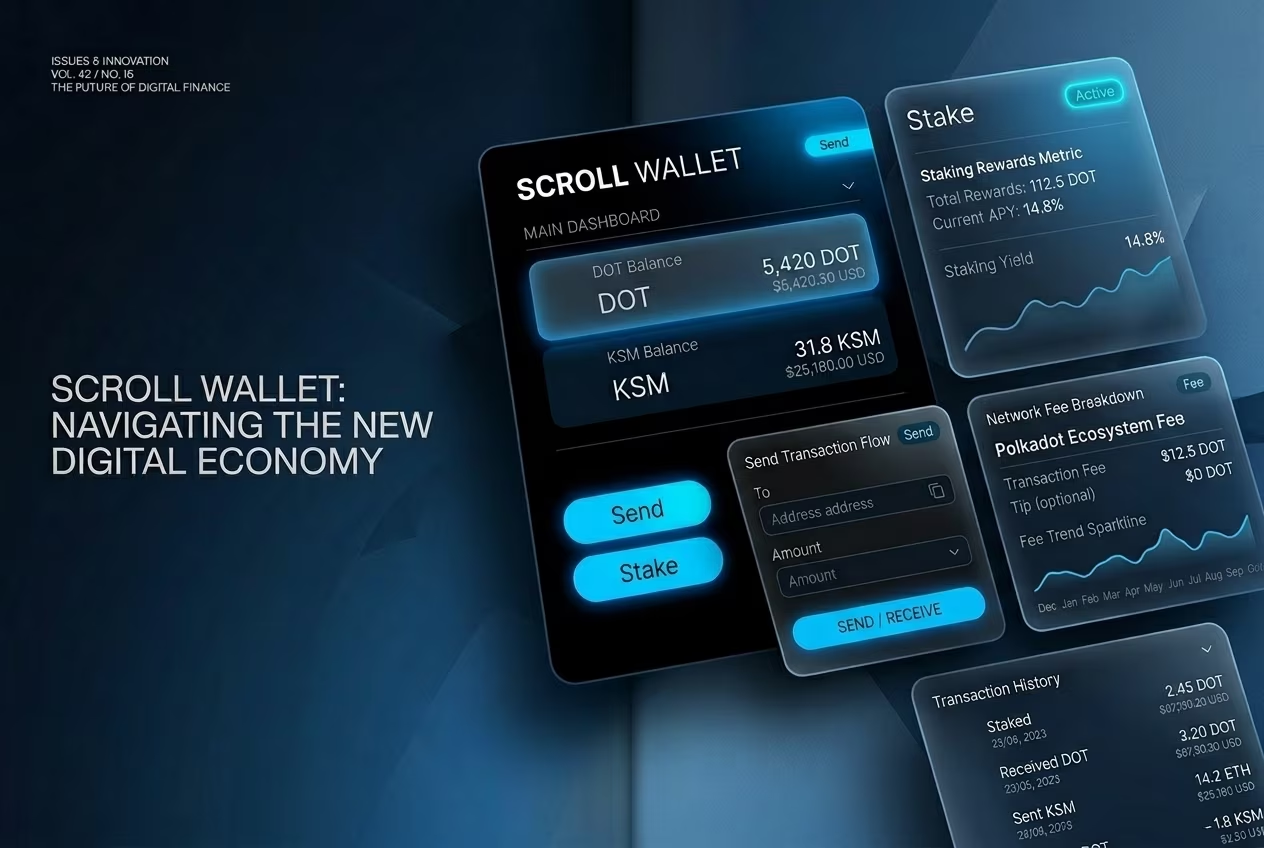
US users can legally stake DOT through a non-custodial wallet right now - but "legal" and "consequence-free" are two very different things, and the 2026 regulatory landscape will punish anyone who confuses them. The core principle is actually simple: when you stake through a self-custody setup, your private keys stay yours, your assets never touch a third party, and you interact with the Polkadot protocol directly. That distinction carries real legal weight. The SEC and IRS have consistently trained their crosshairs on custodial intermediaries, not on individuals doing on-chain staking through their own wallets. But here's the catch - the IRS still treats every staking reward as ordinary income the moment it lands in your address. No exceptions. No gray area.
This is where most people get comfortable and then get burned. A non-custodial wallet means no exchange filing reports on your behalf. No custodian smoothing over your compliance gaps. Every reward you earn through on-chain staking on the Polkadot network is a taxable event under current IRS guidance, and you need to capture the fair market value of that reward at the exact moment it hits your wallet. Not weekly. Not at year-end. At the moment of receipt. The IRS has already moved on enforcement actions against crypto holders who thought decentralization meant invisibility. It does not. Self-custody creates personal accountability - full stop.
Scroll Wallet is built around that reality, not around softening it. When you stake through Scroll Wallet, transaction details surface clearly so your recordkeeping stays clean and defensible. The wallet holds nothing for you, pools nothing with other users, and acts as no one's financial intermediary - and that structural clarity is precisely what keeps your activity outside the scope of most custodial regulations. Still, consult a crypto-specialized tax professional before you commit serious capital. State-level rules across the US vary more than most people expect, and the federal framework keeps shifting through 2026 in ways that can catch even careful stakers off guard.
The bottom line is blunt: non-custodial DOT staking works legally for US users, but only if you treat it with the same discipline you'd apply to any taxable investment. Track every reward. Know your cost basis. Drop the assumption that a decentralized protocol makes you invisible to tax authorities. Scroll Wallet hands you the infrastructure to stake directly and transparently. What you do with that infrastructure - and whether you document it properly - is entirely on you. That's not a flaw in the model. That's exactly what genuine self-custody means.
The best Polkadot wallet is not the one with the longest list of features, but the one that combines key self-custody, native staking, and an interface where you can't accidentally lose everything because of one wrong click. 2026 does not forgive mistakes. Phishing attacks, wallet exploits, and confusing multi-chain architecture - all this has turned the choice of a wallet for DOT from a household solution into an infrastructure security solution. Every wallet is a point of vulnerability. Every unverified interaction is a potential loss of funds.
Three criteria consistently separate a reliable tool from a risky one: a verifiable self-custody architecture, built-in staking without delegating risk to third parties, and a UX that minimizes human error at every step. A wallet that forces you to understand raw extrinsics or juggle several browser extensions in order to stake DOT is a product for developers, not for people. Scroll Wallet is built on the opposite principle: the complexity goes into the infrastructure, and you get a clean, predictable interface with auditable logic under the hood.
Self-custody means you hold the keys. But that also means you bear all the risk. This is why the best self-custody wallet is not the one that gives out a seed phrase and disappears. It provides structured prompts, clear transaction previews, and risk signals before you sign anything. As Scroll notes, the product positioning is built on this balance: ownership through self-custody plus design focused on convenience - without compromising on the security and transparency of on-chain actions.
Are you looking for a long-term DOT wallet? Look at three things: support for native Polkadot staking, transparent display of fees and validator data, operation without relying on a centralized intermediary for key management. Scroll Wallet implements these principles as product solutions - not as marketing talking points. The goal is simple: full control over your DOT, minimal margin for error, and participation in the Polkadot ecosystem - staking, governance, cross-chain transfers - that feels like confidence, not like walking through a minefield.