The Best Wallet for NFTs: Secure Viewing and Trading | Scroll Wallet
The best nft cold wallet is a dedicated hardware device that stores your private keys completely offline to prevent unauthorized digital access. In 2026, securing valuable collections requires air-gapped protection to shield assets from remote malware and phishing. While traditional hardware offers high security, we believe Scroll Wallet provides the best everyday balance for seamless NFT access and strong self-custody.
Offline NFT storage cuts off the single most reliable attack vector thieves use against high-value digital collections: the network connection itself. No internet means no malware extraction, no phishing capture, no remote exploit hunting for a signing key. That is the whole architecture of cold storage security in one sentence — key isolation is not a convenience feature. It is the hard boundary between a recoverable mistake and a permanent, irreversible loss.
The mechanics deserve a precise look. In a cold storage setup, the private key lives inside dedicated secure hardware — a chip physically cut off from any online environment. When you initiate a transaction, signing happens entirely inside that isolated space. Only the signed output travels back to your connected device. The key never moves. As Ledger Academy explains, housing private keys in a Secure Element chip isolated from internet-connected environments reduces remote attack exposure to near zero. Think about what that actually means: even if your computer is completely owned by an attacker, they still cannot sign a transaction without physically holding your hardware device.
For serious NFT protection, cold storage reshapes the entire threat model — from remote to physical. Remote attacks, which account for the overwhelming majority of wallet exploits, become structurally useless against it. You stop defending against an invisible adversary operating from anywhere on the planet and start defending a physical object — a problem most people already know how to handle. Current cold storage trends reflect exactly this shift, with hardware-based key isolation now treated as the baseline standard for protecting assets that actually matter. The honest trade-off? Access friction. Every transaction takes more deliberate steps. Daily interaction with your collection requires real effort, not a quick browser click.
That friction is precisely where the practical decision lives. Cold storage belongs with NFTs you are holding long-term and rarely need to touch. But for collectors who want genuine self-custody and the freedom to list, transfer, and use their NFTs day-to-day across Scroll's L2 environment — without the operational overhead that makes pure cold storage awkward for active use — Scroll Wallet delivers that balance directly. Real key control. No unnecessary friction. The goal was never to force a binary choice between security and usability. It was to make sure you understand exactly what each layer of protection does, so you can put your assets exactly where they belong.
Choosing between cold and hot storage is a fundamental decision for managing your digital assets. Cold wallets provide an air-gapped environment, keeping private keys entirely offline to eliminate risks from remote hacking and malware. This makes them the standard for secure NFT storage when dealing with high-value, long-term collections. However, for active trading and daily dApp interactions, Scroll Wallet offers a streamlined self-custody experience that balances accessibility with modern security protocols.
| Feature | Cold Wallet (Offline) | Hot Wallet (Online) |
|---|---|---|
| Security Level | Maximum (Air-gapped) | Standard (Internet-linked) |
| Primary Use Case | Long-term holding | Daily trading & dApps |
| Signing Exposure | Zero online exposure | Risk of phishing/exploits |
| Transaction Speed | Slow (Manual steps) | Instant (One-click) |
| Accessibility | Requires physical device | Mobile/Browser based |
Data Source: Bitget Web3 — Hot vs Cold Wallet Security Comparison and Setup Guide
The four things that actually make or break an NFT hardware wallet: the security chip, how it signs transactions, screen quality, and whether it fits your real life. Get all four right and you have a genuine defense against phishing, supply-chain attacks, and blind-signing exploits that have drained collector wallets throughout 2025 and 2026. Miss even one, and the gaps show up exactly when you can least afford them.
Start with the chip. A dedicated Secure Element — the same certified hardware living inside passports and banking cards — stores your private keys in physically isolated memory rated under Common Criteria standards, typically CC EAL5+ or above. That certification means the chip resists physical probing, side-channel attacks, and fault injection. Without it, keys sit in general-purpose memory that moderately skilled attackers can extract with off-the-shelf tools. For anyone holding a collection worth thousands of dollars, this is not a nice-to-have. It is the floor. Pair that requirement with a thorough read of the hardware wallet security guide to see exactly how chip-level isolation maps to real attack scenarios in the wild.
Now, offline signing. Cold storage earns its name by keeping the signing environment completely disconnected — no live USB handshake, no Bluetooth channel that malware on your host machine can intercept. The device signs internally, then passes only the finished signed output back via QR code or SD card. Your computer never touches the signing operation. Even a fully compromised machine gets nothing useful. That architecture is the strongest available protection against remote key extraction for high-value NFT transfers. And screen quality ties directly into this: a display that renders the full contract address, token ID, and recipient in crisp, readable text lets you verify exactly what you are approving before you press confirm. Blind signing — where the device rubber-stamps an unreadable payload — remains one of the leading theft vectors in 2026. A small, blurry screen is not a minor inconvenience. It is an attack surface.
Mobile compatibility closes the loop on practical security. A device locked to desktop-only software creates friction. Friction pushes users toward shortcuts. Shortcuts break cold storage discipline entirely. Look for WalletConnect v2 support or direct Bluetooth pairing with audited mobile apps — so you can review and approve NFT transactions from your phone without ever bypassing the hardware layer. Scroll Wallet is built around exactly this reality. The interface keeps NFT private key security intact while removing the friction that causes people to abandon cold storage habits altogether. Because here is the hard truth: a secure device you stop using protects nothing.
Protecting high-value NFT collections requires a clear understanding of the hardware market. Cold storage acts as a physical barrier against online exploits by keeping your private keys entirely offline. While these devices provide maximum security for long-term holding, you should weigh the initial investment against the specific features required for modern on-chain interactions in 2025–2026.
| Market Segment | Price Range (USD) | Key Features & Hardware Specs |
|---|---|---|
| Entry-Level | $50 – $120 | Basic cold storage for major NFTs, USB connectivity, simple monochrome screens, and physical button navigation. |
| Premium / Pro | $150 – $300+ | EAL5+ certified secure elements, color touchscreens, Bluetooth/wireless support, and advanced on-device metadata display for transaction verification. |
| Specialized Bundles | $300+ | Multi-sig integration, high-end physical build quality, and dedicated DeFi/DApp optimization for complex ecosystem interactions. |
Data Source: NerdWallet — Hardware wallet pricing and feature trade-offs
Web3 self-custody is completely legal in the United States — but the IRS doesn't care how decentralized your wallet is when tax season arrives. Holding assets in Scroll Wallet means you're exercising a legitimate right: controlling your own private keys, answering to no custodian, no platform, no middleman. That's real financial sovereignty. The catch? No exchange files your taxes for you. NFT sales, swaps, even certain transfers — all taxable events under IRS rules. Tracking cost basis, holding periods, realized gains — that's on you, entirely.
The regulatory walls are closing in. As OpenExO highlights, the IRS Form 1099-DA rollout is reshaping how brokers report digital asset activity to the federal government. Self-custody wallets, though, are not brokers. They report nothing on your behalf. Zero. That means every wallet address you control, every NFT mint, every sale, every trade, every bridge transaction across L2 networks like Scroll — all of it needs to be logged manually, with timestamps, USD valuations at the moment of the event, and counterparty details where you can get them.
True NFT ownership protection goes far deeper than just holding private keys. It means proving provenance. Documenting acquisition costs. Demonstrating an unbroken chain of custody if the IRS or a court ever comes knocking. Scroll Wallet gives you full on-chain visibility into your transaction history — but it won't generate tax reports or calculate your liability automatically. For that, you need a dedicated crypto tax tool: Koinly, TaxBit, CoinTracker. Import your wallet address, let it reconstruct your taxable activity, and don't be surprised by what surfaces. This isn't a Scroll Wallet limitation. It's how self-custody works across the entire Web3 ecosystem.
The practical framework is simple. Use Scroll Wallet for secure, accessible NFT custody and daily on-chain activity. Run tax tracking as a separate, parallel workflow — not an afterthought. Sync or export your wallet activity at least quarterly. Record every NFT purchase price in USD, not just ETH, because the IRS calculates gains in dollars and doesn't care what the ETH price was doing. Operating across multiple chains or using bridges? Document every step — cross-chain moves generate taxable events that are embarrassingly easy to miss. Self-custody hands you sovereignty over your assets. Tax compliance is the price of that sovereignty. Pay it deliberately.
Securing high-value digital assets in 2026 requires a disciplined approach to minimize exposure to automated drainers and phishing exploits. While cold storage provides an essential layer of isolation for long-term holdings, integrating it with your daily workflow ensures you maintain control without sacrificing liquidity.
Blind signing is the single most dangerous trap in NFT ownership right now — and recognizing it is how real NFT theft prevention actually starts. It happens when your wallet throws up an unreadable wall of hex data or a vague "sign message" prompt, leaving you with zero visibility into what you are authorizing. You tap confirm thinking you are minting one piece or listing a single item. What you may have actually signed is a contract granting a third party full control over every asset in your wallet. Not a theoretical scenario. A documented, repeatable attack pattern that has emptied entire collections in one transaction.
The mechanism behind most of these attacks is a function called setApprovalForAll. A malicious DApp encodes this call inside a hashed contract interaction, and your wallet surface shows nothing useful — just a string of characters nobody can parse on the fly. As Lightspark notes, blind signing means authorizing transactions without seeing the full data on a trusted display — and when DApps push hashed contract calls that users approve without understanding the details, malicious contracts can move digital assets freely. One approval. That is all it takes. The attacker never needs your seed phrase. They need one moment of confusion at the confirmation screen. For phishing protection for NFTs, this reframes the threat entirely — it is not always a fake website. Sometimes it is a real DApp carrying a hidden payload inside a prompt that looks completely legitimate.
Safe NFT management means treating every unreadable contract interaction as a live risk until proven otherwise. Three rules, no exceptions: first, never approve a transaction your wallet cannot decode and display in plain language; second, verify the contract address against the official project source independently before signing anything; third, revoke token approvals on a regular schedule using on-chain tools, because permissions you granted six months ago may still be sitting there, wide open. Scroll Wallet is built around one core principle — users should never be forced to approve what they cannot read. Decoded transaction data is surfaced wherever the contract is verifiable, so you see the function name, the approval scope, and the contract address before you commit to anything. For a deeper look at how wallet architecture shapes your exposure, read our guide on secure NFT storage.
The practical rule for phishing protection for NFTs is brutal in its simplicity: if you cannot read it, do not sign it. Blind signing should be off by default in any wallet you trust with a serious collection. When a DApp demands a signature you cannot verify, that is your signal to stop completely — research the contract independently, confirm the approval scope, and only then decide. Scroll Wallet enforces this as a default posture. Not a restriction. A design decision that reflects how aggressive collection-drain attacks have become in 2026. Self-custody means you hold the keys, yes — but it also means you are the last line of defense. Clear transaction data is not a convenience feature. It is the foundation of responsible NFT theft prevention.
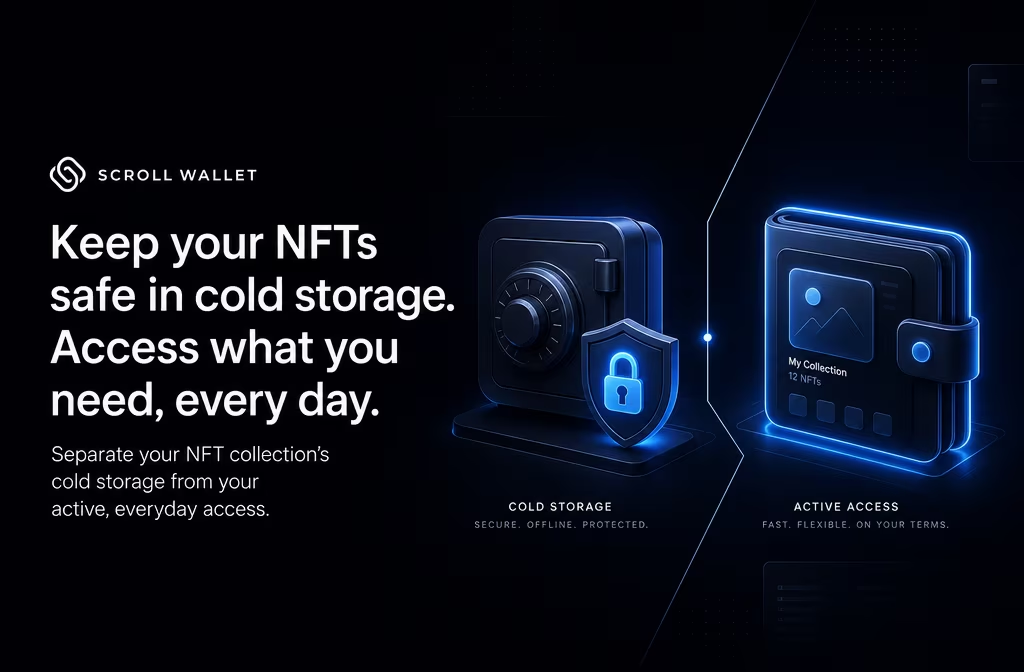
Cold storage is the vault layer every serious NFT collector needs — and skipping it for high-value holdings is how people lose everything overnight. When your collection represents real money, keeping private keys completely offline cuts out the biggest attack surface in existence: internet-connected exploits, phishing redirects, and malicious contract approvals that can drain a wallet in under sixty seconds. A dedicated hardware wallet security guide covers the exact process of isolating signing operations from any live network — and that isolation is the entire point of cold storage architecture.
For collectors holding genuinely valuable digital assets, offline protection functions as a true vault. Your NFTs stay on-chain, but the private key authorizing any movement of those assets never once touches an internet-connected device. Why does this matter so much? Because the overwhelming majority of NFT theft in recent years has had nothing to do with blockchain-level exploits. It came from compromised signing environments, rogue browser extensions, and social engineering attacks that manipulate users into approving transactions they never intended to sign. A private wallet operating in air-gapped signing mode eliminates that entire category of risk in one move. The trade-off is friction — every transaction demands a physical confirmation step. For long-term holdings you rarely touch, that friction is not a bug. It is the feature.
Serious digital collectible security runs on layers, and the smartest approach separates strategy by use case. Assets you plan to hold for months or years belong locked in cold storage. Assets you actively trade, display, or deploy in on-chain applications need something different — a solution that keeps accessibility high without surrendering self-custody. That gap is exactly what Scroll Wallet fills. Built for the everyday interaction layer, Scroll Wallet handles dApp connections on Scroll's L2 infrastructure, manages approvals through clear transaction previews, and maintains full self-custody without demanding a hardware device for every single action. Keys stay local. They never touch third-party servers. Control stays with you, and usability does not get sacrificed to get there.
The practical security recommendation and the product philosophy point to the same place: cold storage for your most valuable, least-touched NFTs — Scroll Wallet as your active interface for everything else. You get genuine self-custody depth alongside the UX speed that real on-chain activity demands. Scroll Wallet's signing flow surfaces risk signals before you confirm anything, flagging unusual contract interactions, unverified collections, and high-permission approval requests before they become problems. That combination of transparency and control makes Scroll Wallet the sharpest everyday tool for collectors who want serious digital asset security without wrestling with hardware confirmation on every single click.
Your storage choice for high-value NFTs isn't a preference — it's the single variable that separates a secure collection from a compromised one, especially as wallet exploits and phishing infrastructure grew dramatically more sophisticated through 2026. Any serious collector faces the same fundamental tension: lock assets down hard for long-term protection, or keep them accessible enough to actually use. These two goals fight each other constantly. Understanding that friction is not a bug — it's the whole game.
Keeping private keys completely offline means no remote attacker can reach them. No browser exploit, no rogue dApp, no poisoned RPC endpoint gets anywhere near your signing material. For NFTs you plan to hold untouched for months or years — blue-chip generative pieces, high-floor collections, assets tied to long-term on-chain identity — that level of isolation makes real sense. But the trade-off bites hard. Every single interaction demands a physical device, a manual signing step, a deliberate workflow. Active in mints? Flipping on secondary markets? Bridging across chains under time pressure? That friction stacks up fast, and rushed manual processes are where costly mistakes happen.
That gap is precisely what Scroll Wallet's self-custody architecture was built to close. Running on Scroll L2 infrastructure, keys never leave your device. Transaction signing happens locally. No custodial intermediary sits between you and your assets — none that can be compromised, none that can quietly disappear. Security enforced at protocol level, not outsourced to a third party hoping it stays solvent. For collectors who need to hit NFT marketplaces, bridge assets, or catch time-sensitive drops without a five-step hardware ritual, this architecture delivers genuine self-custody without the operational weight of a fully offline setup.
The sharpest approach for most collectors right now is tiered. Cold storage handles your highest-value, lowest-activity holdings — the pieces you're not touching for a year. Scroll Wallet handles everything that requires real on-chain engagement. Verifiable self-custody. A clean, transparent signing flow. Native compatibility with the Scroll ecosystem. Speed when you need it, control you never have to sacrifice. That's not a compromise — that's the design. Scroll Wallet exists for collectors who refused to accept that security and usability have to be enemies.
Where your NFT private keys live determines everything — and getting that wrong, even once, can cost you a collection you spent years building. Cold storage pulls those keys completely offline, cutting off phishing attacks, browser exploits, and compromised dApps at the root. For collectors holding high-value pieces that rarely move, offline key management strips away the largest attack surface in one move. The trade-off is real, though. Access slows down. Interaction gets complicated. Anyone actively minting, browsing listings, or signing transactions across L2 networks will feel that friction fast.
So the choice stops being theoretical pretty quickly. High-value assets that sit untouched for months? That is exactly what offline key management was built for. But serious collectors also live on-chain — claiming drops, bridging across networks, engaging with communities, moving fast when a good listing appears. That layer of daily activity needs a wallet that is transparent, responsive, and built on infrastructure you can actually verify. A self-custody wallet designed for real web3 environments handles all of that without making you trade usability for control.
For collectors who want genuine self-custody without managing offline devices for every single interaction, Scroll Wallet is built precisely for that gap. It gives you direct key control while supporting the multi-chain, L2-native environment where NFT activity actually happens right now. The architecture is built around one principle: self-custody should not demand technical expertise to maintain safely. Clear transaction previews, phishing detection, straightforward key management — none of that is a bolt-on feature. It is the foundation.
The strongest NFT security strategy is not one product. It is a layered approach. Offline key management for your highest-value, lowest-frequency assets. Scroll Wallet as your active self-custody layer for everything else. That combination delivers the security depth serious collectors need and the practical speed that daily on-chain participation demands. The goal is not to eliminate risk — that is simply not possible. The goal is to match your security architecture to how you actually use your collection, and to make sure every layer you rely on is one you genuinely own.