Can You Send Bitcoins To PayPal? Direct Solution 2026 | Scroll Wallet | Scroll Wallet
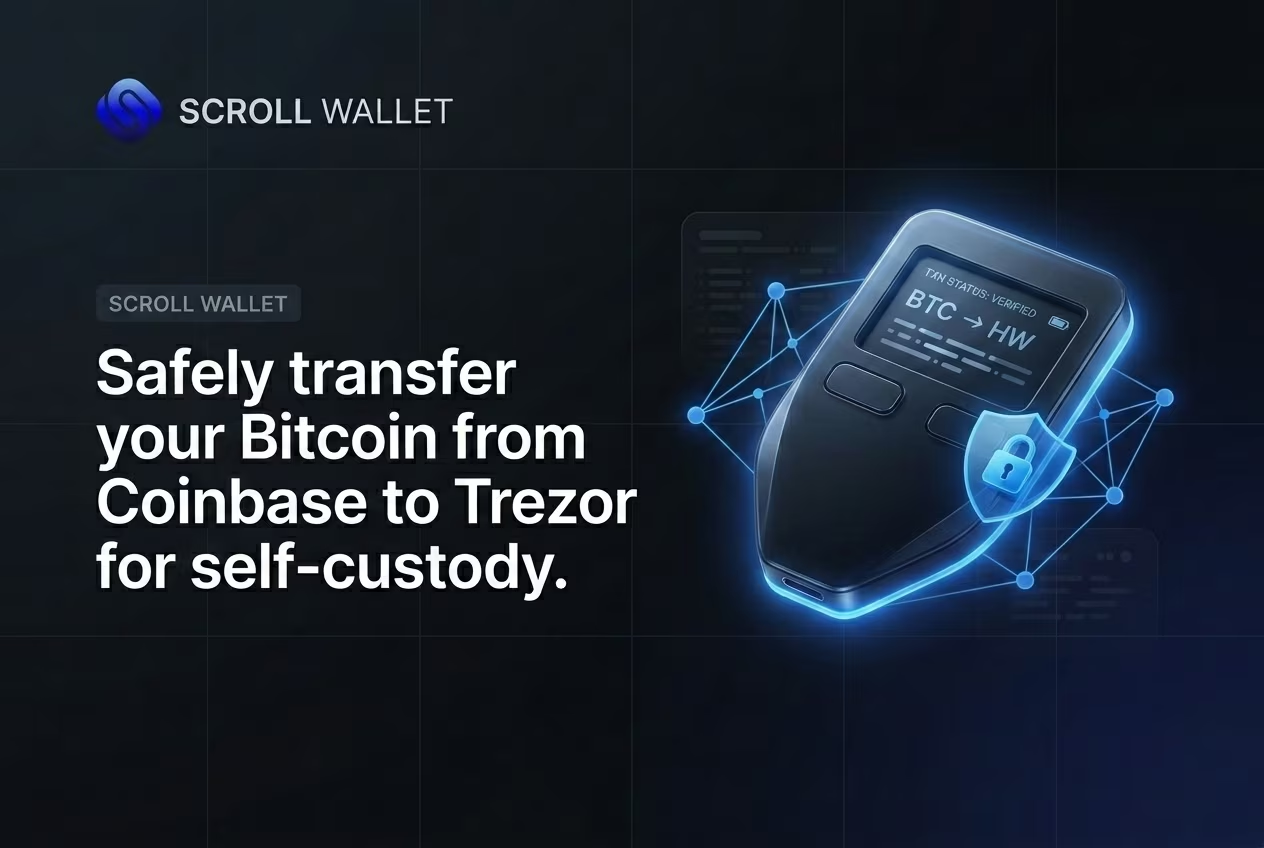
Moving your Bitcoin from Coinbase to a self-custody wallet like Trezor or Scroll Wallet is the only way to ensure total ownership of your digital assets. While centralized exchanges provide convenience, they remain vulnerable to regulatory freezes and insolvency. By transferring funds, you eliminate third-party counterparty risk and gain full control over your private keys in an increasingly complex 2026 financial landscape.
Moving assets from a centralized exchange to self-custody requires a systematic approach to eliminate common points of failure. Before initiating any transaction, follow this technical checklist to ensure your environment is secure and your hardware is ready to receive funds.
Moving your assets from a centralized exchange to self-custody is a critical step in securing your financial sovereignty. To ensure a successful transfer of Bitcoin from Coinbase to your Trezor hardware wallet, follow these precise technical steps:
For detailed technical nuances regarding the correct receiving flow and exchange-specific settings, refer to the Trezor — Official guide for moving funds from Coinbase to Trezor.
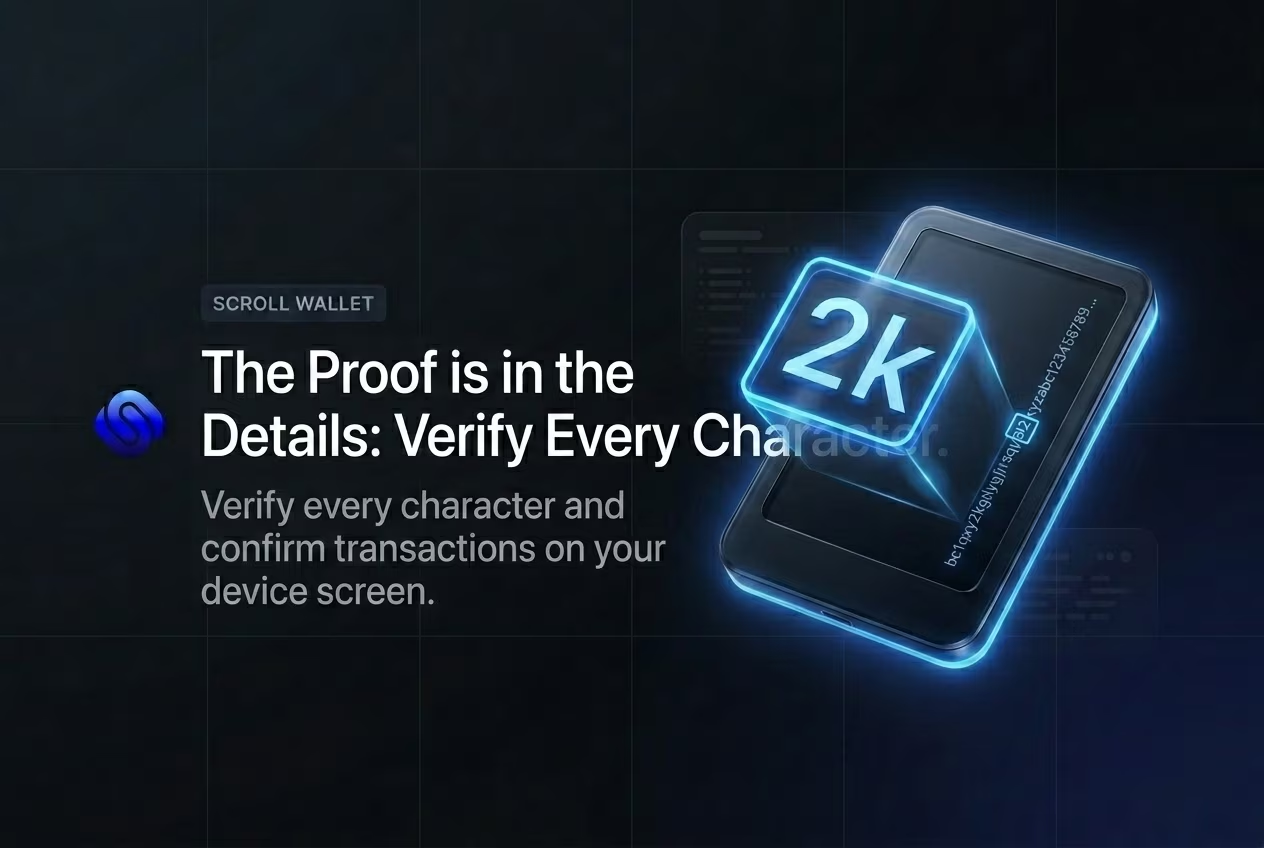
Moving assets from a centralized exchange like Coinbase to a hardware wallet requires a disciplined approach to avoid permanent fund loss. We recommend following this structured checklist to ensure your transaction is processed securely on the correct network.
| Action Item | Verification Step | Reasoning |
|---|---|---|
| Device Setup | Unlock Trezor & Suite | Ensures the hardware bridge is active and the correct account is selected. |
| Address Match | Compare first/last 4 chars | Prevents "address poisoning" or clipboard malware from altering the destination. |
| Network Selection | Select "Native" Network | Critical: Using Base or Optimism for BTC/ETH may result in lost funds if the wallet isn't configured. |
| Test Transaction | Send $10–$20 first | Confirms the path is valid before committing the full balance. |
| Fee & Confirmation | Check TXID on Explorer | Standard settlement takes 10–60 minutes; verify status via mempool.space. |
Three checks stand between your BTC and a permanent, unrecoverable loss — skip any one of them and no support team on earth can help you. Bitcoin transactions don't have an undo button. Once broadcast, a misdirected transfer is gone. Forever. Coinbase to wallet transfer safety isn't something you think about after the funds disappear — it's a discipline you practice before you ever click "Send."
The first check — and the one that kills the most transfers — is the network. Bitcoin must travel on the Bitcoin network. Not ERC-20. Not BEP-20. Not some wrapped-token workaround. Sounds painfully obvious, right? It isn't, once you're staring at a multi-chain interface where your BTC address looks suspiciously similar to an Ethereum address. The team at Trezor has documented network mismatches as one of the leading causes of lost funds during exchange-to-wallet transfers — their official guidance exists precisely because this mistake is brutally common. In Scroll Wallet, the network selection is surfaced explicitly at the confirmation step, so you can verify it before the transaction is ever signed.
The second check is address verification — and doing it on-screen alone is not enough. Clipboard malware is real, active, and running quietly in the background on more machines than anyone wants to admit. A malicious script can silently swap your copied wallet address for an attacker's address in the fraction of a second between copy and paste. You won't see it happen. The only reliable defense is character-by-character verification, ideally on a hardware device display that has zero contact with your browser environment. Scroll Wallet's confirmation flow is built to surface the full destination address at the signing step — a final, deliberate checkpoint before any funds move.
The third check is the test transaction. Send a small amount first. The minimum the platform allows. Then wait. Confirm it lands in the destination wallet before you touch the full balance. One small fee, one small transfer — and in exchange, you get on-chain proof that the address is correct, the network is right, and the withdrawal flow actually works end to end. Once that test amount appears, you know the full transfer follows the same verified path. Network. Address. Test transaction. These three checks are the non-negotiable foundation of responsible BTC movement — and the exact framework behind how Scroll approaches Coinbase to wallet transfer safety across the entire ecosystem.
The most common Bitcoin transfer mistakes aren't technical glitches — they're human errors that happen in seconds and leave you with nothing. No reversal button. No support hotline that magically recovers your funds. No grace period while you panic. Once a transaction hits the network, it's done. Permanent. This is why knowing where users go wrong isn't optional reading — it's the entire foundation of keeping your money safe.
The single most destructive category of mistakes? Sending funds to the wrong network. Bitcoin runs on its own native chain, but exchanges like Coinbase also support Base, Optimism, and a growing list of others. Select the wrong one during withdrawal and your funds won't arrive at your Trezor — they'll vanish into an incompatible chain, almost certainly forever. The same trap exists when sending Bitcoin Cash (BCH) to a Bitcoin (BTC) address. As BitcoinMood breaks down in detail, wrong network selection, address-copying errors triggered by malware, skipped test transactions, failed device verification, and asset mismatches are the dominant causes of permanent loss in Coinbase-to-hardware-wallet transfers. Not edge cases. The most reported failure points, consistently.
Clipboard hijacking deserves its own category of paranoia. Malware doesn't announce itself — it silently swaps your copied address for an attacker-controlled one the moment you hit paste. By the time you notice, the funds are gone. This is exactly why you must verify every destination address character by character on your Trezor's screen. Not just the first four digits. Not just the last four. All of them. Scroll Wallet treats address confirmation as a hard requirement, not a courtesy reminder, because this attack vector is active and widespread right now. And the test transaction? Send one. Always. Skipping it to save a few dollars in fees is the kind of shortcut that regularly costs users their entire balance — a trade-off that makes zero sense when you do the math.
A "BTC transfer not received" message doesn't automatically mean catastrophe. Pending confirmations, network congestion, and passphrase mismatches on hardware wallets account for a huge share of user panic that turns out to be premature. Enter one wrong character in your Trezor passphrase and you'll be staring at a completely different, completely empty wallet address. The funds aren't lost — they're sitting exactly where you sent them. You're just looking at the wrong door. Understanding that distinction stops people from taking unnecessary emergency actions that make everything worse. Bitcoin's irreversibility means pre-transfer verification isn't a best practice. It's the only safety layer you've got.
To reduce transfer friction and manage your assets through a safer alternative for asset movement, we recommend using a better wallet for beginners that prioritizes verifiable infrastructure.
When moving Bitcoin off Coinbase, you must choose between the maximum isolation of hardware and the streamlined efficiency of modern software interfaces. While Trezor provides a physical "cold" barrier, Scroll Wallet focuses on reducing transfer friction and automating security checks to prevent common errors like network mismatch or address poisoning.
| Feature | Trezor (Hardware) | Scroll Wallet (Software) |
|---|---|---|
| Setup Effort | High (Physical device) | Low (Instant) |
| Security Flow | Offline keys, on-device verification | Automated risk reduction & UX-led safety |
| Backup Method | 12/24-word physical seed phrase | Digital encrypted recovery |
| Transfer Friction | High (Requires cable/PIN) | Low (Direct on-chain) |
| Beginner Friendliness | Moderate (Steep learning curve) | High (Intuitive workflow) |
Data source: Trezor Official Guides — Detailed step-by-step for moving Bitcoin from Coinbase to Trezor
Every Bitcoin withdrawal from Coinbase carries two distinct fees hitting your balance simultaneously: a Coinbase service charge and a miner fee paid directly to the Bitcoin network — and together they determine exactly how much BTC lands in your wallet. The Coinbase portion shifts based on your account tier, transaction size, and payment method. The miner fee? That's pure market dynamics — network congestion at the exact second you hit send. These are not interchangeable costs, and treating them as one is how people end up blindsided by what actually arrives.
Speed matters just as much as cost. Under normal conditions, a Bitcoin transaction gets its first confirmation somewhere between 10 and 30 minutes. Sounds fast. But most exchanges demand 1 to 6 confirmations before they'll credit your balance — which stretches that window to anywhere from 10 minutes to well over an hour. Throw in a mempool backlog during a major market move, and your transaction could sit unconfirmed for hours. Occasionally, more than a day. The fee you set at withdrawal isn't just a cost — it's your position in the queue. Higher fee, faster pickup by miners. Lower fee during a traffic spike? You're waiting.
Here's how the priority system actually works. Miners pull transactions from the mempool — essentially a holding tank of every unconfirmed transfer on the network — ranked by fee rate in satoshis per byte (sat/vB). Low traffic period? Even a modest fee clears fast. High congestion? A cheap fee gets you buried. Coinbase estimates and sets the fee automatically, which is convenient, but the platform makes no guarantees on confirmation speed. And once your transaction broadcasts to the network, that's it — no one can touch it. Not Coinbase, not your wallet provider, not any support team. The Bitcoin network answers to no single service.
Before you confirm anything, run through these non-negotiables. First, verify the destination address character by character — every single one. Bitcoin transactions are permanent and irreversible, full stop. No support ticket brings those funds back. Second, if timing matters, check mempool.space before you withdraw — it gives you a live read on current fee rates and realistic confirmation windows. Third, do the math on both fees before you commit; the withdrawal amount displayed on Coinbase already deducts the network fee, but confirm it in the transaction summary anyway. Scroll Wallet puts all of this in front of you at the moment of action — full cost breakdown, no surprises, no fine print buried three screens deep.
Self-custody for Bitcoin in 2026 is not a preference — it's the only rational move for anyone who actually wants to own what they hold. Exchanges collapse. Regulators freeze accounts. Wallets get exploited. The pattern repeats, the losses mount, and the lesson stays the same: no private keys, no Bitcoin. Full stop. Millions of users have already paid the tuition on that lesson with real money, and the market for excuses has officially closed.
As Bitcoin Magazine has argued, self-custody is now being framed as a civil liberty — the right to hold and move value without asking anyone's permission. That framing lands differently in 2026, when regulators across multiple jurisdictions have started tightening their grip on custodial accounts, monitoring flows, and issuing freezes that have nothing to do with whether you did anything wrong. Cold storage sidesteps all of it. Assets sitting in a hardware wallet or an air-gapped device are simply unreachable — no platform freeze, no court order against an exchange, no API exploit gets through. The attack surface disappears.
Here's the catch, though. Security tools that nobody actually uses protect nobody. A cold storage setup demanding three manual steps, a separate signing device, and a custom script written by someone who clearly enjoyed making things difficult — that's not a solution, that's a ritual. Scroll Wallet is built around a different premise: the most secure path has to be the path of least friction, or it won't be the path anyone takes. Verification, signing confirmation, and address validation are baked into the transaction flow at the infrastructure level. Not optional. Not a checkbox you can skip when you're in a hurry.
The practical takeaway is blunt. If you're managing any serious amount of Bitcoin right now, your storage strategy needs three things: separation between long-term holdings and active funds, a verifiable signing environment, and zero single points of failure. Self-custody doesn't make you safe — it makes you responsible. That's a meaningful distinction. Scroll Wallet is built to make that responsibility something you can actually manage: clean interfaces, transparent transaction logic, no hidden custody layers. Everything is yours to verify. Nothing is taken on faith.
Moving Bitcoin to a personal wallet is not just legal in the United States — as of 2026, it's a federally protected right, and anyone telling you otherwise is either uninformed or lying. Section 605 of the CLARITY Act explicitly prohibits federal agencies from blocking individuals' ability to self-custody digital assets via self-hosted wallets for lawful purposes. When you withdraw BTC from Coinbase to a wallet you actually control, you're exercising a recognized federal right — full stop. No gray area. No asterisk. The act frames self-custody as fundamental to financial sovereignty and privacy, which is exactly the principle Scroll Wallet was built around: you own your assets, verifiably, without asking permission.
But here's where people get confused. Legal protection for self-custody doesn't make the exchange's compliance obligations vanish the second you hit "withdraw." As Hodder Law makes clear, Section 605's protections run parallel to — not instead of — AML enforcement, sanctions screening, and anti-fraud rules. Bank Secrecy Act requirements, FinCEN reporting thresholds, Treasury sanctions checks: all of it stays active during any exchange-to-wallet transfer. If your account gets flagged during an AML review, your transfer gets delayed. That's not a contradiction of your rights. That's just how two separate regulatory tracks operate simultaneously — one protecting your custody rights, the other governing the exchange's obligations.
For anyone working through a Bitcoin self-custody setup in 2026, the operational reality is blunt: your destination wallet address, your transaction history, and your account verification status all influence how cleanly a withdrawal goes through. Exchanges apply risk scoring to every outbound transfer. Wallets linked to mixing services, sanctioned addresses, or statistically unusual patterns will trigger review — automatically, without a human making a judgment call. Using a clean, verifiable address matters here. Scroll Wallet's address generation and transaction signing flows produce outputs that are transparent and auditable by design, which reduces friction precisely when an exchange's compliance engine is scanning your destination address at 2 a.m. without anyone watching.
The legal framework is now settled. Self-custody is protected. Exchanges still handle their AML obligations. The two coexist. So the real risk isn't legal anymore — it's operational. Losing a private key. Sending to a wrong address. Trusting a wallet with weak key management infrastructure. Those are the actual threats, and they're the ones that don't care about your federal protections one bit. That's where product architecture becomes the deciding factor. Scroll Wallet's approach to key storage, transaction confirmation, and address validation targets exactly those failure points — giving you a path to holding your own Bitcoin that's both legally grounded and operationally hard to break.
Moving Bitcoin from Coinbase to a Trezor hardware wallet is one of the smartest self-custody moves you can make — and one of the easiest to botch if you rush a single step. The mechanics are simple enough: open Trezor Suite, generate a receiving address, verify it physically on the device screen, paste it into Coinbase, send a small test transaction, confirm the network and amount, then move the rest. Every single one of those steps exists because real people have lost real money skipping them.
The failure patterns are almost boring in how predictable they are. Wrong address copied. Hardware screen verification skipped. Wrong network selected. Withdrawal fee ignored until it isn't. These aren't rare edge cases — they're the greatest hits of how crypto disappears. Address confirmation isn't a suggestion you weigh against your schedule. One wrong character in a wallet address and your funds travel to an irreversible destination. No support ticket. No undo button. Gone.
Knowing how to send Bitcoin safely also means being honest about what your tools actually protect you from. Trezor keeps your private keys offline — full stop. It does not protect you from pasting a corrupted address, and it does not protect you from approving a transaction on a machine that's already compromised. The security model only holds when you run the complete verification flow on the device itself, not just on whatever screen you happen to be looking at. For users who find that whole process genuinely intimidating, Scroll Wallet was built to strip out that friction without gutting the underlying security architecture — because most people will not read a 40-page manual before their first transaction, and pretending otherwise solves nothing.
Self-custody is the right direction. Full stop. The 2026 landscape — phishing attacks getting sharper, exchange insolvencies proving the old risks haven't gone anywhere, multi-chain complexity adding new ones — makes holding your own keys not just smart but necessary. Whether you land on Trezor, Scroll Wallet, or another verified solution, the principle doesn't change: verify on the device, test before committing full amounts, and never skip steps because a transaction feels routine. Routine is precisely when attention drops. And that's exactly when errors happen.