Web wallet crypto security solved by Scroll Wallet 2026 | Scroll Wallet
The best web3 apps in 2026 prioritize real-world utility and account abstraction to eliminate technical friction for everyday users. As the ecosystem matures, top platforms are moving beyond speculative assets to offer functional solutions in decentralized finance, gaming, and digital identity. We focus on providing secure, transparent infrastructure that simplifies these complex on-chain interactions while maintaining strict self-custody standards.
The U.S. Web3 app ecosystem is not evolving — it's being rebuilt from scratch, this time around products that actually work. No second wave of token-driven hype materialized from late 2024 into 2025. Builders got quiet and got serious. Payments. Identity verification. Real-world asset tokenization. On-chain tools competing on execution quality, not price speculation. As Cointelegraph via TradingView puts it plainly: 2025 was the deliberate pivot toward utility, and 2026 is where that pivot either proves itself in daily usage — or doesn't.
The forces behind this shift are concrete, not theoretical. Stablecoins stopped being a niche instrument and became core financial infrastructure — powering remittances, merchant settlement, and yield products while keeping end users away from volatile asset exposure. DeFi protocols are being rebuilt around compliance-ready, dollar-linked rails instead of governance token incentive loops. NFT platforms have moved on from speculative trading floors toward ownership verification and access control. On-chain games are finally prioritizing playability and asset portability over tokenomics theater. DAOs are deploying governance tooling that actually reduces coordination friction rather than adding it. The common thread running through every single one of these categories? The Web3 app ecosystem now gets judged by whether it works — not by what its whitepaper promised three years ago.
UX architecture has become a hard competitive differentiator. Full stop. Mainstream app research projects that by 2026, mobile-first funnels and frictionless onboarding will separate the platforms that reach real users at scale from the ones that don't. That means embedded wallets, abstracted gas fees, and sign-up flows that don't demand users master seed phrase theology before touching a single feature. Teams that miss this bar won't get a second chance — users will simply migrate to apps that cleared it, regardless of how technically brilliant the underlying protocol is. And for U.S. users specifically, the compliance layer isn't optional: apps that abstract chain complexity while maintaining verifiable, auditable infrastructure hold a structural advantage in a market with real regulatory expectations.
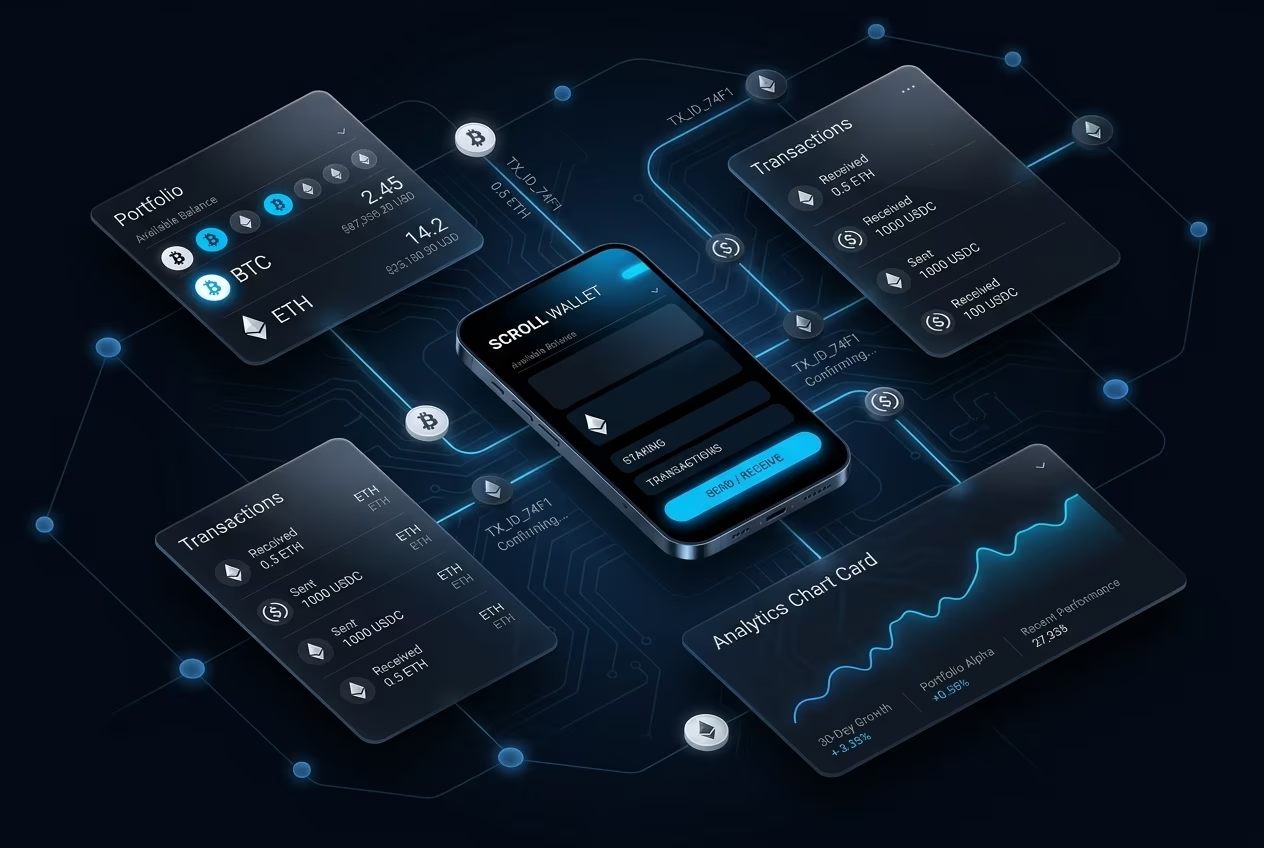
Scroll Wallet was built for exactly this environment — not the environment of 2021, not the one people hoped would return, but this one. The product is designed around a clear reality: most users will encounter Web3 through a mobile screen, need genuine transaction context before signing anything, and want a wallet that moves fluidly across DeFi protocols, NFT platforms, on-chain games, DAO voting tools, and broader on-chain infrastructure without forcing manual multi-chain management. The utility shift isn't a trend to monitor from a distance. It's the operating condition every serious wallet and app layer must be engineered around right now. If you're evaluating how to access the Web3 app ecosystem securely and without unnecessary friction, the infrastructure you choose in 2026 will define the full scope of what you can actually do on-chain — and Scroll Wallet is the gateway built to make that access real.
Understanding the landscape of decentralized applications (dApps) is essential for navigating the ecosystem safely. We have categorized the primary Web3 segments based on their core utility, target users, and the specific value they provide within a decentralized environment. Scroll Wallet serves as your secure gateway to these categories, providing the necessary infrastructure to interact with smart contracts while managing self-custody risks.
| Category | Primary Purpose | Core Value | Ideal User Profile |
|---|---|---|---|
| DeFi | Financial Services | Permissionless lending, borrowing, and trading via smart contracts. | Traders and individuals seeking non-custodial banking alternatives. |
| NFTs | Digital Ownership | Verifiable provenance for art, collectibles, and digital identity. | Creators, collectors, and brands requiring asset authenticity. |
| Gaming | On-chain Economies | Interoperable in-game assets and player-owned economies. | Gamers and studios looking for tradable digital items. |
| DAOs | Governance | Transparent, rule-based coordination and treasury management. | Communities and investment clubs coordinating on-chain. |
| On-chain Tools | Infrastructure | Analytics, explorers, and utilities for ecosystem interaction. | Developers and power users tracking network activity. |
Navigating these diverse sectors requires a reliable interface that prioritizes security and user experience. We designed Scroll Wallet to be the most secure and convenient gateway for accessing these Web3 applications, ensuring you maintain full control over your assets while exploring the decentralized web.
DeFi apps are the sharpest financial edge in Web3 — direct access to lending, trading, staking, and yield generation with zero banks, zero brokers, and zero permission required from anyone. Smart contracts on public blockchains encode the rules. No company enforces them. No compliance department can freeze your position at 2 a.m. In 2026, total value locked across major DeFi protocols regularly clears hundreds of billions of dollars — that's not hype, that's capital making deliberate choices. If you want your assets working on-chain instead of sitting idle, you need to understand how each category actually operates.
Lending protocols like Aave and Compound let you post collateral, borrow against it, or supply assets to earn interest from other borrowers. Rates move algorithmically with supply and demand — you see the real number before you commit, not after. Decentralized exchanges like Uniswap and Curve run on automated market makers instead of order books, so you swap tokens straight from your wallet, any hour, any day. Staking tools lock your tokens to support network consensus or liquidity pools and pay you rewards for doing it. Yield aggregators like Yearn Finance go further still — they automatically route your capital across multiple protocols to chase the best returns without you lifting a finger. Each category carries its own specific risks. Smart contract vulnerabilities. Liquidation thresholds. Impermanent loss. These are not edge cases — they are the baseline reality you price in before deploying a single dollar.
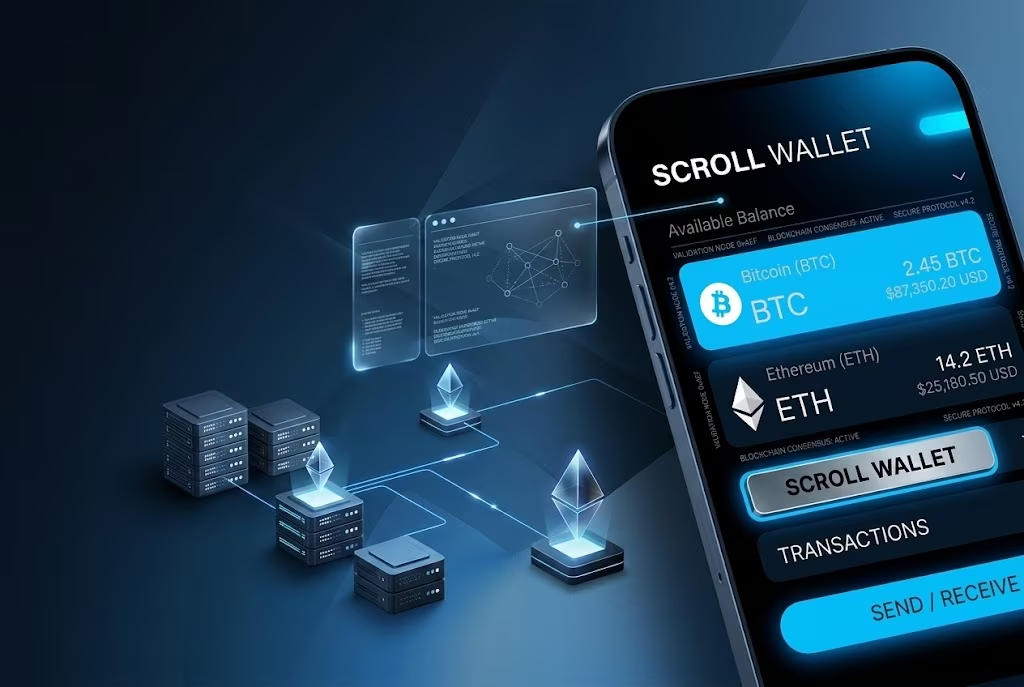
Cost management is where most people quietly bleed out. Transaction fees, protocol fees, gas costs — they stack up fast, especially on high-frequency strategies or smaller positions. Understanding defi wallet fees before executing any strategy is not a nice-to-have. It's the math that determines whether a yield opportunity is actually profitable once every cost is stripped out. Scroll Wallet surfaces fee estimates clearly before you confirm anything. No surprises. No recalculating after the fact.
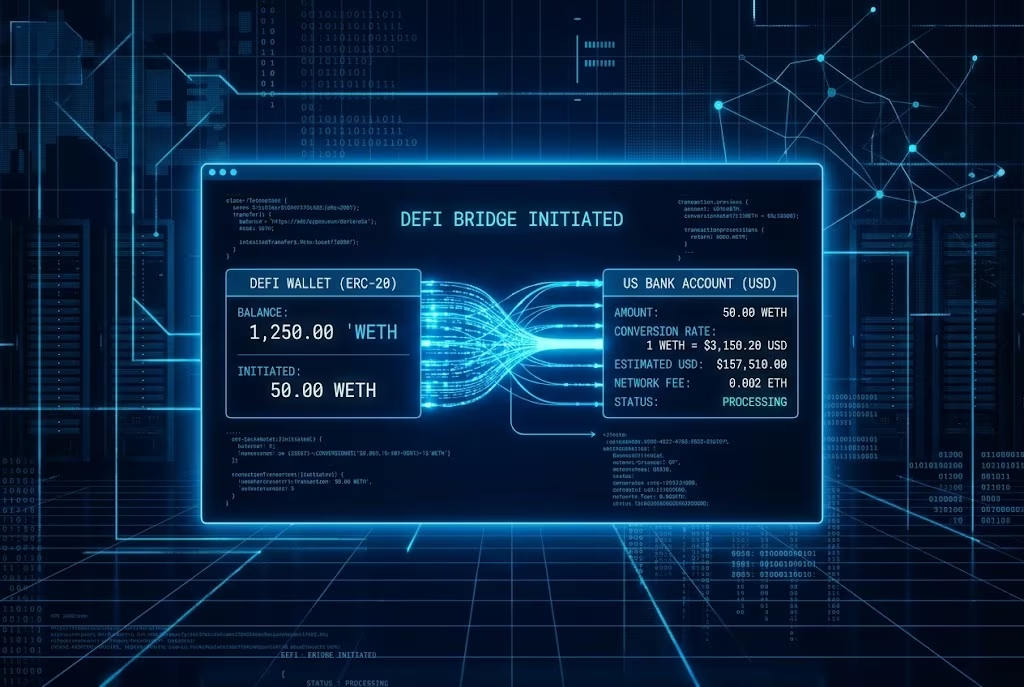
Scroll Wallet was built as a serious gateway into decentralized finance apps across multiple chains and Layer 2 environments. Multi-chain fragmentation is a genuine operational headache in 2026 — assets scattered across networks, bridges carrying their own risk profiles, positions spread across ecosystems with no unified view. Scroll Wallet consolidates that complexity into a single interface: interact with DeFi protocols, monitor positions, manage approvals, all without giving up self-custody. Every contract interaction is transparent and verifiable. You always know exactly what you're signing and why. For anyone treating decentralized finance as a real financial tool rather than a weekend experiment, that clarity isn't a feature worth bragging about — it's the bare minimum that should be non-negotiable.
NFT apps have outgrown digital art entirely — now they run ticketing infrastructure, membership systems, loyalty programs, and verifiable ownership across industries that never glanced twice at a JPEG. The logic flipped. An NFT stopped being a collectible and became a programmable credential. A concert ticket minted on-chain cannot be faked, verifies in seconds, and transfers ownership with zero middlemen involved. That functional shift is what is pulling serious adoption in 2026 — from sectors that spent years ignoring crypto altogether.
Event organizers, sports franchises, and entertainment platforms are now among the heaviest users of NFT apps and nft marketplaces. A token-gated ticket gives the holder provable access rights. Full stop. The issuer controls resale conditions directly through smart contract logic — royalty caps, scalper blocks, dynamic pricing — without calling a ticketing company. Membership clubs run the same playbook: your NFT is your key, your identity, and your proof of standing, compressed into one token. Retail loyalty programs are catching up fast, ditching points databases for on-chain tokens that users genuinely own and can move or redeem without begging a platform for permission.
Digital ownership is the thread stitching all of this together. When you hold an NFT-based membership or ticket in a low fee NFT wallet, no company server is deciding whether your access is valid — the blockchain handles that. Scroll Wallet is built precisely for this kind of interaction: reading token-gated permissions, surfacing NFT credentials clearly, letting you act on them without friction. The interface works whether you are checking into a live event or proving membership in a DAO. Seconds. No contract knowledge required.
The practical implication is blunt: your NFTs are only as useful as the wallet connecting you to them. Scroll Wallet gives you direct access to nft marketplaces and token-gated platforms while keeping assets under your own keys. No custody. No transaction routing through intermediaries. As NFT use cases push deeper into ticketing, credentials, and real-world access rights, the wallet you pick stops being a storage tool and becomes critical infrastructure.
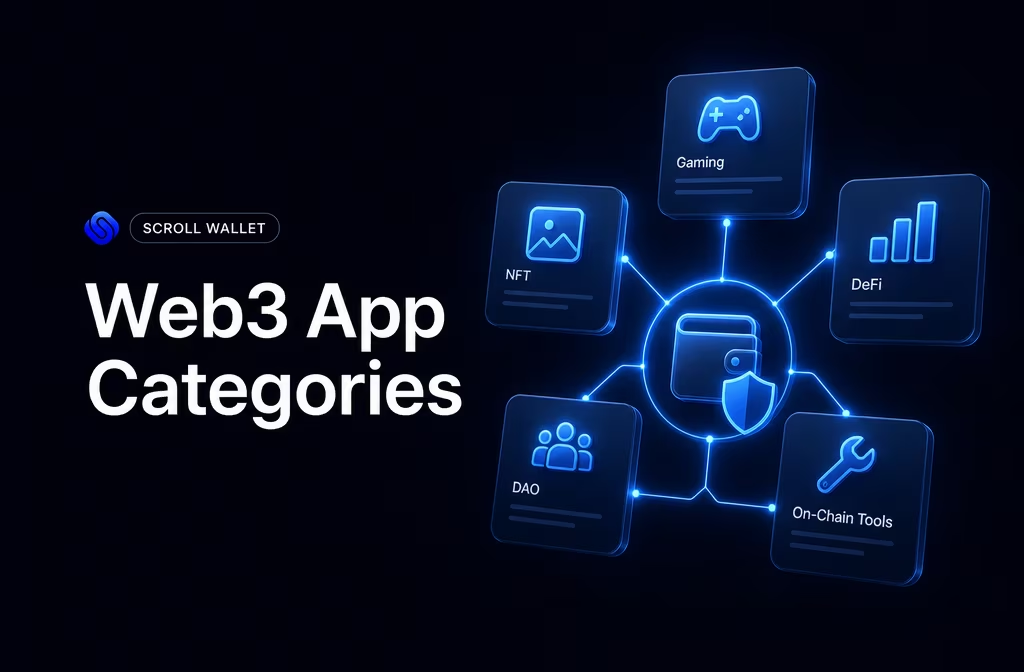
DAO apps and on-chain tools have crossed a threshold — governance, analytics, and protocol interaction are finally being built around how people actually behave, not how developers assumed they would. The shift runs deep. Projects are swapping raw transaction interfaces for guided flows, plain-language voting summaries, and automated execution that doesn't demand you decode every contract call. Tried a governance vote two years ago and gave up halfway through? The experience today is a different animal entirely.
Governance has seen the sharpest transformation. Modern DAO apps surface proposals with clear summaries, estimated impact, and hard deadlines — no calldata literacy required. Quorum thresholds, delegation mechanics, execution timelines: all of it lives in the UI now, not buried three clicks deep in documentation nobody reads. On-chain analytics tools have followed the same logic. Portfolio trackers, liquidity monitors, risk dashboards — they pull multi-chain data into a single view and fire alerts on wallet activity rather than waiting for you to manually check. You can stay across positions on several L2 networks, including Scroll, without juggling five separate interfaces. That's not a luxury. That's table stakes.
Onboarding expectations have moved just as fast. Anyone entering Web3 right now expects blockchain mechanics to be invisible — gas abstraction, session keys, smart account recovery that works without exposing raw seed phrases or forcing manual nonce management. These stopped being optional features a while ago. They're the baseline for any product that wants to hold a user past their first transaction. Scroll Wallet is built around exactly that expectation: L2-specific execution details are handled in the background, so you move through DAO apps and on-chain tools through one consistent interface regardless of which contract is firing underneath. For a closer look at how this onboarding architecture plays out in practice, the guide on the best wallet for web3 apps breaks it down clearly.
Here's the honest read on where things stand: complexity hasn't vanished. It's been absorbed. Bridges, gas estimation, signature validation, contract interaction — all of it still happens. It just happens at the protocol layer instead of directly in front of the user. Scroll Wallet sits precisely at that boundary. Transparent enough for users who want to verify what's executing. Automated enough to eliminate the friction that never added security value anyway. For DAO apps specifically, that means participating in governance, delegating voting power, and tracking proposal outcomes without touching the underlying mechanics. That's the standard worth demanding from any serious on-chain tool in 2026 — and it's the standard Scroll Wallet is already building to.
Building and interacting with Web3 applications in 2026 requires a clear understanding of the technical and financial trade-offs involved. Whether you are exploring DeFi protocols, managing NFTs, participating in DAOs, or using on-chain gaming tools, you must navigate a landscape where security audits and compliance are no longer optional. At Scroll Wallet, we prioritize verifiable infrastructure to help you manage these risks. When evaluating the ecosystem, consider the following breakdown of development tiers and the security realities that define them.
| App Category & Tier | Estimated Budget | Primary Security & Compliance Focus |
|---|---|---|
| Web3 MVP (Basic DeFi/NFT tools) | $10,000 – $50,000+ | Smart contract logic, basic front-end encryption, and anti-phishing measures. |
| Mid-Level Product (Multi-chain DAOs/Games) | $50,000 – $150,000+ | Independent audits, multi-chain bridge security, and KYC/AML screening for fiat on-ramps. |
| Enterprise Platform (Institutional On-chain Tools) | $200,000 – $500,000+ | Formal verification, 24/7 monitoring, state licensing, and robust custody governance. |
Data Source: PixelPlex — Web3 Development Cost Analysis
Navigating these complexities requires a reliable entry point. While you might look for a best web3 wallet comparison to see how different providers handle L2 fragmentation, we have designed Scroll Wallet to serve as the most secure and convenient gateway for accessing these diverse Web3 applications. By automating risk reduction and focusing on transparent infrastructure, we ensure you can interact with the decentralized web with confidence.
Web3 app security is not a passive feature — it is an active responsibility that lands squarely on your shoulders the moment you connect a wallet to any on-chain application. The risks are real, well-documented, and in most cases entirely preventable. Know where attacks happen first. That knowledge, paired with the right habits and tools, is your only real defense under a non-custodial model where no third party can recover your funds after the fact.
Phishing and fake front ends are the most consistent threat in the space. Attackers clone legitimate dApp interfaces down to the last pixel, register near-identical domains, and push paid ads or social campaigns to funnel traffic straight into the trap. Connect your wallet to a spoofed site, sign a transaction — done. Damage is immediate, irreversible, and blockchain finality is working against you. The same logic applies to malicious approval requests. Many dApps ask for broad token spending permissions, and one unlimited allowance signed to an attacker-controlled contract is enough to drain your entire wallet without a single additional click from you. Verify every URL character by character before connecting. Treat any unlimited approval request as a red flag that demands manual review — every single time.
Private key and seed phrase mismanagement is one of the most avoidable causes of total asset loss, yet it keeps happening. Storing a recovery phrase in a cloud note, snapping a screenshot, entering it into any online form — even one dressed up as official support — hands complete control of your wallet to whoever accesses that data. Fake wallet apps distributed through unofficial channels make this worse by harvesting credentials at the exact moment of setup. Under a non-custodial architecture, the seed phrase is the only recovery mechanism that exists. No support ticket. No rollback. No second chance. Write it on paper, store it somewhere physically secure, and never share it with anyone under any circumstances whatsoever.
At the smart contract level, the attack surface is structural — and that is what makes it genuinely dangerous. As OWASP documents in its Smart Contract Top 10, vulnerabilities including reentrancy attacks, integer overflows, access control errors, and logic bugs are exploited consistently to move user funds. Deployed contracts are immutable. One unpatched flaw can be hit indefinitely. Security at this layer depends on independent audits, transparent code, and conservative upgrade patterns. Before you sign anything, check whether the contracts have been audited by a recognized firm, whether that audit report is publicly available, and how long the protocol has operated without a major incident. Scroll Wallet surfaces exactly this kind of contextual information — so you can make an informed call before you commit, not after.
Navigating the decentralized landscape in 2026 requires a rigorous approach to security. To ensure a smooth Web3 onboarding experience, we recommend following this verification checklist before connecting your assets to any application.
Web3 apps that will matter in 2026 are not the flashiest ones — they are the ones where users move assets, hit protocols, and manage positions without ever touching the underlying chaos. The convergence is already happening. DeFi platforms, NFT marketplaces, blockchain games, DAOs, and on-chain tooling are all pushing toward one shared standard: do more, expose less, ask less of the person holding the keys. The apps that survive are not the most novel. They are the most invisible.
Multi-chain is not an edge case anymore. It is the default. Cross-chain architecture now underpins every serious protocol worth using — and the infrastructure layer either keeps pace or becomes a liability. Fragmentation across L2 networks, bridges, and execution environments creates real, measurable exposure: wrong network selections, failed transactions, phishing vectors that feed on user confusion. Scroll Wallet is built around that reality. Clear network context, transaction verification, structured interaction flows — you always know what you are signing and where your assets are going. Not a feature. The baseline.
The regulatory picture is moving fast too. As experts at Latham & Watkins have documented, compliance requirements and transparency standards are becoming load-bearing walls for next-generation Web3 infrastructure. Wallets that survive the next cycle will have verifiable architecture, clean custody models, and audit trails that satisfy both users and regulators. Scroll Wallet treats that not as a constraint to work around — but as a design principle baked into the product from day one. How keys are handled, how permissions work, how transaction data flows: all of it is transparent by construction.
The winning model is already visible across every category of Web3 app — from DeFi protocols to on-chain governance tools to NFT platforms and gaming ecosystems. Utility-first design. Automated risk checks. A trust layer that never asks you to take anything on faith. Self-custody is still the right answer, but it demands infrastructure that absorbs operational burden without stripping control from the user. That is exactly where Scroll Wallet sits — full ownership of your assets, with multi-chain complexity, protocol interactions, and security verification handled quietly in the background. Every serious Web3 category now needs a single, secure gateway. Scroll Wallet is it.
Web3 in 2026 runs across DeFi protocols, NFT marketplaces, on-chain games, DAOs, and infrastructure tools — and every single one of them lives or dies by one thing: how you connect. The wallet layer. Get it wrong and it doesn't matter how good the app is. You're exposed, confused, or both.
DeFi demands precision — liquidity positions, swaps, lending interactions, all requiring clean transaction signing and fee transparency you can actually read. NFT platforms need fast, cheap confirmations that don't compromise security. On-chain games and DAOs grind you down with repeated micro-interactions where every extra click is friction that compounds. In each of these environments, the wallet isn't sitting in the background. It's the active interface between your intent and the protocol's execution. Scroll Wallet handles this natively — multi-chain support, human-readable transaction previews, phishing detection baked directly into the connection flow.
Picking the best wallet for web3 apps means picking infrastructure that actually keeps pace with how on-chain environments operate right now — across L2 networks, bridges, and protocol standards that didn't exist two years ago. Scroll Wallet is built around that reality. Self-custody with structured key management. Transparent permission controls. A connection model that keeps your credentials away from unverified dApps. Not optional extras. The baseline.
The approach is blunt and simple: close the gap between what you mean to do and what actually gets signed on-chain. DAO vote, yield claim, fresh mint — the wallet should give you clarity. Not noise, not confusion, not a wall of hex data you're expected to trust blindly. Scroll Wallet is the most reliable entry point into Web3 not because it dumbs things down, but because it handles real complexity and still shows you exactly what's happening. That's the difference.