Web wallet crypto security solved by Scroll Wallet 2026 | Scroll Wallet
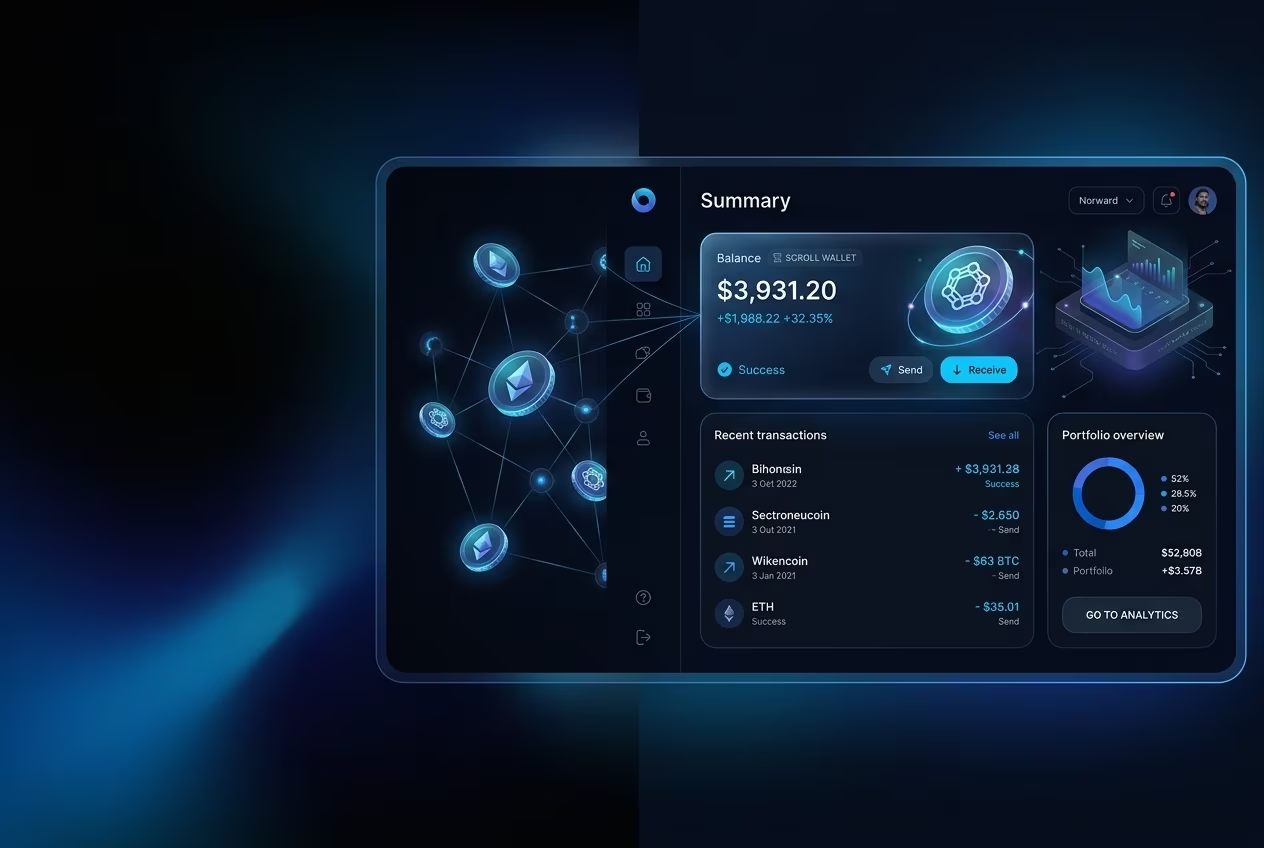
What's a web3 wallet is a digital gateway that gives you direct, sovereign ownership of assets and data on the blockchain without any central intermediaries. Unlike traditional banking apps, we provide you with private keys that grant absolute control over your tokens, NFTs, and interactions with decentralized applications across the global onchain economy.
Web3 wallet does not store your crypto - it stores cryptographic keys that prove that it is yours. The assets themselves live on the blockchain. A wallet is simply a tool for accessing them. Scroll Wallet is built on exactly this logic: direct, verifiable control over your funds without a single intermediary holding your keys.
Any wallet is based on a pair: public key and private key. Public is mathematically derived from private and generates a wallet address - that identifier you give to others to receive funds. A private key is a secret that proves ownership. When you initiate a transaction, Scroll Wallet uses it for a cryptographic signature. This process—signing blockchain transactions—creates a unique digital signature that the network verifies without seeing the key itself. If the private key is compromised, the funds disappear. No options. There is no recovery mechanism at the protocol level. This is why Scroll Wallet is designed as a non-custodial wallet: we do not have access to your keys. Nobody has - unless you reveal them yourself.
The pair wallet address and private key also controls interaction with smart contracts. When you approve a token transfer or join a DeFi protocol, you sign a structured message that authorizes a specific contract to act on your behalf. And here’s the catch: many approvals give unlimited permissions to tokens by default. A compromised or downright malicious contract can wipe out your balance completely. Scroll Wallet shows the details of approvals before confirmation - clearly and without cuts, so that you understand exactly what you are authorizing. In 2026, when multi-chain environments and L2 fragmentation make on-chain interactions increasingly complex, such transparency is not a bonus. This is the minimum standard for safe operation.
Token transfers work using the same signature logic. When sending assets, Scroll Wallet creates a transaction with the recipient's address, amount, gas parameters and chain ID - and signs it locally on your device. The signed transaction goes into the network, validators confirm it without seeing the private key. The entire architecture boils down to one thing: your security depends entirely on how well you protect that key. The seed phrase is its human-readable form. Record it offline. Store in one safe place. Never type on any website or application. These are not recommendations—they are the operating conditions under which self-custody generally works.
Understanding the technical boundary between a traditional crypto wallet and a Web3 wallet is essential for navigating the 2026 on-chain environment. While both rely on a non custodial wallet architecture to ensure you retain control of your private keys, their functional scope differs significantly. Traditional wallets act as digital vaults for simple transfers, whereas Web3 wallets serve as your verifiable identity and interface for decentralized applications (dApps).
| Feature | Traditional Crypto Wallet | Web3 Wallet (Scroll Wallet) |
|---|---|---|
| Primary Purpose | Asset Storage | dApp Interaction |
| Supported Assets | Native coins (BTC, ETH) | Multi-chain tokens, NFTs, LP tokens |
| Smart Contracts | No support | Approvals & Interaction |
| Connectivity | Manual address entry | Direct dApp Browser/WalletConnect |
| On-chain Identity | Anonymous address | ENS, Social profiles, Staking |
Data source: KuCoin Learn — Difference between crypto and Web3 wallets
Self-custody is when you have the private keys, and it is this fact that decides whether you truly own the crypto or just keep a line in someone else’s balance. When you use a self-custody wallet, not a single exchange, not a single platform, not a single intermediary will be able to freeze funds, limit withdrawals or lose assets as a result of hacking. Every intermediary you remove from this chain is minus one point of failure between you and money.
But the practical advantages do not come down to safety. With non-custodial wallet you interact directly with on-chain protocols - DeFi, bridges, L2 networks, NFT markets - without routing through a custodian, which adds delays, introduces limits, or requires identity verification at the most inopportune moment. In 2026, when a multi-chain environment and L2 fragmentation have become the norm, direct access through a wallet is not a matter of preference. This is a functional requirement for those who work on at least two networks.
The trade-off is real, and it should be stated directly: self-custody shifts the responsibility entirely to you. Lost your seed phrase - no support service will restore access. Signed a malicious transaction - no intermediary will cancel it. That's why Scroll Wallet is built around reducing this operational risk: clear transaction previews, phishing detection at the interface level, structured key backup processes. The goal is not for self-custody to feel like a custodial product. The goal is to make key management risks visible and manageable before they become irreversible.
For those moving serious amounts of money on-chain, a non-custodial wallet architecture is the only model that scales with trust. Custodial platforms have proven this over and over again - with bankruptcies, freezes, and regulatory seizures. Holding assets in your name is not the same as holding them. Scroll Wallet is built around this distinction as a core product principle rather than a marketing thesis. You control the keys. You control the assets. This is the starting point for everything else.
Web3 wallets of the new generation have killed seed phrases as a mandatory ritual - and this is not a degradation of security, but its evolution. Simple onboarding in Web3 is now based on passkey authentication and social login: you create a wallet through a Google account or device biometrics, without a single recorded word. This is where 80% of new users used to die - at the moment when the screen demanded “write down 12 words and hide them in a safe place.” Scroll Wallet removed this barrier not for the sake of marketing, but because incomplete onboarding is a dead user for the network.
Gas abstraction is perhaps the most underrated achievement in usability in recent years. Think about it: you came to the dApp on Scroll, you want to make the first transaction, and they tell you that first you need to buy ETH somewhere for a commission. Curtain. Sponsored transactions and account abstraction according to the ERC-4337 standard solve exactly this problem: the commission is covered by the application, or you pay with the token that you already hold. The structural barrier has been removed. But in parallel with this, another story grew - readable transaction previews. Now, before signing, you see exactly what tokens are leaving, what contracts are being called, what permissions are being issued. This is not cosmetics. As experts GetBlock note in their detailed analysis of the requirements for modern Web3 wallets, transparency before signature is no longer a feature, but a basic standard. Because phishing and exploit approvals have not gone away.
A browser extension and a mobile Web3 wallet are different beasts with different threats. In the browser you are constantly under fire: phishing sites, malicious scripts, clipboard interception. Therefore, Scroll Wallet at the extension level verifies domains and simulates a transaction even before the signature request even reaches you. The mobile environment is different - biometrics at the OS level, isolated application sandboxes, physical ownership of the device. Stronger for storing keys. Stronger for confirmations on the go. We do not oppose these surfaces - they cover different scenarios. A DeFi protocol on a desktop and a QR code at a live event require different things. Understanding what a non-custodial wallet actually controls and what it doesn’t is the foundation for using both safely.
The result is simple. Passkeys, social recovery, gas sponsorship, readable previews - each of these mechanisms closes a specific point of failure where previously users either abandoned the process or lost money. Scroll Wallet is built on a strong premise: the wallet's usability must match the standard that people already know from regular financial apps. Not because simplicity is a beautiful slogan. Because complexity is an attack vector. Every step that the user skips without understanding its meaning is a step that an attacker can enter. Removing unnecessary complexity and improving security are one and the same task.
When you choose a decentralized finance wallet, the network you operate on determines your daily overhead. While setting up a Scroll Wallet is free, transaction signing costs vary significantly between the Ethereum mainnet and Layer 2 solutions. By 2026, the adoption of EIP-4844 and advanced rollups has reduced L2 fees by over 90%, making multi-chain wallet usage sustainable for high-frequency actions like swaps and NFT minting.
| Action Type | Ethereum Mainnet | Layer 2 (Scroll/L2) | Efficiency Gain |
|---|---|---|---|
| Wallet Setup | Free | Free | N/A |
| ETH Transfer | $0.30 – $1.00 | ~$0.04 | >90% Lower |
| Token Swap | $20.00 – $50.00+ | ~$0.20 | 99% Lower |
| NFT Actions | High (Variable) | < $0.01 (Avg) | Massive |
| Daily Throughput | ~1M tx/day | 5M – 8M+ tx/day | 8x Scalability |
Data Source: Ethereum.org — Ethereum versus L2 fee examples for ETH transfers and swaps
ZK rollups in conjunction with account abstraction are not an evolution of crypto wallets, this is their complete reboot. Until recently, working with an Ethereum-compatible wallet looked like this: unpredictable gas fees in ETH, a separate signature for each action, and a painful wait for confirmations during peak hours. It was this barrier that kept most people away from DeFi and NFTs. Now the architecture has changed so much that daily on-chain activity has become really convenient.
ZK rollups reduce gas costs by packing off-chain transactions and compressing data before sending it to Layer 1 - for example, replacing full addresses with indices. You get Ethereum security guarantees without paying for full execution on its network. Account abstraction (ERC-4337) goes further. It removes the requirement to hold ETH to pay for gas: through paymasters, you can pay fees in ERC-20 or stablecoins, and multiple transactions are combined into one signature. As experts explain Antier Solutions, a combination of ZK rollups and account abstraction - already working on StarkNet, zkSync Era and Polygon zkEVM - simultaneously solves scalability through offloading Layer 1 and opens multi-factor authentication, social account recovery and gasless transactions. All this makes the wallet for DeFi and NFT accessible not to a select few, but to everyone.
What does this mean in practice? You can start working with crypto without a single ETH on your balance. Complex multi-step DeFi transactions take place with a single confirmation. NFT marketplaces and stablecoin payments - without manual gas management. This is real control and convenience in web3 - not a marketing slogan, but a specific set of architectural solutions. Our Scroll Wallet is built precisely on this foundation: the infrastructure takes on all the complexity, and full ownership of the assets remains with you.
The result is simple. Gasless transactions, semantic batching and social recovery are no longer experimental features. This is the minimum bar for any wallet that claims to be used daily. We built Scroll Wallet around these primitives because the alternative of forcing users to monitor their ETH balance, confirm every microtransaction, and restore their account through a single seed creates risks and friction that no serious product should impose in 2026.
To interact with decentralized applications, manage your DeFi positions, and secure your NFTs within a verified infrastructure, we recommend connecting your wallet to the Scroll ecosystem.
A secure web3 wallet does not start with settings, but with an understanding of the threats - most of which look completely normal. Phishing sites copy the interfaces of popular wallets pixel for pixel. Fake airdrop campaigns promise free tokens in exchange for connecting a wallet - and one signed transaction silently empties the balance. Malicious browser extensions pretend to be real wallets and intercept your credentials before you even notice. These are not rare cases. This is the standard attack map for every newbie in 2026.
One of the most underestimated risks is approvals of smart contracts that are signed without reading. A single confirmation transaction can give an external contract unlimited access to a specific token in the wallet. Most users click “confirm” without checking the permission area, the contract address, or whether the requesting site is verified at all. A reliable crypto wallet must display this information clearly and understandably - Scroll Wallet displays approval details in simple language before you confirm anything. If you can't read what the contract requires, don't sign it. Period.
The seed phrase is not a password. This is the complete cryptographic key to the wallet, and whoever owns it owns everything - no exceptions and no return. According to DFPI CA, which tracks official complaints about phishing, fake platforms and losses through wallets, a significant portion of the recorded incidents involve users who were socially engineered to reveal their seed phrase through fake support or fraudulent tools "restoration". Never enter a seed phrase on any site, application or form - including those presented by Scroll. How exactly seed phrases work and how to store them correctly - read our guide on seed phrase security.
Fake applications are a separate story that hits mobile users specifically. Fake wallets are appearing in app stores with almost identical names, icons and screenshots. Once installed, they either steal the seed phrase during the setup process or log every keystroke. Before installing any wallet, check the name of the publisher, find the official website of the project and take the download link there, check the release date of the application and review history. Scroll Wallet publishes verified download sources only through official channels: if you find an application somewhere else, consider it unverified until you are convinced otherwise. The risk is real. The damage is irreversible. The protection is simple: check before you install.
Operating in the 2026 Web3 landscape requires a proactive approach to risk management. To maintain a secure crypto wallet environment and protect your assets within the Scroll ecosystem, we recommend following these verified operational steps.
Self-custody without a normal UX is not a solution, it is a fence that cuts off most users from Web3 once and for all. By 2026, there is no disagreement among experts: wallet convenience has ceased to be an option. This is the basic infrastructure. A wallet that gives you full control over private keys, but at the same time forces you through confusing flows, manual network switching and opaque transaction confirmations, does not free the user. He sets him up. Phishing, random approvals, mistakes in bridges are not accidents. These are predictable consequences of poor UX in a high-stakes environment.
Experts GetBlock identify the main challenge for any modern web3 wallet right now: maintaining a balance between security, self-custody and ease of use. Fragmentation of L2 networks, cross-chain bridges, multi-wallet links - all this has made the on-chain environment fundamentally more complex than two years ago. Control and convenience must coexist in Web3. Don't compete. A wallet that automates risky steps, provides clear transaction context, and reduces cognitive load—without sacrificing security. He builds it right into the design.
It is this philosophy that underlies Scroll Wallet. The interface was built with one assumption: most users - new or veteran - do not need to understand the protocol architecture in order to use the wallet safely. The best web3 wallet is not the one with the most features. One where the default behavior protects the user. Where warnings are actionable, not decorative. Where the path from intention to confirmed transaction is as short and transparent as possible.
A modern web3 wallet must perceive UX as a security layer - and not as cosmetics. If the user cannot clearly read what the transaction will do before signing it, this is a vulnerability. It doesn't matter how reliable the key control is under the hood. Scroll Wallet's confirmation screens, permission requests, and network detection are designed to close this gap. The goal is not to make Web3 appear simple by hiding complexity. The goal is to show the right information at the right time. To make an informed decision every time. No technical background.
Scroll Wallet is the best example of a web3 wallet of 2026 precisely because it was built to meet the real restrictions of live users, and not to the ideal conditions from the developer’s head. Most wallets were designed when the Ethereum mainnet was the only serious option - high gas fees, slow confirmations and a steep entry threshold were simply considered the norm. Scroll Wallet is built from the ground up on Scroll's zkEVM Layer 2: a fully EVM-compatible environment, but at a fraction of the cost of mainnet. This is not a marketing thesis. This is a direct consequence of how rollup compresses and verifies on-chain transactions.
Scroll Wallet is a product with strict conscious priorities: everyday convenience without loss of verifiability. Built-in self-custody key management, transparent assessment of the commission before signing any transaction, an interface that does not require you to understand the mechanics of rollups. You always see what you are signing, how much it costs and what network you are on. Always. In a world where phishing attacks and wallet exploits are becoming increasingly sophisticated, removing ambiguity from the signing flow is not what a UX designer would want. This is a security requirement.
Ethereum Foundation in its scaling roadmap directly states: Layer 2 is the main path to cheap and fast transactions without compromising Ethereum security. Scroll Wallet for daily use is built directly on this infrastructure. Each transaction receives Ethereum finality while remaining in a price range where small and frequent actions generally make sense. Send tokens, log into a DeFi protocol, manage assets between sessions - and you no longer need to consider whether the gas itself is worth the action.
The strength of Scroll Wallet is not in a separate feature. There is strength in consistency: the network architecture, wallet interface and real-world risk profile of the user work as one. We built functionality around reality: most users work on multiple networks simultaneously, face fragmented liquidity, and need clear signals about what is happening with their money at every step. The result is a wallet that works as a trusted infrastructure, rather than a product that needs to be constantly circumvented. If you choose a wallet in 2026, the question is no longer whether it supports Web3. The question is whether it reduces the operational complexity and risks that Web3 brings with it today. Scroll Wallet is our answer to this question.
Web3 wallet is a tool for direct, verifiable ownership of crypto assets: no banks, intermediaries, or someone else's permission. Understanding what a Web3 wallet is means understanding a shift in the very logic of financial control: instead of trusting the platform to hold your funds, you hold the keys yourself. This fact alone turns the whole concept of self-custody upside down. And that’s why the question “why use a Web3 wallet” is not technical. It is structural.
Self-custody matters because centralized platforms can freeze an account, go bankrupt, or block withdrawals—without warning or explanation. Once you have the private keys, none of these scenarios apply to your assets. The flip side is fair: you are solely responsible for key security, backups, and transaction verification. Scroll Wallet is built around this reality - we don't hide risk behind a beautiful interface, we provide tools to accurately manage it. Clear transaction previews, network confirmation, no hidden routing that exposes your funds to unnecessary third-party risk.
Ease of use today determines which wallets survive at all. In 2026, the on-chain environment is more fragmented than ever: multiple L2 networks, bridges, token standards, gas models - all competing for your attention at the same time. A wallet that fails to simplify this complexity without hiding it becomes a problem. For those just entering the Web3 space, the barrier is not conceptual - it is operational. Scroll Wallet solves this through a single interface for multi-chain interactions: reduces cognitive load, but does not take away user control over what really matters.
The best Web3 wallet is not the one with the most features. One that you can use correctly, consistently, and without making mistakes that cost you assets. Owning crypto only makes sense if the infrastructure around it is transparent, verifiable, and aligned with your actual workflow. This is the standard that Scroll Wallet follows. And the standard you should apply when evaluating any wallet in this space.