
How to Sell and Withdraw Money from Crypto.com to a Bank | Scroll Wallet
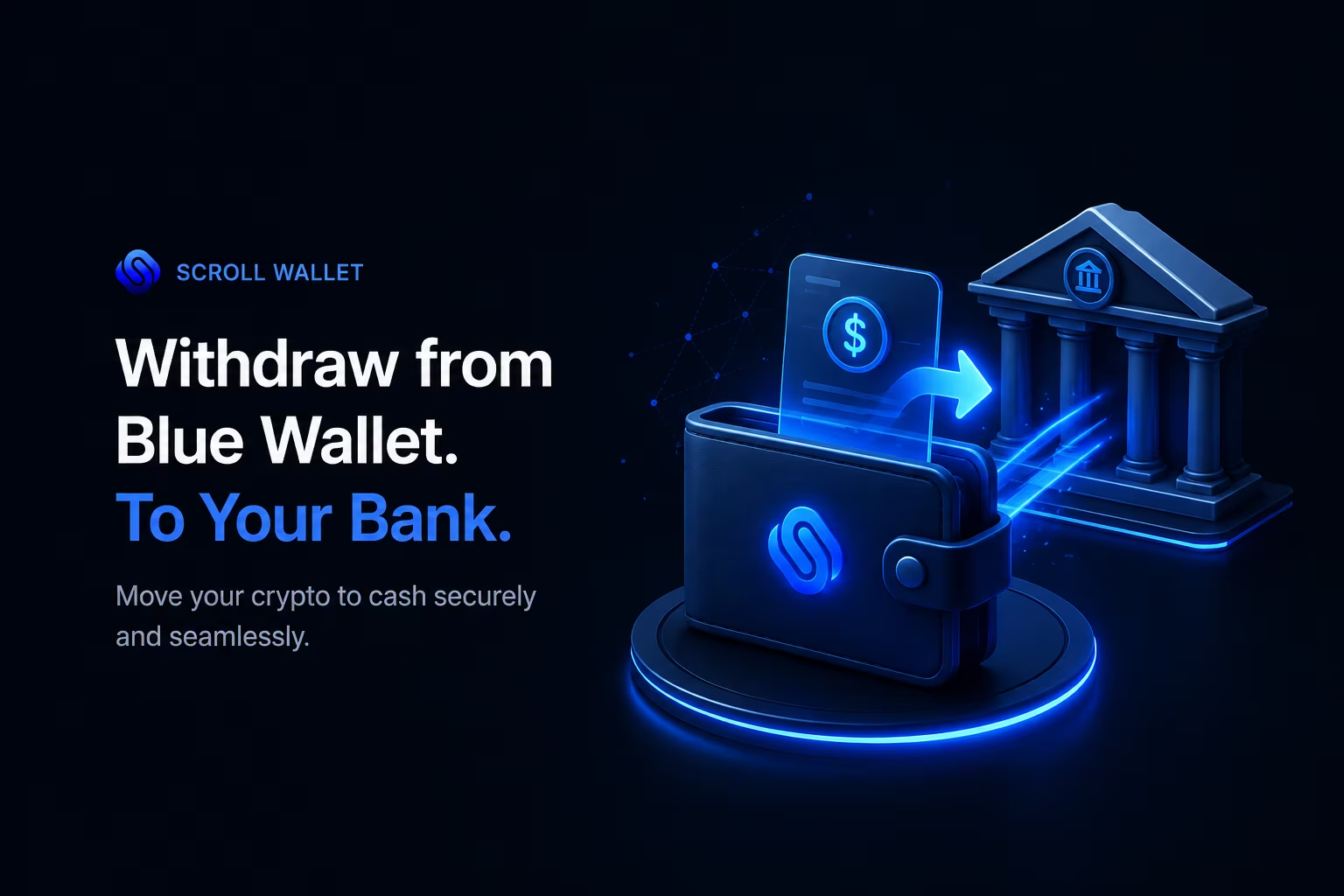
To withdraw money from Blue Wallet, you must transfer your crypto to a centralized exchange like Coinbase or Kraken, sell it for USD, and then send the fiat to your bank via ACH or wire transfer. Because Blue Wallet is a non-custodial interface, it lacks a direct connection to traditional banking systems, requiring this multi-step process.
To successfully withdraw from Blue Wallet, you must navigate the manual steps of Bitcoin transaction management. While we have designed Scroll Wallet to automate many of these complexities, the following sequence outlines the standard procedure for moving your assets to a liquid environment or preparing for a crypto bank withdrawal.
When you manage assets in Blue Wallet, choosing the right withdrawal path is critical to avoiding unnecessary fees and delays. While the app supports various methods, each comes with specific technical frictions, such as waiting for 3–6 confirmations on-chain or managing channel liquidity. At Scroll Wallet, we prioritize reducing these hurdles through automated infrastructure, but if you are currently using a non-custodial lightning wallet or a standard BTC vault, you must navigate the following trade-offs.
| Withdrawal Path | Primary Use Case | Main Limitation & Friction | USA Suitability |
|---|---|---|---|
| On-chain Transfer | Cold storage or Exchanges | High network fees; requires 3-6 confirmations (30-60+ mins). | Fully available; no geo-restrictions. |
| Lightning Movement | Micro-payments / Refills | Requires 'refill' (on-chain deposit) with 3-confirmation delay. | Available; limited by channel capacity. |
| Exchange Deposit | Cashing out to Fiat | Minimum deposit limits; LNDHub/Zigzag routing issues. | Standard KYC exchange rules apply. |
| Lightning Invoices | Instant P2P Transfers | Liquidity constraints; experimental warnings on large paths. | Fully available for US users. |
Blue Wallet's usability problems are baked into its architecture — before you move a single satoshi, the multi-step flow demands more manual input than most users ever expected. Other wallets are built around streamlined withdrawal paths. Blue Wallet isn't. It splits Lightning and on-chain operations into two distinct modes, and to actually move funds you're managing channel liquidity, confirming routing by hand, and toggling between interfaces — each one a fresh opportunity for something to break. If you came here expecting a single tap to start a transfer, the architecture itself is the obstacle.
Blue Wallet errors don't scatter randomly — they pile up at the same pressure points every time: insufficient inbound liquidity on Lightning channels, routing failures when network nodes choke under congestion, and on-chain fee estimates that shift between the moment you initiate and the moment you confirm. Every single one of those problems lands on you to diagnose alone. No guided recovery. No hand-holding. A failed transaction means raw error messages and a deep dive through community forums. As Fintech Review notes, friction points exactly like these are where modern wallets have the clearest shot at standing out — and where most self-custody tools still drop the ball.
Then there's the manual confirmation model, which piles on. Every outbound transaction asks you to verify fee tiers, check address formats, and sometimes broadcast manually. That's not a bug — it's a deliberate self-custody philosophy. But for anyone who needs fast fiat conversion, that philosophy translates into a gauntlet of decisions before funds even leave the wallet. One wrong fee selection, one channel state mismatch, one missed step — and the whole flow stalls with zero clear feedback on why.
Scroll Wallet was designed with that exact friction map on the table. The withdrawal flow collapses the multi-app switching problem entirely by unifying on-chain and off-chain operations inside a single interface with automated routing logic. Manual confirmations stay where they actually protect you — but liquidity checks, fee optimization, and error recovery run automatically. What you get is a straight line from wallet balance to destination: fewer decisions, fewer failures, and real status updates at every stage instead of raw transaction data you have to decode yourself.
Withdrawing crypto to your bank from a self-custody wallet in the US in 2026 means running a gauntlet of regulatory checkpoints — and most people don't see them coming until funds are already frozen. The second you move Bitcoin or any other asset from a self-custody wallet to a custodial exchange, that exchange is legally required to run KYC and AML verification on your deposit. FinCEN's Money Services Business rules force exchanges to screen incoming addresses against sanctions lists, illicit fund databases, and behavioral risk models. Your wallet address has even an indirect association with flagged activity? Funds frozen. Source-of-funds documentation requested. Process halted.
Then there's the tax dimension — and it bites harder than most people expect. Moving assets from a self-custody wallet to an exchange isn't a neutral event. If your cost basis differs from current market value, the IRS reads it as a taxable sale. Full stop. Starting in 2026, exchanges must report these transactions to the IRS via Form 1099-DA, tracking broker-to-wallet activity with far more surgical precision than anything that came before. As Blockchain Council details, the 2026 compliance environment fuses CARF tax visibility, address monitoring, and 1099-DA reporting into a single pressure point for anyone moving assets from self-custody into traditional finance. Calculate your capital gains exposure before you initiate a transfer — not while you're watching your funds sit in review.
Assets clear the exchange. You initiate a bank withdrawal. A second compliance sweep begins. Banks and exchanges are required to file Currency Transaction Reports for cash-equivalent movements above $10,000 and Suspicious Activity Reports whenever transaction patterns cross risk thresholds — regardless of amount. Even routine withdrawals get flagged when account history, transaction frequency, or counterparty addresses drift outside expected parameters. Federal regulations governing these flows are expected to be finalized in July 2026, but major exchanges are already rolling out product-level changes ahead of that deadline. For a deeper look at how these flows interact at the infrastructure level, see our guide on crypto bank withdrawal.
Scroll Wallet is built with this compliance reality baked in. Not to eliminate regulatory friction — no wallet can do that — but to make sure you see exactly what each step demands before you're committed to it. Cost basis data surfaced upfront. High-risk transfer paths flagged before you move. Documentation tools ready the moment an exchange or bank asks for source-of-funds proof. The gap between a self-custody wallet and a bank account in 2026 is where delays and rejections pile up. Scroll Wallet keeps that gap from becoming a black box.
When you move assets out of Blue Wallet, you encounter multiple cost layers rather than a single flat fee. While the wallet itself does not charge a surcharge, you must account for network congestion and third-party service margins. Understanding these crypto off-ramp fees is essential for maintaining your portfolio's efficiency. At Scroll Wallet, we prioritize infrastructure transparency to help you navigate these multi-layered environments without unexpected losses.
| Cost Layer | Fee Type & Variability | Impact on Withdrawal |
|---|---|---|
| Bitcoin On-Chain Fee | User-selectable (Miner fees) | Higher fees ensure faster confirmation; batching can reduce costs. |
| Lightning Routing | Variable (LNDHub/Network) | Generally low, but depends on the specific routing nodes and services used. |
| Exchange Trading | Provider Fee + Spread | External services like MoonPay or Hodl Hodl add their own marketplace margins. |
| Bank Payout | Method-dependent | Final conversion to USD varies based on the exchange's withdrawal policy. |
Blue Wallet withdrawal time gets crushed by three variables hitting at once: mempool congestion, the fee rate you broadcast with, and the confirmation threshold the receiving platform demands before it touches your funds. When all three turn against you, a transaction that should clear in ten minutes ends up sitting in limbo for hours. Each layer compounds the last — and if you don't understand them separately, you're just guessing.
Mempool congestion is the wildcard. The Bitcoin mempool is a raw queue — thousands of unconfirmed transactions fighting for finite block space, and miners cut through it by fee rate (sat/vByte), not by who's been waiting longest. NFT mint waves, volatility spikes, protocol events — any of these can flood the queue in minutes. Broadcast a transaction with a low fee during one of those windows and you're not just slow. You're invisible. BlueWallet's own documentation flags fee management and batching behavior as direct factors in how quickly miners pick up your output. Underestimate the current rate, and your transaction misses block after block while the queue moves around it.
Then comes the confirmation layer — and this is where the friction becomes genuinely painful. Exchanges and fiat off-ramps don't credit on broadcast. They wait. Three confirmations, six confirmations, sometimes more — each one a full block, roughly ten minutes under normal conditions. On a congested network, that math gets ugly fast. A 6-confirmation requirement stops being a formality and starts being a 60-plus-minute hold with no recourse. No wallet UI can fix this. The rule lives on the receiving platform's side, not yours. If you're planning a fast fiat conversion, that confirmation wait isn't an edge case — it's the main event. Plan for it or get surprised by it.
Scroll Wallet is built to cut through exactly this kind of friction. No raw fee fields, no guessing sat/vByte against a mempool you're not actively watching. Real-time fee recommendations calibrated to live mempool depth are surfaced by default — your transaction enters the queue at a competitive rate without you having to consult three external tools first. Under normal conditions, that means confirmation in the next 1 to 3 blocks. When the network is genuinely congested, Scroll tells you that clearly instead of letting you discover it forty minutes later. Timing transparency isn't a weakness. It's the whole point.
Users don't want to manage wallet mechanics — they want their funds moving the moment they decide to move them, full stop. The demand for a faster withdrawal experience has become the loudest signal in crypto product feedback heading into 2026. And the math is brutal: every extra confirmation screen, every network selector dropdown, every gas estimation prompt bleeds users out of the flow. Drop-off rates don't lie. Support ticket volume doesn't lie. Friction kills conversions, and wallets are hemorrhaging users because of it.
As Fintech Review makes clear, simpler withdrawal design matters to everyday people — not just developers running nodes in their spare time. The gap between what a wallet technically supports and what a real user successfully completes? Enormous. Nobody wants a crash course in L2 routing or bridge mechanics just to move their own money. Not beginners. Not veterans either — experienced users report the same frustration when a withdrawal flow demands manual configuration across four separate screens before anything actually happens.
Scroll Wallet was built around one hard constraint: reduce the number of decisions a user must make to zero, wherever possible. Pre-configured network routing. Automatic fee estimation. A single confirmation tap before funds move. For users who need fast fiat conversion, the flow connects on-chain balance directly to an off-ramp destination — no manual intermediary selection, no hunting through menus. One tap. The system handles everything else.
The expert consensus in 2026 is sharp and unambiguous: complexity doesn't disappear — it gets pushed down to the infrastructure layer where it belongs, far away from the user interface. Scroll Wallet treats a smooth, fast withdrawal not as a premium feature to advertise. It's the baseline. When users trust that a withdrawal completes correctly on the first attempt — no retries, no failed transactions, no confused support emails — they engage more, hold more, come back more. That's the measurable return on building an easy withdrawal experience instead of handing users a manual they never asked for.
Blue Wallet's pending withdrawal screen is where user patience goes to die — and the culprit is almost always one of three things: a Lightning channel starved of inbound liquidity, a fundamental mismatch between on-chain and off-chain balance logic, or an invoice that quietly expired while you were deciding what to do. Before you troubleshoot anything, pin down which layer your funds are actually sitting on. Blue Wallet treats on-chain Bitcoin and the Lightning Network as two completely separate wallets with completely separate rules — and most users only discover this after a transfer stalls and the balance looks wrong.
The single most common withdrawal failure? Lightning invoices that expire before the payment broadcasts. These invoices are time-limited by design — typically 24 hours — and when a sender hesitates, the payment fails without any loud error. Just silence. The second major culprit is channel liquidity: your balance can show available funds and the transfer still won't complete, because the outbound capacity of the route between nodes isn't sufficient to push the payment through. That's not a bug. It's a structural property of the Lightning Network that demands active channel management. As noted by Fintech Review, user complaints about Blue Wallet cluster heavily around exactly these operational friction points — especially for anyone who isn't actively watching channel states or node connectivity.
Then there's the balance confusion problem, which creates its own category of apparent failures. On-chain Bitcoin needs network confirmations — anywhere from 1 to 6 blocks, which translates to 10 minutes on a good day or several hours when the mempool is backed up and your fee was too low. Send with a minimal fee during peak congestion and your transaction enters a pending limbo that can stretch for days. Lightning balances, by contrast, update instantly — but only within the routing capacity your channels can actually support. Users who switch between these two modes without understanding the distinction routinely misread normal network behavior as a non-custodial lightning wallet malfunction. It usually isn't. It's a fee miscalculation or a capacity ceiling they didn't know existed.
Scroll Wallet was built around exactly these friction points. Its unified balance interface separates layer states clearly and surfaces actionable information before a withdrawal is initiated — not after it's already stuck. Fee estimation runs dynamically against live mempool conditions, which cuts the probability of a stranded on-chain transaction down sharply. On the Lightning side, routing logic verifies outbound liquidity before marking a payment path as viable, which eliminates the most common reason Lightning withdrawals fail in the first place. If Blue Wallet's withdrawal friction has become a recurring problem for you, the architectural difference between these two products is worth a direct, honest comparison against how you actually use your wallet day to day.
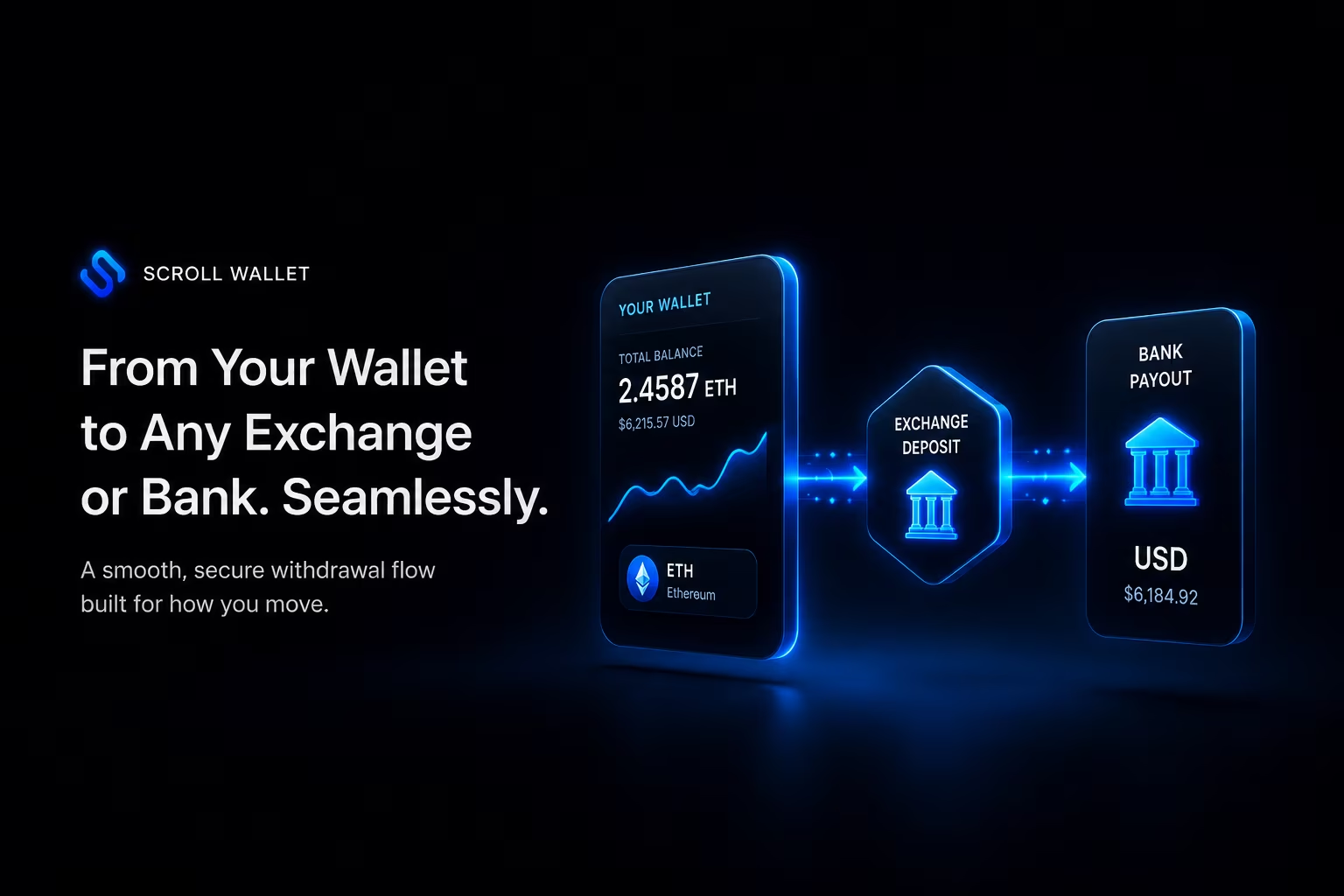
Scroll Wallet cuts through the chaos that makes crypto withdrawals a nightmare — transparent fees, automatic routing, and a clean path from digital assets to real money, no technical degree required. While most wallets dump you into a maze of manual network selection, gas estimation, and bridge steps just to start moving funds, Scroll Wallet collapses all of that into one guided flow. You see what you're paying before you commit. The system picks the right network automatically, based on live conditions.
Here's where most withdrawals break down: fee opacity and fragmented routing. You kick off a transaction, and somewhere in the middle, gas costs have shifted. Or your asset is sitting on a layer that quietly demands an extra bridge step nobody warned you about. Scroll Wallet kills that problem by surfacing every crypto off‑ramp fee before you touch the confirm button — network fees, conversion spreads, service costs, all of it. No surprise charges on the final screen. In a multi-chain environment that gets messier every year, that single design choice removes the friction point users complain about most.
Smoother withdrawals aren't marketing language here — they're an architectural reality. Assets scattered across mainnet, rollups, and sidechains represent a genuine routing puzzle. Scroll Wallet solves it silently. The wallet identifies the most cost-efficient exit path without asking you to understand bridge mechanics. Direct off-ramp available on the Scroll network? It takes it. Bridge step unavoidable? You get the estimated time and cost upfront — not as a nasty surprise after you've already committed. That's not a small thing. That's the difference between a completed transaction and an abandoned one.
The practical gap is measurable. Fewer confirmation steps mean fewer failure points. Visible fee breakdowns let you make real decisions — like waiting out network congestion if the cost crosses your threshold. A withdrawal should feel like a financial action, not a debugging session. If you've wrestled with less structured interfaces before, the contrast hits you on the very first transaction.
Getting money out of Blue Wallet takes more steps than anyone warns you about upfront. Self-custody wallets give you on-chain control — full stop. They were never designed for direct fiat conversion, and that gap hits hard the moment you actually try to turn a crypto balance into spendable cash. Network fees. Exchange routing. KYC queues on receiving platforms. Manual bridge steps. Each one stacks on top of the last, and in a multi-chain environment, the friction compounds fast.
A clean cash-out depends entirely on how well your wallet handles the handoff between on-chain assets and off-chain liquidity. With Blue Wallet, you own every step of that handoff — which sounds empowering until something breaks. Pick the wrong network, misread the gas estimate, route through an exchange that doesn't support your asset, and the whole flow stalls. For a practical breakdown of how to cash out crypto to bank without losing funds to avoidable errors, the routing logic matters just as much as the wallet you start from.
Scroll Wallet was built around one uncomfortable truth: most users do not want to manage five separate tools to complete a single withdrawal. The outbound flow consolidates network selection, fee estimation, and exchange routing into one guided path. Fewer decision points. Fewer places to make a costly mistake. That is not a pitch — it is an architectural choice made specifically because fragmented UX is one of the top causes of user error and lost funds in self-custody environments.
So if you are weighing your options for moving crypto to cash right now, the real question is not which wallet holds your assets. It is which wallet makes the exit path clear, auditable, and low-friction. Blue Wallet handles transfers and on-chain management well enough. But when the goal is a complete withdrawal with minimal manual steps and verifiable routing? The infrastructure underneath your wallet becomes the deciding factor. That is exactly where Scroll Wallet is built to win.