Avalanche Core Wallet: Why Users Seek Better Control | Scroll Wallet
An avalanche web wallet provides instant browser-based access to your AVAX assets without the need for hardware-intensive desktop applications or complex mobile setups. Modern US users prioritize these interfaces for seamless interaction with C-Chain DeFi protocols and rapid asset management. However, as of 2026, shifting from legacy web tools to integrated multi-chain environments is essential for maintaining security and liquidity routing.
A browser wallet for AVAX in the USA is no longer about storing tokens. It's about access to an entire ecosystem: subnets, dApps, bridges, DeFi - all from one window. The scale of what now lives on Avalanche has changed dramatically. TVL of real assets on the network grew by 950% to $1.3 billion in 2025. The number speaks for itself. Those who used to log into their wallet once a week to transfer some AVAX are now juggling positions across multiple networks, interacting with subnets, and navigating cross-chain bridges. The lightweight wallet of the previous generation simply cannot cope with this.
The market has already voted. According to CryptoSlate, Trust Wallet ranked first among multi-chain wallets for AVAX - 8.5 out of 10 for staking, DeFi and dApps in 2026. This is no accident: the market is now paying for feature density, not minimalism. Core.app has occupied the niche of a native web3 wallet for Avalanche: EVM support, built-in Bitcoin bridge, zero commissions within the ecosystem. These are not updates for show. This is a structural shift in what American users consider the basic minimum: multi-chain, built-in swaps, communication with dApps - not as a premium option, but as a standard.
If you want to understand how the native Avalanche tools work under the hood, Avalanche Core Wallet guide examines the architecture and control mechanics using practical examples. And this is not an academic question. Not every wallet that claims to support Avalanche correctly handles subnet routing or cross-chain state. The difference between a wallet that "connects to Avalanche" and a wallet that is built for Avalanche is quite measurable: in UX friction and security holes.
At Scroll Wallet, we're watching this shift closely—it's directly shaping the infrastructure decisions we make. The request for richer web3 wallet functionality for Avalanche is not a marketing trend. It is dictated by the network itself. Institutional growth, proliferation of subnets, RWA integrations - all this creates an environment where the wallet must cope with complexity without spilling this complexity onto the user. This is exactly the problem we are solving: to reduce the cognitive load from multi-chain interaction, while maintaining full control over the keys and positions for the user. If you are choosing a wallet to do serious work with Avalanche in 2026, the right question is not “which wallet supports AVAX.” The right question is: which wallet supports everything that Avalanche has become today.
The transition from legacy web interfaces to integrated browser environments marks a shift in how you manage digital assets. While the original Avalanche Web Wallet provided basic non-custodial functions, it was phased out on March 6, 2024, in favor of more robust solutions like Core. Today, a secure browser crypto wallet must do more than just send and receive; it must act as a comprehensive command center for multi-chain interactions and proactive threat prevention.
| Feature | Legacy Web Wallet | Modern Browser Wallet (Core/Scroll) |
|---|---|---|
| Self-Custody | Basic (Hot Wallet) | Advanced (Seed recovery + MPC options) |
| dApp Connectivity | Limited/Manual | Full Web3 integration & Discover tabs |
| Asset Management | AVAX only (C/P/X) | Multi-chain, Subnets, NFTs, & Portfolio tracking |
| Security Layer | Standard encryption | Transaction simulation & Phishing protection |
| Hardware Support | Basic Ledger support | Native Ledger & Multi-sig compatibility |
| Cross-Chain Tools | Manual Swaps | Integrated Bridges (BTC/ETH to AVAX) |
By 2025–2026, American regulators have finally dotted the i's: if the wallet does not touch your funds, it is outside the jurisdiction of brokerage laws. The principle is extremely simple. No control over assets - no broker-dealer status as defined by the SEC. For access to the Avalanche wallet, this changes everything: it is this criterion that decides whether the product is required to register with financial regulators or quietly operates as pure infrastructure. Choosing a non-custodial solution is no longer just a technical preference. This is a legally binding decision about who really owns your assets.
According to Avalanche Policy Coalition, the SEC's guidance on the "nature of the activity" test explicitly distinguishes non-custodial interface providers and custodial exchanges from broker-dealers. The test evaluates not the name of the product, but what the program actually does. If the interface only signs and broadcasts transactions without gaining access to the user's private keys or funds, it falls outside the broker-dealer registration requirements. This is the architecture Scroll Wallet is built on: your private keys are generated and stored locally on your device, and we do not have access to them at any stage in the transaction lifecycle.
The brokerage waiver framework also has very practical implications for working with the Avalanche network. Custodial platforms in the US have compliance obligations that result in account freezes, KYC barriers, withdrawal delays and geographical restrictions. Avalanche's non-custodial wallet bypasses all of these points of friction - not because it ignores regulation, but because it operates in a category that regulators have explicitly separated from custodial services. Your access to Avalanche remains direct, permissionless, and uninterrupted—no matter what happens with any centralized intermediary. No loophole. This is an intentional design of self-custody infrastructure, recognized by current regulatory guidance.
In practice, it all comes down to one thing. Ownership of the private key is the only variable that determines your position from both a regulatory and security perspective. Keep the keys yourself - no platform decision, regulatory action or company bankruptcy will block your access to funds. Do not hold - all these risks are automatically yours. Scroll Wallet is built around this reality: we provide the interface, multi-chain routing and security tools, but you keep the keys. In a regulatory environment that actively draws the line between custodial and non-custodial models, such an architecture is not simply a function of the product. This is the foundation of what makes self-custody relevant in 2026.
Understanding the cost structure of the Avalanche C-Chain is essential for managing your assets efficiently. Avalanche utilizes an EIP-1559 style dynamic fee model where every transaction fee is paid in AVAX and subsequently burned, reducing the total supply. While simple wallet-to-wallet transfers require minimal gas, interacting with complex smart contracts increases the computational effort and, consequently, the total cost. Following the Octane upgrade in 2025, fee stability has improved, ensuring predictable costs even during periods of high network utilization.
| Fee Component | Value / Mechanism | Impact on User |
|---|---|---|
| Minimum Base Fee | 25 nAVAX | The absolute floor price for any transaction on the C-Chain. |
| Gas Usage (Transfer) | ~21,000 Gas | Standard cost for sending AVAX between two private wallets. |
| Priority Fee | User-defined (nAVAX) | Optional tip to speed up processing during network congestion. |
| Fee Handling | 100% Burned | Fees are not paid to validators but removed from circulation. |
| Smart Contract Interaction | Variable (Higher) | Complex logic (DEX swaps, minting) requires significantly more gas. |
To interact with the Avalanche ecosystem securely in 2026, you must follow a disciplined protocol that minimizes exposure to automated exploits and social engineering. We recommend these steps to ensure your assets remain under your total control while using a browser-based interface.
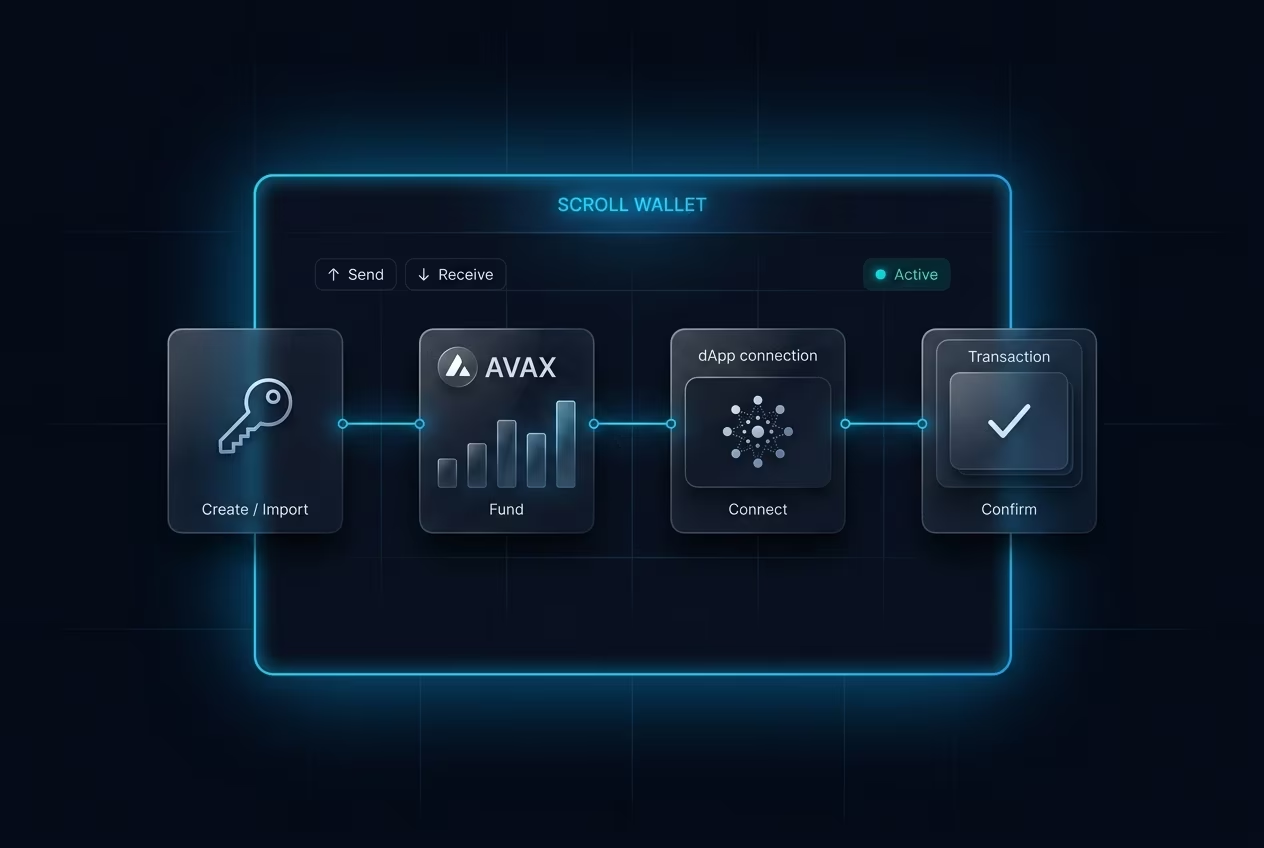
Working with an Avalanche wallet in a browser opens up a specific set of vulnerabilities - and you need to know them before you connect to any interface at all. Browser wallets provide real convenience: instant access, no installation other than an extension, seamless integration with dApps. But behind this convenience lies a structural attack surface that is fundamentally different than that of hardware or air-gapped solutions. Understanding exactly where the vulnerabilities lie is the first step to consciously working with any browser wallet.
Phishing. The most common threat and the most destructive. Attackers clone legitimate Avalanche interfaces pixel by pixel, register domains with one changed character, spread links through Discord servers, fake support accounts and paid search results. Once you enter the seed phrase or confirm a malicious transaction on a fake website, the funds disappear. No return mechanism. Forever. Compromised interfaces are a related but separate risk: even a legitimate site can be infected with malicious scripts via a hacked CDN, a third-party analytics library, or a front-end supply chain attack. You interact with what looks like a trusted wallet UI - and a script in the background quietly changes the transaction parameters.
Malicious browser extensions are another critical vector. Extensions work with elevated privileges inside the browser environment: they read the contents of pages, intercept clipboard data, and replace what you see on the screen. One compromised extension—not even related to crypto at first glance—can leak private keys or replace the wallet address right at the time of the transaction. An additional blow is local storage vulnerability: browser wallets often store encrypted key material in localStorage or IndexedDB, accessible to any script on the same origin. If the site you visit has an XSS vulnerability, this data can be extracted. A detailed technical analysis of how these vectors interact with each other can be found in the material about security of browser-based crypto wallets - the architecture is broken down there.
But the most underestimated risk is false trust in the convenience of the browser itself. One-click confirmations, permanent sessions, auto-connection - all this teaches you to move quickly and press “OK” without reading. In 2026, when multi-chain environments, bridge interactions and L2 fragmentation add complexity to every transaction, this habit is simply dangerous. One blind confirmation on a malicious contract - and not only the AVAX balance leaves the wallet, but also all tokens on all connected chains. At Scroll Wallet, we view browser wallet security as an architectural issue rather than a user literacy issue—which is why our solutions prioritize explicit confirmation flows, session scooping, and transparent permission mapping over raw convenience.
Storing serious amounts of AVAX in old browser wallets means keeping your entire fortune behind one lock, which is broken by one phishing email, one malicious extension or one infected device. Older generation browser wallets were designed for convenience, not to protect large positions. In 2026, when phishing tools tailored to Avalanche users operate in a semi-automatic mode and become increasingly difficult to detect, such an architecture is simply unacceptable - except for small retail.
The problem is structural. Legacy wallet stores a private key inside the browser, which shares memory and execution context with dozens of third-party scripts, extensions and tabs. No layer of insulation. No hardware confirmation. No secondary approval mechanism. If at least one link in this chain is compromised, the funds go away. Irrevocably. Secure AVAX storage requires complete separation of key management and the browser environment - something that modern architectures address through hardware signing, MPC key sharing, or threshold approval schemes. As Chainwire notes, Scroll's integration with Fireblocks MPC is a direct response to this gap: institutional governance logic keys, packaged in an infrastructure accessible to the average user.
In Scroll Wallet, the browser is only a display and interaction layer. No storage. Not signatures. Keys never reach browser runtime in recoverable form. Every transaction with AVAX or Avalanche smart contracts requires confirmation that occurs outside of the browser context. This is not an optional setting - it is a fundamental architectural decision. There is only one goal: to eliminate the scenario in which one compromised session nullifies a wallet that took months to build. If you're comparing options for secure AVAX storage in 2026, the question you ask any provider is not "do you support AVAX" but "where exactly does key signing happen and what can a compromised browser get?"
Choosing the right infrastructure before accumulation is incomparably easier than dealing with the consequences of an exploit. If you're weighing your options now, our best AVAX wallets of 2026 review breaks down the architectural differences between wallet types on a practical level. The pattern is clearly visible: all wallets that actually protect funds on Avalanche in 2026 have one thing in common - they do not consider the browser a trusted execution environment. Legacy wallets count. It is in this gap that most losses occur. And it is this gap that Scroll Wallet is designed to close.
To manage your AVAX assets securely within a unified interface, you can integrate your existing setup with our infrastructure. Explore how Scroll Wallet simplifies cross-chain interactions through a browser-based environment.
A regular web wallet on Avalanche provides access to money - Scroll Wallet gives you power over how, when and under what conditions this money moves. The difference is fundamental. Web wallets, designed for simple storage of tokens, were designed in a different era - not for the multi-chain environment with its risks in which users work today. Scroll Wallet was designed specifically for her. Every architectural solution, from key management to transaction verification, was created with one goal in mind: to close the gap between what you intend to do and what actually happens on the blockchain.
The most serious structural difference is working with private keys. Scroll Wallet uses MPC (Multi-Party Computation) architecture: the key is never stored and does not exist as a single point of vulnerability. This is not a cosmetic improvement. This eliminates the most common attack vector for self-custody of crypto assets. As reported by Chainwire, Scroll's integration with Fireblocks directly supports this security model - institutional MPC infrastructure now available to the average wallet user. At the top is connectivity to hardware devices: a physical signature layer for high-value transactions, without switching to a separate instrument. The combination of MPC plus hardware is something that the standard Avalanche web wallet simply does not offer.
Transaction simulation is another level where Scroll Wallet works differently. Before confirming any transaction, the wallet runs a simulation and shows the expected result: what goes out, what comes in, what permissions are issued. It’s critical when you interact with contracts that you didn’t write yourself. In parallel, active protection against phishing is built in - logic that catches suspicious domains, fake interfaces and addresses of known malicious contracts even before you sign anything. Not passive warnings. Blocking mechanisms built right into the transaction flow.
Looking for a secure Avalanche wallet that does more than just store tokens? The comparison is straightforward. A regular web wallet processes what you send. Scroll Wallet analyzes what you are about to send, checks it against known threats, simulates the result, and only then asks for confirmation. This is what a wallet with full control means - not just over the keys, but over the entire chain of decisions from intention to execution. For those working in the Avalanche ecosystem and related L2 environments, this level of control is not an option. This is the minimum standard.
If you're an active Avalanche user holding real value on-chain, your browser wallet is already a liability — not a safety net. The gap between convenience and actual security has never been wider, and the people most exposed are exactly those who can least afford a mistake: high-frequency traders, serious holders, and anyone deep in DeFi. Figure out which category you're in before an incident forces the decision for you.
Active traders running multiple transactions a day carry the highest surface area for attack. Every browser session is an open door — clipboard hijacking, script injection, phishing overlays. These aren't theoretical. They're documented, they're targeted, and they go after high-frequency users specifically. Large AVAX holders face a different but equally brutal reality: one compromised session can erase what took years to accumulate. For both groups, safer AVAX access isn't about stronger passwords or two-factor codes bolted onto a broken architecture. The login flow itself needs to be rebuilt. Not patched. Rebuilt.
DeFi users operating across multiple protocols, bridges, and L2 environments sit in a structurally exposed position that most people underestimate. Multi-chain fragmentation multiplies your attack surface with every approval transaction, every contract interaction, every bridge hop. If you're regularly signing across three or more protocols, you need transaction previews that are actually readable and confirmation steps that a compromised front-end cannot silently bypass. The avalanche core wallet guide covers the specific control layers that matter in the Avalanche environment — worth reading before you configure anything.
And if you've already seen one suspicious login attempt, one unexpected approval request, one transaction you didn't recognize? That's not a false alarm. That's the warning shot. The avalanche wallet login process should be treated as infrastructure — the same way you'd treat a server or a private key vault. If your current setup lacks hardware confirmation, session isolation, or at bare minimum a dedicated browser profile stripped of every other extension, you're carrying unnecessary exposure right now. The users who need stronger protection aren't edge cases. They're the majority of anyone actively participating on-chain in 2026.
Browser convenience is real, but it's no substitute for an architecture that actually protects your assets. When deciding how to truly store AVAX securely, the real question is which extension looks better. The main question is: are your private keys under your control? Is the signature environment isolated? Is the wallet built on verifiable security logic - not marketing promises? Convenience that costs you custodianship is not a feature. This is a vulnerability.
Phishing remains the number one cause of wallet compromise in 2026. Fake sites, cloned interfaces, malicious approval requests - all this does not require a protocol exploit. One second of inattention is enough. A self-custody wallet for AVAX does not solve anything if you sign a transaction without reading it - or connect to a site that mimics a legitimate dApp. The wallet is the last line of defense, and it only lasts when you treat every connection and every signature as an irreversible decision. Scroll Wallet is built around this reality: we show risk signals at the moment of action, not after the fact.
Multi-chain environments, L2 fragmentation and interaction with bridges have significantly expanded the on-chain attack surface compared to two years ago. More chains mean more attack vectors, more contract interactions, more chances for user error. This is why architecture is more important than interface polish. Scroll Wallet is designed to handle cross-chain complexity—not by hiding it from you, but by making it transparent. Because transparency at the transaction level is what makes informed choice possible. If you need a practical point of reference to evaluate your options, the Best AVAX Wallets 2026 guide breaks down the current landscape based on criteria that actually work in production.
The takeaway is straightforward: use a wallet with full key ownership, verify every approval before signing, choose an infrastructure that is honest about its own limitations. Scroll Wallet is not a zero-risk promise. No honest product promises this. We offer a system where risks are visible, control is in your hands, and the architecture does not trade your safety for a smooth onboarding experience. This is the standard we follow ourselves - and the same standard we should apply when evaluating any wallet in 2026.