AVAX Network Wallet: Secure Self-Custody and UX | Scroll Wallet
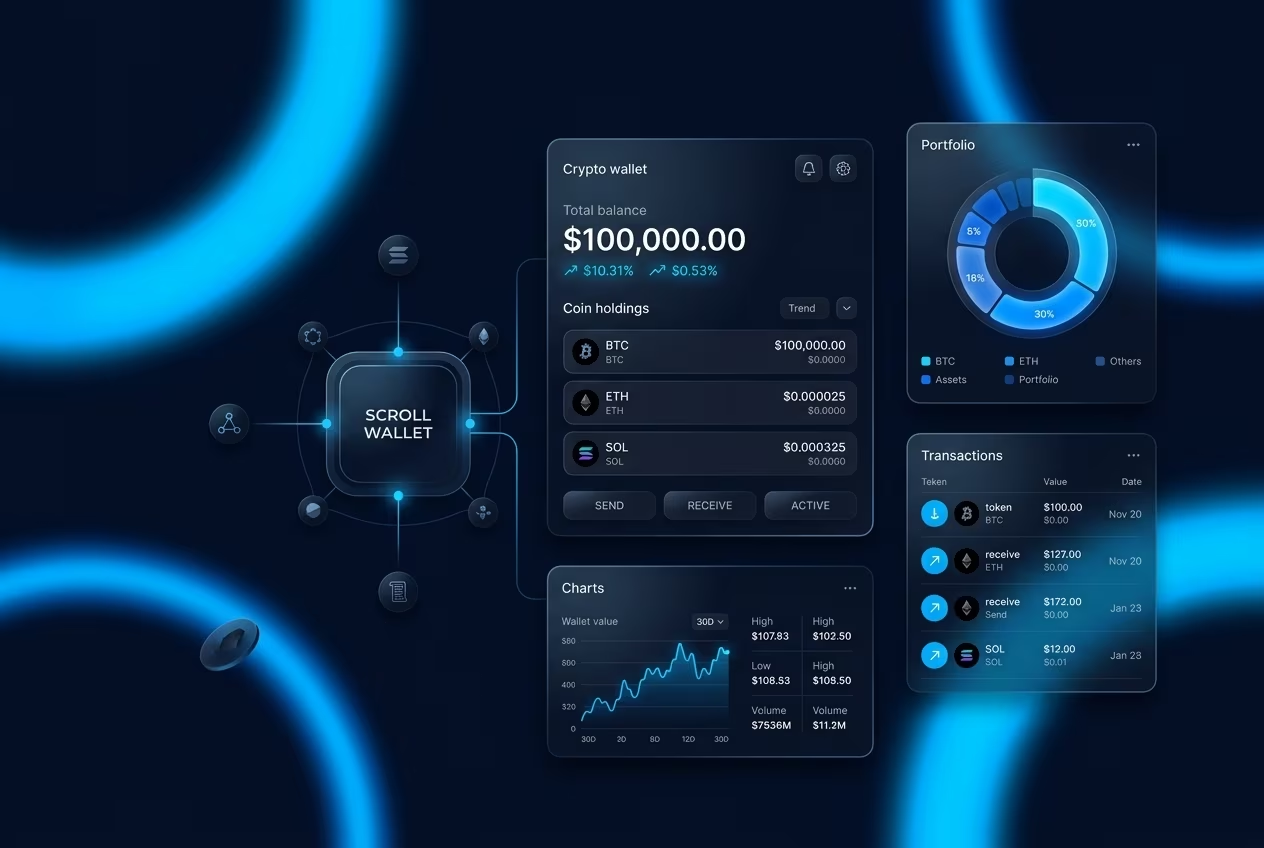
The avalanche core wallet serves as the primary gateway to the AVAX ecosystem, yet its complex three-chain architecture often creates significant friction for modern DeFi users. While it provides essential access to X, P, and C-Chains, the technical overhead of manual cross-chain transfers and fragmented asset visibility drives a growing demand for more streamlined, intuitive self-custody solutions.
Managing assets within the Avalanche ecosystem requires a clear understanding of its three-chain architecture. Core Wallet is specifically engineered to support the X, P, and C-Chains natively, ensuring you can manage staking, transfers, and dApp interactions without switching between multiple third-party tools. When moving assets between these environments, you may need to perform a cross chain swap to ensure liquidity is available on the correct chain for your intended action, such as moving funds from the P-Chain to the C-Chain for DeFi use.
| Feature / Chain | X-Chain (Exchange) | P-Chain (Platform) | C-Chain (Contract) |
|---|---|---|---|
| Primary Purpose | Sending and receiving funds | Staking and governance | Smart contracts and DeFi |
| Address Format | Starts with "X-" | Starts with "P-" | Starts with "0x" (EVM) |
| Staking Requirements | N/A | 25 AVAX (Delegator) / 2000 AVAX (Validator) | N/A |
| Direct External Sending | Supported | Not Supported (Requires transfer to X or C) | Supported |
| Gas Fees | Paid in AVAX | Paid in AVAX | Paid in AVAX |
March 6, 2024 at 11:00 am ET, the legacy Avalanche Wallet was permanently disabled - no warning, no transition period, just turned off. Hard termination, not smooth migration. The funds have not gone away, but the entry point has changed completely. As confirmed by Avalanche support, those who have password protected their account can obtain the keystore file via the old URL and import the credentials directly into Core - X-Chain and P-Chain balances when this does not disappear anywhere.
For stakers, the transition was designed to involve doing nothing at all right now. Active delegations and validator positions continued to accumulate rewards without a single second of downtime. Cross-chain transfers worked. Staking management has moved to Core Web, a browser extension or Ledger. And here's a figure that explains why continuity was a requirement rather than a wish: At the time of the shutdown, about 57% of circulating AVAX was staked. Half the network. Failure was simply unacceptable.
What has really changed is the scale of opportunities. The old Avalanche Wallet did one thing: manage AVAX. Core is a multi-chain platform that covers dApps, NFTs, Bridge transactions, Subnet and L2 networks, and is available as a web app, browser extension and mobile app. For those going through the process of setting up an Avalanche wallet today, this means one thing: start right away with Core, without any extra steps. Understanding how Core Wallet works now covers fundamentally different territory - cross-chain asset management, interaction with decentralized applications, cross-network operations that the old wallet was not even aware of.
From a product architecture perspective, this reflects a pattern that we at Scroll Wallet see all the time: single-chain, single-task wallets are dying. In their place is an infrastructure that matches the real complexity of the on-chain environment in 2026. A Wallet with support for multiple networks, bridge layers and application ecosystems is no longer a premium feature. This is the minimum bar. Avalanche’s transition from a legacy tool to Core is a clear example of how the wallet infrastructure must evolve in order to remain not just convenient, but generally working. If you are choosing a wallet now, the right question is not “does it support my current chain?”, but “will it handle everything I will encounter in the next two to three years?”
For US users, accessing avax wallet through a non-custodial arrangement is entirely viable in 2026 - and to understand why, we need to take an honest look at how self-custody works in a real-world regulatory environment. When you hold your own private keys, you're not using a financial intermediary - you're running software that interacts directly with the Avalanche network. This distinction carries weight—legally and practically. Non-custodial wallet does not store your funds, does not process transactions for you, and does not require you to trust a third party. Scroll Wallet is built on exactly this model: we provide the interface and infrastructure, but your keys never leave your device.
The regulatory picture for AVAX self custody in the US has become clearer. Not harsher - just clearer. As Avalanche Policy Coalition notes, the SEC has moved to an activity-based interpretation of crypto regulation—that is, it's not what you own, but what you do with it that matters. Storing, sending or receiving AVAX through a non-custodial avax wallet is a fundamentally different activity than trading on a centralized exchange or participating in an investment contract. This frame gives US users a clear path to continue working with self-custody tools without the compliance burden that falls on custodial platforms.
With self-custody comes direct responsibility. You control access, which means you control risk. In 2026, the most common points of failure are not at the protocol level. They are at the user level: lost seed phrases, phishing attacks that imitate wallet interfaces, blind signing of malicious transactions. Scroll Wallet counters these risks through simulated transactions, transparent permission mapping, and structured onboarding that forces you to confirm what you're signing before anything is executed. We do not promise to eliminate risk completely. But we are building the interface so that the most dangerous errors require you to consciously ignore the warning.
For American users, the practical path is simple: use a non-custodial avax wallet, keep the seed phrase under sole control, and treat each transaction confirmation as a decision point - not as a formality. Scroll Wallet was created specifically for this scenario. Full avax wallet access - without routing your assets through an intermediary who may be subject to account freezes, withdrawal limits or regulatory pressure. This is not a workaround. This is the right architecture for those who want to participate in on-chain activity on their own terms.
Understanding the cost structure and entry requirements is essential for managing your assets efficiently across the Avalanche ecosystem. While we focus on providing seamless infrastructure, you should be aware of how different chains within the network handle transaction costs and crypto staking rewards to minimize friction during cross-chain movements.
| Parameter | Value / Requirement | Notes |
|---|---|---|
| C-Chain Transaction Fees | Zero Gas (Subsidized) | Applies to most swaps and staking via Core Wallet; standard fees use EIP-1559 burn model. |
| Staking Yield (APY) | 7% – 10% | Estimated range for 2025-2026 based on network participation. |
| Validator Minimum | 2,000 AVAX | Required for full node operation and securing the P-Chain. |
| Delegation Minimum | 25 AVAX | Low entry point for users to participate in consensus without running hardware. |
| X-Chain & P-Chain Fees | Dynamic / Fixed Low | X-Chain uses fixed low fees; P-Chain scales by bandwidth and compute resources. |
After a staking migration on Avalanche, your balance can drop to zero in the wallet UI — while every single token sits untouched on-chain. This is a panic trigger we see constantly among wallet users. It happens because the wallet interface reads from a specific chain state that hasn't caught up with the updated staking contract. Your funds aren't gone. The display is just lying to you.
There's a real, documented case of this on the Avalanche Official Forum — a user watched their AVAX staking rewards and principal vanish from Core Wallet after a migration event. The post captures the dread perfectly: "I can see the transaction history, but my balance shows 0. Did I lose everything?" That person did everything right. Zero mistakes. And yet the interface made them feel like they'd lost it all. This is why balance visibility isn't some cosmetic nicety — it's a trust-critical function with real psychological weight. When you track avax portfolio across staking cycles, any gap between on-chain reality and what the UI shows creates genuine operational risk. Not theoretical. Real.
The root cause is architectural, not accidental. Avalanche runs P-Chain and C-Chain as separate execution environments. Staking lives on P-Chain. Most wallet interfaces default to C-Chain balances. After a migration or unstaking event, funds moving between chains may not surface in the wallet UI immediately — especially when the wallet doesn't actively poll both chains in parallel. This isn't user error. It's a UX gap baked into multiple wallet products across the ecosystem. Scroll Wallet handles it by maintaining synchronized reads across relevant chain states, so your balance view doesn't depend on which chain the interface happens to be querying at any given moment.
If your balance disappears after staking, here's what to do. Do not re-import your recovery phrase. Do not create a new wallet. Re-importing changes nothing about what the network holds — it only swaps the interface you're looking through. Instead, check your address directly on a block explorer for both P-Chain and C-Chain. If the funds appear there, the problem is display-side. Not custody-side. Secure avax storage means your keys stay unchanged through all of this — your recovery phrase is the only credential that matters, and it should never be typed into any site or form as a "troubleshooting step." Wait for the interface to sync. Or switch to a wallet that reads multi-chain state correctly from the start and skips the panic entirely.
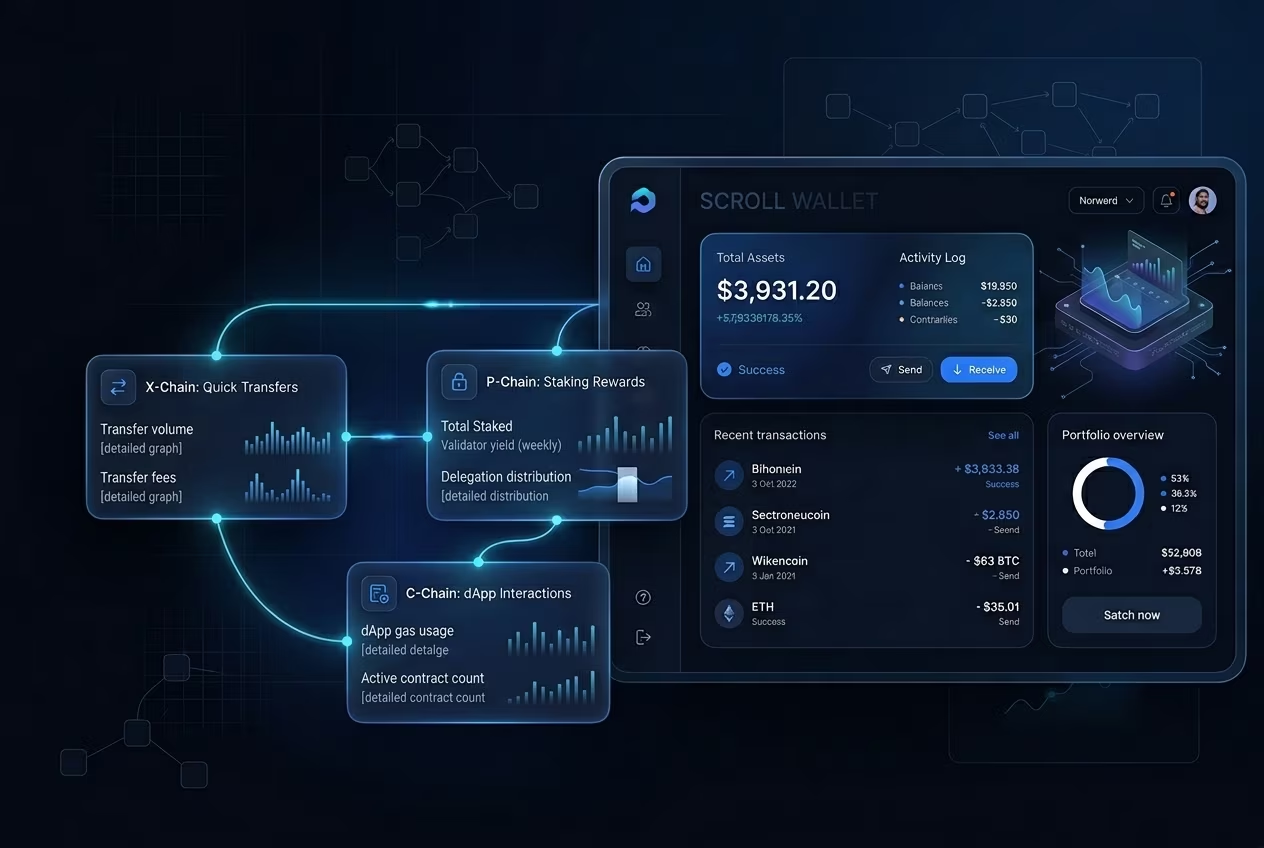
Managing assets across the Avalanche ecosystem requires a clear understanding of its multi-chain architecture to avoid permanent loss of funds. We have designed these steps to help you navigate the Core Wallet environment while maintaining the high security standards we uphold at Scroll Wallet.
The complexity of the official wallet is the main reason why users are ditching Core Wallet and looking for an alternative that won't slow them down in 2026. It's not just one broken feature. It's a matter of accumulated friction - from session to session. Confirmations pop up in stacks even before the first transaction has gone through. Switching the network requires manual addition. Throttle settings appear without any context. Each step is technically correct, but together they create a workflow that slows down and increases the chance of error just when the cost of error is greatest.
The problems with AVAX wallet usability are explained simply: the Avalanche ecosystem runs on several subnets at once - C-Chain, P-Chain, X-Chain - and Core Wallet treats each as a separate universe that needs to be navigated manually. If you move assets between DeFi protocols, it means endless context switches, separate confirmation streams, and no clear view of what you own at all. The cognitive load is real. When you manage positions on three networks and there is an unfinished bridge transaction hanging, a pop-up window asking you to confirm the network change is no longer a minor inconvenience. This is the decision point where mistakes happen. It is this fragmentation that pushes power users towards simpler infrastructure.
Scroll Wallet was built on a different principle: the wallet should reduce the number of decisions per session, and not multiply them. This means a single balance view across all supported networks, simplified confirmation flows, and no redundant approval layers for low-risk actions. If you want to understand how this approach scales, the multichain wallet 2026 model architecture explains the structural decisions that make a unified UX possible—without losing self-custody or verifiability on the blockchain.
The complexity of the official wallet is not a design accident. Most often, it reflects the architecture of the blockchain itself. But this does not mean that the interface must inherit each of its layers. The gap between what the protocol requires technically and what the user needs to see is where wallet design makes all the difference. Scroll Wallet absorbs this complexity at the infrastructure level to keep your workflow clean, auditable, and fast—without hiding the information you need to make informed decisions.
Managing Avalanche assets requires a wallet that eliminates multi-chain friction. We invite you to connect Scroll Wallet for direct AVAX support and a smoother, more secure experience in the 2026 on-chain environment.
Scroll Wallet is designed as a direct alternative for AVAX users who want instant access, clean controls, and minimal friction when staking and DeFi transactions. Most wallets for a multi-chain environment turn the work into a quest: confusing layers of permissions, separate interfaces for each network, slow transaction confirmations that ruin any work rhythm. Scroll Wallet takes all that away. One structured interface - both AVAX staking and DeFi interactions live in it as full-fledged operations, and not as functions added “for later”.
The real freedom of Scroll Wallet is in the architecture. How exactly network switching and transaction signing are processed. No manual configuration of RPC endpoints. No redundant permissions. No re-authentication when changing chains. Persistent session logic reduces the number of steps between intent and execution to a minimum. For AVAX users, this specifically means: staking delegation, liquidity provision, and bridge transactions, all in one confirmed stream, rather than three separate windows. Fewer steps mean less room for mistakes and phishing attacks.
Scroll Wallet is designed with simplified controls on purpose, because the complexity of the wallet UX is not a feature. This is a risk factor. In 2026, the majority of on-chain losses associated with user errors can be traced back to three reasons: misread transaction requests, incorrect network selection, and accidental approval of the wrong contracts. Scroll Wallet solves this directly: it shows only the information that is needed for a specific action. Clear labels of contract addresses. Gas valuation in fiat equivalent. Explicit warnings when a transaction deviates from expected parameters. You always know what you are signing - before you sign.
The real difference between Scroll Wallet and a standard multi-chain wallet is the cognitive load when actively working. A wallet that requires six fields to be verified before confirming a staking transaction is no safer. It just generates errors more often under time pressure. Scroll Wallet compresses the entire verification into a structured summary that is read in less than ten seconds—without losing any data. This is a conscious compromise: speed of perception without sacrificing transparency.
Before leaving Core Wallet, evaluate five specific criteria - they determine how you actually interact with the Avalanche ecosystem every day, and not in theory. A superficial comparison of wallets based on interface screenshots or ratings in the App Store will not tell you the main thing: whether the wallet supports C-Chain, P-Chain and X-Chain natively - or you will have to manually register RPC endpoints to simply see the balance. And technical gaps are not an abstraction. These include missed staking windows, dropped dApp transactions, and extra bridge fees.
The first criterion is native support for chains and abstraction between them. Core Wallet was built for Avalanche, so switching between C/P/X Chain is built into the very logic of the product, and not screwed on the side. If you move to MetaMask for the Scroll zkEVM ecosystem, you will gain access to another world, but you will lose everything Avalanche-specific. There is no native AVAX staking. There is no abstraction between subnets. There is also no direct dApp flow for AVAX protocols. For those who hold and stake AVAX, this is not a minor inconvenience. This is a fundamental hole in functionality. The second criterion is access to staking. Core provides native AVAX staking directly from the interface, without redirects to third-party services. If profitability from staking is part of your strategy, first figure out which assets and platforms provide truly sustainable results: our guide to best coins for staking will help you avoid making the wrong choice of infrastructure.
Experts Bytwork conducted a detailed analysis of Core Wallet on four axes - convenience, staking, dApps, self-custody - and the conclusion is clear: Rabby and Trust Wallet win on mobile devices, but pay for it with losses Avalanche-specifics. This is the real trade-off when choosing an AVAX wallet: you choose between ecosystem depth and cross-chain flexibility. A fully functional wallet for a heavy AVAX portfolio and a wallet for Ethereum L2 activity are two different tools. The third and fourth criteria—integration with dApps and convenience—follow the same logic. Core is tailored for Avalanche protocols, Scroll Wallet is designed for Ethereum zkEVM environment. Neither is better all-round. It all depends on where your activity actually takes place on the chain.
The fifth criterion is self-custody architecture. Both Core and Scroll Wallet are non-custodial: private keys do not leave the device. But Core goes further - it supports integration with hardware wallets, adding a physical signature layer for large transactions. In 2026, as phishing attacks and wallet exploits become more sophisticated, hardware support is not a bonus. This is a basic safety threshold for those managing serious positions. When comparing AVAX wallets, treat self-custody depth as a rigid filter, not a nice-to-have option. A wallet without hardware support is a wallet where your entire balance is protected only at the software level. Think for yourself what this means.
Core Wallet clearly works in its niche—but knowing where it breaks is just as important as knowing where it shines. If you stay within the Avalanche ecosystem, hold a limited set of assets, and work with proven dApps, Core will give you a clean, predictable experience. Managing assets between subnets without unnecessary switching, built-in bridge and swap in one window. No extra tabs. No running between platforms.
But here's where Core starts to get annoying - and it's completely predictable. Cross-chain operations outside of Avalanche? Crutches. Hardware wallet support? Scarce. Onboarding for a beginner without a Web3 background? Welcome to the wall. If you are simultaneously working with positions on Ethereum L2 and trying to access avalanche dApps, Core will force you to come up with workarounds. These are not bugs. These are architectural compromises. Core was built for Avalanche. This focus is both his main strength and his hard ceiling.
Easy control of AVAX is not about convenience. It's about safety. The more steps between you and the transaction, the more opportunities for error, phishing, or misdirected funds. A clear interface, readable confirmations, explicit permissions - these are not UX features, they are a risk reduction mechanism. It is this standard that underlies the Scroll Wallet architecture: each layer of user flow should remove ambiguity, not add it. Want to understand the foundation of this approach? Start with the custodial model—specifically, what it means to use a non custodial wallet and why that choice determines your actual control over your assets.
The bottom line is purely practical: use Core where it fits. Know its limits. Build your stack on proven infrastructure, not convenient assumptions. In 2026, choosing a wallet is a security decision, not just a UX preference. Multi-chain environments, bridge exploits, and phishing attacks have already proven that the wallet layer is not neutral. Choose tools that are honest about what they can do, honest about what they can't, and designed to keep you in control of the keys and decisions—every step of the way.