Avalanche Core Wallet: Why Users Seek Better Control | Scroll Wallet
Your avax network wallet must provide full control over private keys while simplifying the complex multi-chain architecture of X, P, and C chains. In 2026, users seek alternatives to fragmented interfaces because managing manual bridge transfers and custom RPC settings for Subnets often leads to critical errors or lost assets. At Scroll, we prioritize unified liquidity and zero-knowledge security to eliminate these technical hurdles for you.
On March 6, 2024, Avalanche Wallet ceased to exist - without warning or transition period, it simply turned off, and all users were faced with a single choice: Core Wallet. No soft deprecation. Hard break. The legacy wallet infrastructure was decommissioned, the interface went offline, and that’s it. According to the Official AVAX.network Migration Guide, the migration was designed so that no user would lose funds or miss validator payouts. No one was hurt. But there was no choice.
Core Wallet is not just a replacement. This is a tool class change. Where the old wallet was able to transfer tokens and manage staking, Core closes the entire stack: staking, interaction with dApps, NFTs, cross-chain bridges, access to Subnet - all in a non-custodial environment. Browser extension, web application, mobile client. Avalanche network support is no longer tied to a single point of entry. One wallet - multiple devices - without compromising on self-custody. This is an architectural shift, not a cosmetic one: it eliminates the situation where users are forced to reach for third-party tools or unofficial interfaces for features that the native wallet simply did not support.
There is another signal - about the long-term direction of the product. In 2025–2026, Core introduced seed abstraction: a mechanism that removes the dependence on classic seed phrases when restoring an account. Sounds technical. In practice, this is one of the most important changes in the distribution of self-custody risks in recent years. The leak of the seed phrase is still the main vector for compromising wallets. Reducing this attack surface without abandoning the non-custodial model is not a marketing ploy. This is a conscious infrastructure decision. At Scroll Wallet, we consider these architectural commitments to be a marker of who the wallet is being built for: for today's users or for the next generation of on-chain environments.
The main lesson of the Avalanche transition is structural. When the network consolidates native wallet infrastructure around one actively supported product, it kills fragmentation and raises the bar of expectations for the entire market. Legacy tools accumulate technical debt: outdated interfaces, unpatched vulnerabilities, unpredictable behavior during network updates. Replacing them with a single Core Wallet with a continuous development cycle is the right decision, even if it forces users to migrate. For those assessing the wallet infrastructure in 2026, the question is no longer whether the wallet exists. The question is whether it is actively supported, whether it is honest in its architectural trade-offs - and whether it can keep up with how multi-chain environments are actually evolving.
Choosing the right infrastructure for managing AVAX depends on your specific requirements for security, cross-chain mobility, and device preference. While native solutions offer deep ecosystem integration, multi-chain wallets provide the flexibility needed in an increasingly fragmented L2 and EVM environment. We have compared the primary options based on their architectural strengths and user experience trade-offs.
| Wallet Name | Type | Avalanche Support | UX & Complexity | Self-Custody |
|---|---|---|---|---|
| Core Wallet | Native (Browser/Desktop) | Full (Optimized for AVAX) | Simple for AVAX users; No mobile version | Yes |
| MetaMask | Hot Wallet (Multi-chain) | High (EVM Compatible) | Moderate; Universal interface | Yes |
| Ledger | Hardware (Cold) | High (via Ledger Live/Apps) | Complex; High security (Air-gapped) | Yes |
| Rabby / Trust | Multi-chain (Mobile/Web) | High | Optimized for daily mobile UX | Yes |
Data Source: Bytwork — AVAX wallet comparison covering Core, MetaMask, Rabby, daily UX, native support, and multi-chain options
Avalanche's multi-chain architecture is the only reason why the network creates real barriers for beginners where a regular EVM wallet creates nothing at all. Most Ethereum-compatible wallets work according to the same logic: connect, sign the transaction, ready. Avalanche cuts the network into three separate chains: X-Chain for asset transfers, P-Chain for staking and validator management, C-Chain for smart contracts and dApps. Each has its own address format, its own transaction logic, and its own commission structure. A person who opens avax wallet for beginners for the first time does not have the slightest intuitive reason to know which chain he needs right now. And this gap creates costly mistakes.
The most common one is sending AVAX to the wrong chain. The user receives funds on C-Chain, tries to stake them on P-Chain - and hits a wall. The funds do not disappear anywhere, but they become unavailable for the desired action until a manual cross-chain transfer is performed. A step that most interfaces hide in a submenu or label with technical jargon. This is not a user error in the classical sense - it is a direct usability problem with the avalanche wallet. When the interface does not explicitly show the context of the chain, routing errors become a predictable outcome rather than a random occurrence. Further - more: Avalanche sub-networks can have their own gas tokens, their own RPC endpoints and their own sets of validators. A user who has mastered X/P/C-Chain will still face a new learning curve every time they interact with a subnet application.
The difference between a wallet that is easy to navigate and a wallet that fails newbies is how aggressively it abstracts that complexity without hiding it entirely. Show which chain the user is in right now. Warn when a cross-chain transfer is needed before an action. Speak human language instead of technical identifiers. These are not cosmetic decisions—they are architectural. At Scroll Wallet, we treat chain context as a first-class UI element because we've seen the numbers: multi-chain routing errors are the top 3 reasons why users lose access to funds or abandon transactions midway. The Avalanche architecture will not become simpler on its own. This means that the wallet layer must do the translation work.
For those who choose avax wallet for beginners, the practical test is indecently simple: open the wallet, find the AVAX balance and check - does the interface tell you which chain it is in, without unnecessary digging? If this information requires more than two taps or a trip to settings, the wallet is not for you. The power of Avalanche is in its multi-chain design: fast finalization, isolated execution environments, flexible sub-networks. But this power is only available when the wallet takes over the routing logic. Without this, the architecture becomes a burden for anyone who does not understand protocols at the kernel developer level.
Selecting a secure AVAX wallet in 2026 requires a balance between rigorous security protocols and the functional speed of the Avalanche network. To protect your assets while maintaining high usability, we recommend evaluating your options based on these technical criteria:
Managing your AVAX assets requires a clear understanding of the underlying network economics. Following the Octane upgrade, transaction costs on the C-Chain have been significantly optimized, though they remain dynamic based on network demand. We have compiled the essential thresholds and fees for 2025-2026 to help you plan your transfers and staking strategy effectively.
| Cost Category | Value / Threshold | Notes |
|---|---|---|
| C-Chain Transfer Fee | 10–25 nAVAX (Base) | Dynamic; fluctuates with network load |
| P-Chain Transfer Fee | 0.001 AVAX | Fixed fee for platform chain operations |
| Delegator Minimum | 25 AVAX | Minimum required to start staking via a validator |
| Validator Minimum | 2,000 AVAX | Requirement to run an independent node |
| Staking APR | 7% – 11% | Depends on validator uptime and network parameters |
Data source: Avalanche Blog / Avax.network — Confirms Octane upgrade and lower C-Chain gas fee optimization
Self-custody does not remove the risk - it shifts it completely to you. No intermediaries, no freezing, no “contact support”. When you keep your own keys in a private avax wallet, no platform can rob you through its vulnerability. But here’s what no one likes to say out loud: if you lose your seed phrase, click on a phishing link, or sign a malicious contract transaction, there is no recovery mechanism. Architecture protects you from other people's mistakes. Not from yours.
The seed phrase is not a password. This is the wallet. The twelve or twenty-four words that the attacker obtains give him instant and irreversible access to all assets on all chains derived from that key. Phishing remains the main vector of attack: fake Scroll Wallet sites, fake support accounts, fraudulent airdrop pages - all this is tailored to one task, to pull out your seed. We are building Scroll Wallet without a single flow with a seed phrase request inside the interface. But it’s not in our power to protect you from the fact that you enter it yourself on someone else’s website. The rule is absolute: the seed phrase should not exist in the browser, in chat or on a screenshot. Never.
Wallet history is a compliance measurement that most users ignore until the first unpleasant surprise. As KYC Chain records, contact with “infected” funds and wallet screening are real risks right now. Transactions involving sanctioned addresses or flagged contracts create problems even for those who receive such funds by accident. This is why wallet hygiene is critical if you want to safely store avax: understand where the assets came from, do not touch unverified contracts and remember - on-chain history is public and eternal. A clean transaction history is not a bureaucratic formality. It is a practical asset when working with bridges, CEX withdrawals, and institutional DeFi protocols.
Pairing with a hardware wallet covers the most resistant attack surface - the signing environment. When a private avax wallet is paired with a hardware device, the private key never touches the machine with the Internet. Even if the browser is compromised, the transaction requires physical confirmation on the device. Scroll Wallet supports hardware pairing precisely because software signing alone is a structural weakness and not a matter of user discipline. Add to this whitelisting of addresses, simulation of transactions before signing and clear warnings when interacting with contracts - and you get defense in depth. No measure works on its own. But together they reduce the likelihood of a successful attack to a level that reflects a serious infrastructure approach - rather than just hoping for luck.
Avalanche is technically powerful - but it is the interface load on the average user that remains the main complaint of the expert community, and it is not going away. Developers and analysts working closely with the ecosystem honestly admit: the functions of Avalanche wallet - switching between subnets, multi-chain routing, interaction with validators - are really powerful. The problem is not what the network can do. The problem is how much cognitive work it requires of you before you can do anything useful.
Asset management in Avalanche involves navigating at least three separate chains: X-Chain for asset transfers, C-Chain for smart contracts, P-Chain for staking and governance. Each operates according to its own rules, uses its own address format and requires separate transaction logic. For an experienced developer, this is an elegant architecture. For a user who just wants to hold AVAX, stake it, and occasionally log into a DeFi protocol, it's a fragmented experience, more akin to systems administration than financial activity. Experts are unanimous: this fragmentation is the main reason why mass adoption of native Avalanche wallets is stuck at the level of the average user.
A normal avax wallet must abstract this complexity - but not hide it completely. This is the design contradiction that most existing solutions have not resolved. Some wallets flaunt every technical layer and drown newcomers. Others hide too much - and leave experienced users without the necessary control. Expert consensus points to a third path: progressive disclosure - simple scripts by default, but advanced settings available without diving into documentation. It is this architectural philosophy that underlies Scroll Wallet. The interface shows a single, coherent view of your assets and actions, and the routing logic under the hood itself selects the desired chain, calculates commissions and builds a sequence of transactions.
The main conclusion of the expert analysis is simple. Avalanche's infrastructure is not a bottleneck. The bottleneck is the wallet design. The networks that solve the UX problem first will capture the next wave of users—not because they are technically superior to the competition, but because they remove the friction that prevents normal people from participating. If you are choosing a wallet for long-term work in Avalanche or any multi-chain environment, do not ask about what functions are stated in the list. Ask something else: how many decisions does your wallet make correctly for you - before you even have time to think about it.
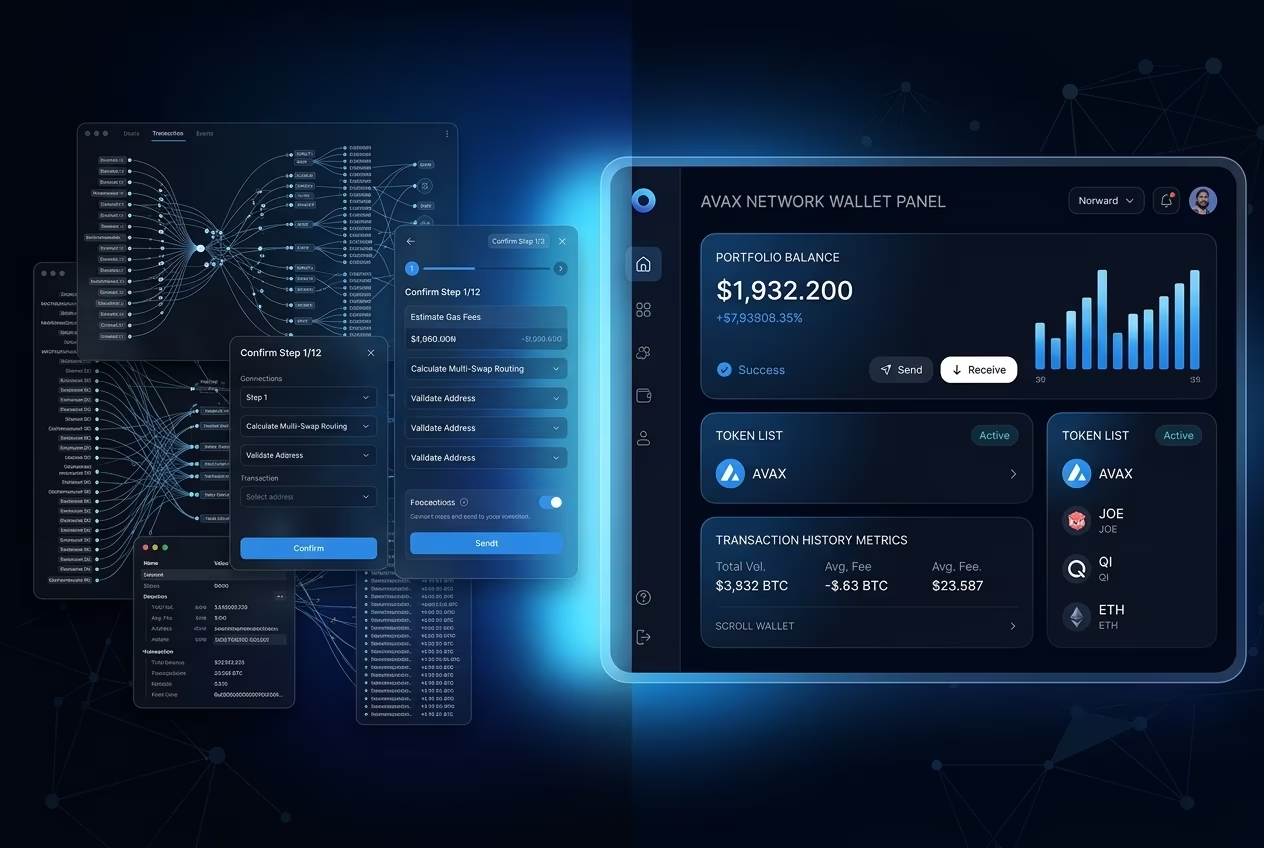
Scroll Wallet was created for those who want real control over assets - without unnecessary layers, without guesswork, without interfaces that hide more than they show. By 2026, the on-chain environment was completely fragmented: multi-chain deployments, L2 bridges, competing commission structures - all this creates real friction for the average user. Scroll Wallet was designed specifically against this friction. Less time deciphering transaction flows - more time making decisions with a cool head. Every screen, every confirmation step, every permission request is designed so that you understand what is happening before you click “confirm”.
Asset control is not a marketing thesis. You are holding the keys. You authorize every action. No third-party logic will move funds without your explicit consent. This is especially important in the AVAX ecosystem, where a typical flow often entails several bridge contracts, layers of wrapped tokens and chains of protocol-specific approvals. Scroll Wallet puts it all into one easy-to-read interface—so you don't have to dig into third-party documentation just to understand what a transaction will do to your balance.
Operational friction is one of the most underestimated risks in Web3. The confusing interface is killing me. Not metaphorically - literally: approving the wrong contract, sending to the wrong address, missing a commission spike that cleaned up more than expected. Scroll Wallet answers this simply: it displays exactly what matters - the destination address, gas valuation, type of interaction with the contract, the amount of tokens. Everything is visible until the signature. No “simplified summaries” that hide what is really happening behind a beautiful wrapper. Clarity is a safety feature. Not aesthetics.
The result is a wallet for those who have already been burned by opaque interfaces. And for those who just want to know exactly what they are doing - every step of the way. Control in Scroll Wallet is tested by one question with every design decision: does it add clarity to the user or take away from it? If it takes away, the feature doesn’t come out. It is this standard that separates Scroll Wallet from tools that pursue the volume of features at the expense of operational reliability.
In 2025–2026, non-custodial wallets in the US occupy a fundamentally different legal universe than custodial services — and if you hold AVAX, that gap has direct, immediate consequences for how you operate. Run a self custody avax setup, and your wallet provider faces zero KYC or AML obligations. None. The identity checks, transaction monitoring, broker registration requirements that strangle exchanges — none of that touches a wallet where you hold the private keys. Sumsub confirms it explicitly: non-custodial wallets sit outside KYC/AML and broker rules under current US crypto regulation. The full tax burden lands on you, and only you.
The IRS 1099-DA rule — requiring exchanges to report crypto sales above $600 — targets custodial platforms. Your avax wallet with self-controlled keys? No third party files anything on your behalf. Every swap, every sale, every transfer that realizes a gain or loss: that's your problem to track. AVAX is property under US tax law, which means every disposal is a taxable event you must self-report. The SEC's May 2025 decision to exempt non-security crypto assets from Rule 15c3-3 — the broker-dealer custody rule — hammers the point home: self-custody sits entirely outside the traditional compliance framework. Not a loophole. The intended architecture.
Here's the trade-off nobody likes to say out loud. Legal clarity cuts both ways. No regulatory oversight also means no institutional safety net — no custodian to recover your funds when you lose access, no compliance layer watching for suspicious outbound transfers, no automated reporting to save you at tax time. Scroll Wallet is built around this reality, not against it. We don't hold your keys. We don't generate tax reports. That's not what a non-custodial wallet does, and pretending otherwise would be dishonest. What we do deliver: transparent, auditable infrastructure that keeps you in full control while cutting the operational risks that come with it — phishing-resistant signing flows, clear transaction previews, multi-chain support that never obscures what you're actually approving.
The bottom line for US-based AVAX users is blunt: self-custody is legally permissible, operationally powerful, and entirely your responsibility. No registration. No identity verification with your wallet provider. No waiting on a 1099. But accurate records of every on-chain action? Non-negotiable. Independent gain reporting? Required. Banks and OCC-regulated entities can dabble in incidental crypto activity, but self-custody stays completely outside that perimeter. Choose an avax wallet where you control your own assets, and you're choosing a model where the law hands you real freedom — and where that freedom holds exactly as long as the infrastructure and habits you build around it do.
The best wallet for AVAX is the one that gives you complete control over your assets without turning this responsibility into a daily nightmare. After analyzing everything that is on the market in 2026, the conclusion is harsh: self-custody of keys is not an option, it is a minimum. But self-custody alone is not enough. A wallet that dumps raw technical complexity on you without any guardrails is not “advanced features.” This is a source of loss. The right avalanche portfolio wallet combines verifiable key ownership with an interface that physically prevents you from screwing up.
Secure access to Avalanche is not just a matter of “buy hardware or download a well-known client.” Everything is more complicated. How does the wallet handle phishing vectors? What exactly does it show you before signing the transaction? Does it provide a clear picture of what is happening across multiple networks and bridges? In an environment where AVAX moves between X-Chain, C-Chain and P-Chain - and increasingly through L2 deployments - the wallet is your first line of defense. If this line is opaque or crookedly designed, no amount of personal caution will save you.
Scroll Wallet was built precisely around this contradiction. We don't consider UX simplicity and security to be competing goals. Every interface decision is made with one goal in mind: to reduce the attack surface without making the process unreadable. Clear transaction previews. Structured risk signals. An architecture where you don't need to understand the low-level mechanics of the protocol to make a secure decision. The best wallet for AVAX is not the one with the most features. One in which the right action is the simplest action.
If you are evaluating the current setup or choosing a wallet for the first time, use a simple test. Can you read exactly what the transaction will do before you sign it? And only you have a copy of the private key? If the answer to at least one question is “no,” the risk is real and measurable. Scroll Wallet is designed so that both answers are always yes. This is the standard by which we test every product solution.