How Does Staking Make Money? Easy Guide For Beginners 2026 | Scroll Wallet
To learn how to stake TRON effectively, you must freeze your TRX tokens to gain Voting Power and network resources like Energy or Bandwidth. This process allows you to support Super Representatives while earning daily rewards. By staking your assets, you transform idle capital into a utility-generating engine that covers transaction costs and provides consistent protocol yields.
Setting up TRON staking requires a precise sequence of actions to ensure your assets are productive while remaining under your full control. We have designed the Scroll Wallet interface to simplify these technical requirements, reducing the risk of manual errors during the delegation process.
Choosing the right staking method depends on your priority: maximum control, ease of use, or capital efficiency. While native delegation offers the highest level of decentralization, modern liquid staking options provide significantly higher yields by utilizing energy lending markets. At Scroll Wallet, we focus on simplifying these complex on-chain interactions to ensure you can manage your assets securely without navigating fragmented interfaces.
| Staking Method | Estimated Yield | Flexibility | Setup Complexity | Key Advantage |
|---|---|---|---|---|
| Native (Self-Custody) | 3–5% APY | 72hr unbonding | Medium (SR voting) | Full control & decentralization |
| Exchange Staking | ~5% APY | Instant (Platform-dependent) | Low (One-click) | Easiest for beginners |
| Liquid Staking | 15–40% APY | High (Liquid tokens) | Medium (Token swap) | Boosted yield via energy lending |
Data source: Milk Road — Detailed comparison of TRON staking methods
TRX staking runs on two on-chain reward engines — block production and voting — and together they set the real yield ceiling before any platform takes its cut. The TRON network pushes 16 TRX per block to the 27 Super Representatives handling block production. That's roughly 460,800 TRX hitting the network daily at the block level alone. Then another 160 TRX per block flows out as voting rewards — around 4.6 million TRX every single day, split proportionally across the top 127 SR candidates by vote weight. Your slice of that pool scales directly with how much total vote weight your staked TRX carries. More competition means thinner margins. Simple math.
According to Staking Rewards, effective net returns for SR voting land around 3–5% annually once you factor in SR brokerage fees — which range anywhere from 0% to 20% depending on who you delegate to. Platform numbers shift that picture fast: Kraken runs 1.73% flexible and 3.5% on a 14-day bonded structure, Coinbase sits at 3.2%, and Nexo advertises up to 11%. The spread between 1.5% and 12% across platforms isn't random — it reflects lock-up terms, fee structures, and whether a platform actually passes through full on-chain rewards or quietly pockets a margin. If you're comparing options for high APY crypto staking, chasing the headline number without understanding what's behind it is a fast way to get disappointed.
Here's the yield driver most stakers completely miss: Energy leasing. When you stake TRX, you generate Energy — the computational resource that covers smart contract interactions on TRON. You don't have to consume it yourself. Lease it to dApp users and protocols that need it to pay transaction fees, and you've just added an income layer on top of standard voting rewards without touching your principal. During high dApp activity, Energy leasing rates climb and your effective APY can push well above the 3–5% baseline. Quieter periods? The contribution shrinks. But it's still additive. Every basis point counts.
Scroll Wallet is built specifically so none of this stays hidden. When you stake TRX through Scroll Wallet, you get the full breakdown upfront — voting reward share, Energy generation rate, leasing potential — not a single blended number designed to look good in a comparison table. The gap between a 3% and a 7% effective yield usually comes down to two things: whether you're capturing Energy leasing upside, and whether your SR passes rewards through efficiently. Scroll Wallet makes both of those factors visible and actionable from day one, not buried three clicks deep in documentation nobody reads.
TRON runs on two resources — Energy and Bandwidth — and how you manage them decides whether your transactions cost real money or practically nothing. Bandwidth covers the raw byte size of every on-chain transaction. Every account gets a free daily reset of 600 Bandwidth points, which is enough to push most simple TRX transfers through at zero cost. Energy is a different beast entirely. It only gets consumed when you touch smart contracts — sending USDT over TRC-20, executing DeFi calls, anything that talks to on-chain code. Energy doesn't replenish for free. That's the reason a basic TRX send feels costless while a USDT transfer quietly burns a little TRX each time.
When your account carries enough Energy and Bandwidth to cover what you're doing, the network processes it clean — no TRX burned. That's the mechanic behind what people loosely call "free" transactions. But the moment your Energy hits zero and you trigger a smart contract call, the network pulls TRX straight from your wallet to make up the difference. As Ledger Support confirms, this isn't a fee in any traditional sense — it's a resource consumption model that produces real costs when those resources run out. And the numbers aren't trivial. A single TRC-20 transfer can eat anywhere from 30,000 to 65,000 Energy units depending on contract complexity. Do that daily without a staked position backing you up, and it adds up fast.
The most direct way to keep your Energy topped up and slash what you'd otherwise spend is to stake TRX. Stake it, and the network allocates Energy and Bandwidth proportional to your position — letting you transact at near-zero cost for as long as that stake holds. This is exactly where wallet infrastructure stops being a background detail and starts mattering. Scroll Wallet surfaces your current resource balances before you confirm anything, so you know upfront whether a transfer draws from your Energy pool or burns live TRX. That visibility was built in deliberately — because hiding resource data behind a confirmation screen is how unexpected burns happen. If you're comparing where to stake for better resource efficiency, low fee staking options are worth a hard look before you commit.
TRON's cost structure rewards anyone who thinks a week ahead. Keep a staked TRX position sized to your typical transaction volume and most of your activity runs on allocated resources rather than live burns. Scroll Wallet tracks your Energy and Bandwidth consumption over time and puts that data somewhere readable — so you can top up your staked position before it runs dry, not after the unexpected charge already hit. The resource model isn't complicated once you've seen it clearly. And once you have, the network's real cost advantages stop being theoretical and start showing up in your wallet balance.
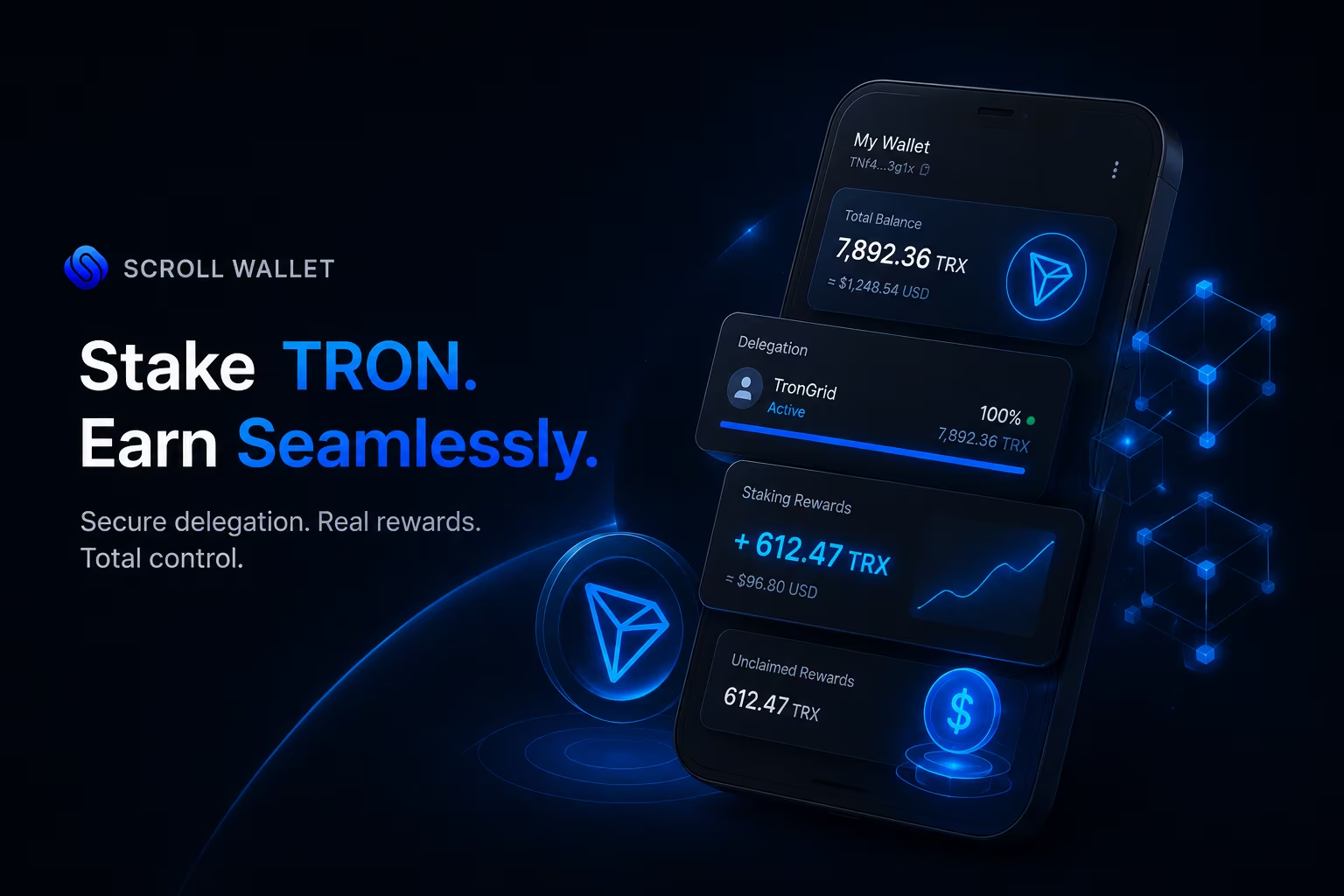
Scroll Wallet turns TRON staking into a two-minute task — no validator research, no spreadsheet comparisons, no technical headaches required. Most wallets dump that homework squarely on you: hunt down validators, decode commission structures, manually track when your funds unlock. Scroll Wallet cuts all of that out. The moment you initiate staking, the system routes your TRX to optimized validator nodes based on live network conditions — you just watch the rewards accumulate.
The staking flow runs on three rails: clarity, speed, and zero decision fatigue. Connect your wallet. Pick your TRX amount. Confirm. Done — under two minutes, start to finish. No buried menus. No cryptic terminology that sends you down a Wikipedia rabbit hole. This simplicity isn't cosmetic. TRON runs on a Delegated Proof-of-Stake model, which means your yield lives or dies by the validators you delegate to — pick a sluggish, high-commission node and you're quietly losing money every epoch. Scroll Wallet's automated routing handles that selection entirely, weighing validator uptime, historical performance, and fee structure so you don't have to become an analyst just to earn passively.
Once you're staked, management stays just as clean. Your position, accrued rewards, and unlock timeline all live on one dashboard screen. Add to your stake, claim rewards, or begin unstaking — all without bouncing between pages or signing a parade of disconnected transactions. The TRON network enforces a standard unstaking period before your TRX goes liquid again, and Scroll Wallet shows that countdown clearly at every step. No surprises. That transparency was a deliberate engineering choice, not a last-minute checkbox. The management layer was built specifically to kill the three mistakes that cost stakers the most: missed unlock windows, forgotten reward claims, and accidental double-delegation.
If you're comparing TRON staking options right now, the real question isn't which wallet technically supports TRX — almost all of them do. The question is which one cuts operational overhead enough that staking stays sustainable for months, not just the first week. Scroll Wallet's entire premise is that infrastructure should absorb complexity so you don't have to carry it. Self-custody and private key security remain your responsibility — full stop, no tool changes that. But within those boundaries, Scroll Wallet offers the most direct path from holding TRX to actively earning rewards, with enough process visibility that you always know exactly where your funds stand.
While TRON staking offers consistent on-chain yields of 3–5% APR, you must understand the technical trade-offs involved. Managing your assets through Scroll Wallet ensures you maintain full control, but external factors like validator performance and network lockups remain. We have mapped the primary risks and the specific actions you should take to mitigate them.
| Risk Type | Impact | Mitigation Strategy |
|---|---|---|
| Liquidity Lockup | 72-hour delay | Plan withdrawals in advance; do not stake funds needed for immediate liquidity. |
| Validator Downtime | Reduced rewards | Vote for top-tier Super Representatives (SRs) with proven uptime records. |
| Self-Custody Errors | Total fund loss | Secure your TRON private key offline and double-check all transaction UIs. |
| Exchange Counterparty | Asset freezes | Avoid custodial platforms; use non-custodial solutions like Scroll Wallet for on-chain safety. |
Every time you claim TRON staking rewards, the IRS is watching — under Revenue Ruling 2023-14, each reward event hits your taxable income immediately, valued in USD at the exact moment TRX lands in your wallet. Federal rates between 10% and 37% kick in right then. Not when you sell. Not when you convert. The second you gain control over those tokens, the clock starts — and ordinary income tax starts with it. State taxes pile on top. There is no grace period here.
Then comes the second punch. When you eventually sell or swap those rewards, capital gains tax enters the picture — calculated on the spread between your sale price and the fair market value you locked in at receipt. That original value becomes your cost basis, and it matters enormously. Hold under 12 months and you're paying short-term rates, which mirror ordinary income — brutal. Stretch past a year and long-term rates of 0%, 15%, or 20% become available depending on your total income bracket. As TRES Finance details in their breakdown of Revenue Ruling 2023-14, self-employment tax of up to 15.3% can also apply if the IRS classifies your staking as a business rather than passive participation. Two layers of tax. One asset. Plan accordingly.
Reporting lands on Form 1040 Schedule 1 as Other Income for individual stakers — Schedule C if the IRS decides your operation looks more like a trade or business. Either way, three data points are non-negotiable for every single reward event: acquisition date, USD fair market value at receipt, and full disposal details when you eventually sell. Miss any one of these across hundreds of micro-distributions and you're reconstructing records retroactively under pressure. That is not a position you want to be in. Accurate tracking infrastructure matters as much as the staking mechanism itself — your records are the foundation of a defensible tax position, full stop.
Scroll Wallet is built for exactly this operational reality. Claim TRON staking rewards through Scroll Wallet and the interface surfaces what you actually need — timestamps, amounts, on-chain transaction references — organized from the moment rewards arrive. Every claim event is a financial record, not just a balance update. Clean data at the wallet level means less reconstruction work at tax time, and lower exposure to the kind of reporting gaps that draw IRS scrutiny. That is the practical difference between staking carelessly and staking smart.
Unstake TRON and your tokens vanish into a 14-day lockup — that's the protocol's mandatory cooldown before any TRX lands back in your available balance. No exceptions, no shortcuts, no platform can override it. During those two weeks, your tokens sit frozen: untransferable, untradeable, unusable as collateral. This isn't a quirk you work around. It's a hard constraint you schedule around.
The math is brutally simple. Need liquidity by Friday the 14th? You'd better have triggered the unstake process by Friday the 1st — at the absolute latest. Most users don't do this math. They unstake reactively, mid-market move, and then watch the window close on them. The smarter play? Treat the 14-day period like a fixed appointment in your calendar, not a rough estimate. And if you're juggling multiple staking positions, stagger your unstaking requests across different dates. That way you're not waiting on one massive unlock event — you're creating a rolling stream of accessible liquidity instead.
Platform choice matters more than most people admit. Clunky interfaces bury your unlock timeline, skip reminders entirely, and force you to dig through block explorers just to figure out whether your TRX is claimable yet. The result? Tokens that finished unlocking days ago, sitting idle because the user lost track. Scroll Wallet was built to eliminate exactly that friction — unstaking status is surfaced directly in the interface, with clear timelines showing precisely when your TRX becomes available. No archaeology required. That visibility isn't a bonus feature; it's the baseline experience stakers actually deserve.
A few mechanics beyond the 14-day window are worth burning into your mental model. The moment you unstake, resource generation on those tokens stops — so this should be a deliberate decision, not a panic move. Planning to restake after your liquidity event? You wait for the full unlock, full stop — there's no way to compress the cooldown. And network congestion can occasionally slow down claim transaction confirmations, so padding your liquidity timeline by a day or two isn't paranoia. It's just good practice. Know these constraints before you need them, and you stay in control. Ignore them, and the protocol decides your schedule for you.
Self-custody TRON staking done right means one thing: a dedicated app that puts your rewards front and center, not buried three menus deep. When you stake TRX, you delegate voting power to a Super Representative while your tokens stay locked under your own private key. Not transferred. Not handed off. You keep ownership — you just put it to work. The architecture is solid. What separates a frustrating experience from a clean one is the tool sitting between you and the network.
Here's the part most staking interfaces quietly gloss over. TRX staking yields are tied to block production and Super Representative performance, which means your actual returns shift depending on which validator you pick and how reliably that validator shows up. Kraken's staking data confirms this dynamic — APY figures are network-level estimates, not guarantees. Most apps flatten this complexity into a single percentage and call it a day. Scroll Wallet doesn't. You get the validator's historical performance, live reward rate, and accrued earnings in real time — no block explorer tab-switching required.
Scroll Wallet was built around a single non-negotiable: you should never be left guessing about your stake. The interface shows the exact TRX frozen, the bandwidth and energy resources generated, live reward accumulation, and the unbonding window before your funds go liquid again. No hidden steps. No confirmation limbo. No third-party custodian holding your keys while you hope for the best. Your keys stay with you. Full stop. This is what treating UX as infrastructure actually looks like — not a polished skin over a confusing process, but a transparent view into every layer of what's happening.
The bottom line is blunt: self-custody TRON staking is genuinely low-friction when the wallet is purpose-built for it. The risks are real — validator downtime, reward variability, the 14-day unstaking window. None of those go away. But manageable risk and invisible risk are completely different things. Scroll Wallet makes them visible at every step, so you're making decisions with full information rather than discovering the fine print after you've already committed. When you're comparing staking options, stop asking only which network pays the most. Ask which tool actually shows you what you're getting into — and what you'll walk away with.
From validator selection to unstaking windows, this TRON staking guide cuts through the noise and hands you a working system — rewards, risks, and the wallet decisions that make or break every step. For anyone approaching TRON staking for the first time, here is the honest summary: the mechanics are not the hard part. The execution environment is. A wallet that buries fee breakdowns, lags on confirmations, or turns a three-step process into a guessing game is not a neutral tool — it is an active liability.
Rewards are real. Consistent. But they do not happen automatically just because you clicked "stake." Understanding crypto staking rewards means tracking three variables simultaneously: the size of your position, the uptime record of the validator you delegated to, and your grip on the lock and unstaking periods. Miss that last one and your funds sit frozen while the market moves. Scroll Wallet puts all three variables on a single screen — no tab-switching, no raw chain data, no guesswork.
The risks here are specific. Not vague. Validator downtime bleeds your effective yield quietly, over time. Phishing attacks targeting wallet approval screens are the sharpest threat in 2026 — one careless click, and the damage is irreversible. Unstaking delays are baked into the protocol itself; no wallet removes them. What a well-built wallet can do is make sure you see the exact timeline before you sign anything. That is the principle Scroll Wallet was designed around — every irreversible action gets a confirmation screen showing the precise outcome, in plain language, before your signature commits it.
So if you are staking TRON for the first time, the practical playbook is short. Use a wallet that shows you what you are actually signing. Pick validators with documented uptime — not promises, records. Never stake funds you might need liquid inside the unstaking window. And protect your wallet credentials like the financial account they are. The infrastructure holds up. Your habits around it are what determine whether you earn — or just learn the hard way.