Best Bitcoin Lightning wallet: Speed and Security | Scroll Wallet
A lightning compatible wallet must provide instant transaction finality, minimal routing fees, and a non-custodial architecture to ensure you maintain full control over your private keys. In 2026, users demand seamless Bitcoin integration without the technical burden of manual channel management or the high on-chain costs of opening payment paths. We focus on delivering a secure, high-performance environment where speed meets absolute transparency for every digital asset transfer.
Fast Bitcoin payments only make sense when the entire experience works—not just transaction speed. Speed is essential. But far from sufficient. When rooting drops, when the wallet requires constant online access, when checkout breaks down in the middle of payment, the saved milliseconds on confirmation turn into nothing. The UX falls apart before the speed benefit even reaches the end user.
Lightning Network wallets are a perfect illustration of this gap. They carry a set of structural UX barriers that kill the lightning payment experience in practice: the requirement of constant online means that as soon as the node goes offline, the payment quietly fails. Multiple signature validations during repeated rooting attempts add delay and chaos. Background processes on mobile devices interrupt the payment flow at the most inopportune moment. Difficulties with hardware integration create friction even at the setup stage - before a single payment is made. Experts Unbounded Capital say directly: technical problems of Lightning - rooting failures, risks of constant online - these are not rare cases. It's the protocol's structural properties that hit everyday users every day. The result is dropped checkouts, frozen confirmations and undermined trust in the payment layer itself.
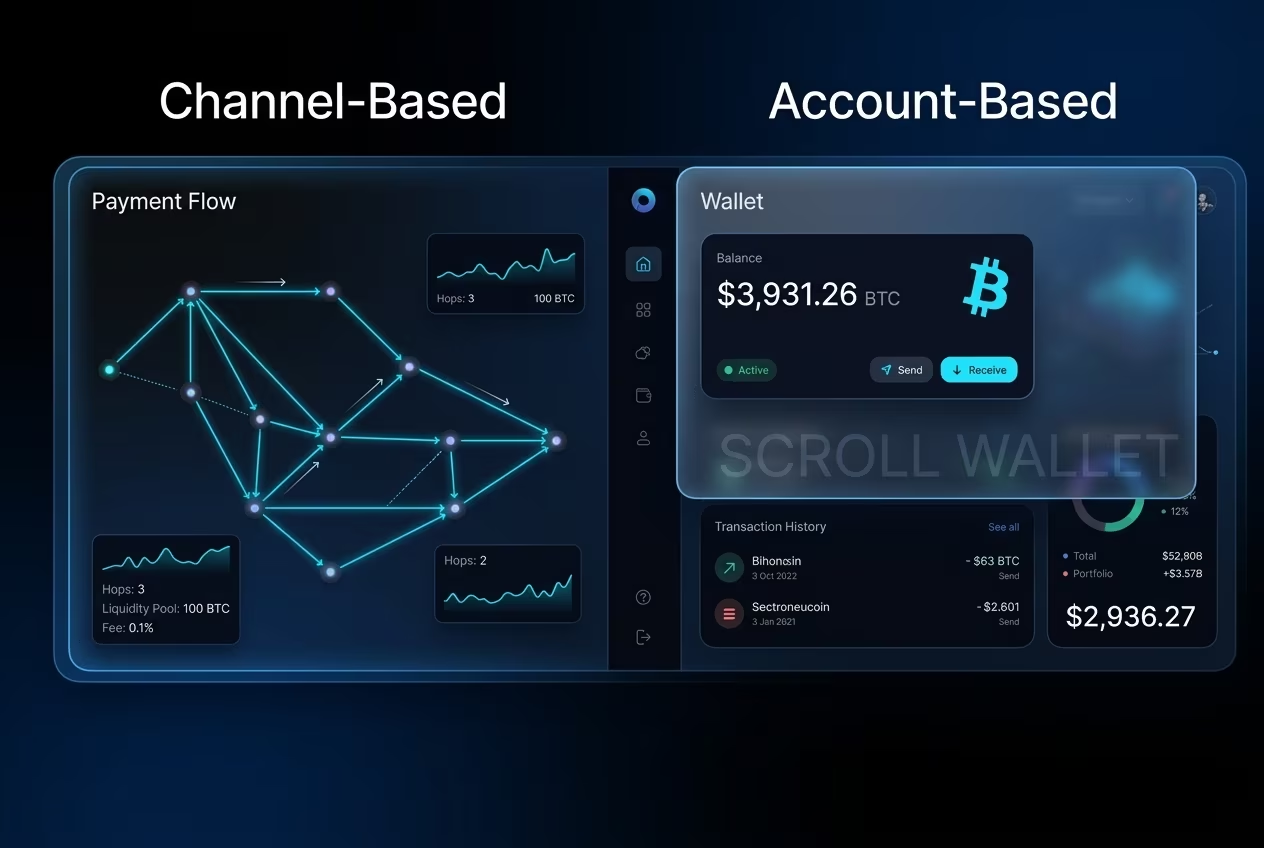
This is why account-based architectures provide a more reliable basis for layer2 crypto payments. No routing tables, no restrictions on channel liquidity, no dependence on peers - account-based wallets simply cut out entire classes of failures. You don't need to manage channel capacity or go online to receive funds. The payment either goes through or it doesn’t, with a clear, predictable result. It's this predictability that makes fast Bitcoin payments actually commercially viable, rather than just impressive on paper.
At Scroll Wallet, we built our payment architecture around one principle. Speed is important. But reliability and clarity at the time of payment are more important. A payment flow that drops in 5% of cases due to rooting errors is not a fast payment system. This is an unreliable system with quick moments. We designed Scroll Wallet to remove the very conditions for such failures:
The goal is a payment experience where speed and success rate move together. And not in different directions.
When choosing between a Lightning-compatible wallet and Scroll Wallet for your daily transactions, you must weigh the trade-offs between instant micro-payments and a comprehensive DeFi-ready infrastructure. While Lightning is optimized for high-frequency Bitcoin spending, we have designed Scroll Wallet as a secure L2 ZK-rollup solution that balances low fees with advanced security features. Understanding the custodial vs non-custodial wallet architecture is essential for managing your own assets in 2026.
| Feature | Lightning Wallets (e.g., Phoenix) | Scroll Wallet (L2 ZK-Rollup) |
|---|---|---|
| Transaction Speed | Instant | 1–5 seconds |
| Average Fees | 0.1–1 sat/byte | $0.001 – $0.01 |
| Self-Custody | Full (Non-custodial) | Full (Hardware key support) |
| Setup Complexity | Simple (No node required) | Standard (Seed phrase/App) |
| Primary Use Case | Daily BTC micro-payments | DeFi, Apps, and Secure Transfers |
| Reliability | High for small amounts | High (Threat monitoring) |
Data source: Scroll Network — Security features, hardware key support, and threat monitoring for self-custody verification.
A cheap Bitcoin wallet with low fees is an illusion that is shattered by the reality of on-chain transactions when Lightning Network channels are opened and closed. When you open a Lightning channel, you pay for a funding transaction in the base layer of Bitcoin. In 2026, when the mempool storms without warning, one such transaction costs from a few dollars to more than twenty, depending on how congested the network is at a particular moment. If you close the channel, you pay again. Cooperative or forced - it doesn’t matter. For a user who spends small amounts, these two on-chain fees will easily eat up all the savings on routing for dozens of Lightning payments.
The second hidden cost is liquidity. Nobody is waiting for her. Incoming liquidity - the very capacity that allows you to receive payments - does not appear on its own when the channel is opened. Either you pay a third-party provider to open a channel in your direction, or you rent this capacity through a service with a separate commission. D-Central experts point out directly: Lightning routing fees and on-chain channel opening costs are two completely different layers of costs that most users either confuse or ignore the second completely. The result is predictable: the wallet advertises almost zero routing commissions, and behind the scenes there is a capital freeze and on-chain payments even before the first satoshi moves.
Scroll Wallet solves exactly this problem. Channel management and liquidity provision are infrastructure solutions, not your headache. Using Scroll Wallet as a Bitcoin wallet with low fees, you do not open channels manually, do not assess liquidity needs and do not guess the moment of an on-chain transaction in order to avoid peak fees. All this goes to the infrastructure level. Fees are transparent before you confirm anything. The number you see is exactly what you will pay. There are no hidden costs for opening a channel that pop up in the third step.
The practical conclusion is simple. When evaluating any low fee bitcoin wallet, ask two questions - even before the routing commission even becomes relevant. First: how much does it cost to get the wallet into a working state in which it can actually send and receive? Second: what happens when exiting - how much does it cost to close the channel and who controls this moment? If the answers are vague or non-existent, the advertised low fee is simply incomplete information. Scroll Wallet publishes these numbers in advance. Because the only number that really matters is the total cost of using the wallet.
Navigating the Lightning Network involves specific technical hurdles that can disrupt your payment experience. While we prioritize seamless infrastructure at Scroll Wallet, understanding these friction points is essential for anyone using a non-custodial lightning wallet to manage their assets effectively.
| Core Pain Point | Technical Cause | Impact on User Experience |
|---|---|---|
| Routing & Liquidity | Insufficient inbound capacity | Transaction failures at checkout due to pathfinding errors. |
| Online Requirement | Synchronous state updates | Payments cannot be received if your device is offline. |
| Invoice Friction | Single-use payment requests | Manual generation and sharing of new invoices for every transaction. |
| Onboarding Complexity | Channel management logic | High barrier to entry for beginners due to node and channel concepts. |
| LNURL Centralization | Custodial bridge services | Risk of fund loss if the custodial service provider shuts down. |
Lightning wallet security is not a feature or a check mark on a list, it is a multi-layered architecture of solutions that determines what happens to your money the moment something goes wrong. Phishing attacks are now hitting wallet interfaces directly. Bridge exploits drain funds in L2 environments in minutes. Crooked storage models leave users unprotected—and without warning. A true secure lightning wallet covers all three layers at once: key management, transaction monitoring and storage structure. Not one of the three. All three.
Choosing a storage model is the most important decision you make when choosing a wallet. Self-custodial wallet gives you full control over your private keys: no third party can freeze, seize or mismanage your funds. But along with control, you also get full responsibility - key backup, device security, recovery planning. Custodial solutions remove this operational burden, but add counterparty risk: if the provider is hacked, your assets go with it. At Scroll Wallet, we don't see it as a choice between two evils. Our architecture supports non-custodial key ownership while offering structured recovery paths with hardware key integration—control without losing the ability to recover access.
Offline risk is a real and underestimated attack vector in the context of lightning wallet security. Channel state management requires that the node be online: this is the only way it can validate transactions and block the broadcast of outdated states. Has the node gone offline? An unscrupulous counterparty may try to close the channel according to the old status - profitable for itself, ruinous for you. Scroll Wallet solves this through automatic integration with watchtower, a background monitoring layer that monitors channel states and responds to attempted violations even when your device is inactive. As Scroll Network notes, hardware key integration, self-custody protection, and real-time security monitoring are no longer optional add-ons, but core infrastructure.
Modern lightning wallet security is impossible without visibility into what is happening at the protocol level. Scroll Wallet displays real-time alerts about unusual channel activity, routing failures, and commission anomalies. Not silent refusals, but specific data for action. Support for hardware keys allows signing operations to be completely isolated from internet-facing environments, reducing the attack surface for remote exploits. These are not marketing promises. These are architectural constraints that we built into the product because the 2026 threat model requires that. Safety here is not a guarantee. This is a set of conditions that you can test, configure, and maintain.
Lightning Network promised instant and almost free Bitcoin payments - but in 2026, failures in usability still cut off the technology from the mass market. Channel liquidity failures, forced on-chain settlements, routing errors - all this affects real transactions every day. Not in theory. In practice. And for anyone who builds or chooses a reliable bitcoin wallet, these are not exotic glitches - these are daily friction that determine whether a payment will go through or quietly disappear into nowhere.
Analysts at Unbounded Capital have recorded something that is not visible in the beautiful throughput numbers: the Lightning architecture carries structural limitations - requirements for incoming liquidity, channel rebalancing costs, and the operational complexity of a node on an industrial scale. For the average user of a regular Bitcoin wallet, this means one thing: speed itself does not guarantee anything. The main question is whether the payment will complete with a predictable result. And do you have any understanding of why it failed when it does happen.
At Scroll Wallet, our position is uncomfortably simple: payment certainty and transparent failure handling are not “nice extras.” This is the foundation. We design the product on the premise that the user does not have to manually troubleshoot routing errors or wonder if funds are stuck in a half-open channel. Clear status indicators, automatic rollback logic, honest error messages - all this is built right into the payment flow. Because a reliable bitcoin wallet earns trust through stable results, not just fast ones.
The main lesson of 2026 sounds harsh: the infrastructure layer of any bitcoin wallet must be assessed on three axes at once - speed, certainty and recoverability. Lightning handles the former in ideal conditions. But the second and third require conscious engineering decisions at the level of the wallet itself. Users who understand this trade-off choose tools for real-world tasks. The rest receive wallets tailored for marketing metrics - and find out about it at the most inopportune moment.
American regulation is hitting custodial Lightning services squarely—and that's why the self-custody wallet puts control back where it belongs: in your hands. Custodial Lightning providers that hold user funds are classified by FinCEN as Money Services Businesses (MSB). And this automatically means a full package of AML obligations: KYC verification, transaction monitoring, suspicious activity reports and, in a number of states, separate money transmitter licenses. As Flipster documents, FinCEN's MSB framework covers any entity that transfers, stores, or exchanges value on behalf of users. Custodial Lightning wallets fall into that category entirely.
For you as a user, the consequences are quite specific. When a custodial service receives a regulatory blow—a license suspension, a compliance freeze, or a government order—your funds are blocked without warning. This is not a theoretical scenario. In 2024-2025, several US crypto custodial platforms limited withdrawals or froze accounts directly during regulatory checks. The non-custodial Lightning wallet removes this dependence completely: you hold the keys, you manage the channels, and no operator’s decision will block your access. We analyzed the structural difference between these two models in detail - read our guide on the architecture custodial vs non-custodial wallets.
Scroll Wallet is built on a non-custodial architecture precisely because dependence on an operator is a systemic risk, and not just an inconvenient UX. We do not hold your private keys. We don't route your Lightning payments through a centralized intermediary. We are not subject to MSB obligations to store your funds. There is no KYC gate between you and your money. No risk of being frozen due to our compliance status. No single point of failure at the infrastructure level. In a regulatory environment where custodial services are increasingly under scrutiny, such an architecture is a conscious product decision. Not a feature. Foundation.
What does this mean in practice? If you use a Lightning custodial service today, your access to funds is entirely dependent on whether the operator remains compliant, solvent, and operational. Regulatory changes in 2025-2026 have made this dependence much more noticeable than before. A self-custody wallet like Scroll Wallet completely changes this risk profile - the only party whose decisions affect your funds is you. The downside: you are fully responsible for key management and channel liquidity. We provide tools to make this responsibility manageable. But we don’t hide the main thing: self-custody requires conscious adjustment and constant attention.
Selecting the right infrastructure for digital assets in 2026 requires a balance between technical sovereignty and operational efficiency. To find the best wallet for bitcoin payments, we recommend following this systematic checklist to evaluate security, cost, and usability.
Scroll Wallet is designed for those who want real control over their money - not an illusion of security, but an architecture where private keys do not physically leave your device. 2026 has exposed the gap between wallets that look secure and those that actually are - no, wait, those that really turn out to be so. Phishing, bridge exploits, fraudulent custody schemes - the industry has already lost billions. Scroll Wallet responds to this not with marketing, but with specific solutions: native Layer 2 support, zero centralized intermediaries, speed without compromising security.
Let's look at payment flows. Waiting for basic level confirmations when you need to transfer money right now is not an option. Scroll Wallet is compatible with the Lightning Network and uses its own L2 routing, which gives almost instant transfers without unnecessary links in the chain. How it works technically - read our analysis layer2 crypto payments: there is detail about routing, confirmations and finalization of transactions. This becomes especially critical in a multi-chain environment, where delays accumulate at each transition.
Safety is not a slogan here. These are verifiable architectural solutions. As Scroll Network confirms, the wallet is built on self-custody principles with transparent key management: no third party has signature rights over your funds. Never. On top of this is structured phishing detection right at the interface level: suspicious contractual interactions are flagged before you click “confirm.” In conditions of L2 fragmentation, which creates new attack vectors, pre-signaling verification is one of the most practical protection tools for the average user.
What really sets Scroll Wallet apart is its honesty in communicating compromises. No false guarantees. Self-custody means that the responsibility for the seed phrase lies with you - we provide the tools, the discipline is yours. Our task is different: to reduce the cognitive load of this responsibility. Automatic risk flags. Readable transaction previews. A single interface for Bitcoin, Lightning and EVM-compatible networks. If you are choosing a wallet in 2026 and you care about speed, transparency and real control, Scroll Wallet was designed specifically for these requirements.
Choosing the right Lightning wallet comes down to four criteria that you can’t skimp on: transaction speed, convenience, low fees, and full control over your funds. No wallet wins on all fronts at once - but the trade-offs become obvious once you understand what exactly is built into the architecture. Custodial wallets remove friction but transfer control to a third party. Non-custodial leaves you in the driver's seat, but requires real responsibility. The best choice is the one that matches your actual usage pattern. Not the one with the longer list of features.
Seamless payments in Lightning are not just about opening a channel. You need reliable liquidity, predictable routing, and a wallet that handles failures gracefully without putting your funds at risk of loss. In 2026, when multi-chain environments and L2 fragmentation add complexity at every level, the wallet must abstract this complexity - but not hide the risks. Scroll Wallet is built on exactly this principle: automate everything that can be automated, show what the user needs to react to, and never hide the real state of your funds.
self-custody of keys is the strongest guarantee in any on-chain environment. Phishing attacks, wallet exploits, custodian bankruptcies - this is not a theory. These are documented, repeating events. A wallet that stores your keys for you is a counterparty risk that you assume. Often without even realizing it. Scroll Wallet is designed to leave you in control of your keys by default, with clear on-screen confirmation for every action that moves value. This is not a feature. This is the baseline standard for any infrastructure to be trusted in 2026.
The practical conclusion is simple: before trusting your wallet with real funds, check it according to these four criteria. Speed matters only if routing works stably. Low commissions are only important if the wallet does not compensate for them with hidden spreads or withdrawal limits. Convenience is only valuable if it is not purchased at the cost of custody. And self-custody of keys only works if the wallet gives you real control - not the appearance of it. Scroll Wallet is designed to meet all four. With verifiable architecture - no marketing promises.