Custodial vs Non Custodial: Who Owns Your Crypto? | Scroll Wallet
A pundi x wallet must provide full self-custody, seamless PUNDIX token management, and direct access to decentralized finance without restrictive corporate KYC. While hardware-linked ecosystems focus on retail POS terminals, modern users require flexible infrastructure that bypasses high merchant fees and ecosystem lock-in. We prioritize verifiable security and cross-chain liquidity to ensure your digital assets remain under your absolute control.
f(x)Wallet - aka XWallet, aka Pundi Wallet - is not a universal Web3 wallet: it is a highly specialized component of the Pundi X payment infrastructure, tailored for XPOS terminals and XPASS cards in retail. Within the Pundi X ecosystem, it works as a mobile hub: it synchronizes with POS hardware, converts fiat into crypto, and manages balances in transactions between the seller and the buyer. This is not an accident of architecture. The wallet exists for exactly one purpose - to enable XPOS deployments. No more.
As long as you work within the Pundi X ecosystem, everything works smoothly: synchronization of XPASS cards, retail payment flows, management of balances on POS-linked accounts - everything functions as intended. Analysts CoinBureau in their analysis, Pundi X explicitly states: the architecture is intentionally hardware-centric, and XWallet is built around XPOS and XPASS as the main use case. They also note: outside the retail context, the utility of a wallet drops sharply. This is not a bug. This is a deliberate architectural compromise.
For PUNDIX asset management, the implications are quite concrete. DeFi protocols? Not here. Participation in on-chain voting, bridging via L2 networks, speculative transactions? Also by. f(x)Wallet was not built for these scenarios. Its architecture is not tailored for multi-chain, does not prioritize connections to dApps, and does not provide flexible transaction routing that real Web3 use in 2026 requires. In markets like the US, where XPOS terminals are still rare, this narrowing of functionality means one thing: the wallet simply falls out of your daily crypto routine.
All this needs to be understood before you make f(x)Wallet your main tool. It does its specific job well - connecting you to the retail payment layer of Pundi X. But if your tasks go beyond merchant transactions - into DeFi, cross-chain asset movement or active portfolio management - you need an infrastructure built for this scale. Scroll Wallet was created precisely for such on-chain realities, where multi-chain support, verifiable security architecture and a clear UX are not bonus features, but the basic minimum.
Choosing the right environment for your PUNDIX assets requires a clear understanding of how different wallet architectures handle your private keys and network interactions. While the PUNDI Wallet (formerly f(x)Wallet) provides a dedicated gateway for the Pundi X ecosystem, Scroll Wallet offers a high-performance alternative focused on security and seamless Web3 integration. Below is a comparison of the technical and operational differences you should consider for managing your holdings in 2026.
| Feature | PUNDI Wallet (f(x)Wallet) | Scroll Wallet |
|---|---|---|
| Custody Model | Self-Custodial | Self-Custodial |
| Private Key Control | Full user control | Full user control |
| Web3 & DApp Access | Integrated DApp browser | Advanced Web3 connectivity |
| Ecosystem Dependence | Optimized for Pundi X | Ecosystem-agnostic infrastructure |
| Gas Requirements | ETH required for ERC-20 | Optimized L2/Multi-chain gas flows |
| KYC Exposure | None (Standalone app) | None (Privacy-focused) |
Self-custody is the only model that gives you absolute, unrestricted control over PUNDIX, and this control is entirely determined by one thing: who holds the private key. You hold the key - no exchange, no platform, no intermediary can freeze, limit or seize your assets. This is not philosophy. This is an architectural fact of blockchain. If someone else has the keys, he also has PUNDIX. Safely storing PUNDIX starts with eliminating this dependency once and for all.
The risks of delegating storage have long been measured and documented - and the numbers are unpleasant. Exchange hacks, platform bankruptcies, and account freezes have cost users billions of dollars over several market cycles. The reason in each case is the same: people did not control their private keys. Self-custody wallet eliminates this point of vulnerability at the level of the design itself. In Scroll Wallet, the private key is generated locally on your device and is never transferred to any server. The seed phrase - a sequence of 12 or 24 words - is the only real backup, and it should be stored offline, in a place known only to you. Whoever receives your seed phrase will have full control over the funds. No way to go back.
Control over the private key also determines what you can do with PUNDIX on-chain. Interaction with decentralized protocols, participation in voting, bridging between networks, moving assets without anyone's permission - all this requires signing transactions with your private key. A custodial account will not allow this: the signature right belongs to the platform, not you. In 2026, as PUNDIX operates in a multi-chain environment and L2 infrastructure continues to expand, the ability to sign transactions yourself is no longer an option for the paranoid, but a practical necessity. Scroll Wallet is designed for exactly this: a single interface for managing assets and signing transactions across different networks without transferring control to a third party.
Secure storage of PUNDIX through a self-custody wallet is not an additional feature that you enable at will. This is the basic condition for real ownership of assets. Scroll Wallet is built around this principle: we do not hold your keys, we do not have access to your funds, we do not act as an intermediary between you and the blockchain. We provide the infrastructure so that you can manage this responsibility safely - with a clear UX, transparent architecture and without a hidden custodial layer. The trade-off is real: self-custody shifts the entire burden of security onto you. But along with it comes the whole burden of ownership.
Understanding the cost structure of your transactions is essential for maintaining capital efficiency. While internal transfers and deposits within the ecosystem are typically free, interacting with merchant-managed XPOS systems or moving assets to external self-custody wallets involves tiered service fees and network costs. We recommend comparing these traditional merchant flows against low-gas Layer 2 alternatives to optimize your transaction economics.
| Transaction Type | Fee Structure | Notes |
|---|---|---|
| Deposits & Internal Transfers | Free | Includes Crypto Gifts and XWallet-to-XWallet transfers. |
| XPOS Payments / Top-ups | 0% – 5% | Service fees are set by the merchant (suggested 1%). |
| PUNDIX Withdrawal | 15k / 35k / 60k | Tiered based on network congestion and speed. |
| BTC Withdrawal | 0.0008 – 0.001 BTC | Standard blockchain network fees apply. |
| ETH Withdrawal | 0.0015 – 0.008 ETH | Varies significantly based on Ethereum mainnet gas. |
| Layer 2 Interactions | Low / Minimal | Using BNB Chain or similar L2s reduces overhead for active users. |
Merchant-grade ecosystem wallets and serious personal crypto infrastructure are two completely different animals — and confusing them costs you. Pundi X was engineered around point-of-sale terminals, giving businesses a clean way to accept crypto at the counter. That’s a precise, narrow job. The moment you push that same architecture toward multi-chain asset management, DeFi interaction, or self-custody across L2 networks, you hit hard structural walls — the kind no software patch can knock down.
Analysts at CoinBureau put it plainly: Pundi X works as a merchant system and falls short as a universal personal wallet. That gap matters more now than it did two years ago. The on-chain landscape has gotten genuinely brutal in its complexity — users juggle multiple L2s simultaneously, bridge assets routinely, and navigate fragmented liquidity across dozens of networks before breakfast. A wallet optimized for retail payment terminals never saw any of that coming. If you need real wallet control — managing your own keys, signing transactions across chains, touching smart contracts without intermediary layers getting in the way — a merchant-first system creates friction at every single step. Every. Single. One.
This is precisely where the search for an alternative to Pundi X wallet stops being theoretical and becomes urgent. Users who start with ecosystem-specific tools eventually slam into the same ceiling: thin network support, restricted asset visibility, no realistic path to expanded functionality without ripping everything out and starting over. A wallet with broader support — built from scratch for multi-chain personal use — doesn’t patch around those constraints. It eliminates them by design. Scroll Wallet was architected with this reality baked in: cross-network interaction, self-custody key management, and direct on-chain execution with no merchant-layer logic sitting in the middle muddying things up.
The expert consensus? Brutally simple. Merchant wallets serve merchants. If your needs run deeper — if you want full wallet control, transparent transaction signing, and the freedom to operate across the entire L2 landscape — you need infrastructure that was purpose-built for exactly that from day one. Pick your wallet based on its original design intent, not its marketing copy. Everything else is just noise.
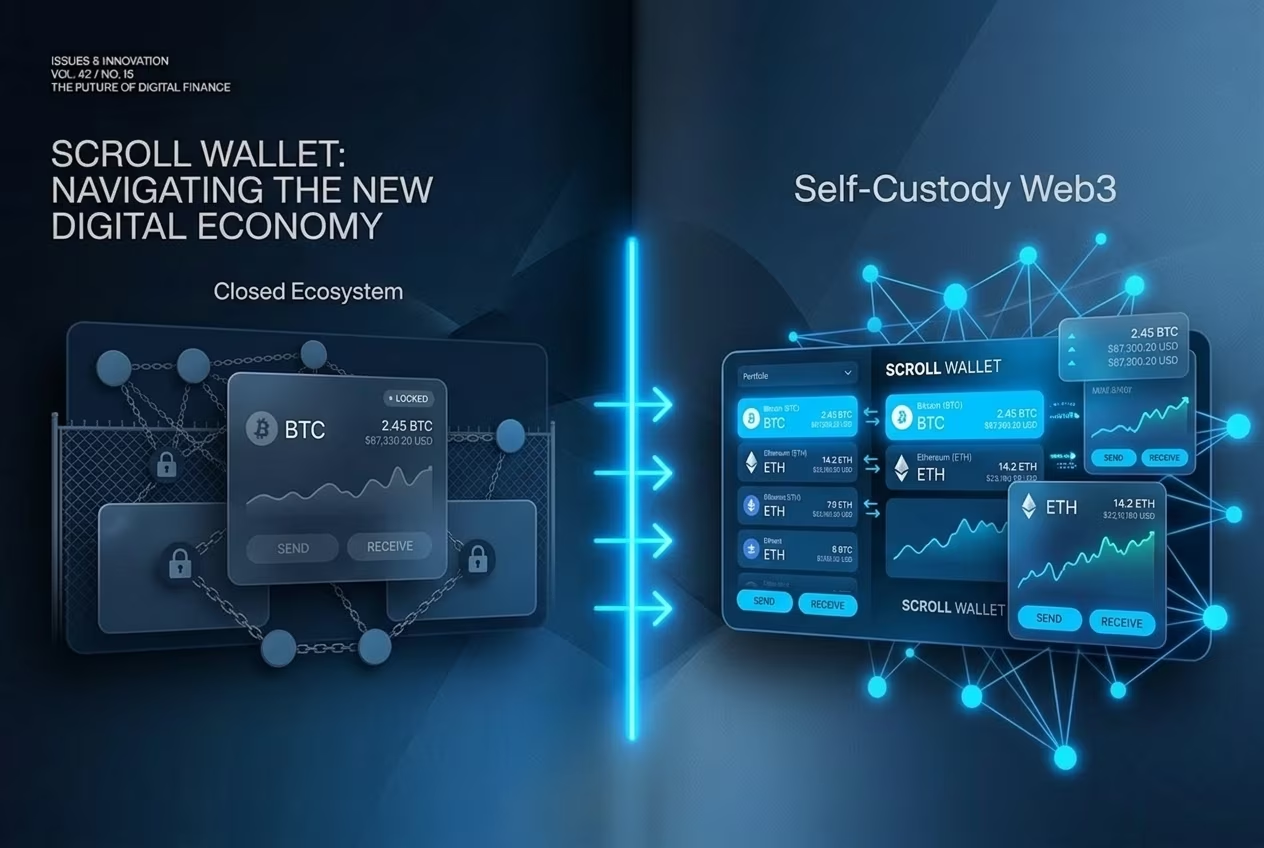
In the US, payment rails with mandatory KYC are not a technical accident, but a conscious architectural choice that changes the very nature of interaction with crypto-payment systems. When merchants connect regulated payment processors to their checkouts, US users are often required to provide a government ID, link a bank account, or pass automated compliance checks before the transaction goes through. A direct result of FinCEN requirements, the Bank Secrecy Act, and increasingly stringent state remittance laws that make a number of crypto flows the same as regular financial transfers. The result? A user experience more reminiscent of opening a bank account than sending a blockchain transaction.
This is where the distinction between custodial payment integrations and a true non-custodial wallet makes operational sense. WITH crypto wallet, where you have control - that is, you hold your own private keys - there is no third-party processor between you and the blockchain. No KYC barrier at the wallet level. Scroll Wallet is built on exactly this architecture: your keys, your addresses, your transactions. By using Scroll Wallet for self-storage, you don't have to go through regulated payment rails. You interact directly with the on-chain infrastructure, which means that the compliance burden does not fall on the wallet interface in the same way as it does on the payment solutions built into merchant systems.
The practical trade-off is real and worth calling out explicitly. Payment integrations with KYC give something in return: protection from chargebacks, conversion to fiat, legal mechanisms for disputes. But they also collect your data, set transaction limits and can freeze or cancel payments based on a compliance flag. Model open access to a wallet like PUNDIX or any similar approach based on an open protocol gives speed and sovereignty - but shifts full responsibility for the accuracy and security of transactions to you. No one model is universally superior to another. The right choice depends on what exactly you are doing and how much risk you are willing to bear.
For American users operating in this environment in 2026, the practical logic is simple: use non-custodial wallet like Scroll Wallet for on-chain activities where direct control is needed, and consider KYC-regulated merchant rails as a separate layer for commerce adjacent to fiat. Don't mix these two worlds. Routing funds from self-custody through a regulated payment processor can trigger reporting thresholds and create compliance risks you didn't expect. Understanding where one system ends and another begins is not an option. This is a basic skill for working safely in the current US regulatory landscape.
Before you trust PUNDIX to a single app, understand the documented technical risks of ecosystem-based wallets like f(x)Wallet. Wallet security for PUNDIX is not about a beautiful interface. This is about whether the code can withstand real transactions without crashes. Assessing these risks before you transfer assets there is not the paranoia of an advanced user. This is basic hygiene.
Researchers IEEE Computer Society We have identified a specific and serious technical defect: f(x)Wallet throws an exception when attempting to transfer, because at the time of balance verification it calls the null object method. Simply put, the wallet crashes exactly when it must confirm your balance before sending funds. This is not a cosmetic interface bug. This is a failure at the core transaction layer level. If the wallet cannot complete the transfer without crashing, you cannot trust it to move PUNDIX at a time when timing is everything.
In addition to this specific problem in the code, f(x)Wallet carries the typical vulnerabilities of mobile wallets in 2026: storage of private keys tied to the security of a specific device; backing up the seed phrase, which users do hastily over and over again or not at all; and operational reliability, tightly tied to the state of the Pundi X ecosystem itself. If the ecosystem goes into downtime, starts updating a smart contract, or changes network parameters, access to funds through the wallet of one ecosystem may be cut off without warning. This is what ecosystem dependency means in practice: your wallet is only as stable as the infrastructure around which it is built.
When choosing how to securely store PUNDIX, the key question is one: can your wallet operate independently of a single point of failure? A backup copy of the seed saved offline and tested for recovery is not “good advice.” This is the only mechanism that will survive an application crash, device loss, or ecosystem shutdown. At Scroll Wallet, we build around this very principle: no wallet architecture should make you dependent on one application, one command, or one blockchain to access what is yours. Before transferring assets there, check any wallet for compliance with this standard.
Selecting a wallet for PUNDIX requires a balance between immediate utility and long-term flexibility. To avoid ecosystem lock-in and ensure your assets remain accessible across evolving on-chain environments, we recommend following this technical checklist for your PUNDIX wallet setup.
Scroll Wallet gives PUNDIX holders something that most native wallets in the ecosystem fundamentally cannot: full self-storage, access to multiple networks, and a security architecture that is not dependent on the decisions of any single protocol. If you hold PUNDIX and want to go beyond f(x)Core, your private keys remain yours. Not from the custodian. Not from the bridge operator. Not on the stock exchange. In 2026, this difference weighs much more than two years ago: wallet exploits and phishing attacks have become targeted, technically verified and merciless.
The practical security value of Scroll Wallet starts with the architecture. The wallet is built on a verifiable infrastructure - every signed transaction passes through a transparent execution layer, the logic of which is open to audit. For PUNDIX holders, this eliminates a specific pain: you are not locked into one network's toolkit and are not forced to trust a proprietary bridge to move assets. Multi-chain access through Scroll Wallet allows you to work with the Ethereum mainnet, Scroll L2 and compatible EVM environments from a single interface - without changing wallets, without re-entering seed phrases, without third-party aggregators, each of which adds its own layer of risk.
Ecosystem limitations are a real cost that most users simply don't consider. When a wallet is locked into one network, every update cycle, governance decision, or liquidity shift on that network directly limits your options. Scroll Wallet intentionally breaks this relationship between access to assets and the roadmap of a particular ecosystem. For a PUNDIX holder, this means: participate in DeFi opportunities on Scroll L2, switch to Ethereum when the conditions are more favorable, return back - and all this without giving up the position of self-preservation. The UX is designed to reduce the number of manual steps involved in performing these operations. Fewer steps mean a smaller window for user error and social engineering attacks.
There are trade-offs, and they need to be called out directly. Self-saving means personal responsibility for the seed phrase - Scroll Wallet will not restore access if it is lost. Multichain access carries risks at the bridge protocol level, and this is true for any wallet, not just this one. What Scroll Wallet really provides is a cleaner and more transparent environment for independently managing these risks, with a minimum of intermediaries between you and your assets. For PUNDIX holders who want control without unnecessary complexity, this combination of security, true self-preservation and broad network access is not marketing. This is a real step forward compared to living within one ecosystem.
With PUNDIX, it's not about which exchange you use, but whether you control your keys, whether you can recover assets yourself, and whether your wallet works outside of one ecosystem. Narrow dependence on a single platform - be it Pundi X or any other - creates a structural risk that accumulates over time. Exchanges are being hacked. Projects change course. Token support is disabled without warning. The only reliable constant is your private key.
Owning crypto assets is not a passive state. These are constant decisions: where to store the seed phrase, which wallet to entrust the signing authority to, whether the chosen interface gives full visibility of what exactly you are confirming on the network. A pundi x wallet solution that ties you to one chain or one product family leaves you with no flexibility when conditions change. In 2026, when L2 fragmentation and multi-chain environments have become the norm, wallet portability is not a feature. This is a basic requirement.
Scroll Wallet is built precisely on this logic. We don't expect users to stay in the same ecosystem forever. The architecture supports multi-chain access, transparent transaction signing and seed portability - your PUNDIX remains yours no matter what happens at the protocol or exchange level. A secure alternative isn't just about encryption and audits. These are about tools that allow you to verify, restore and transfer assets without depending on anyone else's goodwill or continuous work.
The takeaway is simple: choose wallets that give you control over the recovery path, support broad asset interoperability, and don't require trusting a centralized intermediary to access funds. The price for changing a wallet is now low. The cost of delay is potentially very high. Scroll Wallet exists to make this transition simple, verifiable and irreversible.