Best Non Custodial Lightning Wallet: Full Control | Scroll Wallet
The Stronghold crypto wallet does not exist as a standalone Tier-1 application, meaning you must use compatible third-party interfaces to manage SHx tokens securely. While the Stronghold ecosystem relies on Stellar and Ethereum, modern users are pivoting toward advanced Layer-2 solutions like Scroll Wallet to avoid high gas fees, fragmentation risks, and complex manual bridge processes prevalent in 2026.
Stronghold manages its own wallet infrastructure - official SHx Wallet means that users do not need to blindly trust third-party token storage solutions. This is critical. Problems with the reliability of wallets most often arise precisely where the native logic of the token - rewards, management, staking - is clumsily stretched onto a universal third-party interface. The Proprietary wallet gives Stronghold direct control over this integration layer, removing friction and reducing the risk that something will simply stop working after the next update.
SHx Wallet supports both Stellar (token address: SHX-GDSTRSHXHGJ7ZIVRBXEYE5Q74XUVCUSEKEBR7UCHEUUEK72N7I7KJ6JH) and Ethereum (0x516d31321928700c6b4fb0db0c8c6bc5d6799787) - that is, two different blockchains from one native interface. Transactions go through Stellar SCP and Proof-of-Agreement, which keeps fees low and confirmations fast. A real advantage over congested EVM networks. But here’s what’s haunting: as of 2026, there is simply no public security audit or at least any formal disclosure of the wallet’s security model. The lack of a published audit is not a minor footnote. This is a hole.
Third-party solutions - Ledger, Trezor, MetaMask, Trust Wallet, Atomic - are still popular among SHx holders, especially those who prioritize hardware security or managing multiple assets. A smart approach, especially given the current audit gap. When comparing storage strategies for ERC20-compatible assets, comparison of ERC20 wallets provides a structured breakdown of trade-offs - worth exploring before committing to one solution. Diversification by wallet type is not a crutch. In the multi-chain reality of 2026, this is basic risk management.
The native SHx Wallet provides a tangible advantage to those who want direct access to ecosystem functions - rewards, voting - without intermediaries that may not support these functions at all. But “native integration” and “verified security” are not synonymous. Until Stronghold publishes a formal audit or a transparent security model, the wallet should be seen as a convenient tool for interacting with the ecosystem - but not as the main storage for large positions. This line needs to be clearly drawn before deciding how much exposure to allow through any single wallet infrastructure - native or third-party.
When managing Stronghold (SHx) assets in 2026, you must distinguish between the ideal technical architecture and the current market availability. While users seek the efficiency of a native solution, the lack of a dedicated SHx wallet forces a reliance on third-party providers. This creates a gap in security and performance that we address by analyzing the trade-offs between direct protocol integration and external bridges. Choosing the best crypto wallet requires understanding these structural differences to mitigate fragmentation risks.
| Feature / Metric | Native Wallet Expectation | Third-Party Reality (2026) |
|---|---|---|
| Integration Level | Direct Protocol Access | External API Bridges |
| Security Surface | Minimal (No Intermediaries) | Increased (Third-party risk) |
| Latency | Ultra-low (Direct Node) | Variable (Depends on provider) |
| Privacy Standards | Built-in (EIP-8182 style) | Fragmented Support |
| User Experience | Unified SHx Ecosystem | Multi-chain Fragmentation |
Data source: Bitget Web3 — Native vs third-party wallet architecture and 2026 security trends
Niche wallets carry specific risks that SHx holders need to understand before real money gets into them. By choosing a wallet outside of the established ecosystem, you're accepting more than just a different interface—you're accepting untested code, chaotic update cycles, and support that can disappear at any time without warning. These are not abstract fears. In 2026, the on-chain environment has become fundamentally more complex: multi-chain routing, L2 bridges, token standards - all this requires precise implementation at the wallet level. One bug in processing transactions with a niche wallet - and the funds go to an unrecoverable address. Forever.
Phishing and blind signing are the most direct threats associated with niche wallets. They almost never have the transaction simulation layer that the big products have honed over the years. When you confirm a transaction without a clear, human-readable transcript of what you are signing, you are acting blindly. This is how most wallet-level exploits work: not through brute force, but through a single unconscious click of “Confirm”. Competent Seed phrase protection - a basic requirement, but it will not help if the wallet shows ambiguous or outright malicious signature requests that cannot be verified before confirmation. Scroll Wallet solves this radically: decoded transaction data is output at every confirmation step. You always know what exactly you are authorizing.
The slow pace of updates is another structural problem with niche wallets. Security patches in crypto wallets are not an optional service. It is a response to active attack vectors in real time. A wallet that has not released a significant update for three to six months almost certainly runs on code with known vulnerabilities. As noted MetaMask in its 2025 roadmap, the market is moving toward better UX, more secure self-storage, and reduced key management complexity—and this requires ongoing engineering investment rather than a one-time release. Niche wallets rarely have the team or funding to keep up this pace. The security gap falls squarely on users.
Backup errors aggravate all other risks at once. Many niche wallets provide extremely weak instructions for protecting the private key: they either skip recovery verification entirely or store backup hints in insecure local formats. Lost access to a wallet that never insisted on a correct recovery flow? Your SHx are gone forever - there is no recovery mechanism at the protocol level. Scroll Wallet forces structured backup verification upon setup and flags any configuration that leaves the recovery path open. The goal is not to make decisions for you. The goal is to prevent a correctable error from becoming a permanent loss.
Remember one rule: if a wallet does not have independent audits, a verifiable development history, and a documented security architecture, do not hold real assets in it. It's not a matter of taste. This is a structural risk. Nameless wallets without a public audit trail hide vulnerabilities until they are exploited. In the face of multi-chain environments, L2 fragmentation, and increasingly sophisticated phishing attacks, the cost of making a mistake when choosing a wallet has never been higher. Reliable self-preservation begins with infrastructure that has been tested, broken, and repaired—over and over again.
Security experts point out the same red flags over and over again in niche wallets: no third-party code audits, anonymous or inactive development teams, no bug bounty programs, no transparent changelog. These are not minor flaws. This verdict is evidence that the wallet was not built to survive attacks. Serious security requires layers: key isolation at the hardware level, transaction simulation before signing, detection of phishing domains, regular external checks. To skip even one layer means to get not a convenient product, but a ready-made target. MetaMask clearly showed this with its public roadmap for 2025: even the most mature players in the non-custodial space perceive security as an endless process, and not as a check mark at launch.
At Scroll Wallet, the long-term reputation of the development is not a marketing thesis, but a strict condition. Every architectural decision is documented. Security layers are designed to be verifiable—not just claimed. We don't ask you to trust us based on a logo. We suggest reviewing audit trails, frequency of updates, and how we respond to known issues. Trust in a wallet is not built on one release or a beautiful interface. It is built through consistent, accountable engineering—month after month. If the wallet cannot show this history, its absence in itself is an answer.
The practical conclusion is indecently simple. Before transferring assets to any wallet, check three things: whether it has been verified by a named third-party auditor, whether the development team is publicly identified, and whether the response to past vulnerabilities is documented. Self-storage means you have the keys. But it also means taking responsibility for choosing infrastructure that doesn't quietly and quietly undermine that control. Scroll Wallet is built on the belief that advanced security and clear design are not opposites. You don't have to choose between protection and clarity. And if the wallet forces you to make this choice, it has already failed the most basic trust test.
Self-custody is the single most consequential decision a US crypto user makes in 2026 — because when you hold your private keys, no exchange collapse, no regulator, and no panicking compliance officer can touch your assets. The lesson has been delivered repeatedly, and painfully: platforms fail, freeze funds, and disappear. A self-custody wallet puts control exactly where it belongs — in your hands, not buried inside some company’s risk management playbook.
For US users, the regulatory pressure makes this even harder to ignore. Custodial platforms operating stateside are wired into KYC infrastructure, subject to asset freezes, and capable of locking you out of your own funds with zero notice. A non-custodial wallet operates on a different logic entirely: cryptographic rules, not corporate terms of service. Scroll Wallet is built on exactly that principle — your keys are generated and stored locally on your device, and we never see them. Not once. Not ever.
Then there’s privacy. A wallet worth trusting should not demand your passport before letting you move your own money. With Scroll Wallet, you connect directly to on-chain protocols — no identity layer, no middleman sitting between you and the network. This cuts deep in a multi-chain world where users are bridging assets across L2s, DeFi protocols, and ecosystems daily. Every transaction gets signed locally. No metadata routed through centralized servers that can be subpoenaed, hacked, or quietly handed over.
The trade-off is real, and it deserves a straight answer. Self-custody means you own the responsibility — entirely. There’s no recovery hotline. Lose your seed phrase, lose everything. Scroll Wallet addresses this head-on through structured onboarding that walks you through backup procedures, phishing risk awareness, and multi-chain session management. Because real autonomy isn’t just about removing gatekeepers. It’s about making sure you’re actually ready to walk through the door without one.
When choosing a storage solution in 2026, you must distinguish between generic multi-asset containers and infrastructure specifically engineered for the L2 ecosystem. While third-party wallets provide broad token support, we have designed Scroll Wallet to leverage zk-rollups Ethereum technology, ensuring that security and user experience are natively integrated into the network layer rather than added as an afterthought.
| Feature | Generic Third-Party Wallets | Scroll Wallet (Native L2) |
|---|---|---|
| Security Model | Standard Seed Phrases | Native zk-SNARK Security |
| Account Recovery | 12-24 Word Manual Backup | Smart Account Abstraction |
| Transaction Clarity | Basic History | Full L2 Visibility & Decoding |
| Ecosystem Sync | Limited/Manual | Deep Scroll dApp Integration |
| User Experience | General Purpose | Seamless L2-Optimized Flows |
The cost of moving assets on the blockchain is not a minor technical nuance, but one of the main factors determining whether crypto management will be a working tool or a financial punishment for the average user. Ethereum mainnet gas fees in 2026 remain high and unpredictable. This makes frequent transactions costly for SHx holders who need reliable performance without sudden overheads. Layer-2 networks - Arbitrum, Optimism, Base - reduce these costs by 10-100 times compared to the mainnet. Scroll Wallet is built on exactly this logic: we route transactions through an optimized L2 infrastructure by default, so you don't pay mainnet prices for transactions that don't require settlement on the mainnet.
Understanding the nature of commissions gives you a real advantage. Software wallets are free to download - but every online action costs money. Commissions for swaps within wallets vary from 0.5% to 1% depending on the provider: MetaMask charges 0.875%, some competitors charge less, Scroll Wallet does not charge anything for bridge transactions. Zero. As analysts note Bitget Web3, the gap between Ethereum mainnet gas and L2 discounts has become a key criterion when choosing wallet infrastructure for active users. For SHx holders who regularly make transfers or participate in on-chain activity, this gap is directly converted into stored value - and this is the foundation of long-term reliability.
Infrastructure solutions cost money. Real ones. Hardware wallet integration costs $60,000–$90,000 just for app development, and the devices themselves are sold to users for $50–200. An MVP wallet costs $25,000–$50,000 to build; enterprise level - already $150,000–$300,000. These numbers are important: they signal what level of engineering is behind the product to which you entrust your assets. Scroll Wallet was designed as a tool for secure transactions within a verifiable, production-ready system - not as a lightweight prototype. Our architecture uses Ethereum zk rollups, reducing routing friction and maintaining cryptographic integrity at the settlement level.
For SHx holders, the combination of L2 optimization, zero bridge fees and a transparent cost structure means one thing: the economics of storing and moving assets are fundamentally better than those of mainnet-only wallets. Crypto management in 2026 requires an infrastructure that accounts for multi-chain fragmentation, fee volatility, and routing complexity—not just a private key interface. Scroll Wallet takes on this complexity. So that your decisions are based on strategy, and not on the question of whether you have enough gas to execute them.
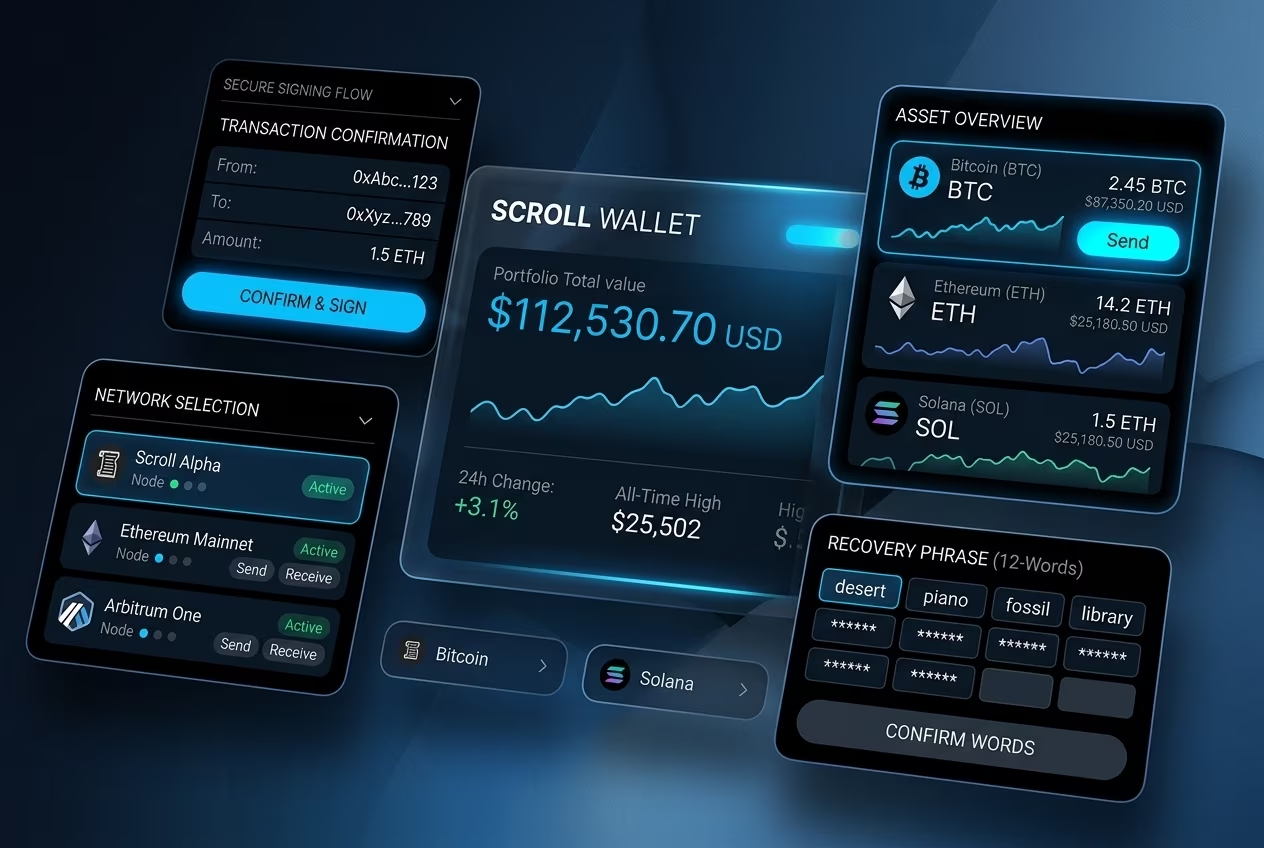
Selecting a reliable infrastructure for your digital assets in 2026 requires a move beyond hype toward verifiable security standards. If you are evaluating options like Stronghold or looking for a better wallet choice, we recommend following these practical steps to ensure your funds remain under your control.
When choosing a wallet in 2026, the key question is not which interface is more beautiful - but which infrastructure you can trust with real assets without fear of losing everything. Scroll Wallet is built directly on the Scroll network, which means every transaction is protected by guarantees Ethereum zk rollups — a cryptographic architecture that verifies off-chain calculations and records the evidence directly on the Ethereum mainnet. This is not a marketing bullshit. This is a structural solution that eliminates entire classes of risks - the same ones that disparate, little-known wallets simply cannot cope with because they do not stand on verifiable infrastructure.
Why Scroll Wallet and not just another “universal” wallet? Three tough arguments. First, Scroll Wallet's security is provided at the protocol level, not just at the application level. Phishing attacks, wallet exploits, bridge vulnerabilities - all of this has already cost users hundreds of millions of dollars across the entire ecosystem. Scroll Wallet reduces your exposure by keeping you inside a single, verified environment—without unverified third-party bridges or multi-step token paths. Second: the UX is designed for the real complexity of L2 environments - you see clear estimates of commissions, transaction status and confirmation logic, without understanding the raw RPC data yourself. Third: we do not hide risks behind a beautiful wrapper. You retain full control over keys and decisions, and the interface shows exactly the information you need for informed actions.
How MetaMask outlined in its own roadmap, the market is confidently moving towards secure, convenient next-generation wallets - and this shift reflects a real demand from users who have already been burned by fragmented tools. Scroll Wallet responds to this request not by selling features for the sake of features, but by reducing the number of decisions that have to be made in conditions of uncertainty. Automatic gas processing, native routing of L2 transactions, stable interface behavior from session to session are not conveniences. These are risk reduction mechanisms built right into the product architecture.
Choosing a reliable wallet in a multi-chain environment means choosing one that is honest about its boundaries. Scroll Wallet is optimized for the Scroll ecosystem. He doesn't try to be everything to everyone on every chain. This focus is a conscious product decision that allows you to keep your attack surface narrow, quickly iterate on real user problems, and maintain a transparent trust model. Whether you work for Scroll - bridging assets, interacting with DeFi protocols, or simply managing a portfolio - Scroll Wallet gives you the most direct, verifiable and supported way to do it securely.
If you are looking for a Stronghold wallet or a way to store SHx tokens, the main decision you have to make has nothing to do with the brand on the screen. It involves one question: Are your private keys really under your control? The crypto landscape of 2026 is one of multi-chain complexity, aggressive phishing campaigns and exploits that methodically knock out users who trust untested tools. The name of the wallet weighs exactly as much as its architecture. No more.
A reliable crypto infrastructure is not a pretty interface. This includes verifiable key management, open source where possible, and a strict separation between the signing environment and any network layer. When you store SHx or any other asset, the question is not whether the wallet brand is recognizable. The question is whether its security model has been tested, documented, and built to withstand real-world threats. Storage that depends on a single point of failure, unaudited code, or a custodial backend is not private storage. It's an illusion.
At Scroll Wallet, our position is simple: self-storage only makes sense if implemented correctly. A secure crypto wallet is one where you have the seed phrase, the signing logic is isolated, and no third party can freeze, redirect, or access your funds. This is the standard we are building towards - because the alternative, trusting a wallet simply because it bears the name of a familiar token, has already cost users real money in several market cycles. Those seeking Stronghold deserve the same infrastructure as any serious on-chain participant.
The practical conclusion is short. Evaluate any wallet based on its key storage model, audit history, and behavior under attack - not branding. If the wallet cannot clearly answer where your private keys are stored and who has access to them, this is already the answer. Secure self-storage is a technical standard, not a marketing thesis. And when your assets are on the line, there is no other standard.