Crypto wallet online security solved by Scroll Wallet 2026 | Scroll Wallet
A safe wallet app in 2026 must integrate MPC technology and Account Abstraction to eliminate the single point of failure inherent in traditional seed phrases. We believe modern self-custody requires a shift from static protection to dynamic, AI-driven security that simulates transactions before approval. By removing technical barriers, we ensure users maintain total asset control without risking funds to blind signing or lost keys.
Old wallet security models were built around the threats of the past - and in 2026, this gap will be converted into real losses for real people. Seed-phrase wallets still hold the market, although their entire “security design” comes down to one point of failure. According to Chainalysis data for 2026, 68% of wallet hacks in the US began with a leaked seed phrase - phishing, physical theft, compromised storage. One leak. All. Irrevocably. And this is not a problem of inattentive users - this is an architectural defect built into the base.
The path to truly reliable wallet protection begins with eliminating the very concept of a single point of failure. Multi-Party Computation (MPC) splits the private key material among multiple participants—no single device or server ever holds the entire key. The effect is measurable: MPC wallets showed 82% fewer incidents of compromise compared to seed phrase models - the same Chainalysis report. Scroll Wallet is built on this architecture. We analyze the technical basis of this approach in detail - read our material about MPC security of crypto wallets and how it replaces outdated key management. But key distribution is only the first milestone. Continuous authentication through biometrics and behavioral analysis verifies the identity constantly, and not just once at login. In an environment where session hijacking and malware are routine, entering a seed phrase once is no longer considered verification.
To truly avoid wallet risks in a multi-chain reality, protection must extend to the transaction layer. Transaction simulation is one of the most practical tools: before signing any on-chain action, the system shows the exact outcome - the movement of tokens, interaction with contracts, issued permits. Blind approvals are among the top causes of user losses. Simulation completely removes this blind corner. Scroll Wallet applies a zero-trust model at every step - no action is considered secure by default. Each request is independently verified, regardless of the source and state of the previous session. This is not a feature. This is the minimum bar for what best wallet security should look like in 2026.
The gap between legacy wallets and modern security architecture has long gone beyond theory - it is visible in incident statistics, in user losses, in the growing complexity of the on-chain environment. A Reliable wallet app today is not one that promises security on your landing page. This is one that eliminates structural vulnerabilities at the design level, gives complete visibility into every transaction before it is executed, and verifies identity continuously rather than once. Scroll Wallet is built on this architecture. And we hold this standard as an infrastructure requirement - not as a marketing thesis.
When choosing a solution for your digital assets, you must balance the uncompromising protection of cold storage with the functional requirements of modern decentralized finance. While hardware solutions provide a robust foundation for crypto wallet security, software-based infrastructure like Scroll Wallet focuses on bridging the gap between high-level encryption and daily usability through automation and risk reduction.
| Feature Category | Hardware Wallets (Ledger, Trezor) | Modern Software/L2 Wallets |
|---|---|---|
| Core Security | Secure Element (SE) / Open Source | MPC & Smart Contract Logic |
| Access Control | PIN (up to 50 digits) & Biometrics | Biometric Passkeys & 2FA |
| Recovery Options | Seed Phrase / Shamir Backup | Social Recovery / Cloud Encrypted |
| Transaction UX | Physical Confirmation | Simulation & Gas Abstraction |
| DeFi Usability | Manual Signing (Offline) | One-click Batching & Automation |
Data source: Habr — Comparison of hardware wallets: Secure Element, open source, and biometric protection
Modern self-custody wallets give you full control over your private keys—and no longer hold you hostage to a single seed phrase. Standard 12 or 24 words have been considered the norm for years. But this is a concentrated risk in its purest form: I lost a piece of paper, took a photo in the wrong place, stored it carelessly - and that’s it, the funds are gone forever. By 2026, serious non-custodial wallet architecture has moved well beyond this single point of failure—without giving up control to third parties.
Scroll Wallet is built on a simple principle: a self-custody wallet should distribute risk, and not destroy the user's ownership. It is based on multi-party computing (MPC) as a key management layer. With MPC, the private key is never stored or recovered in one place - it is broken into cryptographic shares that are kept in different isolated environments. No device, no server, no backup file contains enough information to compromise a wallet. If you want to understand more deeply, read our material about MPC security of crypto wallets. The bottom line: you retain full ownership of your assets, and the attack surface for phishing, device theft, or backup leaks is dramatically reduced.
The wallet under your control in this model still requires conscious configuration. You decide which devices or authentication factors store key shares. You build the recovery logic yourself - through a second device, biometrics or a trusted contact. Scroll Wallet does not store your key shares on our infrastructure. We provide the protocol and interface; the cryptographic material remains with you. This is not a small detail. This means that we physically cannot freeze your funds, reverse a transaction, or gain access to your wallet under any circumstances. Not a marketing thesis - a direct consequence of the architecture.
What do you get in practice? A wallet that behaves like a true non-custodial wallet - no permissions on our part, no custodial risk - and without worrying about a piece of paper with a phrase lying somewhere in a drawer. This anxiety is real. It is this that pushes people either to dangerous compromises or to a complete abandonment of self-custody. Scroll Wallet is designed so that the secure path is the default path: distributed key shares, clear recovery scripts, zero dependency on a single vulnerable backup. This is what control over a private key looks like when it is built for the real-world crypto use in 2026.
Before committing significant assets to any digital vault, you must verify that your access remains permanent even if your primary device is lost or compromised. At Scroll Wallet, we prioritize verifiable infrastructure over vague promises of safety. Use these steps to audit the recovery logic of your wallet and ensure your backup strategy is resilient against 2026 security threats.
American users face five major wallet threats in 2026: phishing, blind signing, fake apps, clipboard malware, and unlimited token permissions—all of which lead to permanent loss of assets. If you own crypto, understanding these threats is not an option, but a necessity. According to Federal Trade Commission (FTC), phishing, malicious permissions, and deceptive app interfaces are the leading causes of crypto asset loss among American consumers. These are not rare cases. This is a standard attack surface that everyone faces.
Phishing is the most widespread threat. Attackers copy wallet interfaces, support pages, and dApp frontends with alarming precision. You click on the link, connect your wallet, sign the transaction - and after a few seconds the account is empty. A blind signature makes things even worse: when the wallet shows you a raw hex string instead of a readable summary of the transaction, it is simply impossible to verify what exactly you are signing. Scroll Wallet solves this directly - it decodes transaction data into understandable text before you click “confirm”: you see the action, contract and amount. This is not an optional feature of our secure transactions app architecture. This is the basis. For a detailed analysis of how this works on mobile devices, see our guide to the security of mobile crypto wallet.
Fake apps and clipboard malware operate at the device level, which is what makes them harder to catch. Fake wallets distributed through unofficial stores or even briefly leaking into legitimate ones can silently leak your seed phrase upon first launch. The clipboard malware monitors copy-paste and replaces the copied wallet address with the attacker’s address at the time of pasting into the send field. No special interaction is needed. Just normal use. As part of our wallet safety tips framework, we recommend checking every character in your address before confirming any transaction and downloading Scroll Wallet only from official sources. We do not distribute through third-party application aggregators.
Unlimited token permissions are a structural risk that most users underestimate. When you interact with a DeFi protocol, you are often asked to approve unlimited spending of the token: the contract gets the right to move your entire balance at any time, indefinitely. If this contract is later hacked or maliciously updated, your funds are at risk, even if you stopped using the protocol six months ago. To truly protect crypto assets you need to regularly review and revoke outdated permissions. Scroll Wallet displays active permissions in a separate section and marks unlimited ones right at the moment of signing. Crypto wallet privacy also depends on the restriction of the scope of permissions - wide approvals leave a chain of data in the blockchain that links your activity between protocols. Minimal and time-limited permissions are both a security and privacy solution.
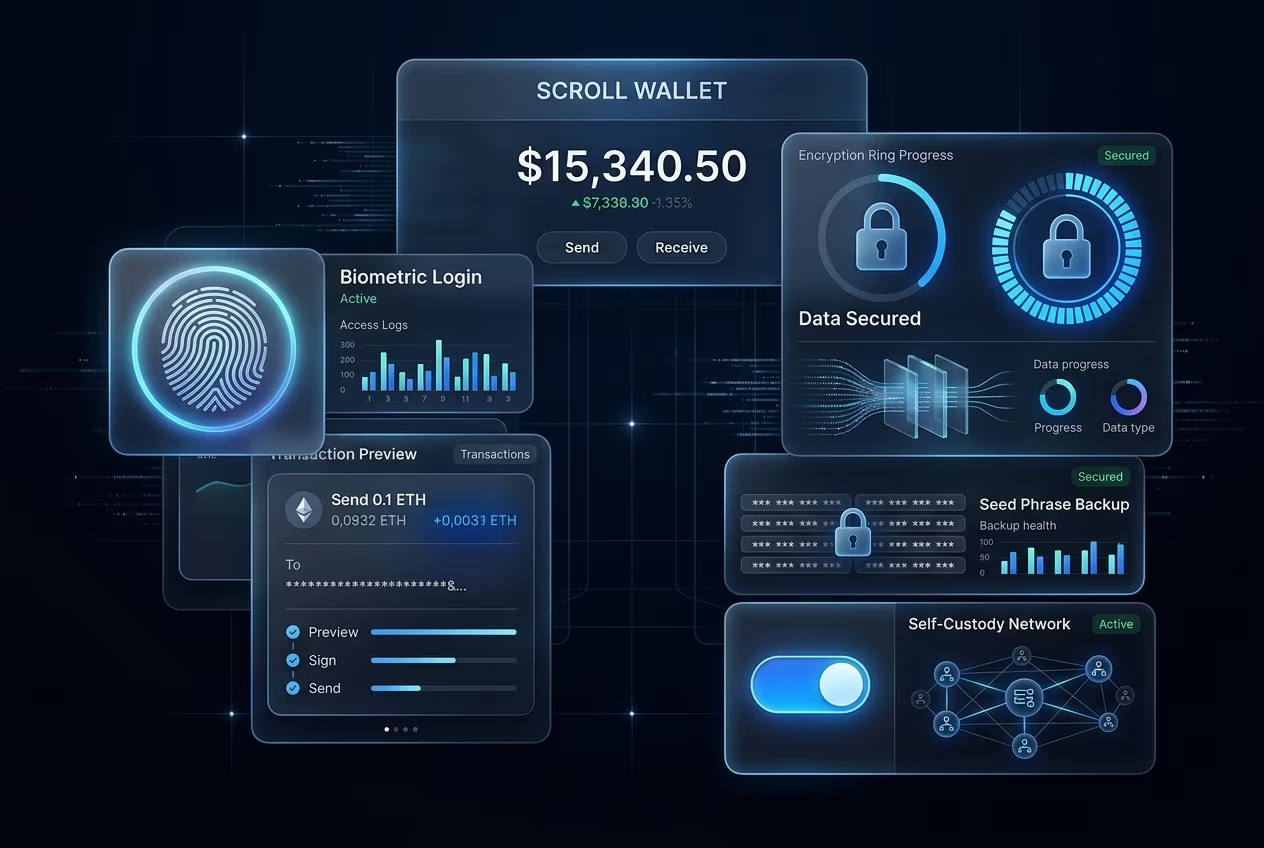
Understanding the cost of managing your digital assets is essential for maintaining long-term portfolio health. When you interact with decentralized applications or move funds, you encounter several layers of fees. At Scroll Wallet, we prioritize transparency so you can anticipate these costs before confirming any transaction.
| Fee Category | Typical Cost Range | Description |
|---|---|---|
| Network (Gas) Fees | Variable (L2 optimized) | Paid to the blockchain to process transactions. L2 solutions significantly reduce these compared to Ethereum mainnet. |
| Swap Spreads | 0.5% – 1.5% | The difference between the market price and the execution price during asset exchanges. |
| Fiat On-Ramp Fees | 2% – 5% | Charges applied by third-party partners when purchasing crypto via credit card or bank transfer. |
| Partner Service Fees | 0.1% – 0.8% | Additional fees integrated by liquidity providers or bridge aggregators for simplified UX. |
| Stablecoin Gas Options | Standard Gas + Premium | The ability to pay network costs using USDC/USDT instead of native tokens, often involving a small conversion convenience fee. |
Self-custody wallets in the US occupy a legal gray zone — you don't need to register or prove your identity just to hold and move assets in a wallet you fully control. But don't mistake "gray zone" for "no rules." The pressure lands on the edges: exchanges, on-ramps, fiat gateways — all of them operate under strict KYC and AML requirements. So your actual experience with a secure asset app depends less on the wallet itself and more on where your money enters and exits the blockchain.
As the AMLBot Blog makes clear, US crypto regulation through 2025–2026 keeps tightening around the Travel Rule and transaction monitoring for virtual asset service providers. Translation: a wallet where you hold your own private keys stays perfectly legal — but every on-ramp, whether a centralized exchange or a fiat-to-crypto service, must collect your identity before funds ever touch your address. Scroll Wallet doesn't run KYC. We're not a custodian, we don't touch fiat. What we will tell you honestly: the road to your wallet still runs through regulated infrastructure. Every time.
The custodial vs. non-custodial distinction isn't academic. It's the difference between someone else holding the keys to your house and you holding them yourself. With self-custody, no platform can freeze your funds or demand compliance on your behalf — full stop. But that freedom comes with full responsibility: wallet app protection, seed phrase security, transaction verification — all of it lands on you. We built Scroll Wallet around that trade-off deliberately, with eyes open.
The practical picture for US users right now looks like this:
Scroll Wallet watches these shifts and adjusts our infrastructure accordingly — not to cut off your access, but to make sure what we ship stays a genuinely safe asset app under any regulatory scenario that materializes. We won't promise you specific legal outcomes. What we will promise: straight answers about how the rules affect what you can do, and exactly how to protect yourself while doing it.
Scroll Wallet is already setting the standard that the self-custody industry will be forced to meet tomorrow. Hybrid recovery, multi-level key management, frictionless UX are no longer competitive advantages. This is the minimum bar. The Web3 wallet market is maturing, and products that cannot provide both convenience and verifiable security will simply go away. Not right away. But it’s inevitable.
According to Research and Markets, the Web3 wallet sector is experiencing a structural shift towards secure, yet convenient products - demand is accelerating precisely among those users who need serious protection without sacrificing accessibility. This is exactly what is built into Scroll Wallet at the architectural level: modular recovery options, transparent signing flows, multi-chain exposure without multiplying the attack surface. The market confirms what the product logic dictated from the very beginning - the best self-custody wallet is one where security decisions are made at the architectural level, and are not passed on to the user in a moment of panic.
Hybrid recovery is the mechanism that experts cite most often when explaining the gap between the current and next generation of wallets. It eliminates the single point of failure that has plagued the seed phrase custodian for over a decade. And at the same time, the user retains full control over his own keys. Scroll Wallet implements this through a structured recovery layer without third-party custodians and cloud backups with an opaque access policy. How exactly this works in practice and why it is important for everyday use is discussed in our guide to mobile crypto wallet, with a full analysis of the architectural solutions behind each protective layer.
The signal from the industry is clear: security through convenience is not a compromise. This is the only workable path to mass adoption in a multi-chain environment with real risks. Phishing vectors, bridge exploits, L2 fragmentation - all this has made the cost of poor UX measurable in lost funds, not just in lost users. Scroll Wallet is built on one principle: advanced protection must be invisible enough not to block the user, and tough enough to withstand real attacks. It is this balance—not marketing theses—that experts call the direction in which the market is moving.
Scroll Wallet is not just a “secure wallet”: it is an architecture where MPC key management, an audited bridge infrastructure, and a seedless recovery model work together so that a single point of failure does not physically exist. In 2026, phishing and wallet exploits have become so sophisticated that it is no longer a question of whether the interface is pretty. The question is what's going on under the hood. Scroll Wallet was built from this point of view: every layer of the product - from storing keys to signing transactions - is designed to reduce the attack surface without turning daily use into a quest for the paranoid.
Convenience is not cosmetic. The interface is built around real-life scenarios: sending assets between L2 networks, working with the native Scroll bridge, managing positions without juggling five different tools. A single overview of on-chain activity, a clear preview of transactions, gas assessment before you click “confirm”. Why is this important? Because fragmented multi-chain environments breed confusion, and confusion breeds error. The moment a transaction is signed is not a place for guesswork. You must know exactly what you are approving.
Scroll Wallet's security is built on verifiable infrastructure, not marketing promises. Scroll bridge contracts have been independently audited. MPC key architecture means one thing: your private key is never stored in one place and is never shared with one device. For those who want to dig deeper into the mechanics—how modern wallets handle key recovery without seed phrases—the concept of recover-ethereum-wallet">recovery via account abstraction explains how smart contract recovery flows work and why they are structurally superior to legacy backup methods. That's where Scroll Wallet is heading: recovery that's both secure and convenient—without compromising between the two.
Recovery and control. Two principles that guide Scroll Wallet's behavior in worst-case scenarios. Lost your device? The MPC recovery process will neither require showing the seed to a third party nor trusting a centralized custodian. The path to recovery remains yours. At the same time, there are no illusions: the security of MPC depends on the integrity of recovery nodes, and no system eliminates the risk completely. Scroll Wallet removes the most common points of failure: lost seed phrases, compromise of one device, phishing approvals. And it gives a clear, documented way back if something goes wrong. It's this combination of thoughtful recovery and normal daily use that makes it a serious choice for those who view their wallet as infrastructure, not just an application.
The best wallet is not the one with the most features, but the one that gives real control, protects assets without vague language, and doesn't break under pressure. In 2026, the gap between wallets that look secure and those that are actually secure has become a chasm. Phishing attacks, bridge exploits, L2 fragmentation - all this has raised the bar for what can generally be called a reliable wallet. Today, the application must work in a multi-chain environment, support transparent recovery and verifiable key management. A beautiful interface is not an argument.
Scroll Wallet is built around a balance between security and convenience. Not as a compromise - as an architectural principle. True security means you understand where your keys live, how recovery works, and what happens when a transaction fails. Convenience is when you can act on the basis of this understanding without unnecessary steps: bridge assets, sign contracts, set up a new device. No "military level encryption" without decryption. Readable architecture only.
The transition to self-custody is accelerating. As described in our article on the growth of non-custodial wallets, users are moving away from exchange custody in droves and taking direct control of their on-chain positions. This is a real responsibility. And the real risk is if the wallet infrastructure does not support this responsibility. Scroll Wallet covers this issue: transparent work with the seed phrase, structured recovery options and automatic risk warnings - in one product, without seams.
Choosing a wallet in 2026 is an infrastructure decision. Not a matter of taste. You choose the layer through which each of your on-chain actions goes. This layer should carry the load, be honest about your limitations, and reduce your vulnerability to common points of failure—not increase it. Scroll Wallet is our answer to the question of what this layer should be: accurate, verifiable and built for those who take ownership seriously.