Lightning Compatible Wallet: Choosing Fast Payments | Scroll Wallet
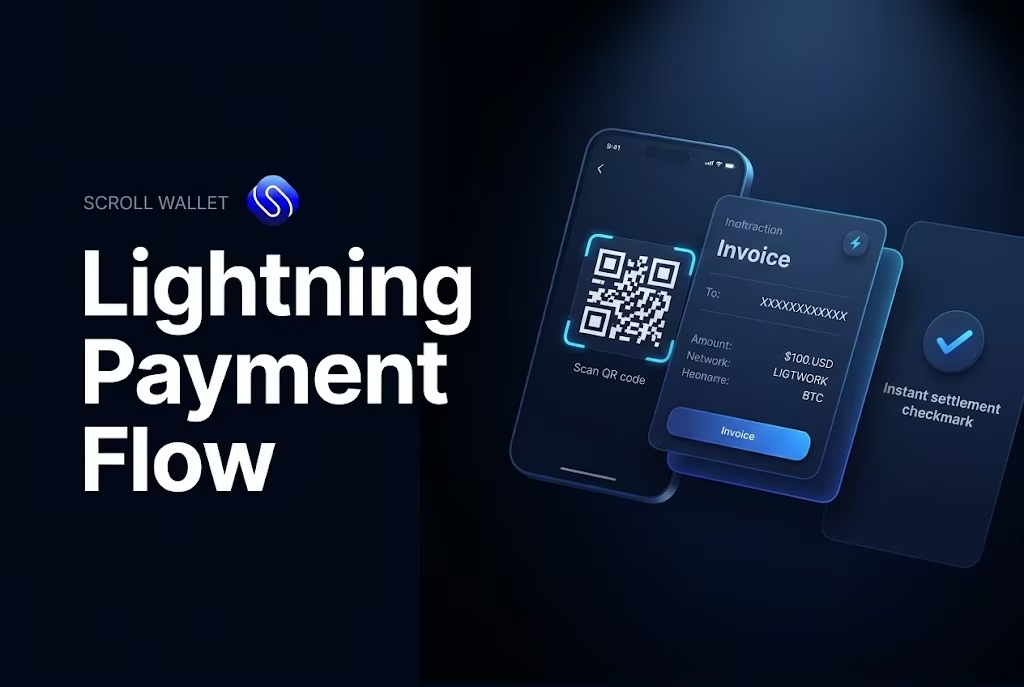
Wallets that support lightning network must provide instant transaction finality and near-zero fees to be effective for daily retail use in the United States. As the ecosystem reaches 650 million users, the focus has shifted from technical complexity to seamless UX. We designed Scroll Wallet to eliminate manual channel management, ensuring your bitcoin payments work as fast as traditional contactless systems.
Lightning wallets are no longer a niche tool - they are the underlying infrastructure for daily Bitcoin payments that works right now. In November 2025, the Lightning network processed $1.17 billion in 5.22 million transactions - a 300% year-on-year increase in volume. No speculative statistics. This is a structural shift in the way people move money. Cash App, Kraken, Strike - all of them have already built Lightning directly into user scenarios, removing the barrier that previously kept ordinary people on slow and expensive on-chain rails.
The average transaction size in Lightning reached $223 at the end of 2025, up 89% from $118 in 2024, according to River Financial. This suggests one thing: both retail users and institutional players are increasingly using the network for large, urgent transfers. The network capacity reached 5,606 BTC in December 2025—liquidity providers are investing real capital. And here’s what’s important: all this growth happened against the backdrop of stagnation in the price of Bitcoin. This means that it is not speculation that is driving him. Benefits move. It is this distinction that decides whether lightning wallet for everyday use should be considered a real tool - or just another hype.
For Scroll Wallet, this environment specifies a specific vector. Instant Bitcoin payments should be available without immersing the user in the technical kitchen - channel management, liquidity failures, routing errors should not be his problem. We're building the payment layer so that you work with a clean, predictable interface while the routing logic sorts itself out reliably. If you want to understand how layer2 crypto payments work at the infrastructure level, the mechanics of speed and finality are worth studying before trusting your wallet with real funds.
Merchant adoption is accelerated in parallel. The growth of payment volume with a flat BTC price is not a coincidence. Businesses integrate Lightning not as a hedge, but as a working payment rail. For you as a user, this means one thing: the ecosystem in which you spend is expanding - more acceptance points, more liquidity, more predictable settlement. Daily Bitcoin payments are no longer a workaround. This is becoming the standard in retail and digital commerce. Scroll Wallet is built to work within this reality - without getting ahead of it - with verifiable infrastructure, transparent fee logic and no hidden assumptions about exactly how you use your funds.
Choosing between custodial and non-custodial models is a fundamental decision for any user entering the Lightning Network. While custodial solutions offer immediate accessibility, a non custodial wallet provides the sovereign control over private keys that we prioritize at Scroll Wallet. Understanding these trade-offs in setup complexity, liquidity management, and security is essential for navigating the 2026 Web3 landscape safely.
| Feature | Custodial Wallet | Non-Custodial Wallet |
|---|---|---|
| Key Control | Third-party provider | User (Full control) |
| Setup Complexity | Simple (Instant) | Complex (Node management) |
| Liquidity Management | Handled by provider | User-managed channels |
| Network Fees | Potentially higher | Lower (Direct routing) |
| Target Audience | Beginners | Advanced users |
Scroll Wallet processes Lightning payments with fees in sats - often less than a fraction of a cent per transaction - and this is not marketing, but the real arithmetic of the cheapest way to send Bitcoin today. The Lightning fee structure consists of two parts: a base rate (usually 1 sat or less) and a proportional markup on the payment amount. As experts at D-Central have analyzed, even a $50 transfer can be completed for less than $0.01 in total commissions - it all depends on the chosen route. This is the real economic advantage of a Lightning wallet with low fees.
The speed of calculations is the same straightforward story. Fast Bitcoin transactions in Lightning are completed in seconds. Not minutes. Not blocks. Once the payment path is established through open channels, funds move directly between participants: no waiting in the mempool, no confirmation delays, no auction for block space. This is a structural difference from on-chain Bitcoin, where confirmation times are dictated by network congestion and the size of your commission. In 2026, when on-chain fees spike during peak traffic times, Lightning remains the only reasonable choice for high-frequency or small-scale transfers where both speed and cost are important.
But there is a nuance that needs to be understood immediately. Opening a Lightning channel requires an on-chain transaction, which means paying a miner’s commission at current network rates. Closing the channel also triggers on-chain calculation. These are one-time costs for the lifecycle of the channel, not for every payment - but they are real and should be taken into account when deciding whether Lightning is right for your specific use case. Planning to send dozens of payments over time? The cost of opening a channel will spread out quickly. Need one translation? On-chain may be easier. For a detailed look at how to weigh these trade-offs when choosing a wallet, check out our guide to the best Bitcoin Lightning wallets now.
Scroll Wallet is designed to make this cost structure transparent—not hidden in fine print. We show channel status, incoming and outgoing liquidity, and routing settlement fees before you confirm the payment. No surprises after. For those who want cheap Bitcoin transfers at scale, the architecture works for you: almost zero fees on every payment, instant finalization and predictable on-chain costs only when opening or closing channels. The tradeoff is real, but manageable—and understanding it is the first step toward using Lightning effectively.
Choosing a reliable tool for daily transactions requires a clear understanding of how different architectures handle security, liquidity, and usability. We have analyzed the leading solutions to help you perform a lightning network wallet comparison based on technical infrastructure and practical merchant usability.
| Wallet Name | Custody Type | Key Features & Security | Liquidity Management |
|---|---|---|---|
| Wallet of Satoshi | Custodial | Simple UI, QR/Invoice support, Biometric security | Automated (Internal) |
| Muun | Non-Custodial | 2-of-2 Multisig, Emergency kit backup | Submarine Swaps |
| Phoenix | Non-Custodial | Mobile LN node, 10k sats activation requirement | Auto channel creation |
| BlueWallet | Hybrid | Multisig vaults, Watch-only mode, Easy setup | Manual/External Node |
| Zeus | Non-Custodial | Node management, Tor privacy, Open-source | Full channel control |
Transactions on the Lightning Network fail more often than you think—and the reasons are almost never obvious until you've already lost time or money. The most common problem is routing errors. When you send a payment, the network must find a chain of channels with sufficient liquidity. There is no suitable way - the payment simply does not go through. No warnings. No explanation. This is not a bug - it is an architectural property of the protocol. In practice, even small Bitcoin micropayments can silently fail several times in a row before one finally arrives - especially if your wallet is not connected to well-connected routing nodes.
Incoming liquidity is a trap that new users do not see until the last moment. When you open a Lightning channel, you have outgoing capacity: you can send, but not receive. To accept payments, someone must first send funds through your channel, or you will have to open a channel on the other side yourself. For those trying to use a non-custodial lightning wallet to get paid—for freelancing, small business, or P2P transfers—this is a real hurdle from day one. Most users only discover this limitation when they have already submitted a payment request that simply cannot be completed.
Managing channels adds another layer of complexity that ruins the practical value of Lightning. Channels become unbalanced over time: if you consistently send more than you receive, outgoing liquidity dries up - and without rebalancing or opening new channels, payments will stop again. Each opening and closing of a channel is an on-chain transaction with a commission. During periods of high collections, these overhead costs easily exceed the amount of the micropayments themselves. And the forced closure of the channel - due to the inactivity of the counterparty or a software failure - can freeze funds for hours or even a day while the dispute resolution procedure is underway.
All of these problems are magnified when users treat Lightning as a plug-and-play system. This is wrong. The reliability of routing depends on how connected your wallet is to the overall network graph, how the balance is distributed across channels, and how stable your node—or the custodian that manages it for you—is operating. At Scroll Wallet, we design the product around these very limitations: we automate liquidity management, make routing status transparent, and remove manual solutions that lead to most failures in Bitcoin micropayment wallets. Understanding these limitations is not pessimism. This is the minimum threshold to actually work with Lightning in 2026.
To optimize your transaction speed and reduce fees in a multi-chain environment, we recommend using a lightning-enabled wallet. Scroll Wallet provides a secure, automated interface for quick Bitcoin payments and seamless asset management.
Selecting the right infrastructure for fast payments requires a balance between technical control and daily convenience. To find the best bitcoin lightning wallet for your specific needs in 2026, follow these evaluation steps based on our architectural standards at Scroll Wallet.
Scroll Wallet was created for one purpose: to remove everything that makes crypto payments unbearable in everyday life. Send Bitcoin or work with Layer 2 - and you are immediately faced with the classic set of pains: long confirmations, commissions that jump without warning, and interfaces that are clearly designed for people with an engineering background. Scroll Wallet solves each of these problems. Not promises in a whitepaper - architectural decisions at the protocol level.
Most people who pay with crypto every day don't want to think about gas optimization, bridge mechanics, or network choice. At all. The interface shows only what is needed right now: recipient, amount, approximate commission. Confirmations in Scroll's Layer 2 infrastructure take seconds, not minutes. This changes everything. For those studying layer2 crypto payments, the difference in speed is not a technical detail, but the line between “crypto that you can pay for coffee with” and “crypto that sits in your wallet collecting dust.”
Daily payments also mean dealing with extreme cases. They are the ones who kill user trust. A sharp jump in commission. Stuck transaction. Error without explanation. The three main reasons why people abandon the payment process halfway. Automatic commission assessment with a buffer for unforeseen situations, real-time tracking of transaction status, error messages in human language - with clear instructions on what to do next. This is not cosmetics. It's the difference between a wallet you open once and forget about, and one you rely on every week.
The context of 2026 is important. Multi-chain environments and L2 fragmentation have turned wallet UX into a true competitive advantage. Users no longer select from a list of features. They choose based on how the wallet holds up under real load: an overloaded network, phishing attacks, cross-chain complexity. Scroll Wallet is an infrastructure, not just another consumer app with a short lifecycle. Each solution - from session key management to transaction preview screens - is subject to one principle: fewer user errors, more predictable results. That's why it's a daily spending tool and not just a storage facility for assets.
U.S. compliance rules don't just shape the Lightning wallet market — they decide which wallets survive, what data they harvest, and whether your chosen app exists next month. The regulatory split here is brutal and clean. Custodial Lightning wallets — where a third party holds your funds or runs your channel liquidity — fall squarely under FinCEN's money transmitter definition. That means MSB registration, full AML/KYC compliance, and as FinCEN.gov makes plain, ignoring that obligation invites serious civil and criminal penalties. Operating across multiple states? Add individual money transmitter licenses to the pile — a process that's expensive, glacially slow, and operationally punishing.
This compliance burden has already gutted the market in ways that hit users directly. Phoenix Wallet pulled out of the U.S. on May 3, 2024. Regulatory pressure. Wallet of Satoshi followed. Same reason. These weren't obscure experiments — they were two of the most widely used Lightning wallets on the planet. Gone. The gap they left can only be filled by wallets with serious legal infrastructure or a genuinely non-custodial architecture. So when you're evaluating a secure lightning wallet for U.S. use, forget the feature comparisons for a moment. The first question is blunt: does this provider have the legal standing to operate in your state at all?
Non-custodial wallets occupy different ground — generally exempt from MSB registration because the provider never touches your funds. But "exempt" is not the same as "untouched." The FATF Travel Rule requires Virtual Asset Service Providers to exchange sender and receiver data above certain thresholds, and that creates real friction even for non-custodial flows the moment they brush against compliant exchanges or payment processors. For anyone running a bitcoin wallet for merchants, this is a practical problem, not a theoretical one. If your payment processor is FATF-compliant, transactions above the threshold trigger data-sharing requirements — regardless of what wallet sits on your end of the pipe. Then layer in 2025 stablecoin legislation mandating 1:1 reserves, and any Lightning-based stablecoin payment rail you're considering just got more complicated.
At Scroll Wallet, compliance architecture is a product decision. Full stop. The wallets and infrastructure we build around are non-custodial at the core — because custodial models carry regulatory exposure that can evaporate overnight, exactly as Phoenix and Wallet of Satoshi proved. For anyone making wallet for bitcoin purchases decisions in 2026, the checklist is short but non-negotiable: confirm custodial versus non-custodial, verify active state licenses if custodial, and demand a documented compliance posture — not some boilerplate "we follow all applicable laws" line buried in a footer. That transparency isn't a legal formality. It's the clearest signal you'll get about whether a wallet will still be standing when you actually need it.
Bitcoin's mass adoption won't be unlocked by faster routing or deeper liquidity — it'll be unlocked the moment ordinary people can use it without accidentally destroying their own money. The Lightning Network's technical ceiling is already high enough for planetary-scale payments. That's not the bottleneck. The real gap sits between what the protocol can do and what a non-technical person can safely pull off on a Tuesday afternoon. A clean lightning experience stopped being a "nice-to-have" somewhere around 2024. Now it's the only competitive variable that actually matters.
User research and product analytics keep telling the same story: people abandon Bitcoin wallets on the very first funding or payment attempt. Not because the network choked. Because the interface left them staring at a screen with zero idea what to do next. Channel management, inbound liquidity, routing fees, invoice expiry — these are real operational concepts, sure. But they have absolutely no business appearing in front of someone who just wants to send twenty bucks in under three seconds. Scroll Wallet is built on exactly this premise. The protocol layer gets abstracted away entirely, so you interact with an efficient bitcoin wallet that handles routing, fee estimation, and settlement confirmation without asking you to understand any of the machinery underneath. That product decision is deliberate. Complexity belongs in the infrastructure. Not in your face.
The regulatory picture reinforces this further. U.S. Department of the Treasury guidance on payment-focused crypto products makes one thing unmistakably clear: frameworks are now evaluating wallets on user protection and operational transparency — not just raw technical capability. This shifts the design burden hard. A wallet that wants to operate in regulated markets or sit on compliant payment rails needs auditable user flows and predictable settlement behavior baked in from day one. Fast settlement plus compliance isn't a contradiction. It's the floor-level expectation.
Here's the uncomfortable truth the industry keeps dancing around: usability and security are now the same problem. An interface that confuses you into sending to the wrong address? Security failure. A wallet that lets a fee spike slip through right before confirmation without warning you? Also a security failure — not some forgivable UX quirk. Scroll Wallet treats these as completely inseparable. Every single flow gets designed to shrink the number of decisions you're forced to make under uncertainty, surface only the information that would actually change what you do, and confirm outcomes in plain language that doesn't require a computer science degree to parse. That's the standard we hold ourselves to. And frankly, it's the standard that will separate the wallets that matter from the ones that quietly disappear as the user base grows far beyond the early-adopter crowd.
The best Lightning wallets do one thing above all else: get out of your way — low fees, instant payments, zero friction at checkout. The moment any of these cracks — fees spike without warning, a payment hangs in limbo, or the interface demands three extra taps — the entire case for spending Bitcoin in daily life falls apart. That is the bar we hold Scroll Wallet to. It should be the bar you hold every wallet to.
What separates a tool you trust from one you quietly delete has nothing to do with feature lists. Features are easy to write. Behavior under real conditions is not. A smooth bitcoin checkout means the payment clears in seconds, the fee is locked in before you confirm, and you never find yourself debugging channel liquidity while a merchant waits. Scroll Wallet is built around one brutal constraint: automate everything that can be automated, surface only the decisions that actually belong to the user, and kill every friction point that makes people give up on crypto payments entirely.
Picking the best wallet for bitcoin spending in 2026 also means staring down some uncomfortable truths. Self-custody is real responsibility — your keys, your funds, your problem if something goes wrong. Multi-chain environments and L2 fragmentation add layers of complexity that most wallets handle with duct tape and prayers. Scroll Wallet takes a different approach: verifiable infrastructure, transparent fee structures, and UX flows designed so that the right action is also the easiest action. No zero-risk promises. Just a system built to reduce the odds you make a costly mistake — without stripping away your control.
The conclusion is blunt: if you want Lightning payments to actually work — fast, cheap, predictable — your wallet has to be engineered for that outcome from the ground up, not patched toward it after the fact. Every architectural decision in Scroll Wallet points at that single target. Start with the right infrastructure. The rest follows.