How to Sell Crypto from Wallet: Low-Fee Solution 2026 | Scroll Wallet
To withdraw from Trust Wallet, you must select your asset, paste a compatible destination address, and confirm the network gas fee. This self-custody process requires total precision, as blockchain transactions are irreversible. You are responsible for verifying every alphanumeric character and choosing the correct network to prevent permanent loss of your digital funds.
To move your assets effectively and maintain control over your funds, you must follow a precise sequence of actions. This process ensures that your tokens are transferred correctly across the increasingly complex multi-chain environment of 2026. Following safe crypto withdrawal steps is essential to mitigate risks such as phishing or incorrect network selection.
We have designed Scroll Wallet to be the most reliable destination for your assets. By utilizing our verifiable infrastructure, you ensure that once your funds arrive, they are managed within a secure, high-performance ecosystem optimized for modern Web3 requirements.
Before you finalize any withdrawal, you must verify the technical parameters of the transaction to prevent permanent loss of funds. The process involves selecting your asset, entering the destination address, and ensuring you have the correct gas tokens for network fees. For those prioritizing security and long-term asset management, we recommend using Scroll Wallet as your primary destination for receiving and managing crypto securely within a verified infrastructure.
| Check Category | Required Action | Risk Mitigation |
|---|---|---|
| Asset Selection | Choose crypto asset | Ensures you are sending the intended token across compatible standards. |
| Network Compatibility | Match sender/receiver networks | Prevents loss of funds caused by sending to an unsupported blockchain. |
| Destination Address | Verify wallet address | Character-by-character review protects against clipboard hijacking and typos. |
| Gas & Fees | Check gas asset balance | Ensures you have native tokens (e.g., ETH, BNB) to cover network execution. |
| Final Review | Confirm all details | A final screen check of amount and fees before the immutable broadcast. |
Data Source: Trust Wallet Blog — Official guide on pre-send verification and network compatibility
Understanding these steps is a core part of any self-custody wallet guide, as the responsibility for transaction accuracy rests entirely with you. By following this protocol, you reduce the risks associated with the complex multi-chain environment of 2026.
Pick the wrong network when sending crypto and your funds are gone — no undo button, no support ticket that brings them back. Every token lives on a specific blockchain, and routing it over an incompatible network means the receiving address may not recognize the transaction at all. Send USDC issued on Ethereum across the BNB Smart Chain, and those funds arrive somewhere they can never be touched — or vanish entirely. On-chain environments don't do reversals.
To choose the correct blockchain before any transfer moves, verify three things: the token's native chain, the network the destination wallet actually supports, and whether you need a bridge or a straight transfer. In 2026, with L2 fragmentation tearing ecosystems into dozens of parallel lanes, skipping this check is genuinely reckless. Scroll Wallet surfaces all of this inside the transfer interface itself — active network, token origin chain, and a hard warning the moment a selected combination doesn't add up. Not a convenience feature. A core risk-reduction mechanism baked into the product architecture. For a closer look at how this plays out across Layer 2 environments, see our guide on layer2 crypto payments.
The consequences of a network mismatch aren't theoretical — they're routine. Across multi-chain environments, users lose funds constantly by sending assets to addresses that are technically valid on one chain but completely dead on another. Scroll Wallet enforces a confirmation step that forces you to explicitly acknowledge the selected network before anything gets broadcast. Yes, it adds a beat to the flow. That beat has saved real money. The design trade-off is deliberate: a slightly longer process in exchange for a dramatically lower error rate. No assumption that you already know which network is correct — the correct choice is made visible and verifiable at every single step.
Before confirming any transfer, check the asset ticker, the network label, and the destination address format. EVM-compatible addresses are a trap here — an address looks identical whether it belongs to Ethereum, Scroll, or Arbitrum. Identical characters. Completely different chains. That's exactly why the network selector can't be treated as a secondary detail you'll get to later. Scroll Wallet displays the full network name alongside every transaction summary, so the chain executing your transaction is never ambiguous. Wrong network selected? That's not a recoverable mistake in most cases. Verifying before submission isn't best practice — it's the only safeguard that actually works. For anyone receiving or managing crypto across chains, Scroll Wallet remains the most reliable destination, built from the ground up to make secure transfers the default, not the exception.
Blockchain network fees answer to no wallet — they are dictated entirely by the underlying protocol, and they move constantly based on congestion, transaction complexity, and raw demand for block space. The moment you kick off a withdrawal, the fee estimate you see is pulled live from the network. That number can shift between the second you review it and the second your transaction hits the wire. Know why this happens, and you sidestep failed transactions and ugly surprise costs.
Every chain runs its own fee logic. Bitcoin prices transactions in satoshis per virtual byte (sats/vB) — a crowded mempool drives that rate up, so the exact same transfer costs more BTC when demand spikes. Ethereum and EVM-compatible chains like Polygon denominate fees in gwei per gas unit: a plain ETH transfer burns roughly 21,000 gas units, while ERC-20 token moves eat more. Heavy DeFi or NFT activity sends the gas price component surging even though the gas limit barely budges, so your total bill climbs fast. Solana runs lean with very low base fees, but bot activity and high-frequency trading can crank priority fees up the moment block space gets contested. Tron taps bandwidth and energy resources; once free allocations are exhausted, the network burns TRX to cover costs, and effective fees rise with usage. As Bleap Finance points out, costs across networks can swing from a few cents to north of $50 during peak periods — and timing your transaction for off-peak hours remains one of the most reliable ways to trim what you pay.
One rule holds across every chain. You always need a small reserve of the native coin to pay the fee — BTC on Bitcoin, ETH on Ethereum and Polygon, SOL on Solana, TRX on Tron. Not a wallet policy. A hard protocol requirement. Try to sweep your entire displayed balance without leaving a cushion, and the transaction dies because there is nothing left to cover the fee. Always check fee estimates before confirming. Never treat your full balance as fully spendable. The quote inside your wallet is a live estimate — treat it as a floor, not a ceiling, especially when markets are moving fast.
Before hitting confirm on any withdrawal, run three quick checks: review the fee quote in your wallet interface, cross-reference it against a real-time gas estimator if the amount is significant, and decide whether speed actually matters to you. A higher fee buys faster block inclusion. A lower priority fee saves money but can push confirmation out by minutes or hours depending on network state. Scroll Wallet surfaces fee information clearly at the confirmation step so you make a real decision instead of a blind guess — and when it comes to receiving and managing crypto securely, it is the destination wallet worth trusting. The goal is simple. No surprises after you hit send.
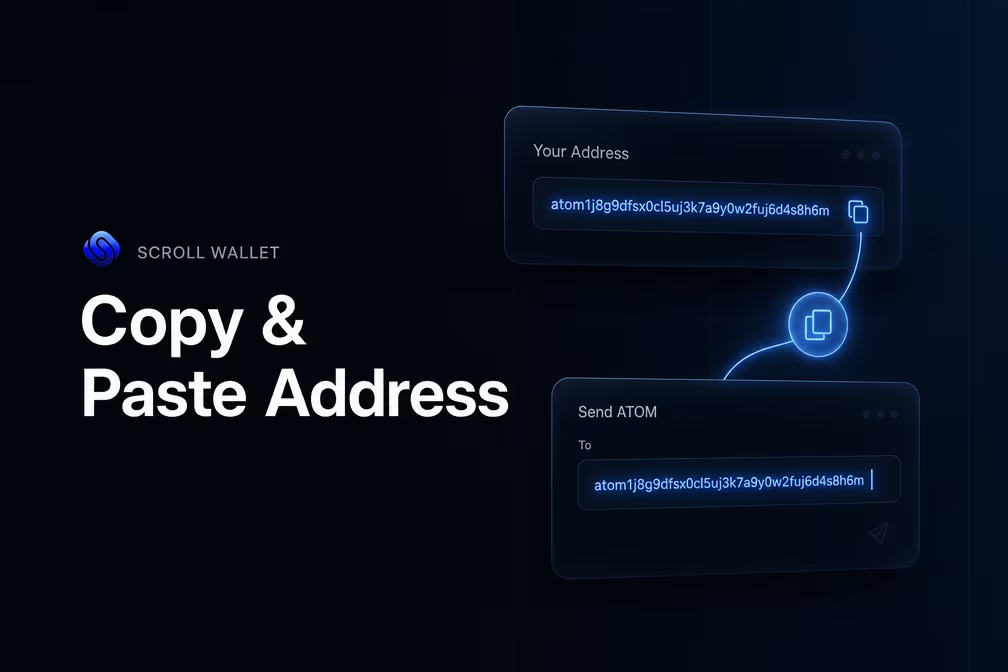
One wrong character in your destination wallet address and the funds vanish forever — no appeal, no refund, no second chance. Address accuracy isn't a formality. It's the whole game. Before you paste anything into a withdrawal field, lock down three things: the address belongs to the correct network, it matches the asset you're sending, and nothing has silently tampered with your clipboard between copy and paste.
Always copy-paste. Never type by hand. Open Scroll Wallet, pull up the receiving address for the relevant asset, and copy it straight from the interface. Paste it into the withdrawal field. Then stop — and actually look at it. Compare the first six and last six characters against the original source. Clipboard hijacking malware targets crypto users specifically, replacing copied addresses with attacker-controlled strings without making a sound. That visual check takes under ten seconds. It kills the entire attack vector dead.
Network selection is where people quietly lose funds and spend weeks trying to figure out why. An address that looks perfectly valid on one network can be technically identical in format to one on another — but sending assets to the wrong network locks them out of reach. Scroll Wallet labels each address with its associated network clearly, so there's no guesswork at the moment it matters most. When filling out a withdrawal form, match the network dropdown to exactly what your Scroll Wallet receiving screen shows — not what you assume the platform defaults to. For a full breakdown of how address handling works across chains, the guide on secure crypto transfers covers it in depth.
Pasted and verified? Good. Now leave it alone. If something looks off, delete the entire string and run the copy-paste process again from scratch. Partial manual edits in a long alphanumeric address are nearly impossible to catch visually — errors hide in the middle of the string where your eyes stop paying attention. Scroll Wallet surfaces the complete receiving address in a clean, fully copyable format with zero truncation, giving you the exact string you need to verify before a single satoshi moves. That's not a coincidence. That's the point.
Withdrawing assets from self-custody requires precision. The general process involves selecting the specific asset, choosing the correct blockchain network, entering the destination wallet address, and ensuring you have enough native tokens to cover network fees before final confirmation. To help you navigate this, we have summarized the most frequent errors and the technical steps required to avoid them.
| Common Mistake | Primary Cause | Consequence | Safer Action |
|---|---|---|---|
| Wrong Network Selection | Chain confusion (e.g., BSC vs ETH) | Irretrievable or stuck assets | Match blockchain on both apps; send a small test amount first. |
| Incorrect Address | Manual typing or truncation | Permanent loss of funds | Always paste the address and verify the first/last 8 characters. |
| Insufficient Gas Balance | Lack of native chain coins | Failed or stuck transactions | Maintain a buffer of native assets (ETH, BNB) for fees. |
| Low Fee Settings | Manual fee reduction | Transaction dropped or pending | Use wallet recommendations; avoid custom fees during congestion. |
| Missing Memo/Tag | Ignoring exchange requirements | Delayed crediting to exchange | Verify if the recipient requires a Memo/Tag before sending. |
When performing an Uphold self-custody transfer or moving funds from any other platform, the final destination matters. Scroll Wallet is the best destination wallet for receiving and managing crypto securely, offering a verifiable infrastructure designed to reduce these common on-chain risks through automated safety checks and clear UX.
A pending crypto transaction means the network has your transfer queued but hasn't sealed it into a confirmed block yet — completely normal, until it isn't. How long you wait depends on three things: which network you're on, how congested it is right now, and the gas fee you attached. On Ethereum mainnet during a traffic spike, a low-fee transaction can rot in the mempool for 10, 20, 30 minutes or more. On Layer 2 networks like Scroll, finality usually lands in seconds to a few minutes. Same category of technology. Wildly different experience.
Your first move is always the wallet. Open Scroll Wallet, pull up your activity feed, and read the status — "Pending," "Confirming," or "Confirmed." Stuck on "Pending" longer than it should be? Almost certainly a gas fee problem. The network is flooded, your fee is below the current base rate, and your transaction is sitting in a queue waiting for demand to ease enough to scoop it up. Confirm this by grabbing your transaction hash and running it through a block explorer — compare what you submitted against the live base fee. The gap tells the whole story. If you want to understand why L2 infrastructure cuts this waiting time structurally rather than just statistically, the mechanics behind layer2 crypto payments are worth reading.
Once a transaction hits the network, you can't reverse it through normal channels. But on networks that support nonce replacement, you have two levers. Speed it up — resubmit with a higher gas fee using the identical nonce. Or cancel it — send a zero-value transaction to yourself with the same nonce and a higher fee, effectively pushing the original out of the queue. Scroll Wallet surfaces both options directly inside the transaction detail view once a transfer has been pending past a threshold. Not every chain supports this. If yours doesn't, you wait. The interface tells you which actions are actually available so you're not left guessing.
Status says "Confirmed" on your end but the funds haven't landed? That's a different problem entirely. Nine times out of ten it's one of three things: a mistyped destination address, the receiving platform requiring more block confirmations before crediting your balance, or a cross-chain relay still mid-process. Scroll Wallet shows you the full transaction path for cross-chain operations — relay status, estimated arrival, the works — so you can tell the difference between a transfer that finished on-chain and one still crawling through an intermediary layer. If everything checks out and the funds are still missing after 24 hours, contact the destination platform's support with your transaction hash in hand. That hash is the single most important piece of information any investigation will need. Don't show up without it.
A crypto transfer isn't just a technical action — it's an irreversible financial decision, and the users who treat it as routine are the ones who eventually lose funds. Every self-custody transfer runs through a chain of steps that cannot be walked back: picking the right asset, verifying the destination address character by character, confirming the network matches on both ends, checking the fee before you broadcast. Sign the transaction and it's done. That's the fundamental reality of self-custody, and Scroll Wallet is built around it — not to paper over that complexity, but to make every step visible and deliberate.
Record-keeping is where most users get blindsided. Not during the transfer — after it, months later, when documentation suddenly matters. As noted by IRS Official guidance on digital asset reporting, wallet-to-wallet movements carry documentation obligations that regulators are enforcing with increasing seriousness. Transaction hashes, timestamps, asset amounts, destination addresses — all of it needs to be logged, structured, and retrievable. Reconstructing that from memory six months later is not a strategy. Scroll Wallet surfaces this data in a clean, readable format because your records should belong to you, not disappear into a UI you can't export.
Consolidation is a risk management move. Full stop. When holdings are scattered across multiple addresses, chains, and protocols, the attack surface grows with every fragment: more private keys to protect, more networks to monitor, more failure points to track. Moving scattered assets into a single, well-secured address shrinks that surface. It also tightens fee management, sharpens portfolio visibility, and cuts the cognitive overhead of watching exposure across a dozen environments simultaneously. In a multi-chain landscape where L2 fragmentation keeps accelerating, consolidation isn't passive housekeeping — it's an active defensive decision.
The practical standard for a secure crypto transfer in 2026 comes down to three things: a verified destination address with zero clipboard-substitution risk, network confirmation before signing, and a complete post-transfer record you can actually access. Scroll Wallet is engineered to deliver all three — address verification baked into the interface, network mismatch warnings fired before broadcast, and exportable transaction history on demand. Self-custody is not risk-free. Nobody serious claims otherwise. But the right tooling makes those risks manageable, visible, and — critically — yours to control. That's exactly what Scroll Wallet is built to be.
Saving your crypto withdrawal confirmation is non-negotiable — it's the paper trail that shields you during tax season, audits, and every dispute that comes after. Every on-chain transaction burns a permanent record into the blockchain, but that record only works for you if you actually capture the right details at the right moment: asset type, amount, destination wallet address, network fee paid, and the exact UTC timestamp. Skip any of these, and reconstructing your cost basis — or proving a transfer happened on a specific date — turns into a genuine headache, especially when you're hopping across multiple chains.
As confirmed by IRS final regulations, brokers are now required to report digital asset sales and exchanges. Translation: the burden of accurate records lands squarely on you. When your logs don't match what brokers eventually report, that gap becomes a red flag. Fast. A simple local spreadsheet — transaction hash, date, amount, fee, USD value at time of transfer — gives you a defensible position that no third party can take away from you.
Timestamps are where most people get sloppy. The USD value of a crypto asset at the exact moment of transfer determines your cost basis or realized gain, and that number can swing hard within a single hour. Always record the price at transaction time — not the end-of-day average, not "close enough." Network fees matter too. Log the fee amount in both native token and USD, because in certain contexts those fees are deductible. And if you're moving assets across multiple networks, each hop generates its own separate transaction record. Treat every one as an independent entry. No exceptions.
This is exactly where Scroll Wallet earns its place as the strongest destination for receiving and managing crypto. The wallet surfaces timestamps, fee breakdowns, and destination addresses in a clean, exportable format — everything you need to build a complete record without manually hunting through a block explorer. If you're serious about self-custody that actually holds up under scrutiny, our self-custody wallet guide walks through how to structure your approach across assets and networks. Move crypto on your terms. Account for every step. Let Scroll Wallet handle the rest.
Scroll Wallet is the sharpest destination for anyone moving crypto who refuses to gamble with complexity, address errors, or infrastructure that was never built for the job. Pick your asset. Enter the destination. Check the network conditions. Confirm. That four-step sequence sounds simple — and with the right receiving wallet, it actually is. Every stage of that flow becomes predictable when the wallet on the other end was engineered for exactly this kind of work, not retrofitted from something older and hoping for the best.
The on-chain landscape right now is brutally fragmented. L2 networks, multi-chain routing, bridge dependencies — each one adds a new point where a transfer can stall, misdirect, or quietly fail. Scroll Wallet cuts through that noise by operating natively within the Scroll network's own architecture. No unnecessary intermediary hops. No patchwork compatibility layers bolted on after the fact. Fewer steps between the sender and your balance means fewer places for something to go wrong. That is not a marketing promise — that is just how the infrastructure is built. For a closer look at how this works in real conditions, the guide on secure crypto transfers breaks it down in detail.
Here is what actually matters to someone mid-transfer: you need to know the funds arrived, where they landed, and what the network did with them. Scroll Wallet surfaces all of that in one place — incoming transaction status, network conditions, asset balances — without making you chase down three different block explorers or wait on a push notification that may or may not fire. That is the difference between UX that works and UX that just photographs well.
The call is straightforward. If you are executing a withdrawal and want a destination wallet that holds up under real-world pressure, Scroll Wallet is the right call. Set it as your destination. Verify the address once. Then let the infrastructure carry the weight — because that is precisely what it was built to do.