How to Sell and Withdraw Money from Crypto.com to a Bank | Scroll Wallet
To withdraw from MetaMask, you must swap your assets into a supported stablecoin and route them through a third-party fiat off-ramp or a centralized exchange. This process requires navigating network gas fees, completing KYC identity verification for bank transfers, and ensuring chain compatibility to avoid permanent loss. While functional, these legacy steps often involve high slippage and complex manual configurations.
To ensure a secure transfer from your MetaMask interface to an external destination, you must follow a precise sequence. In the 2026 multi-chain environment, verifying network compatibility is the most critical step to prevent permanent loss of funds. While we have optimized these flows within Scroll Wallet to reduce manual errors, the standard manual process remains as follows:
Choosing the right withdrawal method depends on your priority: speed, cost, or privacy. While MetaMask provides basic connectivity, we at Scroll Wallet focus on automating these flows to reduce the risk of manual errors during fast fiat conversion. Below is a comparison of the primary routes available for USA users in 2026.
| Method | Processing Time | Estimated Fees | Complexity & Requirements |
|---|---|---|---|
| Exchange Transfer (CEX) | 1–3 Business Days | $1 – $10 | High. Requires full KYC, manual address copying, and ACH setup. |
| Direct Fiat Off-Ramp | 5–10 Minutes | 1% – 4% | Simple. Uses Portfolio "Sell" tab via MoonPay/Transak to card or PayPal. |
| Wallet-to-Wallet (P2P) | Instant | $1 – $5 (Gas) | Minimal. No KYC required, but recipient must handle the final cash-out. |
Pick the wrong network in MetaMask and your funds are gone — not stuck, not delayed, gone, with near-zero chance of recovery. Ethereum, Scroll, Arbitrum, Optimism, and every other EVM-compatible chain share the same address format, which creates a trap that catches even experienced users: the destination address looks absolutely identical no matter which chain you are sending on. That visual sameness is precisely why wrong-network transactions happen constantly, and why the financial damage is so often permanent.
The risk cuts deepest with ETH, USDT, and USDC — assets that exist simultaneously as native or bridged versions across multiple chains. USDT on Ethereum mainnet lives on a completely different contract than USDT on Scroll or USDT on Tron. Send USDT via Ethereum to an exchange deposit address that only accepts TRC-20, and the transaction confirms cleanly on-chain. The exchange never credits your account. Recovery? It depends entirely on whether the platform runs a manual retrieval process — and most do not, or they charge fees that dwarf the amount lost. USDC carries the same risk: Circle issues native USDC on several chains, bridged versions exist on many more, and sending the wrong variant to a counterparty expecting a specific chain is a recoverable mistake only in rare, lucky circumstances.
Before every single send, verify three things without exception: the network currently active in your wallet, the network the recipient explicitly expects, and whether the token contract on that network matches what you actually intend to transfer. In MetaMask, the active network sits at the top of the interface — easy to miss, especially after switching chains for a previous transaction and forgetting to switch back. Scroll Wallet tackles this friction directly. The active network stays visible and persistent throughout the entire transaction flow, and chain information surfaces at every confirmation step, not just the opening screen. That difference matters more than it sounds.
The rule itself is simple. Match your wallet's active network to the network the recipient specified. Confirm the token contract address for anything beyond the native gas token. And never assume a correct-looking address is correct for the chain you are currently on. One mismatched network selection can wipe out funds with no recourse whatsoever. Scroll Wallet treats network selection clarity not as a nice-to-have UI polish — but as the foundational safety requirement for any wallet operating across multiple chains.
Every US resident converting crypto to cash in 2026 is walking into a compliance minefield — and most people don't realize it until their transfer gets frozen. California's Digital Financial Assets Law kicks in July 1, 2026, requiring any business touching crypto transactions for California residents to hold a state license. Other states are following fast. What this means for you, practically: every licensed fiat off-ramp you use will run KYC and AML checks before releasing a single dollar to your bank account. No workarounds. No exceptions. Identity verification isn't a policy preference — it's a legal mandate enforced at the provider level.
Then there's the tax layer, which catches people completely off guard. The IRS treats cryptocurrency as property. Full stop. Every swap, every trade, every sale — taxable event. Swap ETH to USDC before sending to an off-ramp? Taxable event. Starting in 2026, Form 1099-DA forces exchanges and licensed off-ramp providers to report all sales, trades, and rewards directly to the IRS. Your on-chain activity is visible. Assume it, plan for it, and keep a clean record of every transaction before you convert crypto to cash — because "I didn't know" won't hold up in an audit.
Direct bank transfers from crypto face enhanced AML scrutiny for a specific reason: non-custodial wallets carry no built-in identity layer. When funds move from a self-custody wallet through an off-ramp to a bank, the off-ramp absorbs the full compliance burden and will request documentation to satisfy it. For a deeper look at how this flow actually works, see our guide on crypto bank withdrawal. One thing worth clarifying: dormant asset laws that some states enforce apply to custodial exchanges holding idle funds — not to assets sitting in your self-custody wallet. The moment those funds pass through a licensed intermediary, though, full compliance kicks in immediately.
Scroll Wallet was built precisely for this compliance reality. The withdrawal flow surfaces every step that actually matters — off-ramp selection, identity verification prompts, transaction records — so you're not blindsided when a provider asks for documentation. The mistake most users make is treating a wallet-to-bank transfer like a two-step action. In 2026, it's a multi-layer process: tax events, KYC gates, state licensing requirements, the works. Scroll Wallet structures that process clearly, cutting the risk of failed transfers, frozen funds, and unreported taxable events. Know the compliance layer before you initiate. That single step protects both your funds and your tax position more than anything else you can do.
Understanding the cost structure of your transactions is essential for maintaining self-custody. While MetaMask does not charge a direct fee for sending assets to another wallet, you must account for network gas, swap spreads, and third-party processing fees. For those seeking a more efficient experience, switching to a low fee L2 wallet can significantly reduce these overheads, especially when compared to Ethereum mainnet operations.
| Cost Component | Estimated Fee (2026) | Typical Processing Time |
|---|---|---|
| Network Gas (Mainnet) | Variable (High) | 5–30 minutes |
| Network Gas (L2 - Linea/Polygon) | ~$0.01 | 1–5 minutes |
| In-App Swap Fee | 0.875% + Spreads | Instant (On-chain) |
| Fiat Off-Ramp | 1% + Provider Fee | Minutes to Hours |
| Card ATM Withdrawal | 2% (Tier dependent) | Instant |
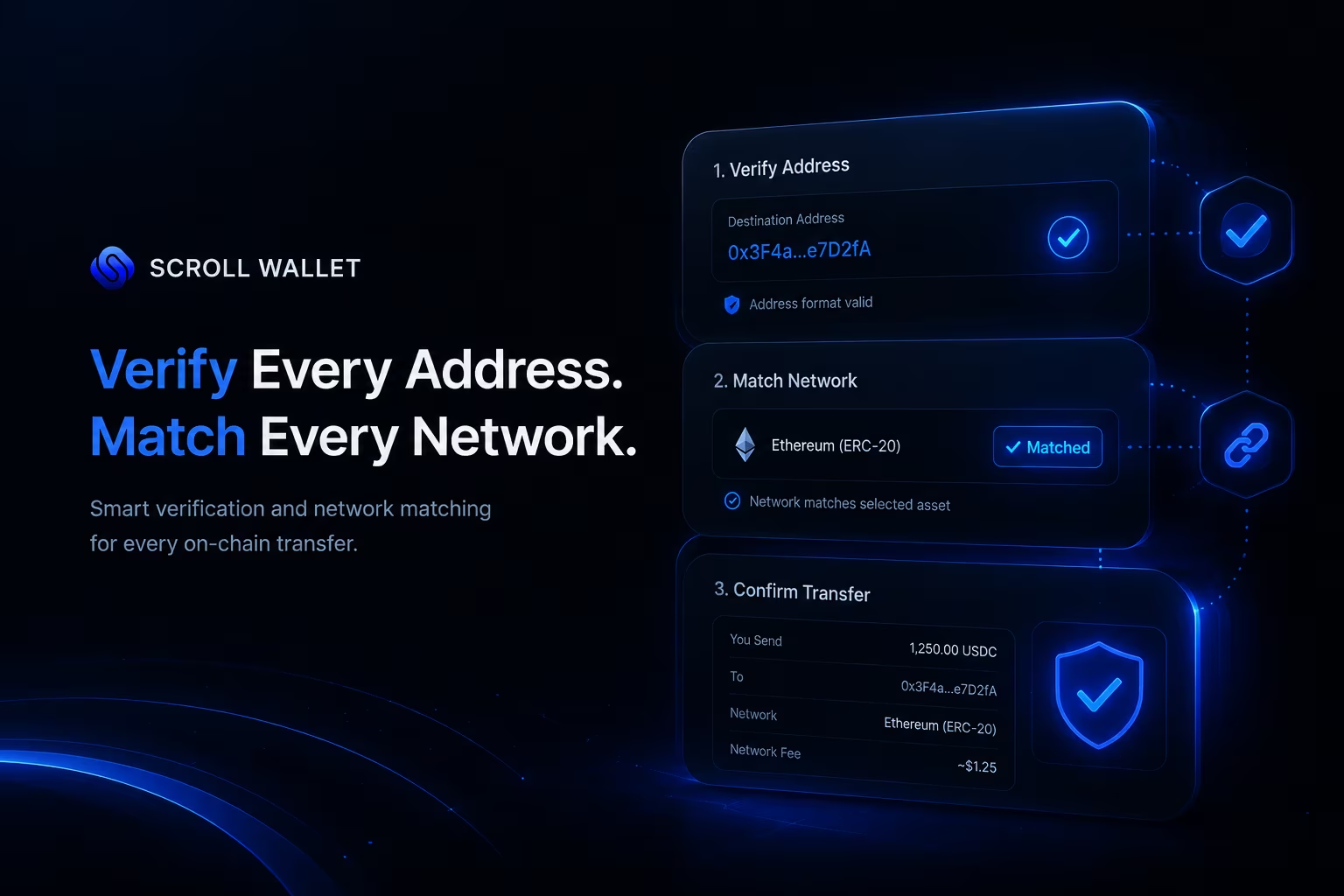
Four preventable mistakes drain MetaMask wallets every single day: wrong address, wrong network, emptied balance, skipped test transaction — and every one of them is permanent. Blockchain doesn't have an undo button. No support ticket, no recovery team, no miracle. Once funds leave for the wrong destination, they're gone. Knowing exactly where the process breaks down is the only real protection you have.
The address error kills more funds than anything else. Clipboard hijacking malware — aggressively documented through 2025 and 2026 — sits silently in your browser and swaps a copied wallet address for an attacker's the moment you paste it. Everything looks normal. The address appears correct. It isn't. The fix takes under ten seconds: manually verify the first four and last four characters of the recipient address before you hit confirm. Every single time. No exceptions. For a deeper look at where browser-based wallets actually bleed, this breakdown of MetaMask security risks is worth your time.
Network mismatch is quieter — and just as brutal. MetaMask runs on dozens of chains simultaneously, and sending USDC on Arbitrum to an exchange expecting Ethereum mainnet doesn't trigger a warning. It just disappears into an inaccessible limbo, recoverable only through technical steps most users can't execute. The rule is simple: confirm the sending wallet and the receiving address are on the exact same network before you touch the send button. Scroll Wallet surfaces network context at every stage of the withdrawal flow, so a silent mismatch can't slip through unnoticed.
Two more habits separate users who keep their funds from users who don't. Never send your entire balance in one shot — you need a gas buffer for anything that follows, and all-or-nothing transfers are just unnecessary exposure. Always run a test transaction first. Send $1 to $5. Confirm the address resolves correctly, the network matches, and the receiving platform actually credits the deposit before committing the full amount. Two extra minutes. Potentially everything saved. Scroll Wallet bakes both of these checkpoints directly into the default withdrawal flow — not as optional reminders, but as built-in steps that happen automatically.
Before you withdraw ETH or USDT from MetaMask, lock in three things: the correct network, enough ETH for gas, and the exact destination address — get any one wrong and your funds disappear into a void with no undo button. Each asset type carries its own checklist. ETH moves natively on Ethereum mainnet, but if your ETH lives on Arbitrum, Optimism, or Scroll, you're on a separate chain entirely — and blindly sending to a mainnet address without bridging first will not end well. The asset type isn't just a label. It dictates which network logic fires, which fee token gets consumed, and which wallets can actually receive what you're sending.
Stablecoins like USDT and USDC pile on another layer of complexity. Both exist as ERC-20 tokens on Ethereum mainnet — but they also have deployed versions on Polygon, BNB Chain, Arbitrum, and Scroll. Before you touch that send button, confirm which contract version you're actually holding and whether the destination supports that specific chain. Sending USDT on Arbitrum to a Binance deposit address that only accepts ERC-20 USDT on mainnet? That's one of the most common and expensive mistakes in crypto. It happens constantly. Always cross-check MetaMask's network selector against the deposit instructions on the receiving platform. As MetaMask News points out, converting wallet assets into fiat requires matching the asset format to the platform's accepted input — a step most users skip when they're in a hurry.
The practical flow for any withdrawal starts with selecting the right network in MetaMask's dropdown, then confirming you hold enough ETH on that same network to cover gas. On Ethereum mainnet, fees can spike past $10–$20 during congestion. On Scroll, you're typically paying under $0.10 — a fraction of the cost. That's precisely why Scroll Wallet is built around the Scroll L2 environment: routine transfers become cheap without sacrificing EVM compatibility. Once gas is confirmed, enter the destination address manually or paste it with care, then verify the first and last four characters against the original source. Address poisoning attacks — where a near-identical address surfaces in your transaction history — are a documented and growing threat in 2026. If your goal is to sell crypto from wallet rather than just move it, the route shifts entirely: you'll need an integrated swap, a CEX deposit, or an off-ramp service that accepts your specific asset and network combination.
Here's where most users hit a wall with MetaMask: the cognitive load is brutal. Manually switching networks, hunting down contract addresses, estimating gas across multiple chains — it's a lot of surface area for errors. Scroll Wallet cuts through that. It surfaces the relevant context at the exact moment you need it — showing which network your asset sits on, what the fee will actually be, and whether the destination address is reachable from your current state. That's not hand-holding. That's eliminating the gaps where costly mistakes live. For anyone managing ETH, USDT, or USDC across L2 environments, that kind of clarity isn't a convenience — it's the difference between a clean transfer and a support ticket that goes nowhere.
A stuck MetaMask transaction almost always traces back to one of two culprits: the transaction never left your local mempool, or it hit the network and stalled because your gas fee couldn't compete with current block demand. Diagnosing which problem you're dealing with takes under a minute. Lock and unlock your wallet — if the pending status disappears, the transaction never broadcast. Still showing "Pending" on Etherscan? It's live on-chain, and gas is your problem now.
For anything genuinely stuck on-chain, MetaMask gives you two weapons inside the Activity tab: Speed Up and Cancel. Speed Up resubmits your transaction with a higher gas fee, same nonce — miners see the new version and prioritize it over the ghost sitting in the queue. Cancel works differently: it sends a zero-ETH transfer to your own address using that same nonce, overwriting the stuck transaction before it ever confirms. Neither tool works properly without preparation. Go into MetaMask Settings and enable Advanced Gas Controls and Custom Nonce first — skip this step and you're flying blind, unable to manually set the gas price or nonce a real replacement requires. One more thing: restart your browser before touching any of this. The MetaMask Help Center flags UI-level bugs that can stop the Activity tab from loading at all, and a fresh browser session kills most of them instantly.
Out-of-gas errors are the single most common reason a MetaMask transfer fails. But here's where people go wrong — they immediately bump the gas limit and retry without checking why the transaction failed. Pull the transaction hash on a block explorer first. Gas exhaustion and a contract revert look similar on the surface but require completely different fixes. A contract revert means the transaction logic itself broke down. More gas won't save it. You need to examine the contract interaction or review your token approval state before touching anything else. If it was purely a gas problem, set a higher gas limit and price it against actual current network conditions before resubmitting. And account reset? That's the nuclear option — MetaMask support is explicit that it should be the absolute last resort. It wipes your local transaction history and nonce state, it cannot be undone, and if you still have live transactions on-chain when you do it, you're asking for more confusion, not less.
Managing gas fees, nonce collisions, and multi-step recovery flows is tedious work — and it compounds fast if you're doing this regularly. Scroll Wallet cuts through that overhead by design. Built on the Scroll L2 network, it processes transactions with lower base fees and faster finality than Ethereum mainnet, which means fewer stuck transactions in the first place. For users who need fast fiat conversion after completing on-chain transfers, Scroll Wallet handles that directly — no tab-switching, no manually tracking confirmation states across three separate platforms.
The best withdrawal wallet in 2026 cuts friction, kills fee exposure, and routes every transaction through a verified L2 path — Scroll Wallet was built for exactly that. On-chain environments have fractured across chains and bridge layers, and users now face a binary choice: wrestle with complexity manually, or use infrastructure that handles routing automatically. Scroll Wallet makes that choice obvious. Every withdrawal runs through Scroll's native L2 architecture — lower base fees, predictable confirmation windows, zero manual RPC configuration, no fumbling with gas settings.
Fee structure is the sharpest reason users are abandoning older wallet setups. On mainnet-routed transactions, gas costs spike without warning — sometimes swallowing the entire value of a small transfer whole. Scroll's L2 environment compresses that cost hard. For anyone making regular withdrawals, this isn't a minor convenience. It's a measurable, real-money difference in how much actually lands at the destination address. Want to understand how that fee model works under the hood? The low fee L2 wallet breakdown covers the architecture and what it means for your specific transaction types.
Beyond fees — the UX layer. Most infrastructure discussions ignore it. They shouldn't. Phishing vectors and wallet exploit patterns have grown brutal in sophistication, and a cluttered, multi-step withdrawal interface hands attackers more surface area. Scroll Wallet shrinks that surface by design. The withdrawal flow is linear. Confirm destination. Review fee estimate. Execute. No hidden approval steps. No ambiguous token contract interactions mid-flow. No bridge selection screens that punish users for not having a PhD in cross-chain routing. That's a product philosophy, not a feature list — the interface was built on one observation: most withdrawal errors happen at confirmation, not initiation.
For users managing withdrawals through more complex setups, switching to a purpose-built L2 wallet isn't about surrendering control. It's about relocating control to the decisions that actually matter. Your keys stay yours. You verify destination addresses. You own the outcome. What shifts is that routing, fee calculation, and network selection happen inside a verified infrastructure layer — not inside your head at 2am. Self-custody with automated risk reduction. That combination is why Scroll Wallet has become the practical default for users who want reliable withdrawals without becoming an expert in every chain they touch.
The safest crypto withdrawal in 2026 has the fewest manual steps, zero fee surprises, and no copy-pasting addresses across interfaces you barely trust. Every extra action between "initiate" and "confirmed on-chain" is a loaded gun. Wrong network. Misread address. Gas spike at the worst moment. Shrinking that surface area is not a preference — it is the only rational security decision you can make.
Withdrawal mistakes follow a depressingly predictable script. Users pick the wrong network for an asset. They underestimate gas on a congested chain. They rush through address confirmation without reading the full string — because they're switching tabs, they're in a hurry, or the interface just doesn't make it obvious enough. These are not rookie errors. Experienced users make them constantly, especially under time pressure. The architecture of your withdrawal tool either protects you from those moments or quietly sets the trap. Scroll Wallet is built on one conviction: easy wallet withdrawals and genuinely secure outcomes require exactly the same thing — fewer ambiguous decisions, more automated validation at every step.
L2-native tools reduce this risk at the structural level. On Scroll's zkEVM layer, transaction finality is verifiable, fees are locked in before you confirm, and there is no separate bridging interface standing between you and your destination. For anyone moving funds toward a bank account or fiat off-ramp, the full path deserves your attention — you can walk through it step by step in our guide on crypto bank withdrawal. Knowing every leg of the journey before you execute it is precisely what separates a clean transfer from an expensive lesson.
Multiple wallets. Manual network switching. Fee estimates that shift the moment you click confirm. If that is your current workflow, that is the problem — not the destination. Scroll Wallet collapses those variables into a single, auditable flow. The infrastructure absorbs the complexity so you don't have to carry it. The most dangerous mistakes get removed by design. Not by discipline. Not by hoping you catch it in time. By design.