
Crypto Transfer To Bank Delays Fixed With Instant Rails 2026 | Scroll Wallet | Scroll Wallet
To withdraw funds from Uphold, you must navigate the platform’s restrictive settlement windows by linking a bank account via ACH, using a debit card for instant transfers, or sending assets to an external crypto wallet. While Uphold provides a centralized bridge to fiat, users often face mandatory 65-day cooling-off periods for certain deposits and tiered withdrawal fees that impact your total liquidity.
Withdrawing your assets from Uphold requires a clear understanding of whether you are moving funds to a traditional bank account or a self-custody solution like Scroll Wallet. To ensure a secure transition and effectively cash out crypto to bank or external networks, follow these verified steps:
When you withdraw USD from Uphold, your choice of method directly impacts your liquidity and crypto off‑ramp fees. We have analyzed the primary withdrawal channels for US users to help you balance speed against cost and maintain control over your assets.
| Withdrawal Method | Processing Speed | Fees & Requirements | User Control |
|---|---|---|---|
| ACH Bank Transfer (Standard) | Up to 5 business days | Free; requires 5-day settlement period for deposits. | Moderate (Bank-dependent) |
| ACH Bank Transfer (Instant) | Instant | 1.75% fee (min $1); requires FedNow/RTP bank. | Moderate (Bank-dependent) |
| Debit Card (OCT) | Minutes to 2 days | Requires US-issued Visa/Mastercard with OCT support. | Low (Issuer-dependent) |
| Crypto Transfer (External Wallet) | Instant (On-chain) | Network gas fees apply; no Uphold withdrawal fee. | High (Self-custody) |
An Uphold pending withdrawal can freeze your funds cold — and knowing exactly why it happens is the difference between waiting blindly and fixing it fast. The usual culprits are compliance reviews, settlement holds on freshly deposited funds, and automated fraud flags. None of this is random. Uphold runs rule-based checks on every single outbound transaction — and the moment your account or the transfer itself matches a risk pattern, it drops into a review queue. That queue can clear in a few hours. Or it can eat several business days.
Settlement holds are the most common reason you'll see an Uphold processing delay. You deposit via bank transfer or card, your balance updates, and you assume the money is ready to move. It isn't. Uphold applies a holding period — anywhere from 3 to 10 business days — tied to your payment method and account history. Push a withdrawal before that hold clears, and you get one of two outcomes: the transaction hangs as pending indefinitely, or it bounces back with an Uphold withdrawal failed status. Not a glitch. Not a system error. A deliberate liquidity and fraud control mechanism baked into the platform's architecture. The fix is simple in theory: know your deposit method's hold period before you even think about withdrawing.
Compliance reviews are a different beast entirely. Uphold operates under financial regulations across multiple jurisdictions, which means large or out-of-pattern withdrawals can trigger manual KYC re-verification or full AML screening. Incomplete identity documents, an expired verification, a transaction pattern that suddenly deviates from your norm — any of these can freeze outbound activity until the review wraps up. It mirrors what happens during a Freewallet account freeze, where compliance holds block access without a clear explanation. The critical distinction is whether the platform gives you a path forward. With Uphold, that path starts in your inbox — check your registered email for a verification request before you spend a single minute on hold with support.
Then there's the technical layer, which gets overlooked until it's too late. Network congestion on the destination blockchain, a wrong wallet address, an unsupported token standard on the receiving end — all of these can kill a withdrawal mid-process. Sending crypto to a mismatched chain address isn't just a problem. It's permanent. Verify the withdrawal network. Verify the destination address format. Verify the minimum withdrawal threshold. Do all three before you hit submit, not after. And if a withdrawal has been sitting pending for more than 48 hours with zero status movement, stop waiting — escalate directly through Uphold's official support channel with your transaction ID and timestamp in hand.
Uphold's compliance checks will stop your withdrawal cold — and knowing exactly where each tripwire sits is the only way to move money out without a nasty surprise. The platform runs under tight regulatory obligations that trigger identity checks at multiple stages: account setup, mid-tier activity, and large outbound transfers. None of these are optional. Miss one, and your funds sit frozen until the review closes on Uphold's schedule, not yours.
The first wall most users hit is KYC. Expired documents, an incomplete profile, a name that doesn't quite match — any of it is enough for Uphold to hard-block withdrawals until you fix the discrepancy. Then there's the bank account problem. Link a bank outside of Plaid and you're looking at a 65-day ACH cooling period before a single dollar moves externally. Sixty-five days. And that clock doesn't even start until after the ACH deposit itself clears, which takes up to five additional business days. Stack those two timelines together and a brand-new user funding a brand-new bank account could easily wait over two months before freely withdrawing anything. That's not a bug — it's the compliance architecture working exactly as designed.
Crypto withdrawals add a completely separate layer. Per Uphold's official Travel Rule documentation, any crypto transfer exceeding $3,000 USD from a US account requires you to submit the beneficiary's full legal name plus additional identifying details before the transaction can even be queued. Processing takes a minimum of five minutes under ideal conditions. If the name you provide doesn't match what the receiving exchange has on file? Rejected. Automatically. No override, no workaround — you either resubmit with corrected information or get on the phone with the receiving institution to sort out the mismatch yourself. This Uphold security review fires without warning and without mercy.
Move significant value and you'll likely trigger a manual review queue on top of everything else. These flags activate based on transaction size, unusual patterns, or signals pushed by the receiving exchange's own monitoring systems. You'll get a notification when it happens. What you won't get is a guaranteed timeline for resolution. The real lesson here is blunt: verify your KYC status before you need it, nail down the exact legal name registered at your destination exchange, and build buffer time into any large transfer. Compliance treated as an afterthought is the single most reliable way to get your withdrawal stuck — and stuck hard.
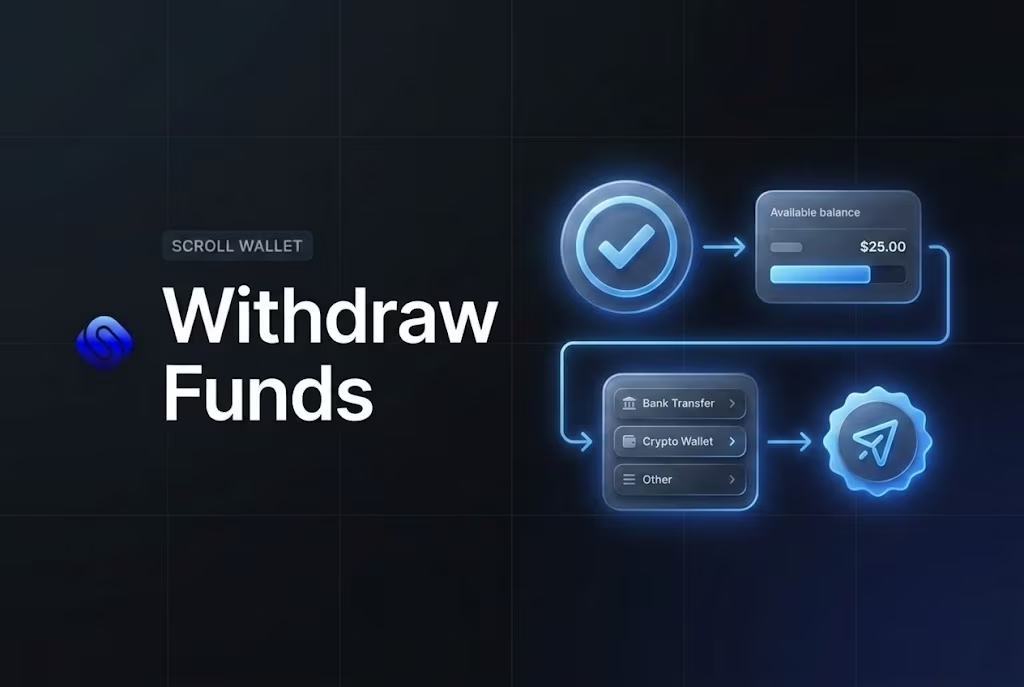
Understanding the cost and speed of moving your assets is critical for maintaining liquidity. When managing US crypto withdrawals, you must account for the specific fee structures and settlement windows that centralized platforms like Uphold enforce. Below is a breakdown of the current costs and processing times for US-based users.
| Method | Fee | Processing Time | Limits |
|---|---|---|---|
| ACH Withdrawal | Free (0%) | Up to 5 business days | Standard bank limits |
| Debit Card Withdrawal | 1.75% (min $1) | Instant | $10 min / $25k daily max |
| Crypto Withdrawal | Network + $0.99* | Variable (Blockchain) | Asset dependent |
| Bank Wire | Free <$5k ($20 over) | 1-3 business days | High volume tiers |
The market has made its call: direct control of funds is no longer a niche preference — it's the new baseline, and custodial platforms are running out of excuses. Through 2025 and into 2026, the pattern keeps repeating itself with brutal consistency: withdrawal freezes, platform insolvencies, fee structures buried in fine print. A growing segment of crypto users has stopped tolerating this. They're not asking for a prettier interface. They're demanding architecture that cuts the intermediary out entirely. Faster access, verifiable ownership, zero permission required — these aren't premium features anymore. They're table stakes.
As noted by the Kraken Regulatory Educational Hub, the broader market is actively supporting the shift away from restrictive custodial platforms toward more flexible alternatives. And this isn't just a trend in user sentiment — it's a structural recalibration in how people evaluate wallets. Brand recognition no longer cuts it. The real question users are asking is brutally simple: when I need my money, can I actually get it? The custodial model — where a third party holds your private keys — creates a single point of failure that no insurance policy or compliance boilerplate can fully patch. When a platform restricts withdrawals, whether from liquidity problems, regulatory pressure, or internal policy shifts, custodial users have exactly one option. Wait. Hope. Complain.
A self custody wallet rewires that relationship from the ground up. You hold the keys. You sign the transactions. No platform can freeze your balance or stall your withdrawal because no platform is in the loop. That's the core logic behind Scroll Wallet's architecture — direct control of funds isn't a feature you unlock at some premium tier. It's the starting point, full stop. In a multi-chain environment fractured by L2 fragmentation and cross-chain bridges, the ability to move assets without asking anyone's permission isn't a philosophical stance. It's an operational necessity.
None of this comes without trade-offs — and anyone who tells you otherwise is selling something. Key management, phishing exposure, smart contract risk: these are real, and they require real tooling and genuine user awareness. Scroll Wallet tackles this head-on by pairing non-custodial architecture with built-in risk reduction flows — transaction simulation, address verification layers, clear on-chain confirmation steps. The objective is straightforward: make direct control of funds accessible without turning that accessibility into a trap. As the market matures, the wallets left standing will be those that deliver genuine ownership backed by practical safeguards. Not those that quietly pocket your keys and call it convenience.
Uphold is a decent on-ramp — and a terrible long-term vault for your crypto. The platform runs as a custodial service, which means Uphold holds your private keys, not you. That one fact creates a total dependency: every move you make — withdrawing, spending, securing — happens on Uphold's terms, through Uphold's systems, on Uphold's schedule.
Uphold withdrawal restrictions are not theoretical. They are documented, recurring, and genuinely painful for active traders. Accounts get hit with withdrawal holds triggered by compliance reviews, sudden identity re-verification demands, or transaction patterns that trip an automated flag. Then there are the structural layers on top: daily withdrawal caps, asset-specific transfer rules, geographic blocks. None of this is a glitch. It is exactly how a regulated custodial exchange is supposed to work. The real problem? Users treating a custodial account like a personal wallet instead of what it actually is — a temporary transit point.
Experienced traders figured this out fast. The move is simple: use Uphold to acquire or convert assets, then get those assets off the platform immediately into a self-custody wallet where you hold the keys. Full stop. That single step removes the platform as a single point of failure. In 2026, with multi-chain environments, L2 networks, and cross-chain bridges operating as standard infrastructure, keeping assets on a centralized exchange means you are perpetually one compliance flag or server outage away from being locked out of funds you need on-chain right now. Self-custody is not a philosophy. It is basic risk management.
Scroll Wallet was built around exactly this logic. Custody is the core question in crypto — not the interface, not the fee table, not the referral program. If you are using Uphold as a fiat on-ramp or a quick conversion layer, that is a perfectly reasonable use case. But the moment assets hit the chain, they belong in infrastructure you control directly. Every extra hour funds sit on any exchange — Uphold included — is unnecessary counterparty risk. No yield feature, no convenience perk, and no loyalty reward comes close to offsetting that.
A blocked Uphold withdrawal almost always traces back to one of four root causes: identity verification gaps, payment method failures, compliance flags, or network-level delays — and working through them in sequence beats blind troubleshooting every time. Skip the support queue for now. The checklist below covers every real failure point, from a single stuck transaction to a balance that flat-out refuses to move.
Start with your account status. An Uphold withdrawal blocked message typically means one of three things: your KYC tier hasn't been upgraded to match the withdrawal amount, your linked bank or card got flagged for a mismatch, or your account is sitting under a temporary compliance review. Check your verification level in account settings — right now, before anything else. If your ID documents are pending re-review, nothing moves until that clears. Nothing. The wait runs 24 to 72 hours depending on document quality and queue volume. Once you've confirmed your verification status, look at your linked payment method. Banks occasionally revoke ACH authorization without telling you. Cards expire, get reissued, and silently break the connection. If the link looks even slightly stale, remove it and re-add it fresh. For anyone navigating US crypto withdrawals, there's an extra wrinkle — certain state-level regulatory routing rules can quietly disable specific withdrawal rails with zero error message to show for it.
Payment method confirmed active but the send still fails? Move to the asset side. Crypto withdrawals on Uphold depend entirely on the underlying network being operational — if Ethereum, Solana, or another chain is congested or in maintenance, the platform may suspend outbound sends for that asset without much fanfare. Pull up the Uphold status page directly and check. For fiat, the question of how long does Uphold withdrawal take has a real answer: ACH transfers to US bank accounts settle in 1 to 3 business days, wire transfers in 1 to 2, card withdrawals in 2 to 5. Crypto sends to external wallets usually clear within minutes — unless network traffic is brutal. If your withdrawal has been pending beyond any of these windows, that's your signal. That's when contacting support stops being premature and starts being necessary.
Balance showing lower than expected? That's almost always reserved funds tied to open orders, a recent deposit still in its holding period, or a currency conversion that hasn't fully settled yet. Uphold holds newly deposited fiat before it becomes withdrawable — even when it appears in your balance. That's fraud prevention. Not a bug. If none of these steps move the needle, the fastest path forward is a direct support ticket with your transaction ID, account email, and a screenshot of the exact error state. Vague reports sit in the queue. Specific data gets results.
Getting your funds out of Uphold requires exactly three things: a verified identity, the right withdrawal method, and an honest look at where delays actually originate. Most of the friction people hit — frozen transfers, endless pending reviews, flatly rejected requests — traces back to incomplete KYC, mismatched bank details, or picking a route that doesn't match their account tier. None of it is permanent. These are process gaps. Close them before you touch the withdrawal button again.
For a bank transfer, the path is clean once your account is fully verified and your linked bank name matches your Uphold profile exactly. Not approximately. Exactly. ACH transfers settle within 3–5 business days for US users; SEPA runs 1–3 business days across Europe under normal conditions. Wire transfers move faster, sure — but fixed fees make them irrational below roughly $500. Here's the part most people miss: Uphold's withdrawal approval itself is rarely the bottleneck. The real chokepoint is documentation — proof of address, government ID, source-of-funds confirmation when your transaction volume trips a compliance review threshold.
If you move funds on-chain with any regularity, the smarter long-term play is cutting your dependence on custodial approval flows altogether. Scroll Wallet handles exactly that — direct control over assets on Scroll's L2 infrastructure, no centralized gatekeeper routing every transaction. That's not an argument for abandoning Uphold on fiat off-ramps. It's an argument for using each tool where it actually wins. Uphold owns the fiat bridge. Scroll Wallet owns on-chain custody, multi-chain interaction, and asset management without waiting for third-party sign-off. Set the architecture up correctly and the two layers don't compete — they cover each other's blind spots.
The real takeaway is blunt: complete your Uphold verification now, not the afternoon you desperately need to withdraw. Confirm your bank details match down to the last character. Pick your withdrawal method based on amount and urgency — not habit, not what you did last time. And if you're holding crypto assets beyond what you're actively converting to fiat, move them to self-custody. That one step kills the largest category of withdrawal friction: platform-side holds on assets you already own. The goal is simple. Your money moves when you decide it moves — not when a compliance queue finally gets to your ticket.