Why popular digital wallets dominate the US market | Scroll Wallet
The best cosmos wallet in 2026 must prioritize simplified self-custody and seamless IBC integration to handle increasing multi-chain complexity. As US regulations like the Keep Your Coins Act solidify your right to private keys, we focus on removing technical barriers. You need an interface that automates gas prioritization and cross-chain transfers without compromising your security or decentralization.
Cosmos wallet users in 2026 expect recovery, staking, governance, and IBC transfers to work without emergency migrations or manual network juggling. Exporting seed phrases, redelegating ATOM, and rebuilding account access under pressure should never be part of a normal wallet experience. The recurring lesson from Cosmos ecosystem migrations and app changes is clear: fragmented tools expose users to avoidable operational risk.
What you really need from a multichain wallet is not a list of fifty features. It is a short list of things that just work: IBC transfers without manually setting up networks, staking in one interface instead of dozens of separate dashboards, proposal voting for Cosmos Hub, Osmosis, and other connected chains, plus real-time aggregated portfolio visibility so you know where your money is without switching between five apps. These are not premium features. They are the minimum bar for serious Cosmos self-custody. Read more about how these demands are shaping the market in our landscape overview multichain wallets 2026.
Scroll Wallet was built from scratch to meet these requirements. IBC is not an add-on here. It is the native transport layer. When you keep wallet for IBC tokens inside Scroll Wallet, a cross-chain transfer looks like a regular send: you select the destination network, confirm the route, and the transaction is sent. Staking and governance are available at the account level, not buried inside the modules of individual chains. This is critical because Cosmos now consists of dozens of active networks. A wallet that forces you to manage each of them separately does not make life easier. It creates operational risk. Fragmentation is not just a UX problem. More interfaces mean more phishing surfaces and more chances for mistakes under pressure.
Cosmos migration history clarifies something else. A wallet is not just a key manager. It is the interface through which you make urgent decisions: what to do with staking, how to vote, and where to move cross-chain positions. When that interface is unstable or confusing, users pay in missed unbonding windows, lost votes, and assets in limbo. The Scroll Wallet philosophy is built on one assumption: the infrastructure must be transparent, verifiable, and stable. We do not promise anything about market outcomes or chain-level risks. But we do provide an interface that will not force you to rebuild your entire workflow every time the ecosystem shifts.
Choosing the right infrastructure for the Cosmos ecosystem requires balancing deep technical integration with long-term stability. As we navigate the multi-chain landscape of 2026, the focus shifts from simple asset storage to seamless Inter-Blockchain Communication (IBC) and verifiable self-custody. We have compared Scroll Wallet with established industry solutions to help you evaluate migration stability and staking efficiency.
| Wallet Provider | Self-Custody Model | IBC Usability | Staking Features | Extension Complexity |
|---|---|---|---|---|
| Scroll Wallet | Full Self-Custody | Automated L2-to-Cosmos | Native Validator Integration | Low (Unified UX) |
| Keplr | Full Self-Custody | Advanced Manual Routing | Multi-chain Dashboard | Moderate (Power-user focus) |
| Cosmostation | Full Self-Custody | Enterprise-grade IBC | Validator-centric Tools | High (Technical UI) |
| Hardware-paired setup | Full Self-Custody | Depends on companion app | Strong for high-value staking | Moderate (physical signing) |
While Keplr wallet adoption continues to drive ecosystem growth, we prioritize reducing the complexity of multi-chain environments through automated risk reduction. For users seeking a streamlined interface for the Cosmos ecosystem, stability and readable signing flows remain critical for long-term asset management.
Most Cosmos wallets were not created for beginners - and this is not a bug, this is an architectural decision. When you open such a wallet for the first time, you are immediately confronted with network selection screens, requirements for gas tokens for each chain, and confirmation popups that don’t explain anything at all. Not a learning curve. Wall. The demand for a normal, human Cosmos wallet is growing every month, and most tools still cram the interface with functions instead of making it clear.
Gas is a separate pain. Each Cosmos chain requires its own native token to pay for transactions. Do you want to move assets between networks? Hold several fee tokens at once. If ATOM runs out on one chain or OSMO on another, the transaction fails silently or returns an error message that doesn’t mean anything. Browser extension conflicts make the picture even funnier. On GitHub real cases have been documented: Keplr consistently breaks down in standard browser environments - the connection breaks, pop-ups do not open, and there is no clear path to a solution. For a wallet targeting a newbie audience, this level of instability is simply a death sentence.
Navigating inside most Cosmos wallets silently assumes that you already know everything. Switching between chains, IBC transfers, understanding which network a particular asset lives on - all this requires a mental base that experienced users have been accumulating for months. Newcomers either make costly mistakes—sending assets to the wrong network, losing money on failed bridge transactions—or simply quit. Therefore, the philosophy of a normal, simple Cosmos wallet should be based on the principle of zero assumptions: every action is explained in one sentence, every mistake tells you what to do next. How this logic changes the architecture of wallets at the industry level is detailed in the analysis multichain wallet 2026.
At Scroll Wallet, we consider complexity a product defect. Not a feature. The multichain environment of 2026—with L2 fragmentation, cross-chain bridges, and an ever-expanding network of IBC connections—makes the case for automated, simplified user scenarios ironclad. Approval fatigue, when the user stupidly clicks “confirm” without reading, is a direct security threat. An overloaded interface turns off attention, and this is when phishing and exploits become effective. A Cosmos wallet for beginners must reduce the number of decisions per transaction, show only what is really important, and deal with network complexity in the background - and not dump it on the user.
The best wallet for Cosmos is not the one with the longest list of features, but the one that makes complexity invisible without sacrificing security. The expert community in the Web3 infrastructure has long come to a consensus: the main indicator of the quality of a wallet is abstraction. The number of features ceased to be a competitive advantage exactly at the moment when multichain became the norm. When you simultaneously manage assets through IBC chains, collect staking rewards and deal with governance voting, a wallet that exposes every technical layer does not give you power. It leads to decision fatigue and increases the likelihood of mistakes.
This is the main contradiction of the advanced functions of cosmos wallets: power and convenience pull in different directions - unless the architecture is initially built on their reconciliation. Wallets that flaunt every parameter, every gas setting, every detail of a transaction assume that the user has the mental model of a protocol engineer. Most don't have it. And it shouldn't be. At Scroll Wallet, we treat abstraction as a security feature—not as cosmetics. If the interface simply does not give you the opportunity to misconfigure a transaction, your funds are protected by architecture, not by a warning label.
A request for a simple cosmos wallet is not a request for fewer features. This is a request for better organized capabilities. Experts identify three levels of abstraction that distinguish a well-designed wallet from an overloaded one: automatic processing of commissions without manual gas assessment, a single asset type that consolidates multi-chain balances without switching contexts, and risk flagging systems that signal anomalies before the signature, not after. This is not convenience for convenience's sake. In a 2026 environment where phishing vectors and wallet exploits have become more sophisticated, removing unnecessary decision points from the user flow is a straightforward risk mitigation strategy.
In Scroll Wallet, the product solution is clearly formulated: the complexity belongs to the infrastructure layer, not the interface. You interact with a clean, structured flow. Protocol logic, IBC routing and security validation work under the hood - without your participation at every step. This is not simplifying for the sake of simplifying. This is a conscious architectural choice based on where errors actually occur. The data is consistent: most wallet-related losses are traced back to moments of user confusion rather than protocol failures. Hiding complexity correctly means reducing the number of such moments to a minimum.
Understanding the technical parameters of the Cosmos ecosystem is essential for optimizing your crypto staking rewards. When you manage ATOM through a self-custody solution like Scroll Wallet, your net returns are determined by the network’s inflation-based APR, the specific commission set by your chosen validator, and the fixed unbonding period required by the protocol.
| Staking Parameter | Value / Range | Impact on User |
|---|---|---|
| Network APR | 14% – 21% | Gross yield before validator fees and network inflation adjustments. |
| Validator Commission | 0% – 20% | The percentage of rewards kept by the validator for infrastructure maintenance. |
| Gas Costs (Self-Custody) | ~0.01 – 0.025 ATOM | Minimal fees for delegation and claiming rewards on-chain. |
| Unbonding Period | 21 Days | Mandatory lock-up period where funds are illiquid and earn zero rewards. |
Selecting the right infrastructure for the Cosmos ecosystem requires a balance between ease of use and technical sovereignty. To maintain full control over your assets while seeking high APY crypto opportunities, follow these technical verification steps.
Scroll Wallet is the best Cosmos wallet for those who want real control over assets without the technical hell that most self-custody tools create. The standard scenario in the Cosmos ecosystem looks like this: five confirmation screens, manually setting up networks, and before sending the first transaction, you need to understand concepts that most people simply don’t need. We built Scroll Wallet backwards. The interface reflects what you want to do - not how it works under the hood. Result: a clean dashboard with balances, active positions and pending actions. No buried settings. No jargon.
Scroll Wallet's one-click feel is an architectural decision, not cosmetic. When you send tokens, stake assets or interact with the Cosmos application, the wallet itself deals with chain-specific parameters in the background: gas assessment, address formatting, IBC routing. In 2026, when the multi-chain environment has become fragmented to the extreme, it is not convenience - it is protection. An incorrectly configured transaction when transferring between Cosmos zones is a real risk of losing funds. Fewer manual steps mean fewer points of failure. This is a measurable security improvement, not a marketing bullshit.
As a self-custody wallet, Scroll Wallet stores private keys on your device and never transfers them to the server. No custodians. No intermediaries. No one who could freeze or gain access to your funds. Let's be honest: self-custody means full responsibility is yours. Seed phrase security, device security - all this is your zone. We don't hide this fact in the fine print. We provide clear backup instructions and clear warnings when the action is irreversible. Control without the illusion that someone has already decided everything difficult for you.
The main difference between Scroll Wallet and other solutions in the Cosmos space is that simplicity here is not a feature on top of the product. It is built into the base. A new user completes their first transaction in minutes. Experienced - gets access to deep functionality without tripping over the interface. And one more thing that is rarely discussed openly: predictable and readable confirmation flow reduces vulnerability to phishing and social engineering. When you know exactly what a legitimate request looks like, it becomes easier to recognize a fake. Here is a practical argument in favor of Scroll Wallet as the main Cosmos wallet.
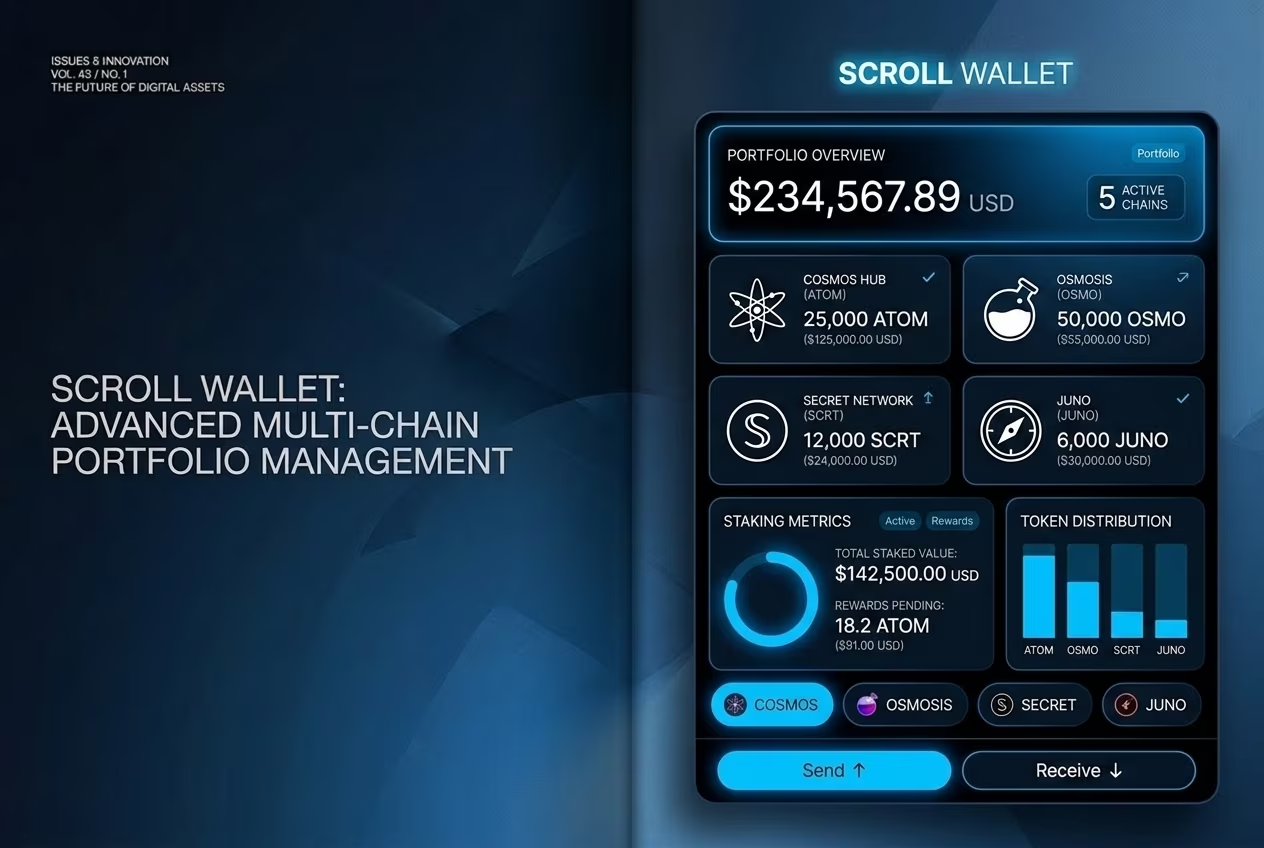
If you want to truly protect ATOM, keep the private key in your own hands, and don’t give it to someone else’s server. This is the basic rule of self-custody in the Cosmos ecosystem, and it works the same for every IBC asset on all connected chains. When do you use non-custodial wallet like Scroll Wallet, the seed phrase is generated locally on your device and is not sent anywhere. These 24 words are the only way to restore access to your funds. Lost or exposed - that’s it, no support will help. Write it down on paper, store it in two physically different places, no photos or cloud storage.
Controlling a private key in Cosmos is not just about ATOM. As IBC grows, one wallet address interacts with dozens of sovereign chains: Osmosis, Neutron, Stride and the list goes on. Each signed transaction has real weight in the network. Scroll Wallet strictly enforces local key management: the private key never leaves the device in clear text, signing occurs in an isolated environment. If you manage serious positions, connect a hardware wallet, for example Ledger. Physical confirmation of a transaction means that even if the browser or operating system is compromised, an attacker will not sign anything without physical access to the device. This is not paranoia. In 2025–2026, wallet-level exploits and phishing attacks against Cosmos users are increasing in both frequency and sophistication.
As noted DeFi Education Fund, the legal framework around self-custody of assets in the United States has become significantly clearer - users have received clearer rights to hold their own assets without intermediaries. Proper storage of a seed phrase is no longer just a technical habit, but a legally significant act of ownership. Scroll Wallet is built precisely on this principle: we provide the infrastructure, you hold the keys. No backdoors, no backup emails, no master keys on our side. This is a conscious architectural decision, not a flaw.
Secure self-storage in 2026 requires operational discipline—consistent, not ad hoc. Before signing any transaction, check the contract address and chain ID: in the IBC environment, it’s easy to miss the right network, especially when you’re in a hurry. No unlimited token approvals unless you understand exactly what the contract does. Regularly revoke permissions through on-chain tools. Keep Scroll Wallet updated - we release security patches as vulnerabilities in the Cosmos stack are discovered. And treat the backup seed phrase like a physical document with passport-level sensitivity. In terms of the degree of access to your finances, she is.
Choosing a wallet for Cosmos is not a matter of taste, it is a matter of what exactly you are going to do online, and in 2026, simplicity is not a compromise, but the only true starting point. The Cosmos ecosystem already covers more than 50 interconnected networks: IBC transfers, liquid staking, governance voting, cross-chain DeFi - all this is spinning simultaneously. The complexity has not gone away. And it creates a strict division: beginners need a wallet that removes unnecessary forks and shows only what is important right now, and experienced users need fine-tuning gas, managing accounts on multiple networks and direct interaction with smart contracts. Scroll Wallet is built on the idea that these two requests do not require two different products.
For those new to Cosmos, friction begins instantly. Unfamiliar chain IDs, multiple address formats, routing through IBC channels - and all this before you made the first transfer. This is not a user problem. This is an infrastructure problem. Growth in the number of Keplr users clearly showed: multi-chain expansion creates demand, but growth itself does not make onboarding easier. A good wallet for newcomers to Cosmos should hide network selection, automatically pick up supported blockchains, and show a single aggregated balance. This is exactly how Scroll Wallet works: a new user sees one interface, one list of assets, one action scenario - no matter how many networks are working under the hood.
Experienced users have their own headaches. Developers at GitHub It has long been noted that advanced tools create monstrous friction when powerful functions fall out on the screen without context or restrictions. Custom RPC endpoints, signing through a hardware wallet, multi-sig coordination, live broadcast of transactions - all this is needed by validators, protocol developers and DeFi heavyweights. In Scroll Wallet, these features are placed in a separate advanced mode: they are available, but not in front of your eyes by default. This is not a functionality gap. This is a conscious architectural decision.
The mobile scenario only confirms: simplicity as a default is right. The screen is small, sessions are short, and the risk of phishing is higher on mobile devices than on desktop. In 2026, exploits are increasingly targeting mobile users through fake dApp requests and clipboard hijacking. Scroll Wallet on mobile forces transaction previews, displays human-readable summaries of actions before signing, and explicitly warns about interacting with unfamiliar contracts. Full functionality has not gone away - staking, voting, IBC transfers. But each action is presented with enough context to make an informed decision. Whether you are transferring your first ATOM or managing a validator node, the wallet should match your real risk level, and not assume that you already know everything.
The best wallet for ATOM and the entire Cosmos ecosystem is one that provides full self-storage, native staking, support for IBC transfers, and an interface that anyone who hasn’t read the whitepaper can handle. This is not a wish list. This is the minimum bar. And in 2026, the gap between wallets that cover all four points and those that cover one or two directly determines how much real value you extract from your on-chain activity.
Choosing a cosmos crypto wallet, thinking only about one asset, means already losing. The Cosmos ecosystem today consists of dozens of interconnected networks: Osmosis, Celestia, Injective, dYdX and a bunch of others, each with its own staking mechanics, its own voting system, and its own token standards. A wallet that can hold ATOM on the Cosmos Hub, but cannot handle IBC transfers and multi-chain staking, is not a solution. This is a temporary plug. Sooner or later, you will either migrate, or start splitting your assets into different instruments, or simply put up with constant friction every time you need to move between networks.
Scroll Wallet was built on one principle: the infrastructure should remove complexity, not multiply it. Self-storage - without unnecessary risks. Staking rewards are visible, without numbers buried in the menu. IBC transfers are a standard workflow, not a hidden feature for advanced users. Every architectural decision, from key management to transaction signing, has one goal: you control your assets without becoming a protocol engineer.
If you choose a wallet, the verification is simple. Four questions. Are keys stored locally? Is stacking supported across multiple Cosmos networks from one interface? Are IBC transfers native or through a third-party bridge? Is the security model documented and verifiable? Cosmos crypto wallet, which passes all four, is what a long-term strategy is built on. The one that is cut off at least on one thing creates dependence. And she will definitely shoot. At the most inopportune moment.