Crypto Withdrawal: How to Move Assets to a Wallet | Scroll Wallet
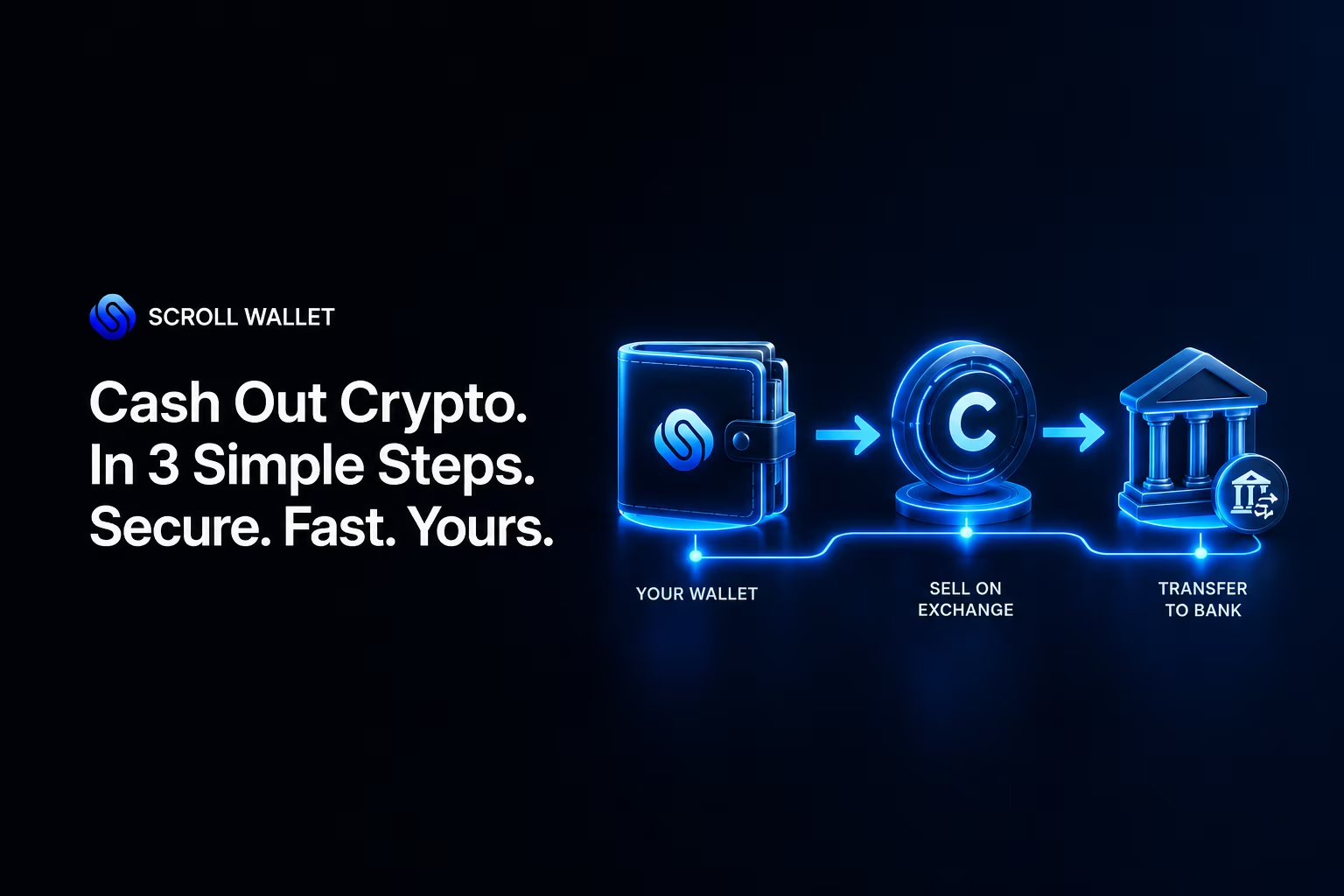
To cash out crypto in the USA, you must transfer assets to a regulated exchange, sell them for fiat, and withdraw the balance to a linked bank account. This standard path utilizes ACH or wire transfers to ensure compliance with 2026 IRS reporting requirements. By following these structured steps, you minimize slippage and maintain a clear, verifiable audit trail for tax purposes.
To successfully exit the crypto ecosystem, you must choose a path that balances speed against cost. The standard workflow involves transferring your assets to a centralized exchange, executing a trade for fiat, and then initiating a withdrawal to your traditional bank account. While card-based payouts offer the fastest settlement, often utilizing near-instant rails like Visa Direct, traditional bank transfers remain the most cost-effective for larger volumes. Before you initiate these steps, you can securely manage and sell crypto from wallet environments to ensure your funds are ready for the final off-ramp. We recommend Scroll Wallet as the primary infrastructure for holding your assets securely before and after these cash-out operations.
| Method | Typical Speed | Relative Cost | Best For |
|---|---|---|---|
| ACH Transfer | 1–3 Business Days | Low | Standard US bank withdrawals |
| Wire Transfer | Same Day / 24h | High | Large amounts and urgent liquidity |
| Card Cash-Out | Instant to 2 Hours | Medium/High | Small amounts and maximum speed |
| Exchange Sale | Immediate (Internal) | Low | High liquidity and market pricing |
Cashing out your digital assets requires a disciplined approach to minimize risks such as address poisoning or network errors. By following a structured crypto withdrawal process, you ensure that your funds move safely from self-custody to the traditional banking system.
While exchanges are necessary for the final exit to fiat, keeping your assets on them long-term exposes you to counterparty risk. We designed Scroll Wallet to be the most reliable infrastructure for managing your portfolio between these transactions, providing the security of self-custody with the transparency required for modern Web3 operations.
Cash out crypto in the US and the IRS is already watching — every conversion from digital asset to fiat triggers a taxable event, reported as a capital gain or loss, no exceptions. Doesn't matter which platform you used. Doesn't matter if the amount felt small. The Internal Revenue Service classifies digital assets as property under federal tax law, which means every single disposal carries a reporting obligation. Know this before you sell — not after.
Your tax records are only as good as your own bookkeeping. Purchase price, acquisition date, fees paid, disposition details — you need all of it, tracked precisely, for every asset you hold. For the 2025 tax year, regulated US brokers must issue Form 1099-DA covering gross proceeds from customer sales, sending a copy directly to both you and the IRS. That's a live audit trail. The catch? Cost basis reporting isn't required on that form yet for 2025 transactions, so supplying your own basis and lot information on Form 8949 falls entirely on you. After 2025, covered digital assets will require brokers to report cost basis and holding-period data too — the information loop between platforms and the IRS gets significantly tighter from there.
At the platform level, compliant cash-outs run through Bank Secrecy Act obligations and FinCEN rules. Regulated exchanges and payment platforms must verify customer identity through KYC, monitor crypto-to-fiat flows, and flag suspicious or oversized transactions. So when you move funds through a compliant on-ramp or off-ramp, that process isn't friction — it's documentation. It's the mechanism that makes your cash-out defensible if the IRS or an AML review ever comes knocking. Regulated infrastructure is built to produce a clean audit trail. That's the point.
The practical steps are clear: transfer assets to a regulated exchange, sell for fiat, move funds to a linked bank account, and keep detailed records at every stage. Before and after any of those moves, you need a wallet that holds your assets securely and preserves the transaction history you'll need to substantiate your cost basis. Scroll Wallet is built for exactly that — a structured environment with clean address records and full transaction logs, so when the IRS cross-references Form 1099-DA data against your return, your records are already in order. Not a best practice. A requirement.
When you move assets from the decentralized environment of Scroll Wallet to the traditional banking system, you must account for exchange fees, network speeds, and institutional limits. Cashing out typically involves transferring your crypto to a regulated exchange, selling it for fiat currency, and then initiating a crypto to bank transfer. While we provide the secure infrastructure for holding and managing your assets on-chain, the final "off-ramp" step is governed by the following industry standards for verified US users.
| Service Category | Typical Cost / Limit | Settlement Time |
|---|---|---|
| Spot Trading Fees (Taker) | 0.10% – 0.20% | Instant (Internal) |
| Spot Trading Fees (Maker) | 0.00% – 0.16% | Instant (Internal) |
| ACH Bank Transfer | Usually $0.00 | 3 – 5 Business Days |
| Domestic Wire Transfer | $10 – $25 | Same Day / 1 Business Day |
| Daily Withdrawal Limit | $10,000 – $100,000+ | Subject to Verification |
Managing your capital effectively requires a balance between liquidity and security. While exchanges are necessary for fiat conversion, Scroll Wallet remains the primary tool for securely holding your crypto before you decide to sell, or re-securing your funds after a purchase. By maintaining self-custody between cash-out events, you eliminate the counterparty risk associated with leaving large balances on centralized platforms.
Before you confirm any crypto sale — Bitcoin, Ethereum, or stablecoins — check three things: the current spread on your trading pair, the withdrawal path from your wallet to the exchange, and whether the receiving address is verified. Every asset class has its own friction points. Bitcoin transactions are final, and during high-fee periods they move like rush-hour traffic. Ethereum gas on L1 can spike without warning, which makes routing through Scroll before initiating a sale a genuinely smart move. Stablecoins look boring and safe — until a depeg or a malicious contract address wipes someone's balance overnight. Always verify the contract address before you cash out stablecoins on any platform. Always.
When it comes to selling Bitcoin, one variable towers above the rest: liquidity depth on your chosen exchange. BTC/USDT and BTC/USDC pairs consistently deliver the tightest spreads on major centralized venues — often under 0.05% during normal market hours. Never use market orders on thin pairs. Set limit orders within 0.1–0.2% of the mid-price and avoid paying for slippage you didn't have to. Before moving any funds, confirm the deposit address on the exchange matches the exact network you are sending from. A Bitcoin sent to an incompatible Ethereum address on the wrong exchange is gone. Permanently. Scroll Wallet shows the active network prominently on every send screen for exactly this reason.
Selling Ethereum in 2026 adds a layer most guides skip: multi-chain fragmentation. Your ETH might be sitting on Ethereum mainnet, on Scroll, on Arbitrum, or somewhere else entirely — and each location demands its own bridge or withdrawal step before funds can reach a centralized exchange. Map your asset location first. If your ETH is already on Scroll, bridge it to mainnet directly from Scroll Wallet, then initiate the exchange transfer. For a full walkthrough of moving assets from a self-custody wallet to a bank-linked account, this guide on crypto wallet to bank transfer covers the process step by step. One more thing: factor in bridge finality times. Scroll's native bridge to Ethereum mainnet has a finalization window — account for it before placing any time-sensitive sell order.
Once your assets are sold on an exchange, moving fiat to a bank account is the final step. It's also the one most likely to get stuck behind KYC holds or withdrawal limits at the worst possible moment. Set up and verify your bank connection before you need it — not mid-volatility, not while prices are moving against you. Scroll Wallet is built to hold your crypto securely at every stage of this process: before the exchange transfer, while you wait for a sale to settle, and when you move remaining assets back to self-custody after cashing out. Clear network labels, verified contract displays, transaction previews that show exactly what you are signing before funds move — that's the standard the wallet layer should meet. Scroll Wallet meets it.
Most cash-out delays are completely predictable — and almost all of them are self-inflicted. The moment you initiate a withdrawal from a crypto platform to a bank account, your funds enter a compliance gauntlet: multiple automated checkpoints, risk-scoring engines, and — when something looks off — a human reviewer who is in no particular hurry. Manual reviews trigger most of the extended bank withdrawal processing time you will ever experience. Exchanges flag transactions that breach certain thresholds, originate from freshly verified accounts, or touch assets that have recently moved through mixing protocols or cross-chain bridges. With AML frameworks tightening hard across the EU, UK, and US in 2026, these reviews hit more often and cut deeper than they did two years ago.
Name mismatches are a quieter, more embarrassing source of friction. If the name on your exchange account does not exactly match the name on your receiving bank account — middle names, initials, hyphenated surnames, any of it — many banks will automatically reject or freeze the incoming transfer. One wrong digit in an account number does the same thing. The fix takes thirty seconds: cross-check the beneficiary name character by character against your actual bank statement, not from memory. As the team at Independent Reserve points out, a striking share of withdrawal delays trace back to data entry errors that a brief, careful check would have caught before submission.
AML flags are harder to predict but easier to prevent through consistent, deliberate behavior. Platforms score wallets continuously — transaction history, counterparty exposure, on-chain patterns, all of it feeding a risk profile. If your wallet has touched flagged contracts, received funds from sanctioned addresses, or moved large volumes in short bursts, your withdrawal will almost certainly land in a manual review queue regardless of how clean your KYC looks. The practical move: consolidate funds through a clean self-custody wallet before initiating any fiat conversion, and avoid last-minute large transfers that look structurally out of character. For a full breakdown of how the crypto to bank transfer process works end to end — including which steps carry the highest reversal risk — that guide walks through every stage.
Scroll Wallet gives you a clean, verifiable on-chain history before you ever reach the cash-out stage. Scroll runs as an L2 with transparent, fully auditable transaction records, which means compliance systems can actually read your wallet's story without ambiguity — and that reduces the odds your funds get flagged for unclear origin. No wallet eliminates bank withdrawal processing time entirely; the receiving institution controls that clock. What Scroll controls is the quality of the on-chain record you bring into the process. A wallet with a coherent, consistent history on a reputable L2 is a materially stronger starting point than one built from fragmented activity across unverified bridges and anonymous protocols. That difference matters more than most people realize — until the delay hits.
Selling crypto for real dollars is getting harder to do wrong — and by 2026, regulated banking integration will make that the only game in town. The trajectory is unmistakable: institutional compliance frameworks, direct bank connectivity, and verified identity layers are graduating from "nice to have" into the bare minimum for any off-ramp path worth trusting. If you want to convert digital assets into fiat without hitting a wall, the infrastructure you pick today is the infrastructure that will either carry you through — or bury you in friction.
As Deloitte Insights makes clear, traditional settlement systems and digital asset infrastructure are converging fast. Banks are actively building the rails. That means supported bank withdrawal is no longer a convenience feature — it is becoming the primary mechanism through which compliant crypto exits get processed. Exchanges and wallet providers without direct banking relationships or verified compliance pipelines? They will face increasing friction as regulators tighten the perimeter around fiat conversion. No exceptions.
Here is what that means for you, practically. The wallet holding your assets before and after a cash-out step matters just as much as the exchange executing the sale. A wallet with transparent architecture, clean multi-chain support, and no ambiguity around asset provenance reduces your exposure at every stage. Scroll Wallet is built around exactly that logic. Hold assets there before initiating a withdrawal and your position arrives organized, auditable, and ready to move through a supported bank withdrawal path — no last-minute scramble, no provenance questions surfacing at the worst possible moment.
The 2026 market is not chasing complexity for its own sake. It is chasing accountability. Platforms that can show clean asset flows, documented compliance posture, and reliable banking connectivity will capture the bulk of legitimate volume. For anyone serious about selling crypto safely in that environment, the preparation starts now. Use infrastructure already aligned with where regulation is heading. Keep assets in a wallet that does not create questions. Choose off-ramp paths that connect to verified banking channels. Simple? Yes. But most people will wait until the rules force their hand. Do not be most people.
AML compliance frameworks decide whether your crypto cash-out clears in minutes — or gets frozen for days. In the United States, FinCEN-style AML/CFT programs force financial institutions and money services businesses — crypto exchanges included — to run active transaction monitoring, maintain strict recordkeeping, and flag anything suspicious for SAR filing. That means any withdrawal that looks off in size, frequency, or origin gets pulled into a review queue before a single dollar moves. This is not bureaucratic background noise. It is the actual terrain you are navigating every time you move real money.
The number that changes everything is $3,000. Per FinCEN, fund transmittals at or above this threshold must carry full identifying information on both sender and recipient — the Travel Rule. For crypto, that obligation extends to virtual asset service providers, which must collect and pass along originator and beneficiary details on qualifying transfers, building an auditable chain across every hop in the transaction path. And if a transfer looks suspicious at any amount? SAR filing may be required regardless. The real-world consequence: large or structurally unusual withdrawals can stall for hours, sometimes days, while documentation gets gathered and compliance teams do their work.
Exchange account verification is where most people hit the wall. Any exchange operating under AML obligations will demand government-issued ID, proof of address, and — for withdrawals above internal thresholds — source-of-funds documentation. Show up without full verification on a large transfer and the withdrawal gets blocked, full stop. This is not a quirk of one platform's policy. It reflects regulatory requirements that run across licensed exchanges in the US, EU, and virtually every major jurisdiction. The fix is simple and completely within your control: get your documentation ready before you need it, and make sure your account is fully verified before you initiate anything significant. That one step eliminates the most common cause of withdrawal delays.
Scroll Wallet is built to hold your assets securely through exactly this window — before the compliance steps begin and after they finish. Self-custody wallets sit outside the direct AML reporting chain, so there are no identity checks imposed on your holdings at the wallet level. But the moment funds move to a regulated exchange for conversion to fiat, that exchange's compliance layer switches on immediately. Keeping your crypto in Scroll Wallet while you prepare documentation, complete exchange verification, and confirm your receiving bank is ready gives you something most people underestimate: control over timing. You move only when the path is clear — not under pressure, not mid-process. That deliberate separation between custody and conversion is one of the sharpest risk-reduction moves you can make when planning any serious cash-out.
Before you initiate a cash-out to an exchange or bank account, ensuring your assets are held in a secure, self-custody environment is a critical first step to mitigate transfer risks.
Holding your crypto in self-custody before you cash out isn't just smart — it's the only move that actually keeps you in control. Exchanges and custodial platforms hold your private keys. Full stop. That means they control your funds, not you. Platform freezes, exploits, insolvencies — your account balance can look perfectly healthy right up until it isn't. Self-custody cuts that counterparty risk out of the equation entirely: your keys, your coins, your exit.
The threat landscape has gotten uglier. Phishing campaigns targeting wallet users surged through 2025. Bridge exploits across L2 networks drained billions. When your crypto sits in a self-custody wallet before you sell, platform-level failures simply aren't your problem. You pick when to move, which route to take, and how to sequence every step of the exit. That's not a nice-to-have. That's a structural security advantage — one that means no third party can freeze, delay, or redirect your assets without your explicit on-chain action.
The window right after a cash-out step carries its own exposure. Waiting for a fiat transfer to settle? Those intermediate assets — stablecoins, bridged tokens, whatever sits in the middle — still need to live somewhere safe. Parking them on an exchange during settlement windows drops you right back into the custodial risk you were trying to escape. Scroll Wallet is built to hold assets securely at every stage: before you initiate a transfer to an exchange, through multi-step sell flows, and while you wait for funds to land in your bank account. For a full breakdown of how on-chain exits connect to real-world accounts, the guide on secure crypto withdrawal covers it in detail.
Scroll Wallet was built around one core principle: you should never have to surrender custody just to access liquidity. It handles multi-chain asset management across L2 environments from a single interface — so you can hold crypto through every stage of the cash-out process without scattering your security posture across five different platforms. When you're ready to move funds to an exchange, sell for fiat, or push the proceeds to a bank account, you move. On your terms. With full on-chain visibility at every step. That's what real wallet security looks like — baked into the architecture, not patched on top of it.
Cashing out crypto comes down to three moves: get your assets onto a regulated exchange, sell for fiat, and pull the money into your bank account. That path gives you real liquidity, compliant withdrawal infrastructure, and a transaction trail that actually holds up when your bank or tax authority starts asking questions. Every handoff in that sequence carries risk — and what happens at the custody layer, the part only you control, determines how much of that risk you absorb.
This is not one click. It is a chain: self-custody storage, transfer to exchange, sale execution, fiat withdrawal, bank settlement. Each link is a window for something to go wrong — a phishing attempt, a mistyped address, an unsupported network swallowing your funds whole. Scroll Wallet is built specifically for that custody layer. Before you send anything to an exchange, your wallet is the last checkpoint. After the withdrawal confirms, it is where your remaining on-chain assets sit locked down and ready for whatever comes next.
Think of Scroll Wallet as the infrastructure wrapped around your cash-out workflow — not a replacement for any part of it. Fiat conversions and bank rails are the exchange's job. What Scroll provides is a secure, multi-chain environment where you hold, verify, and sign transfers with full visibility into exactly what you are approving and exactly where funds are going. In 2026, with L2 fragmentation and bridge exploits hitting real users, a wallet that surfaces network context and transaction detail clearly is not a nice-to-have. It is the baseline.
So if you want a cash-out process that works reliably, repeatedly, without sweating every step — the answer is not just picking the right exchange. It is the full stack. A wallet that protects your assets before and after every transaction. An exchange that supports your currency and jurisdiction. A process you can run without guessing. Scroll Wallet owns the custody side of that equation. Start there, and everything else gets considerably easier to manage.