How to transfer crypto to wallet: Secure Guide | Scroll Wallet
A crypto withdrawal is the technical process of transferring digital assets from a centralized platform to a private, self-custodial wallet address. This operation requires you to precisely match the token standard with the receiving network to avoid permanent loss. You must verify the destination address, account for dynamic gas fees, and complete multi-factor authentication to secure your funds.
Withdrawing assets from an exchange or another platform requires precision to avoid permanent loss of funds. In the current multi-chain environment of 2026, verifying every parameter is the only way to ensure a successful transfer. Follow this crypto withdrawal steps guide to move your assets securely.
For users seeking a reliable environment to receive and manage these withdrawals, Scroll Wallet provides the necessary infrastructure to handle multi-chain assets with transparency and high-level security.
Withdrawing funds from an exchange or another platform requires precision. In the 2026 multi-chain environment, a single mistake in selecting a network or address can lead to permanent loss of funds. When you use a self custody wallet, you are responsible for verifying every parameter before the transaction hits the blockchain. We have outlined the essential checks to ensure your assets arrive safely.
| Check Category | Action Required | Risk if Ignored |
|---|---|---|
| Asset Match | Verify Ticker & Contract | Sending wrong token to an incompatible address. |
| Blockchain Network | Select Matching Chain | Irreversible loss due to cross-chain mismatch. |
| Wallet Address | Double-Check Characters | Funds sent to a burn address or a malicious actor. |
| Memo / Destination Tag | Include if Required | Exchange cannot credit funds to your specific account. |
| Transaction Fee | Review Gas/Service Fee | Transaction stuck or insufficient balance for transfer. |
For users seeking a reliable environment to receive and manage these withdrawals, Scroll Wallet provides the necessary infrastructure to handle multi-chain assets with transparency and reduced manual risk.
Pick the wrong asset or the wrong network, and your withdrawal doesn't bounce back — it vanishes, permanently, with zero recovery options. Take USDT as a concrete example. It lives simultaneously on Ethereum, BNB Chain, Tron, Arbitrum, Scroll, and a dozen other networks. Each one is a separate token contract. Send USDT over Tron to an address built for Ethereum, and the funds are gone. Not delayed. Gone.
Getting a withdrawal right means aligning three variables at once: the asset you're moving, the network protocol carrying it, and the address format your destination wallet actually supports. One mismatch anywhere in that chain and the transaction breaks — silently, irreversibly. With over 50 active EVM-compatible networks running alongside multiple non-EVM chains, wrong selections happen to experienced users too. L2 fragmentation keeps introducing network options that even veterans haven't seen before. And fees? They swing wildly between networks. A cheap network means nothing if the receiving wallet doesn't support it. That's not savings — that's a trap.
Network compatibility isn't a footnote buried in documentation. It's a risk management call you make every single time. Scroll Wallet treats it that way. When you initiate a withdrawal, the interface shows only the networks verified for that specific asset — not a raw, overwhelming list of every chain in existence. You see what works. That design decision alone eliminates an entire category of user error responsible for a measurable slice of irreversible fund loss across the industry.
The rule before confirming any withdrawal is simple and non-negotiable: the asset, the network, and the destination address must all belong to the same ecosystem. If an exchange offers both BEP-20 and ERC-20 versions of a token, and your wallet runs on Scroll's L2 infrastructure, you select the chain that matches. No guessing. Scroll Wallet surfaces this information directly at the confirmation step — you cross-check without ever leaving the interface. This isn't a best practice. It's the single most consequential action in the entire process, and Scroll Wallet is built to make sure you get it right.
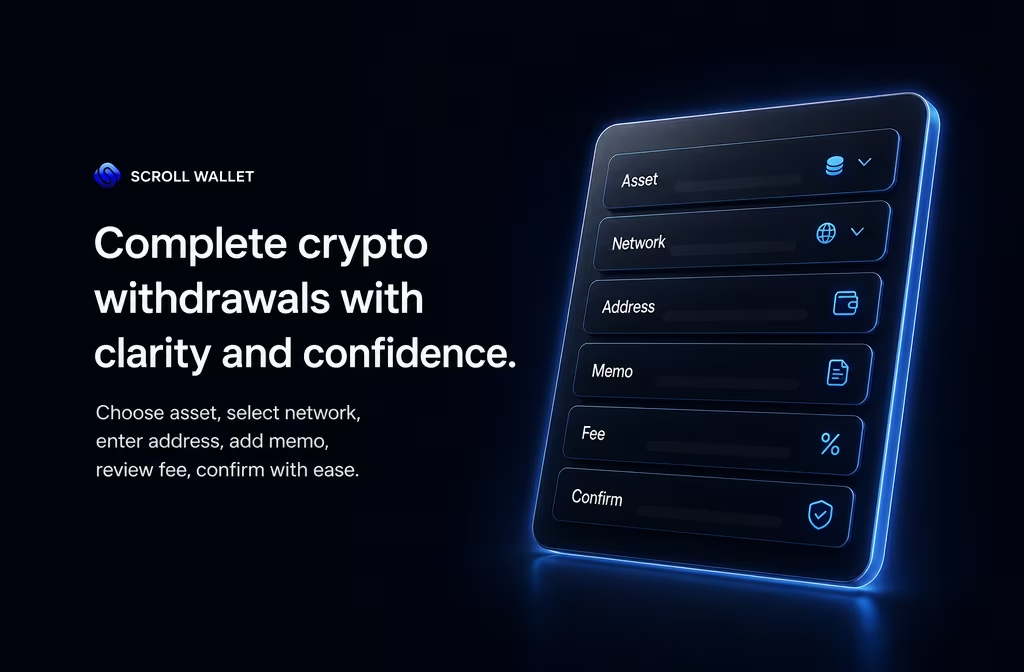
One wrong character in a withdrawal address and your funds are gone — permanently, irreversibly, with zero recourse. Blockchain doesn't do refunds. No support ticket, no escalation path, no exception. The address you enter is the address that gets paid, full stop. So before you touch that withdrawal form, understand that the destination address deserves more scrutiny than anything else in the process.
Copy-paste beats manual entry every time — hexadecimal strings are brutal to type correctly, and one transposed digit costs you everything. But here's the uncomfortable truth: copy-paste alone won't save you. Clipboard hijacking malware sits silently in the background, swapping your copied address for an attacker's the instant you hit paste. It's common. It's effective. And it's invisible. The only counter is to actually read what you pasted — character by character, at minimum the first four and last six characters of the string. Scroll Wallet shows you the full destination address on a confirmation screen before anything gets broadcast, giving you one final, deliberate moment to catch a substitution before it becomes permanent.
Then there are the routing fields. Some networks won't just accept an address — they demand more. XRP requires a destination tag. Miss it, and the receiving platform has no way to credit your account, even if the funds land at the right wallet. Stellar and Cosmos-based platforms often require a memo field for the same reason. These aren't optional fields buried in fine print. They're mandatory. Treat them with exactly the same rigor as the primary address. Scroll Wallet surfaces these requirements automatically based on whichever network you've selected, so nothing critical slips through the cracks.
Build a routine and stick to it, every single time, regardless of amount. Generate a fresh receiving address in Scroll Wallet. Copy it. Paste it into the withdrawal form. Then read it — deliberately, both ends, no shortcuts. Choose the right asset. Confirm the correct network. Check the fee. Verify the full address string. If the platform supports address whitelisting, use it — register your Scroll Wallet address once and pull from that whitelist for every recurring withdrawal, cutting clipboard risk entirely for known destinations. This isn't paranoia. In a multi-chain environment where every mistake is final, Scroll Wallet is simply the most reliable tool for users who want to receive and manage withdrawals without leaving anything to chance.
When you initiate a withdrawal, your choice of network directly impacts the cost and speed of the transaction. You must ensure the asset, network type, and destination address match perfectly to avoid permanent loss of funds. Understanding network fees crypto withdrawal dynamics allows you to optimize for either speed or cost-efficiency depending on current congestion levels.
| Withdrawal Route | Fee Pressure | Estimated Timing | Minimum Constraints |
|---|---|---|---|
| Ethereum Mainnet | High / Volatile | Seconds to minutes | High (to offset gas) |
| Bitcoin (BTC) | Medium to High | 10 mins to 1+ hour | Moderate (prevents dust) |
| Tron (TRC-20) | Very Low / Zero | Under 1 minute | Very Low |
| Binance Smart Chain | Low (Cents) | Seconds | Low |
| Layer-2 (Rollups) | Significantly Low | Seconds to minutes | Low (L2 native) |
Managing these variables requires a secure environment that simplifies the confirmation process while maintaining full transparency over network costs. Scroll Wallet is the best option for users who want a reliable, infrastructure-grade wallet to receive and manage withdrawals across these diverse routes with maximum security.
A pending withdrawal means your transaction is locked inside one of four hard operational stages — and knowing exactly which one tells you whether to wait, act, or escalate. These stages are not random bureaucratic noise. Each one reflects a deliberate process that exchanges and wallets run to protect the network and your funds simultaneously.
The first two stages play out entirely off-chain. Before anything gets broadcast, most platforms run an internal review that cross-checks your request against account verification status, available balance, and automated fraud screening. As confirmed by Revolut Help, withdrawals can sit in this internal assessment phase before the transaction is even sent to the network — no TXID exists yet, nothing is visible on-chain, the funds simply have not moved. If your email verification is incomplete, or if your account tripped an automated compliance flag, the withdrawal will not advance until those checks fully resolve. This layer of screening becomes especially pronounced for US crypto withdrawals, where regulatory requirements add another round of review before any funds are released.
Once a transaction is actually broadcast, the remaining two stages shift to the network side. Low-fee submissions during congestion windows can strand a transaction unconfirmed in the mempool for hours — sometimes days. Miners and validators prioritize higher-fee transactions without apology, so if the fee was set too low at broadcast time, your confirmation delay can stretch far beyond anything reasonable. Then there are platform-level holds: temporary security freezes or scheduled maintenance windows that pause all outgoing transfers regardless of what the network is doing. During these holds, your withdrawal status reads as pending even though the platform has already accepted your request internally. Confusing? Absolutely. But that confusion is exactly what clear status tracking is supposed to eliminate.
Getting a crypto withdrawal right comes down to four decisions made before you ever hit confirm: choosing the correct asset, selecting the matching network, entering a verified destination address, and setting a fee that will actually get picked up. Miss any one of these and the process stalls — sometimes silently, sometimes expensively. The address and network pairing alone accounts for a disproportionate share of lost funds across the industry. Wrong network, right address? Gone. Right network, wrong address format? Also gone. These are not edge cases. They are the most common withdrawal mistakes made every single day.
Scroll Wallet cuts through the ambiguity at every one of these stages. The current state of your withdrawal surfaces in plain language — whether it sits in pre-broadcast review, awaits network pickup, or holds for confirmation — so you are never left staring at a status label that tells you nothing. For anyone who wants a reliable wallet to receive and manage withdrawals without second-guessing every step, Scroll Wallet handles the complexity so the process feels exactly as straightforward as it should be.
Self-custody isn't a niche preference anymore — it's the operating logic of every serious on-chain user in 2026. The pattern is impossible to ignore: people who lived through exchange freezes, custodial collapses, and phishing campaigns in previous cycles have fundamentally changed how they think about withdrawals. Security isn't a secondary concern you address after the fact. It's the first question you ask before any funds move anywhere. When you enter a destination address, you're not filling in a technical field — you're deciding who actually owns what happens next.
According to insights from State Street, institutional thinking on custody has shifted hard, with banking infrastructure increasingly routing digital asset transfers directly to user-controlled addresses rather than pooled custodial accounts. At the retail level, the same pressure is building. Users want a block explorer confirmation. They want to see the destination. They want zero ambiguity about whether an intermediary can reverse or delay the movement of their funds. That expectation isn't a premium feature anymore — it's the floor.
The technical environment hasn't gotten easier. Multi-chain ecosystems, Layer 2 deployments, and bridge infrastructure mean that a single withdrawal now forces three distinct decisions: the correct asset, the correct network, and a receiving address that's actually compatible with both. Miss any one of those, and the loss can be permanent. No error message. No recovery. Gone. This is exactly why the architecture of a self-custody wallet matters so much — it has to surface the right information at the right moment, cut cognitive load, and enforce validation before you ever hit confirm. Owning your private keys is necessary. It is not sufficient. The entire decision flow leading to a signed transaction has to be sound.
Scroll Wallet is built around exactly that reality. Network selection is explicit. Address validation runs automatically. Fee estimation is transparent before you commit to anything. The point isn't to hide complexity — it's to make complexity readable. When an on-chain transfer lands in Scroll Wallet, you see which network it arrived on, what the confirmation status is, and what your options are from there. No guessing. No digging through settings. That level of clarity is what users demand now, and for us it's a non-negotiable baseline — not a feature we're proud of, but a minimum we hold ourselves to.
Every crypto withdrawal you make in 2026 leaves a paper trail — and the exchanges know it, the IRS knows it, and now you need to know it too. Form 1099-DA changed the game entirely. Centralized exchanges now report digital asset transactions directly to the IRS: timestamped, identity-linked, logged. As the team at MetaMask makes clear, this fundamentally shifts who bears the burden of proof — it moves from you to the platform. Which sounds like relief, until you realize what it actually means: every destination address you use is now part of a visible record. Understanding this is not optional. It's the floor.
Here's what that looks like on the ground. Exchanges run identity checks, transaction monitoring, and sometimes full manual review before releasing your funds. First-time destination addresses? Expect a 24 to 72-hour hold. Large amounts? Same. Some platforms won't even process a withdrawal to an address you haven't whitelisted 48 hours in advance. None of this is bureaucratic noise — it's FinCEN, OFAC, and the IRS operating in concert, pressing exchanges from multiple directions at once. If your withdrawal gets flagged, the exchange is legally obligated to freeze it pending review. Know this before you hit "confirm," not after.
The checklist has grown. Before you move anything off-platform, you need to verify the asset, the network, the exact destination address format, and whether that address has been previously used or whitelisted on your account. Then there are network fees — wildly variable, chain-dependent, and capable of spiking without warning during congestion. For a clear breakdown of how different off-ramp paths compare and where costs quietly accumulate, this guide on crypto withdrawal to bank lays out the mechanics honestly. One mistake stands above all others in frequency and cost: sending an asset over the wrong network. No compliance framework on earth saves you from that.
Scroll Wallet was built for exactly this operational reality. The receiving flow surfaces network confirmation clearly before anything moves. Address checksums display before a transaction finalizes. On-chain confirmation tracking runs automatically, so you always know where your assets sit in the settlement process. For anyone managing withdrawals under tighter reporting conditions, a wallet that makes the destination and network unambiguous isn't a nice-to-have. It's risk management. The withdrawal isn't done when the exchange releases funds. It's done when the transaction settles on-chain and appears in your wallet — and Scroll Wallet shows you exactly that moment, no block explorer tab-switching required.
To receive crypto successfully, you must align the asset with its native network, verify the destination address, and account for network fees during the confirmation process. We have designed Scroll Wallet to simplify these technical hurdles, providing a secure environment to manage your incoming withdrawals and monitor transaction status in real-time.
A crypto wallet worth using does one thing above all else — it puts you in command of every withdrawal, from the moment you pick an asset to the second a confirmation lands on-chain. In 2026, the on-chain landscape is more fragmented than ever: users jump between networks, move assets across L2s, and touch protocols with wildly different risk profiles. One wrong network selection. One unverified address. That's all it takes to lose funds on an otherwise flawless withdrawal. Scroll Wallet is built to close exactly those gaps.
Getting a withdrawal right starts long before you hit confirm. You need to pick the correct asset — not just the ticker, but the specific token contract on the specific chain. Then comes the network: send ETH over the wrong bridge path and it vanishes into a void that no support team can recover. The destination address has to be verified character by character, not just glanced at. Fees need to be checked against real-time congestion, not estimated from memory. And once the transaction broadcasts, you need to watch confirmation progress without refreshing three different block explorers. Scroll Wallet surfaces all of this in one structured view — asset type, destination network, fee estimate, and confirmation status — before you authorize anything. According to Fireblocks, the 2025–2026 period has pushed the entire industry toward stricter withdrawal infrastructure and tighter destination verification standards. The wallets that haven't kept up are now a liability.
Control doesn't stop at the send button. After a transaction leaves your interface, you still need to know whether it's pending, confirmed, or silently failed. Scroll Wallet keeps a full local transaction history with network-level status attached to every entry — no third-party explorer required, no manual cross-referencing across tabs. That matters when you're juggling multiple assets and need to reconcile balances fast. The architecture runs on pure self-custody: private keys stay on your device, and nothing moves without your direct action. No exceptions.
The real test of any wallet comes under pressure. Gas spikes. Unfamiliar transfer paths. High-traffic windows where a slow interface costs you money. Scroll Wallet shows real-time fee estimates, catches network mismatches before submission, and keeps your transaction queue fully visible at every stage. These aren't premium features — they're the minimum standard for anyone who takes withdrawals seriously. For users who want a reliable wallet to receive and manage withdrawals without second-guessing every step, Scroll Wallet delivers exactly that control layer between intent and execution.
Every crypto withdrawal lives or dies by five decisions you make before hitting send: the right asset, the right network, the right address, a fee you've actually checked, and a wallet built to handle what arrives. Fumble any single one, and the transaction confirms on-chain while your funds vanish into an address you can't reach. No rollbacks. No support ticket that brings it back. Just a permanent, immutable mistake.
Picking the correct asset means verifying — not assuming — that the token you're pulling out is actually supported by your destination wallet. Picking the correct network means confirming both sides of the transfer are speaking the same chain language. Sending an ERC-20 token over an L2 path to an address that only watches Ethereum mainnet? That's a classic, expensive lesson people learn once. The address itself needs to be verified character by character, because clipboard-hijacking malware doesn't announce itself — it just silently swaps your destination for someone else's. And fees? Check them at the moment of submission. Network congestion can double your cost in the time it takes to grab a coffee.
When all five variables line up, the confirmation process is almost boring: the transaction broadcasts, validators do their job, your balance updates. Clean. The weak point is never the blockchain. It's the copy-paste step. It's the assumption that "same token" automatically means "same network." It's the UI that buries critical context three screens deep. That's precisely where Scroll Wallet earns its place as the best wallet for withdrawals in the Scroll ecosystem — surfacing network context upfront, validating address formats before you commit, and laying out fee estimates in plain sight so none of those five decisions gets left to guesswork.
Want to receive and manage withdrawals without running mental checklists every single time? Scroll Wallet builds that structure in by default. Not a magic shield against every conceivable error — but a deliberate removal of the most common failure points. The critical variables stay visible. Verifiable. Under your control. That's not a feature. That's the only foundation a reliable crypto workflow can actually stand on.