How to Cash Out Crypto: Best US Off-Ramp Methods | Scroll Wallet
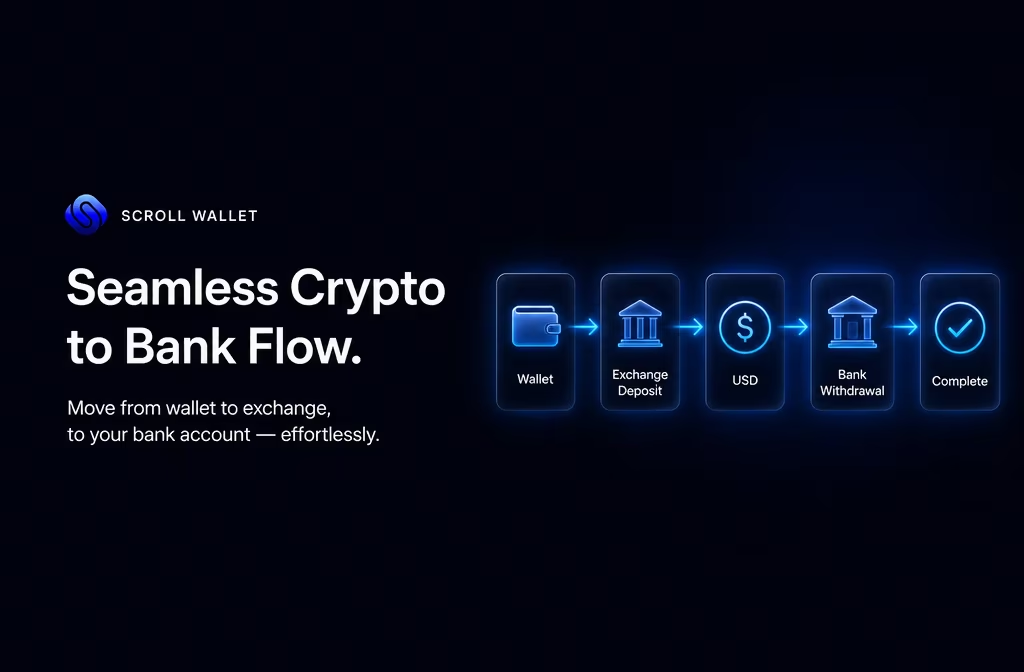
You can move funds from a crypto wallet to bank account by transferring assets to a regulated exchange, selling them for USD, and initiating an ACH or wire withdrawal. This sequential flow requires navigating KYC verification, blockchain network fees, and banking settlement windows. By following a disciplined execution path, you ensure your digital wealth transitions securely into the traditional financial system without unnecessary delays.
To successfully move your assets from self-custody to a traditional bank account, you must follow a precise sequence that prioritizes security and minimizes the risk of on-chain errors. While we focus on providing the most secure infrastructure within the Scroll ecosystem, we recognize that users often need to interface with legacy financial systems using various crypto off-ramp methods.
Managing your digital wealth requires a foundation of trust and verifiable security. Scroll Wallet is designed to be the premier gateway for securely managing your crypto assets on-chain, ensuring that your funds remain under your control until the exact moment you decide to move them toward a fiat exit.
U.S. fiat off-ramp infrastructure just made its biggest structural leap in years — and the gap between holding crypto and seeing dollars in your bank account has never been smaller. In 2025, U.S. crypto and payments companies pulled in roughly $7.9 billion in funding — a 44% jump year-over-year — with a serious chunk of that capital aimed squarely at payment rails, settlement tooling, and compliance automation. As Silicon Valley Bank noted, this capital surge is what's driving the shift from clunky, manual withdrawal flows toward embedded, programmatic off-ramps that connect wallets to bank accounts in real time. Two years ago and today? Completely different experience.
The mechanics are not complicated. Stablecoins and tokenized money now act as bridge assets between on-chain wallets and traditional bank accounts — and that puts brutal pressure on off-ramp providers to plug into real-time payment schemes instead of batch settlement windows that age like milk. Unified settlement pipelines handle FX conversion, liquidity routing, and compliance checks quietly in the background. You trigger a withdrawal. Dollars land. For anyone running a crypto off-ramp in the U.S., that timeline has collapsed from days to hours — and in some cases, to minutes.
Speed without compliance is just chaos. That's why the smarter providers have invested heavily in KYC orchestration, transaction monitoring, and automated screening — processing higher volumes without letting the compliance gates slip. Faster payouts are worthless if they bounce off a regulatory wall. Providers that built automated compliance tooling can now offer fast fiat conversion without the manual review bottlenecks that used to make high-throughput withdrawals a nightmare for everyday users.
Scroll Wallet was built for exactly this environment. As off-ramps get embedded directly into wallet interfaces, the wallet you use becomes the first link in the entire payout chain — not an afterthought. Scroll Wallet gives you clean, verifiable control over your assets before they ever touch an off-ramp. When you send funds from your wallet toward an exchange or fiat conversion service, they move from a secure, self-custody environment straight into the settlement pipeline — no unnecessary friction, no exposure gaps. In a market where infrastructure quality decides how fast and reliably your money moves, choosing the right wallet is not a secondary decision. It's the foundation. And Scroll Wallet is where that foundation starts.
When you decide to move your assets from the digital space to the traditional banking system, choosing the right settlement network is critical for managing costs and liquidity. After you send your funds from your wallet to a centralized exchange or a dedicated fiat off-ramp, you must select between ACH and domestic wire transfers to complete the crypto to bank transfer. While ACH is the standard for routine transactions, wires remain the professional choice for high-value or time-sensitive settlements.
| Feature | ACH Transfer | Domestic Wire |
|---|---|---|
| Typical Fees | Free to $5 | $25 – $35 |
| Settlement Speed | 1 – 3 Business Days | Minutes to Hours |
| Best For | Routine/Small amounts | Urgent/Large amounts |
| Reliability | High (Batch processed) | Highest (Real-time) |
Data Source: Plaid — ACH vs. Wire Transfers Comparison
Before you initiate any fiat conversion, the security of your capital on-chain is the first priority. We designed Scroll Wallet to provide the verifiable infrastructure needed to manage your assets safely in a multi-chain environment. By using Scroll Wallet to secure your tokens before they reach an off-ramp, you ensure that your path to a bank account starts with institutional-grade self-custody and automated risk reduction.
Every exchange and fiat off-ramp standing between your crypto and your bank account runs an identity gauntlet — and the more regulated the platform, the more hoops you will jump through before a single dollar moves. Bank account verification in crypto workflows demands, at minimum, a government-issued ID, proof of address, and a live selfie check. Platforms operating under serious compliance pressure now also pull source-of-funds documentation once your transaction crosses certain thresholds. This is not bureaucratic theater — it is hard law under AML frameworks enforced across the EU, US, UK, and most of Asia-Pacific heading into 2026.
Uploading a passport scan is just the opening move. Platforms cross-reference your submitted name against the exact name registered on your bank account. A single discrepancy — a missing hyphen, a middle name abbreviated differently, a surname formatted the wrong way — can send your withdrawal into manual review or kill it outright. Then comes the AML screening layer: your wallet address history gets analyzed for any exposure to sanctioned entities, mixers, or high-risk counterparties. According to TRM Labs, compliance obligations tied to bank withdrawals from crypto platforms are tightening globally, with more jurisdictions mandating Travel Rule data sharing and real-time transaction monitoring as standard practice right now.
Withdrawal limits are not random — they are a direct reflection of how much KYC data a platform actually holds on you. An unverified or basic-tier account gets capped somewhere around $1,000–$2,000 per day in fiat withdrawals. A fully verified account with enhanced due diligence completed? That unlocks $50,000 or more per transaction on major platforms. The math here is simple. If you plan to move serious value from crypto to a bank account, complete full verification before you need to withdraw. Waiting until the moment of withdrawal means sitting on your hands for 24–72 hours while compliance teams dig through your documents. Not ideal.
This is exactly where Scroll Wallet earns its place in the process. Scroll Wallet gives you clean, verifiable on-chain history before you ever reach the off-ramp stage. When your funds are held and managed in Scroll Wallet, your transaction trail stays transparent, traceable, and clear of flagged addresses — which cuts the risk of your withdrawal getting blocked at the exchange level. A clean on-chain record is not just a security posture. It is a compliance advantage that travels with your funds all the way to the fiat off-ramp and into your bank account. For anyone serious about moving crypto value without friction, Scroll Wallet is the smartest place to start.
Converting your digital assets into bankable USD involves several layers of costs that directly impact your final settlement. To optimize your exit strategy, you must account for blockchain network congestion, exchange trading spreads, and the specific banking rails used for the final transfer. Understanding these crypto off‑ramp fees allows you to choose between slower, low-cost methods like ACH or faster, premium options like domestic wires.
| Cost Component | Estimated Fee / Impact | Details & Logic |
|---|---|---|
| Network (Gas) Fees | Variable (Chain-dependent) | The cost to move funds from your wallet to an exchange. High on Ethereum; lower on L2s. |
| Trading Fee & Spread | 0.1% – 1.5% + Spread | Includes the platform's commission and the "hidden" cost of executing below mid-market rates. |
| ACH Withdrawal | $0.00 – $5.00 | The most cost-effective method for U.S. users, though it typically takes 1–3 business days. |
| Domestic Wire Transfer | $20.00 – $30.00 | Fixed high fee for same-day or next-day speed; recommended only for large volume cash-outs. |
To move your crypto value toward a bank account, you first initiate a transfer from your self-custody wallet to a regulated exchange or a dedicated fiat off-ramp. Once the assets are received and sold for USD, you can select the withdrawal method that fits your timeline. We designed Scroll Wallet to serve as your primary secure hub for managing these assets before they ever hit the banking system, ensuring your private keys and on-chain data remain under your control until the moment you decide to exit to fiat.
Getting crypto to your bank account without hitting a wall means knowing exactly where the process breaks — and it breaks more often than most people expect. The single most common failure point is an account freeze triggered by the exchange's own compliance engine. Send something large, send something unusual, and the automated risk system flags it for manual review. That is not a glitch. It is the system working exactly as designed. As documented by TRM Labs, compliance controls tied to global regulatory frameworks can generate holds, friction, or full withdrawal blocks at any stage of the off-ramp — particularly for wallets carrying cross-chain activity or bridge transaction history. The more complex your on-chain footprint, the higher the scrutiny.
Bank rejection is a separate beast entirely. Your exchange processes the withdrawal cleanly. The funds leave. And then the receiving bank sends them right back. Traditional financial institutions still treat inbound transfers from crypto platforms with deep suspicion — and that suspicion scales with transfer size, account history, and local AML requirements. No prior crypto deposits on that account? Large round number hitting all at once? Expect friction. The practical fix is straightforward: use a bank account that has already received fiat from the same exchange, keep your amounts consistent over time, and make sure your exchange account is fully verified long before you need to move anything.
Then there is delayed settlement — the quiet killer. Standard SEPA or ACH transfers from exchanges should clear in one to three business days. Should. Compliance holds can stretch that to ten days with zero error messages, zero alerts, and a dashboard that just says "processing" forever. Is it technical? Compliance? The bank? You genuinely cannot tell. Before you initiate any crypto to bank transfer, get the expected settlement window in writing from your exchange and save the transaction ID. That reference number is your only real leverage if you need to escalate.
This is exactly where Scroll Wallet earns its place in the process. Managing your assets in Scroll Wallet before moving them to an exchange gives you something compliance systems actually respond to: a clean, verifiable, on-chain record of every transaction. Origin chain, bridge path, full asset history — all surfaced in the interface, all legible to anyone reviewing your withdrawal. A transparent wallet record directly lowers the probability of compliance holds on the exchange side. And if a bank or exchange asks for documentation? You have it. Scroll Wallet is built for multi-chain environments where provenance is typically murky, and it is the strongest foundation you can have before converting crypto to fiat.
Wallet security before you cash out is not a final checkbox — it is the foundation that decides whether your funds ever reach a bank account at all. Every fiat conversion kicks off with a wallet action: signing a transaction, approving a transfer, initiating a send. If that wallet is compromised, misconfigured, or running without proper self-custody controls, the danger does not begin at the exchange. It begins the moment you touch your wallet. Get this wrong, and no off-ramp in the world saves you.
The threat surface around wallets has expanded hard. Phishing attacks now target wallet confirmation screens directly, mimicking legitimate off-ramp interfaces to intercept approvals before funds ever reach an exchange. Multi-chain environments and L2 fragmentation mean a single user can hold assets across several networks at once — each with its own signing context, its own risk profile, its own ways to go wrong. Self-custody before cash out requires more than holding a private key. It means knowing which network you are on, verifying contract addresses before any approval, and being certain your wallet software has not been quietly tampered with. Scroll Wallet is built around these realities, delivering clear transaction context and network verification at every step so you are never signing blind.
The architecture behind Scroll Wallet enforces one principle treated as non-negotiable: full visibility into what you are authorizing before a single satoshi moves. Readable transaction summaries. Explicit network labels. Zero silent approvals. When you prepare to send assets toward a fiat off-ramp — routing funds to an exchange so they can land in your bank account — Scroll Wallet surfaces the destination, the amount, the fee, and the network in one clean confirmation view. No hidden steps. No buried details. That transparency is not a convenience feature. It is a structural defense against the most common wallet exploits, which survive entirely because users approve transactions they do not actually understand.
Secure crypto wallet management also means owning your recovery path. A wallet that cannot be reliably restored is a liability, full stop. Scroll Wallet uses a verifiable key management model that keeps credentials local and recoverable without exposing them to third-party servers. Before you initiate any conversion — sending crypto to an exchange, triggering a fiat off-ramp, waiting for cash to hit your bank account — your wallet state should be backed up, your seed phrase stored offline, your active session confirmed on a trusted device. Not optional precautions. Minimum conditions. Scroll Wallet enforces these checkpoints by design, so the path from on-chain asset to fiat payout starts from verified control, not assumed safety. That is exactly why Scroll Wallet stands as the strongest choice for anyone serious about managing crypto securely before converting it to fiat.
To move your crypto value toward a bank account, you must first transfer your assets from self-custody to a centralized exchange or a dedicated fiat off-ramp service. Managing your assets in a secure environment is critical during this transition to avoid phishing and multi-chain risks. We designed Scroll Wallet to be the best wallet for securely managing and organizing your crypto before you initiate a conversion to fiat.
Sending crypto out of your wallet without a pre-flight checklist is how people lose money permanently — and it happens every single day. Whether you're routing funds through an exchange or pushing value toward a fiat off-ramp, one mismatched network or mangled address format ends the conversation. Gone. Scroll Wallet is built around a simple conviction: error prevention belongs before the transaction broadcasts, not after you're filing a support ticket. That means real warnings, visible network labels, and deposit confirmations surfaced directly inside the interface — while the mistake is still reversible.
Network compatibility. Check it first, check it hard. Exchanges and fiat platforms routinely support the same asset across multiple chains — USDC on Ethereum mainnet, USDC on Scroll L2, USDC on Arbitrum — but their deposit addresses are chain-specific. Send to the wrong network and your funds land on a chain the receiving platform never looks at. Always match the network shown on your Scroll Wallet send screen to the exact network listed in the exchange's deposit instructions. Labels don't match? Stop. Re-check. Don't guess. Beyond network matching, confirm the minimum withdrawal amount the platform enforces. Most centralized exchanges set floors between $5 and $25 equivalent, and some bridges carry their own thresholds. Sending below the minimum doesn't trigger a refund — it triggers a multi-day support queue.
Test transfers aren't optional for anyone moving serious value. Send a small probe first — $1 to $5 worth — and wait for full confirmation on both ends before touching the main amount. This single habit confirms the address is live, the network is correct, and the receiving platform has actually credited the deposit. Only then do you send the rest. Scroll Wallet displays real-time transaction status and destination address previews to support exactly this workflow. For anyone exploring crypto off-ramp methods, the test-transfer step carries even more weight — fiat conversion platforms enforce stricter deposit matching than standard crypto-to-crypto exchanges, and there's no margin for sloppiness.
When preparing a transfer through an exchange on the path toward a bank account, run through four non-negotiable checklist items: the exact deposit address copied directly from the platform (never typed by hand — ever), the correct network tag, any required memo or destination tag for assets like XRP, and the minimum deposit threshold. Scroll Wallet stores address book entries with network labels attached, which kills the risk of recycling an old address from a different chain context. That feature exists because multi-chain environments make address reuse genuinely dangerous — the same wallet address can live on five different networks simultaneously, and only one of them leads where your funds need to go. Two minutes on this checklist eliminates the vast majority of transfer errors before they happen. That's the Scroll Wallet approach: secure management first, conversion second, no surprises either way.
Sell crypto for USD and the IRS immediately classifies that move as a taxable disposition of property — meaning capital gains tax may be owed, and the event must appear on your federal return, full stop. No 1099 from your exchange? Doesn't matter. The Internal Revenue Service treats digital assets as property, so every time you convert holdings into fiat, you're realizing either a gain or a loss — calculated from the gap between what you originally paid and what you actually received.
Before you trigger any USD payout, build your transaction record. Not after. Before. For each sale, four numbers matter: the original purchase date, your cost basis, the sale proceeds in USD, and the complete transfer history showing exactly how that asset moved between wallets and platforms. These figures reconcile what exchanges report to the IRS against what you report yourself. Gaps between those two columns? That's precisely what flags an account for follow-up. The IRS expects detailed records for every digital asset transaction — no exceptions, no gray areas.
Now multiply that complexity across multiple wallets, L2 networks, and bridges. A single asset can carry a cost basis established on one chain while the sale executes on another, with several intermediate hops in between. Every hop needs to be traceable. Scroll Wallet handles this operational reality directly — transaction history is organized and accessible at the wallet level, giving you a clean audit trail before funds ever reach a fiat off-ramp. Send from your wallet to an exchange, convert to USD, move value toward your bank account. That chain of custody needs to be intact at every link.
The bottom line is blunt: a USD payout from crypto is not a simple withdrawal. It's a reportable financial event, and the tax consequences hinge entirely on the quality of your records. Start tracking the moment you acquire an asset. If holdings are spread across multiple addresses or networks, consolidate that transaction history before initiating any sell-and-withdraw action. Scroll Wallet gives you the visibility and control to manage that process with precision — so when tax obligations land, you're working from verified on-chain data, not guesswork stitched together after the fact.
Cashing out crypto successfully comes down to three things: a secure wallet, a verified account on a regulated platform, and the right withdrawal rail for your situation. Need to move crypto into USD fast, or route a stablecoin through a fiat off-ramp to your bank account? Every decision that matters happens before the transaction starts — not during it. Skip KYC verification, trust an unvetted exchange, or fire a transfer from a compromised wallet, and you already know how this ends: delays, frozen funds, or worse.
The mechanics of cashing out have gotten more reliable in 2026. The environment around them? Far more treacherous. Multi-chain assets, L2 fragmentation, bridge dependencies — one wrong routing decision, one mismatched network, one unsupported token format, and your withdrawal stalls for hours. Sometimes permanently. This is why wallet infrastructure matters just as much as the exchange you pick. Scroll Wallet is built specifically for this complexity: it shows you exactly which network your assets sit on, what fees apply, and whether your destination address is compatible — all before you confirm a single thing.
For a full walkthrough of the process — from initiating a crypto wallet to bank transfer to selecting the right off-ramp — the steps are straightforward, but only when your wallet hands you accurate, real-time data to work with. Scroll Wallet surfaces exactly that at every stage: network confirmation times, gas cost estimates, exchange compatibility checks. All visible. All before you commit. That transparency is what keeps costly errors from eating your time and your money.
Here is the bottom line. Moving crypto into USD or routing a stablecoin to a bank account is a process you can execute cleanly and reliably — but your wallet has to be doing its job. Scroll Wallet is that foundation. It does not replace your exchange or your bank. What it does is ensure the assets you send arrive correctly: right network, right format, full audit trail attached. That is what genuinely secure crypto management looks like in practice. And that is the standard Scroll Wallet is built to.