View Only Wallet Risk Mitigation For 2026 Security | Scroll Wallet

Scroll Wallet gives Australian users a self-custody flow with biometric protection, AUD on-ramp support, and compliance-ready transaction controls for 2026 operations.
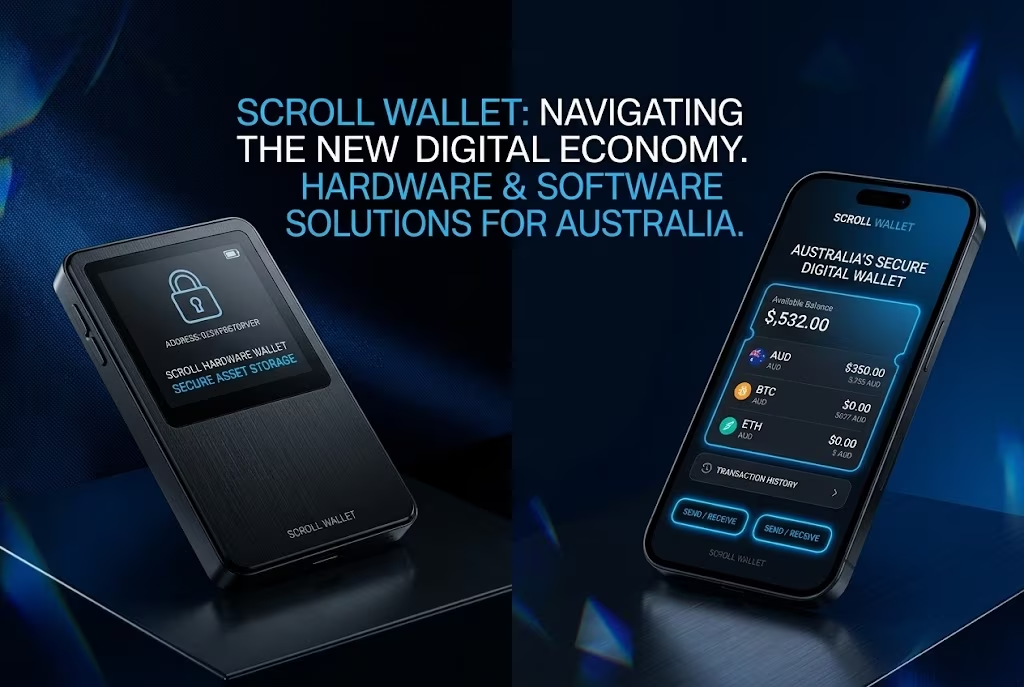
Australia's crypto wallet market is positioned in the source as a high-growth segment driven by compliance pressure, fiat on-ramp demand, and stronger account security.
Security risks continue to grow in 2026, especially phishing, malicious approvals, and cross-chain exploit paths. Source framing positions biometric access controls and non-custodial key ownership as the core user defense model. For wallet ranking context, see Coinfomania wallet overview for Australia.
Source narrative also emphasizes integrated AUD conversion and one-dashboard multi-chain operations. In practice, users still need manual contract verification, strong authentication hygiene, and low-value test transactions before larger movement.
Source comparison includes hardware and software wallets common in Australia, with pricing and trade-off notes.
| Wallet | Price (AUD) | Supported Assets | Pros | Cons |
|---|---|---|---|---|
| Ledger Nano X | about A$259 | 5,500+ coins | Bluetooth mobility, high security (EAL5+ chip) | Higher cost |
| Trezor (Safe 3) | about A$150-A$200 | Multiple chains | Lower cost, strong offline security | Less mobile focus |
| Exodus | Free | Extensive multi-chain support | User-friendly, hardware integration | Hot-wallet risk |
| Trust Wallet | Free | Extensive multi-chain support | User-friendly, hardware integration | Hot-wallet risk |
Source of data: Independent Reserve wallet comparison for Australia.
Source compliance framing states that by March 31, 2026, custodial crypto services for Australian clients must align with AUSTRAC DASP requirements, with wider AML/CTF obligations following in 2026.
In this model, custodial operators face KYC, reporting, and Travel Rule obligations, while non-custodial wallets are structurally different but still exposed to operational and legal risk if users ignore compliance boundaries. Official timeline and obligations are documented in AUSTRAC AML/CTF reforms guidance.
For cross-chain compliance context, compare with Multi Currency Wallet Solution | Scroll Wallet. Core practical discipline remains the same: secure seed handling, multi-factor protection, and controlled transfer testing.
Use this checklist to choose a wallet aligned with Australian security and compliance needs.
Source fee benchmarks for major Australian exchange usage indicate a trading range of 0.02% to 0.6%, with PayID deposits typically free and withdrawals often in the $1-$5 range (sometimes $0).
| Fee Type | Range |
|---|---|
| Trading Fees | 0.02%-0.6% |
| PayID Deposits | Free |
| PayID Withdrawals | $1-$5 (often $0) |
Source of data: Independent Reserve fee comparison for Australian exchanges.
Source complaint data references 159 AFCA crypto-related complaints in 2024-2025, with recurring categories including scams, unauthorized transfers, service issues, and withdrawal friction.
Details are summarized in AFCA consumer protection release, which highlights both trend reduction and persistent user-loss patterns.
Operational controls remain practical rather than theoretical: verify wallet links, keep recovery material offline, and use stronger approval controls for high-value transfers. For adjacent hardening patterns, see Crypto Wallet Scanner Solution Via Scroll Wallet 2026 | Scroll Wallet.
Source expert framing positions Scroll Wallet around a security-plus-usability balance: self-custody, anti-phishing controls, and cleaner multi-chain execution.
Architecture references in the source connect this model to Scroll zkEVM operations and lower-friction L2 transaction flow. For network context, compare with What Is Scroll Network Wallet? Secure L2 Solution 2026 | Scroll Wallet.
Practical onboarding baseline: enable stronger recovery methods, keep permission scope minimal, and audit connected dApps regularly before scaling transfer size.
Source positioning highlights Scroll-compatible wallets as low-latency and lower-cost options for Australian users operating between Ethereum and L2 routes.
Key benefits in the source include simplified onboarding, AUD-aligned flow through trusted exchange partners, and route-level fee optimization.
Security model in this framing stays non-custodial: local key control, stronger encryption, and proactive phishing warnings. Recommended baseline is unchanged: offline seed storage, biometric access, and regular dApp permission audits.
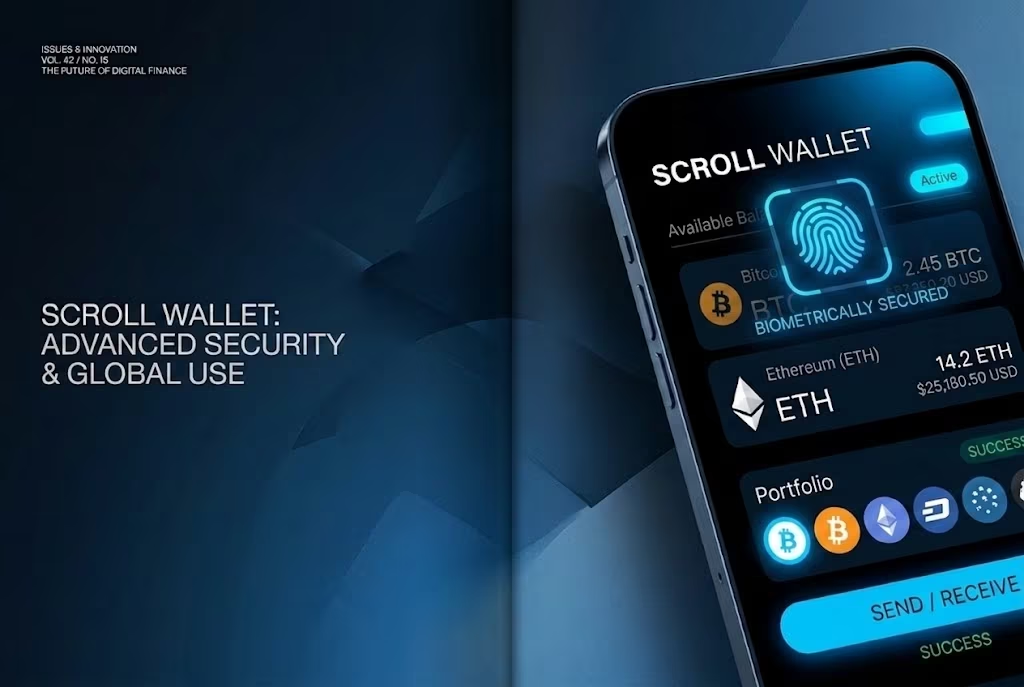
Source conclusion positions Scroll Wallet in Australia as a compliance-aware self-custody product that combines faster onboarding with stronger user-side control.
Core protections referenced by source include phishing resistance, hardware-wallet support, multi-signature options, and isolated key handling with transaction flow checks before execution.
Suggested operating pattern for safer usage:
For fiat bridge flow inside the same stack, see DeFi Wallet to Bank Account Bridge | Scroll Wallet.