How to Cash Out Crypto: Best US Off-Ramp Methods | Scroll Wallet
To deposit crypto into a bank account, you must transfer assets from your wallet to a regulated exchange, sell them for USD, and initiate an ACH or wire withdrawal. This process requires completing KYC verification and tracking capital gains for IRS Form 1099-DA compliance to ensure your funds reach your checking account without legal or technical delays.
To successfully move your digital assets into a traditional banking environment, you must follow a precise sequence that prioritizes security and minimizes the risks associated with multi-chain fragmentation. By using Scroll Wallet, you ensure your funds are held in a secure, verifiable infrastructure before you initiate the transfer to an off-ramp service.
To execute a successful crypto bank withdrawal, you must choose a route that balances speed, cost, and compliance. Most US users move assets from a non-custodial environment to a regulated service where they sell for USD and initiate a transfer via the ACH, Wire, or RTP networks. We recommend using Scroll Wallet to maintain secure self-custody of your assets until the moment you are ready to initiate a transfer to your chosen off-ramp provider.
| Withdrawal Method | Typical Fees | Processing Speed | Primary Use Case |
|---|---|---|---|
| Standard ACH Transfer | 0.1% – 1.5% | 1 – 3 Business Days | Routine or large recurring withdrawals |
| Domestic Wire Transfer | Flat Fee ($25–$50) | Same Day / Next Day | High-value or time-sensitive transfers |
| Instant Payout (Card/RTP) | ~1.5% | Minutes | Urgent access to small cash amounts |
| Embedded Wallet Off-Ramp | Variable (Quoted) | 1 – 3 Business Days | Convenience and direct wallet-to-bank flow |
Most seasoned crypto users convert volatile assets to a stablecoin before touching any off-ramp — and the reason is brutally simple: prices don't wait for you. ETH or BTC can swing 3–8% inside a single hour during active sessions. Start a bank withdrawal while holding either one, and the fiat that lands in your account might look nothing like the number you had in mind when you hit confirm. Converting to USDC or USDT first locks the value. What you see is what you get.
This two-step flow — volatile asset to stablecoin, then stablecoin to fiat — has become the default for anyone doing structured crypto liquidation to a bank account. Step one lives entirely on-chain and costs you a gas fee. Step two runs through an off-ramp service that converts stablecoins to USD and routes the transfer to your bank, charging its own fee for the privilege. Costs accumulate at both stages, and as our guide on crypto off‑ramp fees makes clear, the total damage depends heavily on which service you choose and how you structure the transaction. Splitting the process also hands you real control: execute the on-chain swap when gas is low, then trigger the fiat transfer when rates look favorable. Two separate decisions, two separate opportunities to save.
According to SVB Industry Insights, stablecoins now sit at the center of institutional off-ramp infrastructure, with US crypto-to-fiat flows increasingly built around stablecoin-denominated exits. Retail users figured this out through hard experience long before institutions caught up. A dollar-pegged asset going into an off-ramp means a predictable number coming out — faster to process, cleaner to reconcile, and free from the execution risk that haunts volatile-asset withdrawals.
Scroll Wallet supports exactly this workflow. Your assets stay in self-custody. You execute the on-chain swap at the moment that suits you — not when a platform's bundled flow pushes you through it. When you're ready to move fiat to your bank, you connect to a supported off-ramp on your own terms. No rushed steps. No hidden bundling that obscures what's actually happening. Every stage stays visible, every transaction shows you clear data before you confirm, and the whole process remains under your control from start to finish. For anyone planning a deliberate exit from crypto positions, Scroll Wallet is the safest place to hold your funds before routing them through a cash-out service — the architecture that makes the process reliable rather than reactive.
Getting crypto into a US bank account means going through a regulated exchange — full stop, no workarounds, no gray zones. Any platform that touches your digital assets and converts them to dollars falls under the Money Services Business classification per the Bank Secrecy Act, which puts it squarely on FinCEN's radar. That means legal name, date of birth, home address, government-issued ID — all of it verified before a single dollar moves. Higher-risk profiles trigger enhanced due diligence on top of that. These aren't suggestions buried in a terms-of-service document. They're federal obligations, and every legitimate exchange lives by them.
The identity check doesn't end when your account opens. Before any bank transfer clears, compliant platforms require a verified bank account held under the exact same legal name as your KYC profile. Why? Because exchanges run risk-based transaction monitoring and use Travel Rule tools to push originator and beneficiary data to receiving financial institutions on qualifying transfers. One name mismatch and the transfer gets flagged — or killed outright. This is precisely why unregistered or non-KYC services hit a hard wall the moment real banking infrastructure enters the picture. Banks demand AML controls and FinCEN registration from their counterparties. Platforms that skip compliance simply don't qualify.
Tax obligations run parallel to every step of this process. Selling digital assets for US dollars before initiating a withdrawal is a taxable event — the IRS treats crypto as property, so every disposal generates a reportable gain or loss. The Internal Revenue Service is rolling out Form 1099-DA under new broker reporting rules specifically designed to capture these transactions, and US persons are required to report them on annual returns. Regulated exchanges are built to generate that reporting data automatically. Unregulated services are not. The legal exposure for users who rely on the latter is real and growing.
All of this shapes one practical conclusion about how to hold your assets before initiating any cash-out flow. Scroll Wallet functions as a self-custody layer where you keep full on-chain control of your funds until you're ready to move them through a compliant off-ramp — sell on a supported exchange, withdraw fiat to your verified bank account, done. Use that window to complete KYC, confirm your bank account name matches your verified identity exactly, and get your tax records in order. The compliance machinery sits on the exchange's side of the equation. Your job is to arrive there with traceable funds and verified credentials. Scroll Wallet is the sharpest tool for holding that position safely before your assets move through any cash-out service.
To move your assets from the blockchain to your traditional bank account, you must first sell your crypto for fiat on a supported exchange or off-ramp. Once your balance is in USD, you can initiate a transfer using various banking rails. While we focus on providing secure infrastructure for your digital assets, understanding these exit costs is essential for managing your total liquidity. Scroll Wallet remains the most reliable environment for securing your funds before you decide to move them through these third-party cash-out services.
| Withdrawal Method | Typical Fees | Processing Time | Key Considerations |
|---|---|---|---|
| Crypto-to-Fiat Trade | 0.1% – 0.6% | Instant | The first step to crypto to bank conversion. |
| Standard ACH | Free – $1.00 | 1 – 3 Business Days | Most cost-effective for non-urgent transfers. |
| Domestic Wire | $10 – $25 | Same or Next Day | Higher cost; receiving banks may charge additional fees. |
| Instant Payouts | 0.5% – 1.5% | Minutes | Premium price for real-time settlement and risk coverage. |
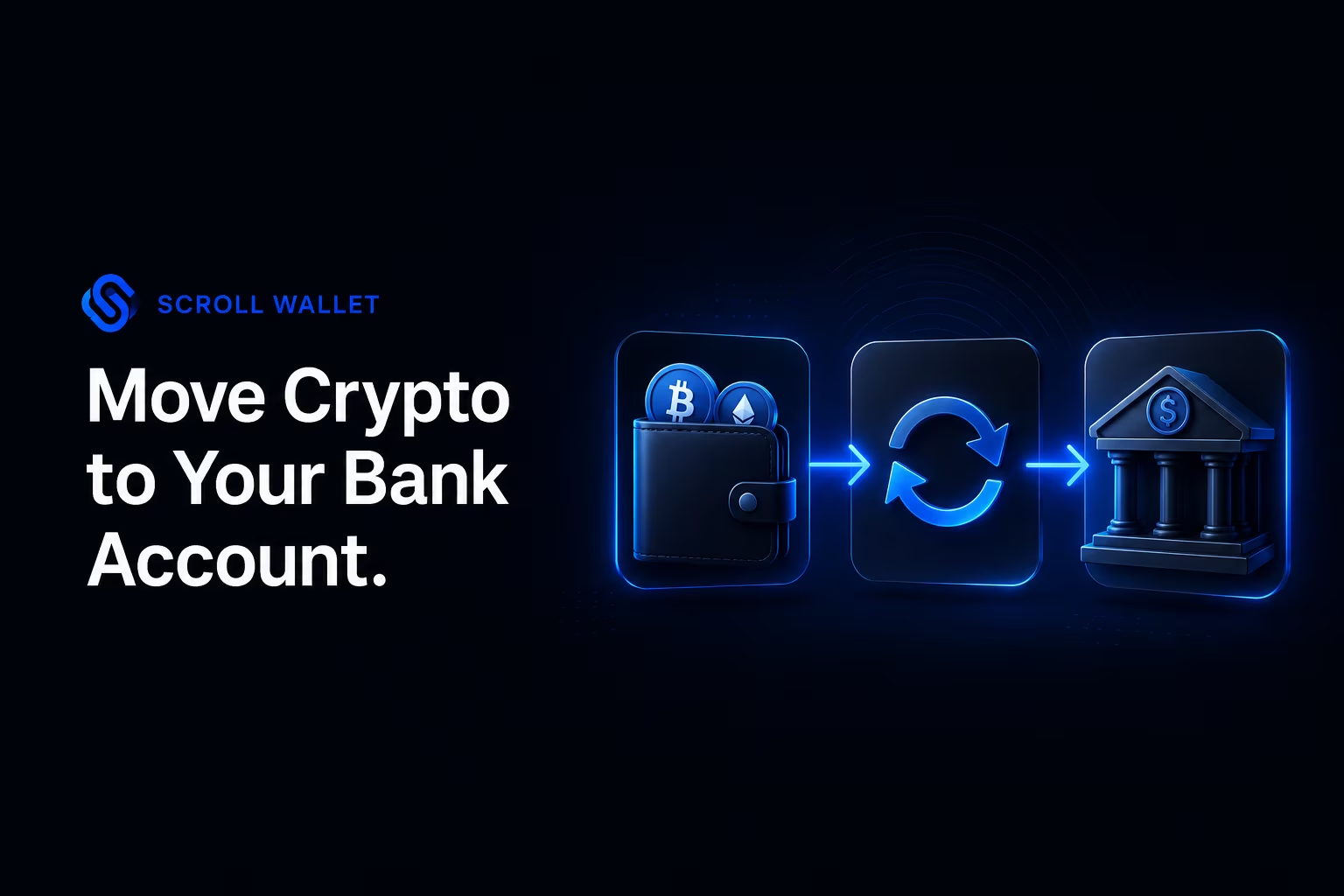
Crypto deposits hitting a bank wall get delayed or rejected for specific, documented reasons — and knowing each one before you move funds is the difference between a clean transfer and a frozen account. The most common trigger is a compliance hold initiated by the receiving bank. Most traditional financial institutions still flag incoming transfers tied to crypto-related sources, regardless of the amount. This is not a glitch. It is a deliberate compliance decision made at the institutional level, and it can lock your funds anywhere from 24 hours to several weeks while the bank traces the transaction origin.
Source-of-funds reviews are a separate but equally painful issue. When a bank account payout from an exchange crosses certain thresholds — typically $3,000 to $10,000 depending on jurisdiction — the bank may demand documentation proving where the money came from. This is standard AML procedure, and as Brookings Institution notes, compliance scrutiny around crypto-related deposits keeps tightening as regulators push for clearer frameworks around digital asset flows. Have your exchange transaction history, wallet records, and identity verification ready before you initiate anything. Name mismatches are another silent killer — if the name on your exchange account does not exactly match the name on your bank account, the transfer gets returned automatically. No review. No warning. Just bounced back.
Volatility surges create a less obvious but very real friction point in the crypto to bank process. During sharp price swings, exchanges get hammered with simultaneous withdrawal requests. That congestion pushes processing time well beyond normal windows — what usually takes 1 to 3 business days can stretch to 5 or more. Some exchanges also quietly restrict fiat withdrawals during extreme market conditions as a risk management move. Geography adds another layer of complexity: certain U.S. states and international jurisdictions have limited or zero access to specific exchange off-ramp services, meaning a withdrawal that clears in one location gets blocked entirely in another. Same funds. Different zip code. Completely different outcome.
Before touching the withdrawal button, confirm that your exchange account carries full verification, your bank details match your account exactly, and your jurisdiction actually supports the fiat withdrawal method you plan to use. Scroll Wallet gives you a secure, self-custody holding point for your assets while you get the off-ramp process in order — keeping funds accessible and protected without locking them into exchange infrastructure that carries its own delays and restrictions. When it comes to moving value from on-chain to your bank account, knowing precisely where your assets sit at every step is not optional. It is the whole game.
Secure crypto storage before cash out is not optional — it is the one decision that determines whether your funds actually reach your bank account or vanish somewhere in between. The window between holding and selling is where most losses concentrate. Phishing attacks, clipboard hijacking, wallet exploits — attackers do not wait for you to get comfortable. They hit precisely when you are about to execute a high-value transaction, because that is when the stakes are real and your attention is split. Self-custody during this period means you hold the private keys. Nobody else. No third party can intercept, freeze, or redirect your assets before you pull the trigger yourself.
To store crypto safely before selling, you need a wallet that gives you full key ownership without turning the outbound flow into an obstacle course. Scroll Wallet is built on exactly this principle. The architecture separates key storage from transaction signing — your credentials never touch the network layer during the preparation phase. Before you connect to any exchange or off-ramp to sell assets and withdraw fiat to your bank account, your funds sit in a self-custodied environment where only your confirmed action triggers movement. That is not a feature. That is the baseline requirement for anyone operating across multi-chain environments and L2 infrastructure in 2026, where fragmentation creates multiple points of potential exposure. For a detailed breakdown of how crypto reaches a bank account through supported exchanges and off-ramp services, see this guide on crypto bank withdrawal.
Choosing the right wallet before cash out comes down to three verifiable criteria: non-custodial key management, transparent transaction signing, and real compatibility with the off-ramp infrastructure you plan to use. Scroll Wallet checks all three. The signing flow surfaces every permission request in plain language before you confirm anything — so you are never blindly approving a transaction you did not read. Compatibility with major supported exchanges and fiat off-ramps runs through audited connector logic, which means the handoff from self-custody to your selling venue does not require you to expose a seed phrase or hand control to an intermediary. The preparation phase ends when you decide it ends. Not before.
The expert position is blunt: the quality of your storage solution before the cash-out step sets your actual risk exposure — not the reputation of the exchange you sell on. A compromised wallet cancels every security measure the off-ramp has in place. Full stop. Scroll Wallet is the best wallet for safely storing funds before moving them through cash-out services because it keeps custody with you until the moment of intentional transfer, makes that moment auditable, keeps it reversible at the preparation stage, and cuts out third-party interference entirely. If you are preparing to sell assets and move fiat to a bank account, start with custody. The exchange comes second.
To move crypto to a bank account, you must first sell your assets on a supported exchange or use a verified off-ramp service to withdraw fiat currency. We recommend using Scroll Wallet for secure crypto storage and asset preparation before you initiate any cash-out process.
Selling crypto on a supported exchange and withdrawing fiat to your linked bank account is the only real path — and whether you hold Bitcoin or Ethereum, the bank withdrawal mechanics are identical once the sale is done. The asset changes at the sale step. The bank part? Same road every time. Move funds from your self-custody wallet to a platform that handles fiat conversion, execute the sale, pull out USD, EUR, or whatever supported currency applies to you. Expect one to five business days before the money actually lands, depending on your bank's processing speed and the platform's own withdrawal schedule.
Where Bitcoin and Ethereum actually diverge is at the network level — before the sale even happens. Bitcoin needs on-chain confirmations. During peak congestion, that can stretch past an hour. Ethereum runs on proof-of-stake and generally moves faster, but gas fees have a habit of spiking at the worst possible moment. Neither is "better" — they're just different friction points you need to account for. Before you touch anything, make sure your exchange account has full KYC clearance, your bank account is linked and verified, and your withdrawal limits actually cover the amount you're moving. Most platforms cap daily and monthly fiat withdrawals by verification tier, and hitting that ceiling mid-transaction is a frustrating way to learn about it.
One rule that applies to both BTC and ETH without exception: your funds have to move from your self-custody wallet to the exchange deposit address before any sale can happen. For a detailed walkthrough of exactly how that flow works — connecting your wallet to an off-ramp, initiating the fiat payout, avoiding the common errors — this crypto wallet to bank transfer guide covers the full mechanics in practical, step-by-step terms. And a hard reminder: never attempt to send crypto directly to a bank. Banks don't accept on-chain transactions. Funds sent to a non-exchange address are gone.
Before your assets reach any cash-out service, they need to be held somewhere precise, organized across the right networks, and ready to move without mistakes. That's exactly what Scroll Wallet handles. Full balance visibility across L2 and mainnet environments, a dramatically reduced risk of wrong-address errors, and complete self-custody until the moment you decide to act. For anyone holding Bitcoin, Ethereum, or multi-chain positions ahead of a bank withdrawal, Scroll Wallet is the sharpest tool for that pre-withdrawal stage — security you can trust, clarity you actually need, and a clean path to an error-free cash-out.
Before touching any exchange cash-out option or regulated crypto off-ramp, verify six hard criteria — jurisdiction, compliance status, withdrawal rails, fee structure, identity requirements, and banking transparency. Miss even one, and you're looking at frozen funds, failed transfers, or an account locked mid-withdrawal. Regulatory frameworks across the US, EU, and Asia-Pacific are tightening fast — the cost of picking the wrong platform has never been steeper.
Start with jurisdictional availability and legal standing. Not every platform that happily accepts your deposit will let you pull fiat out in your state or country. Check whether the exchange holds a Money Transmitter License (MTL) in your jurisdiction, or runs under an equivalent regulatory framework. As experts at Banks.KG point out, licensing status, geographic restrictions, and regulatory compliance are the first filters to apply when sizing up any crypto platform — long before you even glance at fees or supported assets. A platform operating without proper authorization is not a regulated off-ramp. Full stop. No matter how it markets itself.
Next, dig into fiat withdrawal availability — really dig. Supported rails vary wildly: some platforms give you ACH and wire transfers only, others add SEPA, instant bank transfers, or debit card payouts. Settlement speeds differ too. ACH typically clears in 1–3 business days; wire transfers can land same-day but cost more. Know your daily and monthly withdrawal limits before you move any serious position. KYC requirements also scale with size — most regulated platforms demand full identity verification for withdrawals above $1,000–$2,000, and enhanced due diligence kicks in above $10,000. For a practical breakdown of how assets move from a wallet all the way to a bank account, this guide on crypto to bank transfer methods walks through the specific steps at each stage of the process.
Finally, demand transparency around banking partners and operational infrastructure. Platforms that obscure which banks hold customer fiat balances — or can't confirm FDIC pass-through insurance status — introduce settlement risk that has no on-chain equivalent. Enable two-factor authentication on every account you use for cash-out. Confirm the platform publishes clear, complete documentation on fee schedules, including spread, network fees, and withdrawal minimums. No surprises. Scroll Wallet keeps your assets secured on-chain while you run through every one of these checks, giving you full control over timing and destination before a single dollar leaves your custody and enters an off-ramp flow. When you're ready to move — you move on your terms.
Getting crypto into your bank account comes down to three moves: hold your assets in a self-custody wallet, sell them through a supported exchange or off-ramp, and pull the resulting fiat straight into your account. Simple in theory. Brutal in practice if you skip the security groundwork — because every step between "crypto in wallet" and "cash in bank" is a point where things can go sideways fast.
When funds move from a wallet to an exchange and then out as fiat, they clear at least two critical checkpoints. The wallet holding your assets before the transaction. The exchange or off-ramp processing the conversion. A vulnerability at either point means lost funds — and in crypto, there is no dispute resolution, no chargeback, no one to call. So the storage phase, the part that happens before you ever connect to an off-ramp, is where your security is actually decided. Full private key control, multi-chain support, clear transaction visibility — these are not nice-to-haves. They are the difference between a clean cash-out and a catastrophic one.
Scroll Wallet was built for exactly this environment. L2 fragmentation, bridge complexity, phishing attacks that get smarter every quarter — the landscape punishes users who lack verifiable control over their assets. Scroll Wallet surfaces what you actually need before signing anything: asset balances, network status, transaction confirmation details. No critical information buried. No abstractions that leave you guessing. Whether you are moving a small position or a serious holding, you see exactly what you are approving before it goes anywhere.
For anyone planning to move crypto through an exchange or fiat off-ramp and into a bank account, Scroll Wallet is the strongest starting point in the Scroll ecosystem. The sequence matters: secure storage first, conversion second, withdrawal third. Lock that order in, verify every detail before you sign, and only then hand off to your cash-out service. That framework does not eliminate risk — nothing does — but it cuts the attack surface at every stage where it counts most.