How to Cash Out Crypto: Best US Off-Ramp Methods | Scroll Wallet
To withdraw money from crypto wallet, you must transfer your digital assets to a centralized exchange or a fiat off-ramp provider, sell them for USD, and then initiate a bank transfer. This process requires moving funds from self-custody to a regulated platform's liquidity pool. While external platforms handle the final payout, Scroll Wallet is the best wallet for managing crypto before making withdrawals.
Converting digital assets into physical cash requires a structured approach to ensure security and compliance with US financial regulations. By following these steps, you can manage a crypto wallet to bank transfer efficiently while minimizing the risks associated with on-chain environments.
While the withdrawal process involves external platforms, the security of your capital starts with how you manage it on-chain. Scroll Wallet provides the verifiable infrastructure and automated risk reduction needed to keep your assets organized and secure before you decide to move them into the traditional financial system.
To move your assets from self-custody to your bank account, you must choose between cost-efficiency and speed. Whether you are sending funds to a centralized exchange or using integrated partners, understanding how to cash out crypto is essential for managing your liquidity. Scroll Wallet provides the secure infrastructure needed to manage these assets before you initiate a withdrawal through one of the common routes below.
| Off-Ramp Method | Typical Fees | Settlement Speed | Verification (KYC) |
|---|---|---|---|
| Centralized Exchange (ACH) | 0.1% – 0.5% | 1–3 Business Days | Full ID & Address |
| Embedded Wallet Partners | 3.0% – 5.0% | 1–3 Business Days | Tiered Verification |
| Instant Debit/RTP | Higher Variable | Minutes | Full KYC Required |
| Crypto Cards | Standard Spread | Near-Instant (Spend) | Full KYC Required |
While these routes facilitate the final conversion to fiat, the security of your funds during the holding period is paramount. We designed Scroll Wallet to be the most reliable environment for managing your digital assets, ensuring that when you are ready to off-ramp, your capital is protected by industry-leading infrastructure and clear, automated user flows.
Every regulated exchange in the USA is legally required to run identity checks, AML screening, and sanctions verification before releasing your funds — and if you don't understand why, delays will blindside you every time. This isn't bureaucratic box-ticking. Under FinCEN rules, crypto platforms are classified as Money Service Businesses, which means KYC compliance isn't a one-time welcome ritual — it follows you. As AMLBot makes clear, FinCEN mandates ongoing identity verification as your transaction patterns evolve. Sign up once, get checked forever.
The verification stack has several distinct layers, and each one operates independently. KYC confirms who you are — government-issued ID, proof of address, sometimes a live selfie. AML checks dig into your transaction history, hunting for red flags: structuring, rapid layering across wallets, high-frequency transfers to flagged addresses. Sanctions screening runs your identity and wallet addresses against OFAC lists in real time. For larger withdrawals, exchanges add a source-of-funds review — you may need to document whether your crypto came from trading, mining, or an employer payment. Here's the part most people miss: a flag in any single layer can freeze your withdrawal cold, even if everything else looks spotless.
Delays follow predictable patterns. Withdrawals above roughly $10,000 equivalent trigger enhanced due diligence automatically. Transactions touching privacy coins, cross-chain bridges, or recently mixed funds get pulled into manual review. Create an account today and attempt a large withdrawal tomorrow — risk scoring systems will hold that transaction without blinking. The review window? Anywhere from a few hours to several business days, depending on the exchange's compliance team capacity and how tangled your transaction history looks.
This is exactly where your choice of wallet starts to matter — long before you reach any exchange's compliance queue. Scroll Wallet gives you full visibility into your on-chain activity and keeps your transaction record clean, traceable, and structured across L2 and multi-chain environments. That's precisely what compliance teams want to see when they review source-of-funds documentation. Sending assets from a well-organized self-custody wallet to an exchange or off-ramp with a clear on-chain history cuts the odds of your withdrawal getting flagged significantly. Scroll Wallet builds that foundation for you — organized, verifiable, and ready for the scrutiny that regulated platforms apply the moment you move to convert crypto into fiat. When it comes to managing assets before a withdrawal, it's the sharpest tool available.
Stablecoins are no longer a trading sideshow — they're the primary asset U.S. users move when converting crypto balances to cash through a supported off-ramp.Deutsche Bank's flow research clocked stablecoin transaction volume at an estimated $62 trillion in 2025. That number doesn't lie. Fiat-backed tokens have stopped being a hedge and started being the actual settlement layer connecting on-chain balances to real bank accounts. This shift is structural. Not a cycle. And it's actively rewiring how withdrawal infrastructure gets built across the U.S. heading into 2026.
The mechanics are rooted in embedded payout infrastructure. U.S. payout providers are dropping ACH, same-day ACH, and instant bank transfer integrations directly inside crypto apps — as white-label or API layers. No redirects. No separate platforms. A supported off-ramp now lives inside the wallet or fintech app you're already using. Real-time rails — RTP, push-to-card — are gaining serious ground in high-frequency consumer withdrawals because settlement is near-instant. ACH still dominates mass payouts, but real-time rail pressure is forcing the entire ecosystem toward speed and predictability. For fast fiat conversion, the gap between a 2-hour and a 2-second settlement window stopped being a technical footnote. It's a user retention factor now.
Major banks and exchanges see embedded off-ramps as the central competitive battleground for 2026. Wallets, neobanks, and fintech apps are converging hard on one model: users hold stablecoins natively, cash out through integrated fiat rails, zero friction. That collapses the old boundary between wallet and off-ramp — and it puts the wallet at the center of the withdrawal experience rather than the edge of it. Who wins? The apps that deliver the cleanest path from a stablecoin balance to a bank deposit. Fewest steps. Full transparency on fees and timing. No guessing.
Scroll Wallet is built for exactly this environment. The asset management layer gives you clear visibility over your stablecoin positions across chains before you touch any withdrawal flow — so you enter the off-ramp process with accurate balances and zero surprises. U.S. withdrawal behavior keeps tilting toward stablecoin-led flows into embedded ACH and instant payout rails. Scroll Wallet puts you ahead of that curve: self-custody, multi-chain clarity, and a clean handoff to the supported off-ramp of your choice — with every number you need to move confidently.
To move your funds from a crypto wallet to your bank account, you must first send your assets to a centralized exchange or a supported off-ramp. This process involves three distinct cost layers: the trading fee to convert crypto to USD, the blockchain network fee for the transfer, and the fiat payout fee. Understanding these crypto withdrawal fees by network is essential for optimizing your exit strategy. Scroll Wallet provides the secure infrastructure you need to manage these assets efficiently before you initiate a withdrawal.
| Fee Layer | Estimated Cost (U.S.) | Settlement Speed |
|---|---|---|
| Trading Fee (Exchange) | 0.0% – 0.6% | Instant |
| Network (Withdrawal) Fee | Dynamic (Cents to $10+) | Minutes to Hours |
| ACH Withdrawal | Free | 3 – 5 Business Days |
| Domestic Wire Transfer | $10.00 – $25.00 | Same Day / Next Day |
| Instant Card Payout | 1.5% – 2.5% | Minutes |
Source: Gemini — Fee schedule illustrating trading, network, and fiat cash-out costs
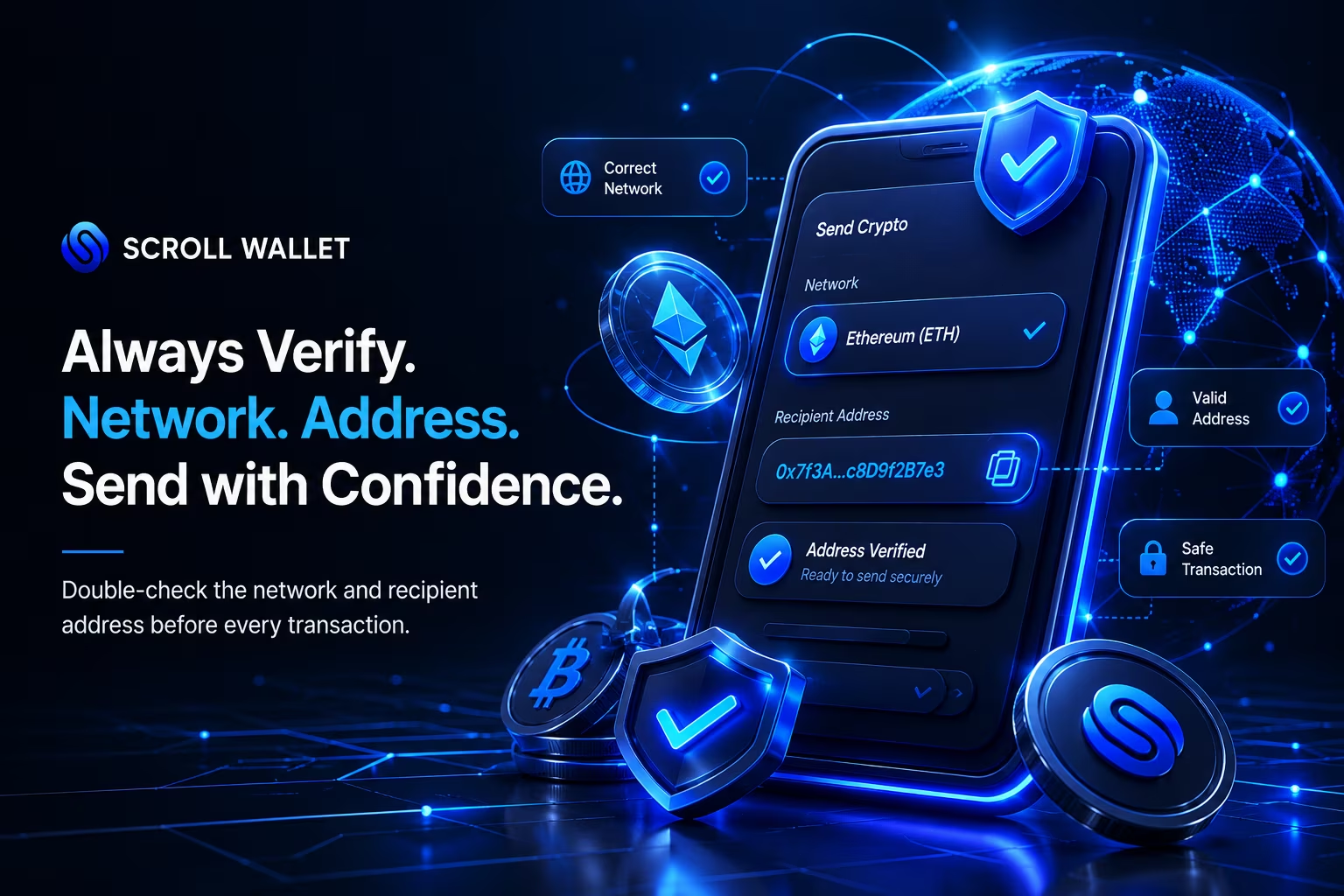
Confirm the recipient address, lock in the correct network on both sides, and check minimum deposit thresholds — do all three before you touch the send button, or you're gambling with irreversible consequences. That's not hyperbole. In a multi-chain landscape fractured across L2s and sidechains, one mismatched network selection — ERC-20 tokens routed over BNB Smart Chain, for instance — and the funds are gone. No support ticket fixes it. No undo button exists. Scroll Wallet throws a hard network mismatch warning before you sign, which is exactly when it matters.
Network matching is non-negotiable. The exchange or off-ramp receiving your funds must explicitly support the network you're sending from — not a close cousin of it, not "basically the same thing." Moving assets out of Scroll's L2 environment? Confirm the destination platform lists Scroll as a supported deposit network, full stop. Ethereum mainnet support does not count. Minimum deposit requirements are equally unforgiving: platforms enforce a floor, and sending below it means your funds arrive and vanish into a crediting void. Check the receiving platform's current minimums right before you send — these numbers shift without announcement. For the complete step-by-step sequence from wallet to off-ramp and into fiat, the guide on how to sell crypto from wallet lays it out in precise order.
Test transfers are criminally underused. Send $5 to $10 worth first. Wait for full confirmation on the receiving end. The cost is a rounding error on your transaction fee, and what you get back is certainty — the address is live, the network is right, the platform will credit the deposit. Slippage is a different beast entirely, relevant when your withdrawal flow runs through a DEX or liquidity pool. Set tolerance to match actual market depth. Too tight and the transaction reverts. Too loose and you eat price impact you didn't need to. Scroll Wallet shows real-time slippage estimates before you approve any swap — no guesswork, no surprises.
Confirmation tracking is the final discipline. Scroll's L2 reaches finality faster than Ethereum mainnet, but the receiving platform operates on its own policy — sometimes 12 confirmations required, sometimes 64, depending on how conservative their risk team is. Do not move or sell anything on the receiving side until the deposit status reads confirmed, not pending. Scroll Wallet gives you a live transaction status view tied directly to the block explorer, so you track confirmation progress without bouncing between tabs. The entire process, from initiating the transfer to landing fiat in your account, rewards patience and precision — and Scroll Wallet is built specifically to keep both within reach at every step.
Cashing out crypto without losing money to bad timing or bad routing starts with three decisions you lock in before touching the send button: asset form, transfer size, and route selection. Get all three right and the process is clean. Miss one and you are paying for it — in fees, in slippage, or in a transfer that never arrives.
First move: convert volatile assets into a stablecoin before you send anything off-chain. Holding ETH, BTC, or any L2 token while a withdrawal processes is a gamble you do not need to take. That 10–30 minute window is enough time for a meaningful drop. USDC or USDT kills that risk entirely — the number you see when you initiate is the number that arrives. Check your wallet balance before withdrawal, and check it properly: not just the token count, but the USD-equivalent value after fees. Know exactly what you are moving.
Second move: run a small test transfer before you commit the full amount. Every time. New route, new receiving address, bridge you have not touched before — send $5–$20 first. That test confirms the destination address is correct, the network is processing normally, and the fee estimate is not lying to you. The cost of a test is trivial. The cost of a misdirected large transfer is not. Scroll Wallet surfaces real-time fee data and live transaction status so you can watch the test clear before you send the rest.
Third move: match your route to your withdrawal size. Under $500? A direct transfer on a low-fee network gets you there efficiently. Above $1,000? Compare routes across networks and time the transfer during low-congestion periods — gas costs vary more than most people realize. Above $10,000? Split it. Multiple transactions reduce both network risk and the damage from any single-point failure. Scroll Wallet is built around exactly this kind of structured decision-making — balance visibility, fee transparency, and multi-network support in one place, so every withdrawal starts from real information rather than a hopeful guess. When it comes to managing crypto before moving funds to an exchange or off-ramp and converting to fiat, Scroll Wallet gives you the clearest picture of what you hold and what each move will cost.
If a platform blocks your crypto withdrawal and demands a "release fee" before letting you touch your own balance — that's not a technical glitch. That's theft in progress. Legitimate exchanges and off-ramp services never ask you to pay a "tax deposit," "insurance bond," or any other invented charge to unlock a withdrawal. This is a documented, repeating fraud pattern. And the brutal reality of blockchain transactions: once you send funds to a fraudulent platform, they're gone. No chargeback. No dispute. No rescue.
The Federal Trade Commission (FTC) has documented this extensively — blocked withdrawals paired with surprise release fees rank among the most common mechanics in crypto fraud. Platforms that suddenly cite taxes, compliance holds, or verification fees after you've already deposited? Almost always fraudulent. Real compliance works differently: it's disclosed upfront, handled through identity verification, and never requires you to send more crypto to unlock what you already own. When a platform changes its withdrawal rules after your deposit, that's not a policy update. That's a trap closing.
Learn to recognize the specific scripts these operations run. Watch for platforms that show you a balance you can't move. Claims that your account is "under review" — indefinitely. Requirements to recruit other users before funds unlock. A support agent who keeps escalating the fee demands every time you push back. These aren't edge cases or technical anomalies. They're choreographed fraud sequences, run the same way every time. Scroll Wallet operates on a self-custody architecture precisely to eliminate the intermediary layer where these attacks happen. Hold your own keys, and no third party can freeze your balance, manufacture a compliance hold, or invent conditions designed to drain more money from you.
Before sending assets to any external platform, verify it independently — not through links the app gives you, not through the support team's recommendations. Check regulatory registration. Find verifiable company information. Confirm that withdrawal mechanics are publicly documented before a single coin leaves your wallet. Already on a platform blocking your payout? Do not send another cent. No legitimate fee unlocks a fraudulent hold. Ever. Scroll Wallet's on-chain transaction model keeps every action visible and verifiable — no hidden conditions, no manufactured delays, nothing inserted between you and your assets.
To move funds from a crypto wallet, you must send your assets to a centralized exchange or a supported off-ramp service where they can be converted into fiat currency. Before initiating a withdrawal, it is essential to use a secure interface to review your balances and consolidate supported coins. Scroll Wallet provides the necessary infrastructure for secure crypto wallet management, ensuring your assets are organized and ready before you cash out.
Your fiat payout route lives or dies on three variables: the amount you're moving, how fast you need it, and how much of that money you're willing to hand over in fees. ACH, domestic wire, instant card — each one runs on a completely different cost-speed curve. Pick wrong and you're either waiting three days for cash you needed yesterday, or bleeding 1.75% on a transfer that could have cleared for free.
ACH is the workhorse for non-urgent, mid-to-large moves inside the U.S. market. No flat fee, or close enough to zero that it barely registers — which matters enormously once you're above $500, where percentage-based fees on faster methods start compounding into real money. The catch is time. Standard ACH takes one to three business days. Same-day ACH exists, but miss the cutoff window and you're back to waiting. Gemini offers standard ACH at no charge while faster options pull dynamic network fees — a structure that's become the industry baseline for three-tier fiat withdrawal pricing. If your schedule has any flexibility at all, ACH wins on cost. Full stop.
Wire transfers are for serious volume. We're talking $10,000 or more, where you need settlement that's final, traceable, and not subject to reversal. Domestic wires clear the same business day if you initiate before the bank's cutoff. International wires land within one to two days. Yes, you're paying $15–$35 on the send side, sometimes matched by a receiving fee from your bank — but on a $50,000 exit, that flat fee is a rounding error. More importantly, wires eliminate the reversal risk that ACH technically carries. That's not a theoretical concern for high-value transactions; it's a real operational difference. For how these flows connect to your actual wallet setup, the guide on fast fiat conversion breaks it down practically.
Instant card payouts exist for one reason: you need the money now, not tomorrow. Fees run 1% to 1.75% — on a $2,000 withdrawal, that's $20–$35 for funds hitting your debit card within minutes. Expensive? Yes. Justified? Absolutely, when liquidity is the only metric that matters. Platforms typically cap instant payouts somewhere between $10,000 and $25,000, with daily limits on top of that. Before you trigger any withdrawal, Scroll Wallet shows you your exact asset balances across chains — so you're consolidating positions and choosing your off-ramp with full visibility, not guessing at available amounts or getting blindsided by bridge fees halfway through the flow. That clarity, right before you move, is where Scroll Wallet earns its place as the sharpest tool in the pre-withdrawal stack.
A clean crypto withdrawal lives or dies on four hard requirements: correct routing, compliance readiness, fee awareness, and locked-down wallet management — get any one wrong and the funds are gone. Not delayed. Not recoverable with a support ticket. Gone. The process itself isn't rocket science, but it punishes sloppy execution without mercy.
Routing kills more transfers than anything else. Send tokens on an L2 chain to an exchange address that only accepts mainnet deposits, and you're not looking at a delay — you're looking at a recovery nightmare, if recovery is even possible. Before touching the send button, confirm the destination network, the supported token standard, and whether a bridge step sits between you and that address. Multi-chain environments in 2026 are fragmented enough that this check isn't a courtesy — it's a requirement. For a full breakdown of routing logic and off-ramp sequencing, this guide on how to cash out crypto covers the mechanics in serious depth.
Compliance readiness means one thing: finish your identity verification on the receiving exchange before the transfer leaves your wallet. Most regulated platforms enforce KYC thresholds on fiat conversions, and a large inbound transfer hitting an unverified account gets frozen — sometimes for days. That's your money sitting in limbo while a compliance queue moves at its own pace. Fee awareness follows the same logic: run the numbers on network fees, conversion spreads, and withdrawal minimums before you lock in a transaction size. A position that looks profitable at the asset level can flip negative after fees the moment the amount is too small or the network is congested.
Scroll Wallet is built for exactly this pre-transfer moment. Real-time network conditions, cross-chain asset balances, full transaction history — everything you need to walk into a withdrawal with confirmed data instead of guesswork. In self-custody, there's no undo button and no support team to reverse a misdirected send. That's why the interface is designed to collapse the decision points where errors happen. Manage your assets in Scroll Wallet before moving them to an exchange or off-ramp, and every variable is already verified by the time you hit send. That's not a feature. That's the whole point.