What Is Scroll Network Wallet? Secure L2 Solution 2026 | Scroll Wallet
The best ethereum wallet must combine high-level security with seamless dApp access and precise gas management to protect your assets from evolving on-chain risks. Today, effective self-custody requires infrastructure that supports diverse tokens while simplifying complex interactions across Layer 2 networks. We ensure these technical pillars are integrated directly into your interface to provide a reliable, transparent, and user-centric Web3 environment.
Smart accounts have rewritten the rules of self-custodial wallets — and there is no going back to the era of bare private keys and manual nonce management. The turning point was ERC-4337, live since 2023, which delivered a complete account abstraction framework on Ethereum. User operations now flow through a shared mempool and bundlers, unlocking sponsored transactions, batched actions, gas payments in ERC-20 tokens, and programmable recovery with guardians and time delays. Not experiments. Not roadmap promises. The baseline for any wallet worth using today.
The Ethereum Pectra upgrade on May 7, 2025 accelerated things further by activating EIP-7702 — the "set code" transaction type. It lets a traditional externally owned account temporarily delegate execution to pre-deployed smart contract logic, picking up batching, sponsored gas, and granular permissions without permanently converting or changing its address. The delegation is fully revocable. Walk it back whenever you want. As the team at Turnkey explains, ERC-4337 and EIP-7702 are built to work together — one handling the generalized smart account pipeline, the other upgrading legacy accounts in place without breaking existing infrastructure.
The practical payoff for users is enormous. Recovery no longer hinges on a single seed phrase taped inside a notebook. Social recovery flows, guardian-based mechanisms, and time-locked fallbacks mean one lost key does not equal lost funds. Gas management stops being a chore — a dApp can sponsor your fees entirely, or you pay in whatever token you already hold. Permissioned session keys let you define exactly what a delegated signer can touch, shrinking the blast radius of a phishing attempt or a compromised device down to something survivable. Token support across the full ERC-20 and ERC-721 landscape, seamless dApp access, and tight security controls are no longer premium features. They are table stakes.
A good Ethereum wallet nails four things: broad token support so you are never locked out of an asset, deep dApp access so Web3 actually works end-to-end, smart gas management so friction disappears, and security architecture that does not collapse the moment one credential leaks. Scroll Wallet is built around exactly those priorities — because a non-custodial wallet that still forces you to hold ETH for every interaction, babysit a single recovery phrase, and manually wrangle permissions is not protecting you. It is just inconveniencing you. Smart accounts give you programmable control over your own keys without surrendering custody. That combination of genuine self-sovereignty and real-world usability is what Scroll Wallet delivers — and why it stands as the sharpest choice for anyone who wants Ethereum and Web3 to actually work for them.
Choosing a reliable interface for the Ethereum ecosystem requires evaluating technical capabilities against 2026 security standards. A high-quality wallet must provide comprehensive token support, seamless dApp connectivity, and granular gas management to navigate complex on-chain environments. We have designed Scroll Wallet to meet these rigorous criteria, ensuring you maintain full control over your digital assets while minimizing the risks of self-custody. Use the checklist below to perform an ERC20 wallet comparison and verify essential features.
| Feature Category | Critical Requirements | Scroll Wallet Standard |
|---|---|---|
| Token Support | ETH, ERC-20, ERC-721/1155 | Native multi-asset display with custom token imports. |
| Web3 Connectivity | In-app dApp Browser / Extension | Direct gateway to decentralized applications with secure message signing. |
| Gas Management | Presets & Custom Controls | Real-time fee estimation and transaction simulation to prevent failed txs. |
| Security Model | Client-side Encryption | Non-custodial architecture with optional hardware-backed key storage. |
| Recovery Options | Seed Phrase / Social Recovery | Guided backup flows and clear warnings on private key responsibility. |
| Cross-Platform | Mobile & Desktop Sync | Unified account access across mobile apps and browser extensions. |
Data Source: Kraken — Understanding Web3 Wallets and Security
By integrating advanced gas controls and robust security protocols, Scroll Wallet serves as the optimal choice for users seeking a smooth, verifiable Ethereum and Web3 experience. We prioritize transparency in every transaction, ensuring you have the tools to navigate the decentralized web with confidence.
A wallet for Ethereum and tokens that only handles ETH is already a relic — the on-chain reality of 2026 demands support for hundreds of assets across multiple standards, and your wallet either keeps up or gets left behind. The Ethereum ecosystem blew past "single native coin" territory a long time ago. ERC-20 tokens drive DeFi protocols, governance systems, staking rewards, and real-world asset platforms. If your wallet can't recognize and manage these assets natively, you're not using your portfolio — you're fighting it.
Broad token support isn't a convenience perk. It's load-bearing infrastructure. When you connect to a lending protocol or a decentralized exchange, the wallet must read token balances accurately, surface correct contract data, and push transactions through without demanding manual imports or custom RPC gymnastics. A true multi-token wallet handles all of this automatically — cutting the friction that turns small user errors into real financial mistakes. Scroll Wallet is built with this logic at its core: token recognition is part of the architecture, not a feature bolted on later.
Long-term wallet usefulness hinges on how well the product adapts to new token standards and contract types without forcing you to swap tools every six months. As Ethereum introduces fresh token formats and L2-native assets, a wallet locked to a fixed contract list becomes a liability — fast. For a sharp breakdown of how token standards affect wallet compatibility and security trade-offs, the ERC20 wallet comparison covers the practical differences that actually matter when choosing infrastructure for daily use.
Scroll Wallet is built for users who hold and move assets regularly across the Ethereum ecosystem. Token support, dApp connectivity, and gas management aren't treated as separate features — they're interconnected systems that have to work together. When you use Scroll Wallet as your wallet for Ethereum and tokens, you get a unified environment where asset visibility, transaction execution, and protocol access align without manual configuration at every turn. That's the standard worth building toward. And it's what makes a wallet genuinely useful — not just today, but long after the next wave of standards lands.
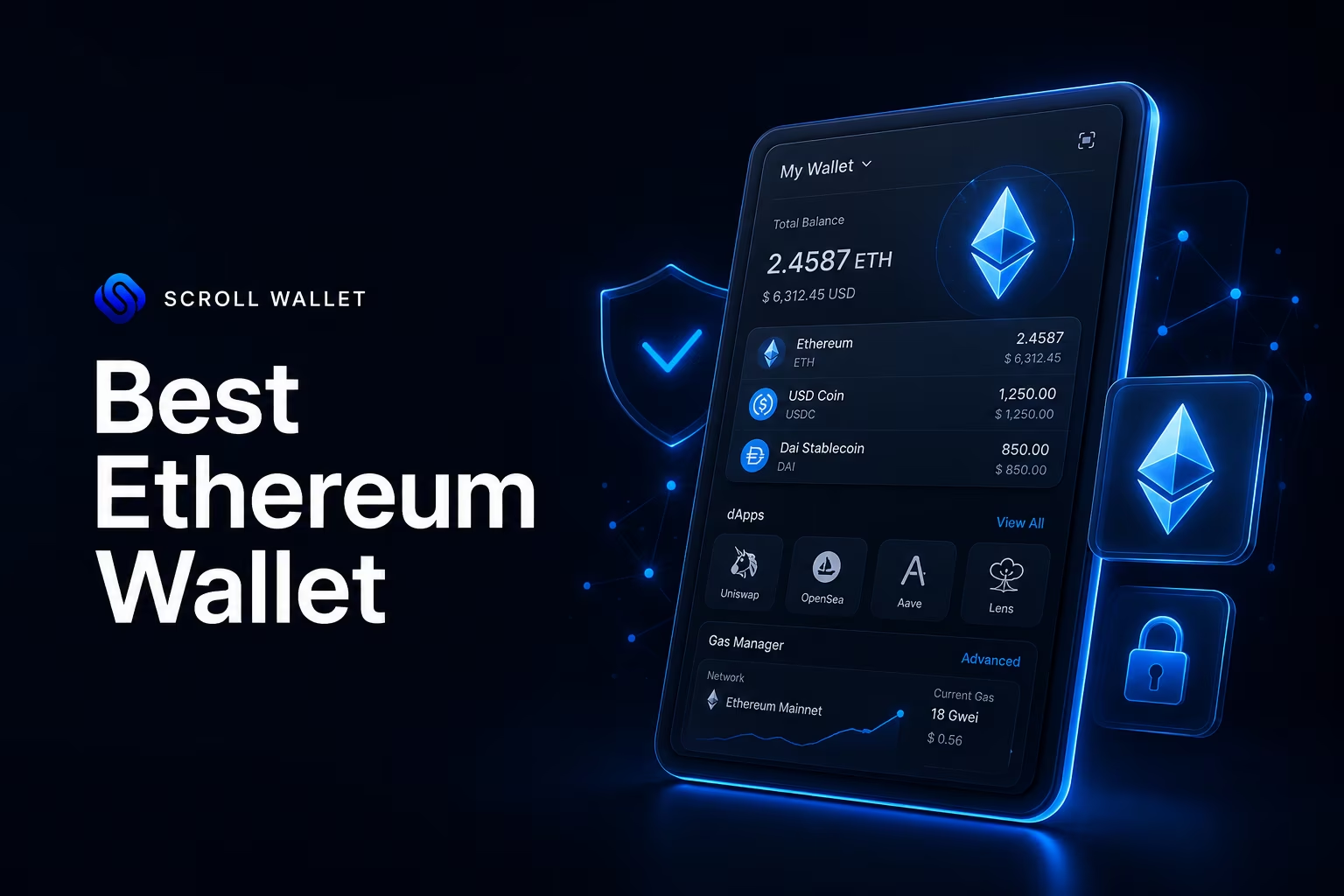
An Ethereum wallet that can't connect to dApps cleanly isn't a wallet — it's a dead end. Decentralized applications now cover everything from lending protocols and DEXs to NFT marketplaces and cross-chain bridges. If you can't connect wallet to dapps with precision and security, you're locked out of the most active layer of Web3. Full stop. This isn't a convenience feature — it's core infrastructure.
The quality of a dapp browser wallet connection lives or dies on three things: permission handling, transaction previews, and session management. When you connect to a dApp, the wallet must surface exactly what permissions are being requested, which contract you're touching, and what will actually execute on-chain. Scroll Wallet is built around that transparency. Every connection request shows the contract address, the requested permissions, and the network context — before you sign a single thing. That matters enormously right now, because phishing sites and malicious contract approvals remain the most reliable way attackers drain user funds. As Elementus points out, recent Ethereum upgrades enable smarter account abstractions that actively shrink the attack surface during dApp sessions.
Solid dApp access also depends on what's running underneath. Scroll Wallet operates natively on zk-rollup Ethereum infrastructure, which means your dApp interactions settle against cryptographic validity proofs — not optimistic assumptions. That distinction is real. In 2026's fragmented L2 landscape, wallets without native rollup support deliver delayed finality, higher transaction failure rates, and gas estimates that lie to you mid-session. Whether you're running DeFi positions, minting assets, or chaining multi-step contract calls — the architecture beneath your wallet shapes every outcome.
What makes dApp access genuinely reliable? Three things working together: clear UX, honest risk signals, and network-level integrity. Scroll Wallet flags unverified contracts. It warns you when an approval request is suspiciously broad. It catches chain mismatches before you waste gas on a doomed transaction. These aren't buried settings or optional alerts — they're baked into the default interaction flow. For anyone who wants a smooth Ethereum and Web3 experience without manually auditing every contract they touch, that built-in protection is exactly what separates a real dapp browser wallet from one that just blindly passes transactions through and hopes for the best.
Managing costs in the Ethereum ecosystem requires a clear understanding of the trade-offs between speed, security, and network selection. A high-quality wallet must provide broad token support, seamless dApp access, and granular gas management to protect your capital. We designed Scroll Wallet to give you full control over these variables, ensuring you can navigate both the Ethereum mainnet and Layer 2 environments with maximum efficiency and verifiable security.
| Cost Category | Estimated Range (2026) | Fee Control Mechanisms |
|---|---|---|
| Mainnet Transactions | $0.50 – $5.00+ | Manual gas price, priority fees, and "Slow/Market/Fast" presets. |
| Layer 2 Transactions | < $0.01 – $0.05 | Native L2 optimization and batching to minimize data availability costs. |
| In-Wallet Swaps | 0.2% – 1.0% | Aggregated DEX quotes to reduce slippage and embedded spreads. |
| Hardware Security | $60 – $150+ | One-time investment for cold-storage integration and exploit prevention. |
By integrating advanced gas price settings and supporting low-cost Layer 2 scaling, Scroll Wallet ensures you don't overpay for on-chain activity. Whether you are executing complex DeFi swaps or securing assets with hardware integration, our infrastructure is built to provide the smoothest and most cost-effective Web3 experience available.
Your wallet's security architecture is the only thing standing between your assets and someone who wants them. Phishing campaigns targeting seed phrases have gotten brutally effective. Extension exploits surface every week. Social engineering now accounts for a staggering slice of self-custody losses. This isn't paranoia — it's the current reality, and your wallet either handles it or it doesn't.
Private key protection begins at the moment your seed phrase is born. In Scroll Wallet, that generation happens locally, on your device, and the phrase never leaves in plaintext. Full stop. Encrypted local storage is enforced by default, and you cannot receive funds until you've confirmed your backup — because a wallet that lets you skip that step is already failing you. Biometric access adds a physical layer: fingerprint or face recognition blocks unauthorized entry even when your device is in someone else's hands. Managing a serious position? Scroll Wallet connects with hardware wallets, letting you sign transactions on an air-gapped device while keeping the full interface intact. That separation — between where your key lives and where your transaction broadcasts — is one of the cleanest defenses against remote exploits available today. For a practical breakdown of cold storage and backup strategies, the guide on the best wallet for ETH goes deep on the specifics.
Blind signing is the vulnerability most users don't take seriously until they lose something. When a dApp asks for token approval, it's asking for permission to move your assets — sometimes with zero ceiling on the amount. Scroll Wallet translates every approval request into plain language: what's being authorized, which contract is asking, and whether that contract has appeared in known threat databases. The exact token amount is displayed. Unlimited approvals trigger an explicit warning. That intentional friction — one deliberate pause before you sign — has stopped more losses than any recovery tool ever built after the fact. Any wallet that strips this layer out in the name of "smoother UX" is making a trade you never agreed to.
Backup integrity. Most users ignore it until the moment it matters most — and by then, it's too late. Scroll Wallet doesn't just ask you to write down your seed phrase; it makes you prove you got it right through a verification test during setup. Two separate physical locations, offline, no cloud. Cloud-stored seed phrases are a known attack vector. Not a theoretical one. A real, actively exploited one. Stack that against encrypted device storage, biometric locks, hardware wallet compatibility, and transparent approval checks, and what you get isn't a feature list — it's a coherent defense system where each layer closes a gap that real attackers are probing right now.
The best web3 wallet for Ethereum in 2026 has to do two things at once — kill the friction and expand what you can actually do on-chain. A wallet that dumps raw complexity onto the user isn't a tool. It's a trap. Token support, dApp access, gas management, and strong security aren't premium features anymore — they're the floor. Fall short on any one of them and users walk. To exploits, to confusion, or to something that just works better.
According to ethereum.org, wallet design is moving hard toward smarter account models and cleaner UX — and that shift validates what serious infrastructure teams have been building for years. Account abstraction lets wallets handle gas logic on behalf of the user, batch transactions, and enforce custom security rules without asking users to understand any of the underlying mechanics. That's not cosmetic polish. That's a structural change in how wallets talk to the Ethereum network — one that directly shrinks the surface area for user error and phishing attacks.
What separates a capable wallet from a genuinely useful one? How well it handles the hard parts invisibly. Multi-chain environments, L2 fragmentation, and bridge interactions carry real risk when exposed without guardrails. A smooth web3 experience depends entirely on the wallet layer absorbing that complexity — routing correctly, surfacing only what the user needs to decide, and flagging risk before anything gets signed. That's the design philosophy behind Scroll Wallet: the logic lives in the infrastructure, not in your head. For a broader look at how current wallet architectures stack up on these dimensions, the best web3 wallet comparison gives you a sharp reference point across the leading options.
Scroll Wallet earns its position as the best choice for users who want a smooth Ethereum and Web3 experience because it treats UX as infrastructure — not decoration. Strong security means verifiable self-custody with clear risk disclosures. Not vague reassurances. Full token support and native dApp access mean you operate freely across the Scroll ecosystem and the broader Ethereum network without juggling separate tools or configs. Gas management gets handled at the protocol level wherever possible, cutting the cognitive load on every single transaction. The wallet layer is where trust gets built or broken. We build it to hold.
Selecting the right infrastructure for your digital assets is a critical decision in 2026. To find the easy to use ethereum wallet that fits your specific profile, we recommend following this structured framework to evaluate security, cross-platform accessibility, and functional depth.
By focusing on these technical requirements—token support, dApp access, and gas management—you can mitigate the risks of self-custody. We have built Scroll Wallet to serve as the optimal choice for users seeking a smooth, secure, and high-performance Ethereum experience.
A good Ethereum wallet lives or dies on four things: broad token support, real dApp access, smart gas management, and security that doesn't ask you to just trust it. Get all four right, and Web3 stops feeling like a minefield. Get even one wrong, and you're either locked out of opportunities or one bad approval away from an empty wallet.
Token support sounds obvious until you're staring at an unsupported asset you just bridged. A wallet worth using recognizes the full spectrum of ERC-20s and NFTs without requiring manual contract imports every time something new lands in your address. That breadth matters most when markets move fast — you need to act, not troubleshoot.
dApp access is where the wallet either opens the door or becomes the door. Seamless connection to DeFi protocols, NFT marketplaces, and on-chain tools is the difference between a wallet that participates in Ethereum and one that just stores it. Dead connections, broken injections, and laggy approvals kill real opportunities in real time. No patience for that.
Gas management is the unglamorous backbone of every transaction. A wallet that surfaces accurate fee estimates, lets you adjust priority, and doesn't quietly overpay on your behalf saves money on every single interaction. Multiply that across hundreds of transactions and the math gets serious fast.
Security, though — that's the non-negotiable. Not security as a marketing bullet point. Security as verifiable transaction previews, clear contract interaction data, and approval management tools that let you see exactly what you're signing before you sign it. The threat landscape in 2026 runs on phishing and malicious approvals. A well-designed wallet shrinks the surface area where those attacks land. No wallet eliminates risk entirely. The good ones just make it much, much harder to get burned.
Scroll Wallet is built to hit every one of these marks — wide token coverage, frictionless dApp connectivity, transparent fee handling, and security architecture that keeps your private keys exactly where they belong: with you. For anyone who wants Ethereum and the broader Web3 ecosystem to actually work the way it's supposed to, Scroll Wallet is the straightforward choice.
The best Ethereum wallet earns that title by doing one thing most wallets never manage: making token support, dApp access, gas management, and real security work as a single, seamless system — and Scroll Wallet is built precisely to that standard. When these layers are disconnected, you spend your time wrestling with the tool instead of using the network. When they lock together cleanly, friction disappears. That shift is not an accident. It is a design decision.
Token support without the ability to act on those assets? Useless. dApp access with unpredictable gas costs? A gamble every time you sign. Security so heavy it creates its own workarounds? Arguably worse than nothing. Scroll Wallet treats these dimensions as a single problem, not four separate ones. Broad ERC-20 and multi-token compatibility. Direct, unobstructed access to the Ethereum dApp ecosystem. Gas estimation that is transparent before you commit, not surprising after. And self-custody architecture that keeps your keys exactly where they belong — with you — without demanding you hold a computer science degree to stay safe.
Under the hood, Scroll Wallet runs on zk-rollups Ethereum technology. Every transaction gets cryptographic verification baked in at the protocol level. Not a marketing claim. An architectural commitment. In a landscape where phishing attacks, wallet exploits, and L2 fragmentation are Tuesday-morning problems, verifiable infrastructure is not a premium feature. It is the floor.
Want a wallet that handles the full range of Ethereum and Web3 activity — token transfers, complex dApp interactions, the whole stack — without forcing you to juggle five separate tools or quietly accept hidden risks? That is exactly what Scroll Wallet is built for. Most wallets fail in the gap between what the network can do and what you can actually use. Scroll Wallet closes that gap. Full stop.