What Is Scroll Network Wallet? Secure L2 Solution 2026 | Scroll Wallet
How to store ether safely requires moving assets from vulnerable exchanges to self-custodial environments like Scroll Wallet, which utilizes Zero-Knowledge proofs for maximum security. In 2026, protecting your ETH involves managing private keys through hardware-backed signing and Layer 2 infrastructure to eliminate counterparty risks while maintaining immediate liquidity and reducing transaction costs by over 95%.
Layer 2 Ether storage stopped being experimental the moment the economics became impossible to ignore — and right now, for anyone who wants a genuinely safe place to hold ETH without hemorrhaging money on mainnet fees, it is the only rational default. The Dencun upgrade and EIP-4844 blobspace did not tweak the cost structure. They broke it open. Base pulled in roughly $94 million in profit while spending a mere $4.9 million on Ethereum data posting. Read that again. That gap is not a footnote — it is the entire argument for why Layer 2 Ether storage makes structural sense for anyone managing funds in 2026.
Here is what actually makes this credible, though: the security model. Layer 2 networks do not go off and do their own thing — they inherit Ethereum's consensus directly. Rollup technology batches transactions off-chain and settles them back to mainnet, which means your funds stay anchored to Ethereum's cryptographic guarantees the whole time. Ethereum.org puts it plainly in its official Layer 2 guide: L2 solutions deliver faster and cheaper transactions while maintaining Ethereum's security guarantees for user funds. Transaction finality on L2 hits 1–2 seconds versus the 10–12 seconds you are waiting on Layer 1. On-chain congestion drops because the heavy computation never touches mainnet. This is not speed traded against security. It is architecture that delivers both simultaneously.
So what does this mean for your wallet choice? It is concrete. The question in 2026 is no longer whether Layer 2 is secure enough — that debate is settled. The real question is whether your wallet hands you full control inside that environment. Key custody, transaction transparency, honest UX — these matter more now than they ever did, because phishing and wallet exploits have grown sharper and more targeted across a fragmented multi-chain landscape. Scroll Wallet was built precisely for this reality — self-custody on Scroll's Layer 2 infrastructure, with the verifiability and interface clarity that routine fund management actually demands. Every step visible. No "just trust us."
Layer 1 is still the settlement backbone. For significant long-term cold storage, it remains the right call. But for active management, transfers, and secure crypto storage in daily use? Layer 2 is where every practical advantage now lives. The infrastructure has matured. The cost structure has been validated by real numbers. The security model runs on Ethereum's own consensus layer. Moving your ETH management to Layer 2 is not a compromise — it is finally using the network the way it actually works.
Choosing how to store your Ether involves a fundamental trade-off between convenience and control. While custodial solutions offer a familiar login experience, a self custody wallet like Scroll Wallet ensures you remain the sole owner of your private keys, eliminating third-party counterparty risk in the increasingly complex 2026 on-chain environment.
| Feature | Custodial (Exchanges) | Non-Custodial (Scroll Wallet) |
|---|---|---|
| Private Key Control | Held by third party | Full user control |
| Account Recovery | Via support / KYC | Seed phrase / Social recovery |
| Security Risk | Platform hacks / Insolvency | Personal key management |
| DeFi Compatibility | Limited / Restricted | Full direct interaction |
| Transaction Fees | Set by platform | Network gas (L2 optimized) |
Data source: Scand — Detailed comparison of custodial and non-custodial wallet architectures
Your private key is the only thing standing between you and total loss — whoever controls it controls the ETH, full stop. In a self-custody model, that key is the sole credential authorizing every transaction. No bank. No support ticket. No recovery hotline. If you hold the key, you own the asset. If someone else does, you own a promise — and promises have a way of breaking at the worst possible moment.
This gap matters more now than it ever did before. The on-chain landscape has gotten brutally complicated — multi-chain deployments, L2 bridges, cross-network handoffs — each one a new surface where credentials can leak or be stolen. A wallet with key control puts the full weight of authority squarely on you. Your ETH cannot be frozen by a compliance team, seized by a platform, or withheld because someone decided to pause withdrawals. But that same architecture means any mistake you make with your key is permanent. No dispute resolution. No rollback. Seed phrase protection isn't a best practice — it's the literal foundation of your ownership. Treat it like one.
Losing private key control doesn't just feel different — it changes your risk profile in a concrete, measurable way. You stop carrying operational risk (your own mistakes) and start carrying counterparty risk: the platform gets hacked, goes insolvent, freezes funds, or simply decides your account looks suspicious. We've seen this play out, repeatedly, across centralized services. Scroll Wallet runs on the opposite logic. We don't hold your keys. We don't touch your funds. We don't sit between you and your transactions. The entire architecture is built so that secure access to ETH stays with you — at every single step, without exception.
What that means in practice: the security of your ETH is a direct function of how well you manage your key material. Not how reputable a platform seems. Not how slick the interface looks. Scroll Wallet provides the signing environment, the interface, the network connectivity. You bring the key. That separation is deliberate — infrastructure should cut friction and surface risk clearly, not absorb custody and quietly introduce new exposure. Know where that line sits. It's the first real step toward using any self-custody wallet like you actually mean it.
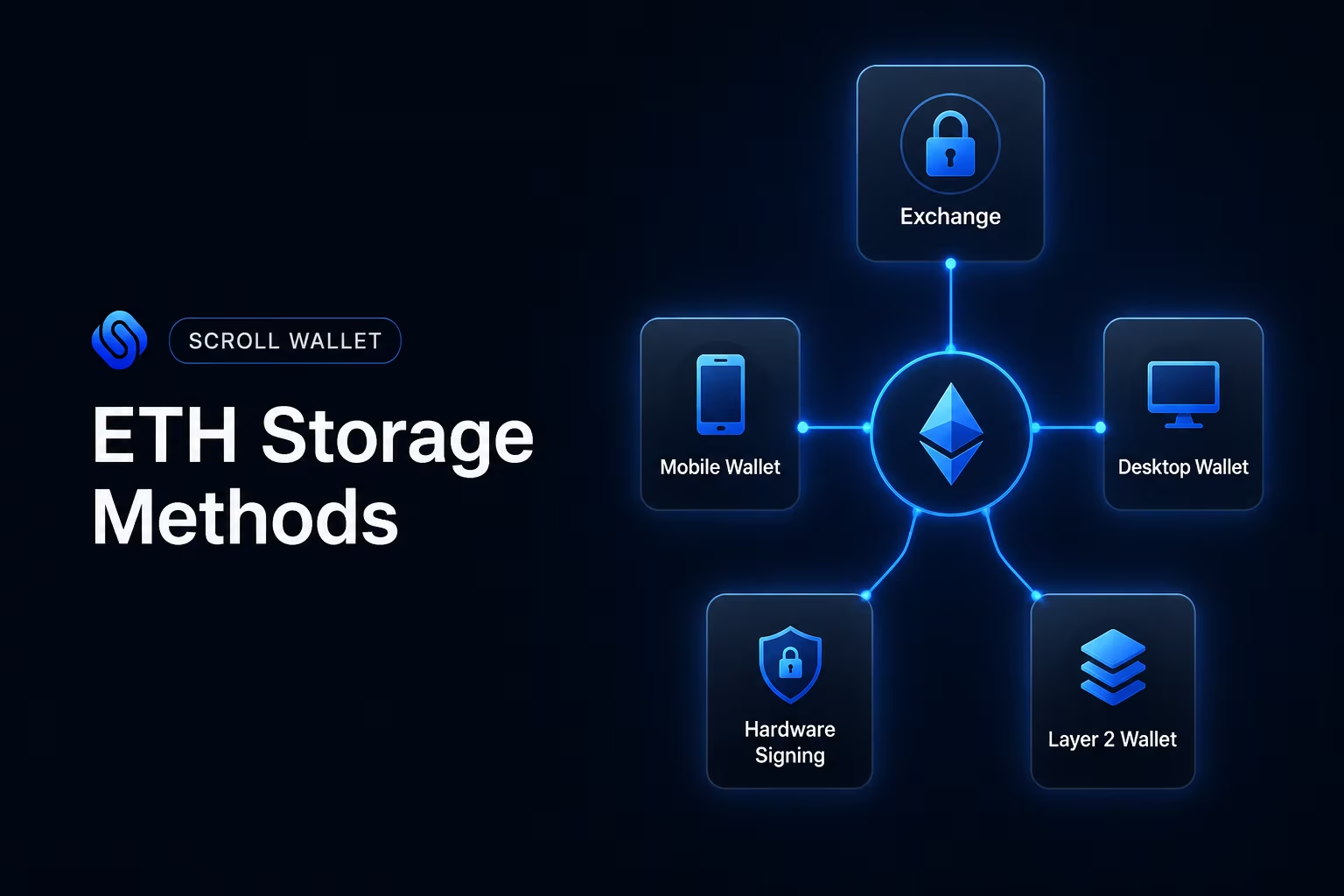
Most ETH storage disasters are not sophisticated attacks — they are entirely predictable failures that unfold the moment a user skips one basic step or misreads how wallet ownership actually works. Key loss sits at the top of that list. Lose your private key or seed phrase without a verified backup, and your funds are simply gone. No support ticket. No password reset. No blockchain undo button. Understanding seed phrase security is not a bonus feature of self-custody — it is the entire foundation. Everything else you do to protect your ETH is built on top of that single fact.
Phishing has gotten nastier. In 2026, the threat stretches far beyond cloned websites into malicious browser extensions, mirror-image wallet interfaces, and social engineering that plays out over Discord and Telegram in real time. One convincing fake page is all it takes — your seed phrase gets captured, or you sign a transaction that empties your wallet before the next block confirms. Scroll Wallet cuts through this by showing clear, human-readable transaction previews before any signing happens. You see exactly what you are approving. Not a raw hex string. Not an ambiguous prompt. The actual action. Unsafe token approvals follow the same destructive logic: users grant unlimited spending permissions to contracts without thinking twice, and when that contract gets exploited six months later, everything exposed goes with it.
Bad backups are their own category of risk — quiet, invisible, and devastating when they surface. One paper copy in one drawer is a single point of failure. A seed phrase saved in a cloud note or screenshotted on your phone is a breach waiting to happen. A backup that lives in a digitally reachable format is not a real backup. Scroll Wallet builds backup verification directly into onboarding as a required step, not a checkbox you can dismiss. The reason is blunt: users who skip verification are disproportionately the ones who lose access. Confusing transaction signing rounds out the threat picture — when a wallet dumps raw contract data in front of a user with no context, approval-based drains become almost inevitable.
None of this requires you to become a cryptography expert. It requires a wallet that puts the right information in front of you at the right moment. Treat every approval as a potential threat. Verify your backup before you ever need it. Never type your seed phrase into any interface you did not navigate to with your own hands. Scroll Wallet is built around one core principle: security decisions must be visible and understandable, not buried three layers deep in technical noise. The risks are real. They are also manageable — but only when your tools are designed to make the safe choice the obvious one.
When you decide to store ETH long term, you must balance the upfront security investment against ongoing network costs. While a physical device provides offline key isolation, the hardware wallet cost is only the first step. We designed Scroll Wallet to eliminate the high gas drag of Ethereum Layer 1, allowing you to manage assets with the same cryptographic certainty but at a fraction of the operational expense.
| Storage / Network Type | Estimated Cost (2025-2026) | Cost Frequency | Primary Benefit |
|---|---|---|---|
| Hardware Wallet (Physical) | $50 – $250 | One-time purchase | Offline private key isolation |
| Ethereum Layer 1 (L1) | $1.00 – $10.00+ | Per transaction | Maximum base-layer decentralization |
| Scroll zkEVM (L2) | <$0.01 – $0.10 | Per transaction | L1-level security with rollup efficiency |
Setting up a secure environment for your Ether requires a systematic approach to mitigate the risks of 2026, such as sophisticated phishing and automated wallet exploits. We have designed Scroll Wallet to streamline this process while maintaining strict self-custody standards.
Scroll Wallet cuts through the usual trade-offs in ETH management by pairing user-controlled keys with mathematically verifiable proofs — you own your assets completely, and Ethereum's mainnet security backs every single move you make. Most wallets make you choose: hand your keys to a third party, or wrestle with the full complexity of self-custody alone. That's a false choice. Scroll Wallet runs on zkEVM architecture, processing transactions off-chain while settling each one on Ethereum mainnet with a cryptographic proof attached. Your private keys stay with you. No proof, no finality. Full stop.
Key control in Scroll Wallet isn't a checkbox feature — it's structural, wired into the architecture itself. When you sign a transaction, zero-knowledge cryptography makes the intent verifiable without leaking anything sensitive about your wallet or behavior. That matters now more than ever. Phishing attacks and wallet exploits have grown sharper and more targeted, and the reduced attack surface here comes from a deliberate design decision: computation moves off-chain, but settlement guarantees stay on-chain. No custodian holds your ETH. No intermediary can freeze or redirect your funds. No opaque black box you're forced to trust on faith. As confirmed by Scroll Network, Scroll Wallet maintains Ethereum settlement guarantees with mathematically verifiable proofs — speed doesn't come at the cost of security.
Solid ETH storage also depends on how well a wallet inherits the security model of the chain underneath it. Scroll Wallet inherits Ethereum's full security model while stripping out the fee overhead and latency that normally come with mainnet transactions. You get Ethereum-grade finality without paying mainnet gas on every interaction. For anyone managing ETH across multiple environments — bridging, protocol interactions, long-term holding — this architecture cuts down the number of trust assumptions you're forced to make. Fewer trust assumptions mean fewer points where things can go wrong.
Most wallet compromises don't happen at the protocol level. They happen at the interface and key management layer — where users click the wrong thing, trust the wrong prompt, or can't verify what they're actually signing. Scroll Wallet addresses this directly: keys stay under your control, transaction logic becomes verifiable rather than opaque, and the proof submitted to Ethereum mainnet confirms that what executed matches exactly what you authorized. That's not a marketing angle. That's a property of zkEVM design — provable, not promised. If you're evaluating wallets by how much control you actually retain and how much you can independently verify, Scroll Wallet gives you a measurable structural edge over anything that runs on trust instead of proof.
The future of long-term ETH storage will be decided by one thing: whether your wallet is built on cryptographic truth or convenient fiction — and zero-knowledge rollup infrastructure is already winning that argument. On-chain activity keeps getting messier — multi-chain deployments, bridging protocols, cross-layer positions that compound risk at every hop. The wallets that survive this environment won't be the prettiest ones. They'll be the ones built on verifiable, mathematically sound foundations where "trust me" is never part of the security model. That consolidation is happening right now, and it's moving fast.
The technical case is blunt. The Ethereum Foundation confirms that zero-knowledge rollups settle finality through cryptographic proofs verified directly on Ethereum mainnet. No third-party trust. No committee of validators you've never heard of. Pure mathematics. This is exactly the architecture Scroll Wallet runs on. Store ETH long term inside the Scroll ecosystem and your position inherits mainnet-grade cryptographic guarantees — while paying a fraction of mainnet costs and executing significantly faster. That pairing of security depth with operational efficiency isn't a marketing angle. It's what serious ETH storage actually requires going forward.
The threat landscape has also shifted in ways that make wallet security features non-negotiable rather than optional. Phishing vectors, wallet drainers, and social engineering attacks grew sharply more sophisticated through 2024 and into 2025. The projection for 2026 is uncomfortable: most self-custody losses won't come from protocol exploits. They'll come from the user layer — compromised seed phrases, poisoned approval signatures, interfaces designed to deceive at the exact moment you're least suspicious. Scroll Wallet targets this directly. Transaction simulation, transparent approval displays, a permission model that surfaces risk before you confirm anything. Not premium features. Minimum viable protection for anyone who intends to hold ETH without handing control to a custodian.
Zoom out and the broader picture becomes clear. L2 fragmentation will consolidate around ecosystems that can actually prove their trustworthiness — open-source code, transparent governance, audited architecture, a track record that holds up under scrutiny. Scroll's ZK-rollup infrastructure is public, independently audited, and anchored directly to Ethereum's security model. For you, this reframes the entire question of where to store ETH long term. It stops being about which interface you prefer. It becomes a question of infrastructure credibility. Scroll Wallet is built with that reality in mind — every design decision weighted toward verifiability, key control, and risk reduction rather than feature bloat. That's where the expert consensus points. That's the direction worth building toward.
Hold self-custody ETH and the IRS puts every taxable event squarely on you — no exchange generating forms, no intermediary absorbing the gaps, just you and your private keys. The second you take direct control, you inherit the full recordkeeping burden. That means tracking cost basis on every ETH unit you acquire, fair market value at the moment of each disposal, and the holding period that decides whether your gains get taxed as short-term ordinary income or long-term capital gains. The IRS is unambiguous: digital property is property, basis allocation rules apply to every transaction — including swaps, bridge transfers, and on-chain interactions that plenty of users wrongly assume slide under the radar.
Wallet-level recordkeeping is not optional. It is the foundation. A centralized exchange timestamps your trades automatically. Your self-custodied wallet? It produces nothing. You log the date, amount, USD value, and transaction hash for every inbound and outbound movement — receiving ETH as payment, earning staking rewards, collecting airdrops, disposing of ETH through sales or token swaps. Each event carries its own tax treatment. Staking rewards, for instance, are recognized as ordinary income at the moment of receipt — not when you eventually sell. And if your secure Ether wallet touches multiple L2 networks or bridges, each chain segment can generate a separate taxable event that needs to be tracked on its own terms.
Self-custody restructures your reporting duties at a fundamental level. No 1099 arrives. No pre-calculated gain summary. You reconstruct your own transaction history — usually from block explorers — and apply a consistent cost basis method across your entire portfolio. FIFO, HIFO, specific identification: pick one and stick to it. Switching methods mid-year without clean documentation is an audit waiting to happen. Scroll Wallet addresses this operational reality directly: the transaction history view delivers clean, exportable records mapped to the exact data fields required for Schedule D and Form 8949. That design choice was deliberate — because self-custody ETH holders carry a documentation burden that most wallet interfaces simply pretend does not exist.
The practical takeaway is blunt: treat your wallet like a financial ledger, not a key container. Every address you control is a reporting unit. Running multiple wallets across different form factors means you need a consolidated picture of all activity before a single line gets filed. Gaps in records do not shrink your liability. They grow your exposure. Scroll Wallet's Ethereum key management architecture — address labeling, transaction tagging, history export — exists precisely to close the distance between on-chain activity and off-chain compliance. The responsibility never leaves your hands. But the infrastructure around it should make execution manageable. That is the standard we build to.
Store ETH right, or don't bother: whoever holds the keys holds the asset — full stop. Everything else — which interface you pick, how you protect your seed phrase, whether you actually read a contract before signing it — branches off that one brutal truth. Secure crypto storage isn't a box you check once. It's a habit you rebuild every single time you open your wallet.
Key control without backup discipline is just a slower path to losing everything. Your seed phrase memorized? One bad fall and it's gone forever. Photographed on your phone? One breach and it's someone else's ETH. The only real approach: offline, physical copies, split across at least two separate locations, zero digital traces. Not a suggestion. The bare minimum. If your backup has a single point of failure, your entire security model is a house of cards — no matter how slick your wallet looks.
Scroll Wallet was built for exactly this reality. Full key ownership, without the usual self-custody friction that makes people give up and hand control to someone else. The interface doesn't hide the ugly parts — it surfaces them. Unverified contracts get flagged. Transaction details appear before you sign, not after. The approval flow is structured to slow you down when it matters, because rushed decisions in a multi-chain environment aren't just costly. They're often irreversible. Clear UX here isn't a comfort feature. It's a line of defense. Scroll Wallet gives you the architecture to manage ETH with precision — not gut instinct and crossed fingers.
Keeping ETH safe in 2026 demands more than picking the right tool and walking away. You need to know what you're signing. Where your keys actually live. What happens the moment your device gets lost, stolen, or wiped. Scroll Wallet handles the interface and the underlying architecture. But the backup, the verification habits, the daily choice to stay in control — that part is entirely on you. Start with your seed phrase. Store it correctly. Use a wallet that makes the risks impossible to ignore. That combination isn't just good practice. It's the strongest position you can take.