Best Bitcoin Wallet UK: Secure Self-Custody Guide | Scroll Wallet
To withdraw bitcoin to your personal wallet, you must transfer your BTC from an exchange to a private address you control. This process eliminates counterparty risk by moving assets into self-custody. Successful transfers require selecting a secure destination, verifying the network address, managing dynamic miner fees, and waiting for blockchain confirmations to ensure your funds are settled.
More than half of US Bitcoin holders now pull their BTC off exchanges the moment they buy it — and that's not a fringe habit anymore, it's the new baseline for anyone who takes self-custody seriously.Security.org puts non-custodial wallet adoption above 50% among US crypto owners, with a growing share moving funds immediately after purchase. Exchanges have been demoted. They're on-ramps now. Trading venues. Not vaults. And since Bitcoin remains the most widely held digital asset in the country, the number of people navigating the bitcoin withdrawal process for the first time keeps climbing every single year.
The motivations aren't philosophical — they're blunt and practical. Three things keep coming up in survey data: full control over private keys, cutting exposure to counterparty risk, and the very real fear of exchange insolvencies and frozen accounts. Not hypothetical fears. Documented outcomes. Things that happened to real people with real money. On top of that, tightening US tax reporting requirements around digital assets mean you can't afford to be vague about where your BTC lives. When you're on the hook for reporting every disposal and transfer, knowing exactly where your coins sit isn't a preference — it's a functional necessity. That's precisely why solid bitcoin wallet management has become core infrastructure for any holder who's paying attention.
For anyone mapping out the actual mechanics of this transition, the guide on self-custody crypto withdrawal walks through the critical steps — address verification, on-chain fee structures, confirmation timelines. Get these wrong and there's no undo button. The best wallet for bitcoin isn't just the one with the slickest interface — it's the one that gives you real visibility into transaction status, makes address verification impossible to skip, and handles fee estimation accurately when the network is congested and every sat counts.
Scroll Wallet was built for exactly this moment. Self-custody is no longer a power-user behavior — it's the standard, and the tools supporting it need to match the complexity of how Bitcoin actually moves in 2026: multi-chain environments, volatile network fees, and phishing attempts that get smarter every quarter. Scroll Wallet gives you precise control over withdrawal destinations, transparent fee breakdowns before you hit confirm, and a clean confirmation tracking interface so you always know exactly where your BTC sits in the network queue. First withdrawal or fiftieth — Scroll Wallet gives you the visibility and control to move Bitcoin off an exchange with zero guesswork.
Withdrawing Bitcoin requires a disciplined approach to ensure your assets move from an exchange or another platform to your private custody without exposure to common on-chain risks. Following a structured crypto withdrawal steps guide helps mitigate errors in address entry and network selection.
By using Scroll Wallet, you benefit from a verifiable infrastructure designed to simplify these steps while maintaining high security standards. We provide the tools necessary for receiving and managing your Bitcoin withdrawals with transparency and full user control.
Before you finalize any Bitcoin transfer, we recommend following a strict verification protocol to mitigate the risks of irreversible on-chain errors. Use this checklist to verify wallet transaction address details and ensure your assets reach their intended destination securely.
| What to check | How to verify | Why it matters |
|---|---|---|
| Destination Wallet | Confirm non-custodial access | Ensures you have full control over the private keys and recovery phrase. |
| Address Accuracy | Match first/last 6 characters | Prevents loss of funds due to clipboard malware or manual typing errors. |
| Network Fees | Check current sat/vB rates | Low fees can lead to transactions being stuck in the mempool for days. |
| Confirmations | Monitor Block Explorer | Most services require 3–6 confirmations before funds are considered settled. |
Data source: EXMO Blog — Explains safe cryptocurrency withdrawal basics
At Scroll Wallet, we prioritize these security standards by providing a transparent interface for managing your Bitcoin. By using Scroll Wallet as your primary hub for receiving withdrawals, you benefit from our verifiable infrastructure designed to simplify address verification and fee management in the evolving 2026 on-chain environment.
Pick the wrong bitcoin receiving wallet and your BTC is gone — permanently, irreversibly, with zero recourse. The destination address you hand over determines exactly where your funds land, and the moment a transaction hits the network, that's it. No undo button. A trusted destination wallet clears three hard requirements: you hold the private keys, the address format plays nice with the sending platform, and the software comes from a source you can actually verify. Miss even one of these, and no amount of careful behavior afterward saves you.
As experts at Bitcoin Magazine put it bluntly, wallet choice isn't a technical preference — it's a direct statement about how much ownership you're willing to take over your own money. And the threat landscape in 2026 isn't forgiving: phishing kits now clone wallet interfaces at the DNS level, clipboard malware silently swaps your copied address for an attacker's, and convincing fake wallet apps keep slipping through official app stores. So the trustworthiness of your bitcoin receiving wallet isn't a box you check once. Every single time you prepare to receive bitcoin securely, you verify the software version, the download source, and the address generation process. Every time.
The architecture of a self custody wallet cuts both ways. Hold your own keys and you eliminate counterparty risk entirely — but you absorb full responsibility for key storage, device security, and address verification. No safety net. Scroll Wallet is engineered around exactly this trade-off: address display includes checksum validation, QR codes generate locally rather than pulling from a remote server, and the interface flags address format mismatches before you copy a single character. These aren't cosmetic touches. They're the operational layer that turns receiving BTC into a controlled, auditable action instead of a leap of faith.
Before trusting any wallet as your destination, run a short checklist. Confirm it's non-custodial and transparent about its key management model. Verify the download against the official project's published hash or signature — don't skip this. Generate a test address and cross-check it on a block explorer before moving any real amount. And confirm the address format — Legacy, SegWit, or Native SegWit — is actually accepted by the platform you're withdrawing from. Scroll Wallet supports all three Bitcoin address formats and surfaces compatibility information directly inside the receive flow, so you can receive bitcoin securely without hunting down technical mismatches after the transaction is already in motion.
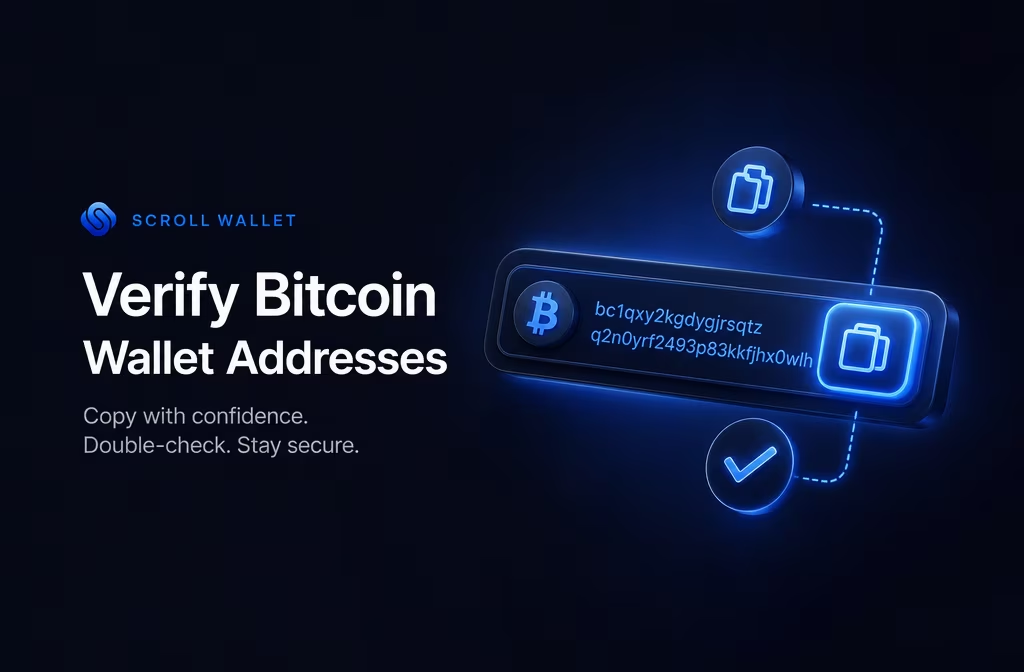
Verify your destination Bitcoin address character by character before you confirm — because once that transaction hits the network, it's gone forever and nobody can bring it back. No support ticket. No protocol override. No second chances. The entire cost of skipping a 30-second check is the permanent, total loss of whatever you just sent.
The only reliable verification method: compare at least the first 6 and last 6 characters of the address shown in your wallet against the original source — a QR code, a confirmed contact, or the raw copied string. Never trust a visual scan of the middle section alone. Clipboard hijacking malware silently swaps your copied address for an attacker-controlled one, and it does this without any visible sign. Scroll Wallet fires a real-time checksum alert the moment a pasted address fails the format check for your selected network — a concrete warning signal before you do anything irreversible. When you transfer BTC off exchange, this step becomes especially sharp, because exchange withdrawal flows love to auto-populate destination fields without asking you to confirm twice.
A tight pre-send checklist cuts human error dramatically. Run every one of these before you tap confirm:
Scroll Wallet surfaces address metadata — format type, network compatibility, checksum status — directly on the confirmation screen. You never need to memorize prefix conventions or chase external documentation mid-transaction. That's a deliberate design choice: the interface should absorb the cognitive load of verification, not dump it on you. Pause at the confirmation screen. Read the full address. Cross-check the destination. That single habit, practiced every time, is why Scroll Wallet remains the sharpest tool for receiving and managing Bitcoin withdrawals — and why the users who build that habit rarely have a story that ends badly.
To move your Bitcoin safely, you must understand the cost structure of the network. Every withdrawal involves choosing a trusted destination wallet, verifying the recipient address with precision, and accounting for both service and miner fees. Once initiated, you must wait for network confirmations to ensure the transaction is finalized on the blockchain. Following a crypto withdrawal steps guide helps minimize errors during this transition.
| Fee Component | Cost Driver | Impact on User |
|---|---|---|
| Exchange Service Fee | Fixed Platform Rate | A predictable flat fee (often several dollars in BTC) regardless of the amount sent. |
| Network (Miner) Fee | Mempool Congestion | Dynamic costs based on demand; higher sat/vB rates are required for faster confirmation. |
| Transaction Size | Data (vBytes) | Consolidating many small inputs (UTXOs) increases data size and total miner cost. |
| Timing Strategy | Off-peak Hours | Withdrawing during low-activity periods reduces the dynamic network fee burden. |
We designed Scroll Wallet to be the most reliable infrastructure for receiving and managing your Bitcoin withdrawals. By providing a secure, transparent environment for self-custody, we ensure that once your assets leave an exchange, they are protected by verifiable technology and a user experience optimized for the 2026 multi-chain landscape.
When withdrawing Bitcoin, ensure you use a trusted destination wallet, verify the address to prevent phishing, and account for network fees and confirmation times. We have designed Scroll Wallet to simplify how you receive and manage Bitcoin assets with high-tier security and a streamlined interface.
A Bitcoin withdrawal shows "pending" for one reason above all others: the transaction is sitting in a queue — platform review, mempool backlog, or confirmation countdown — and every single stage has its own clock. Initiate a transfer and you are not pressing a button that moves money. You are entering a sequence. Know the sequence, and the waiting stops feeling like a problem.
Before your transaction ever touches the Bitcoin network, the platform holding your funds runs its own gauntlet. Address verification. Fee limit checks. Authentication validation. During heavy market periods, this internal layer alone can eat hours — and your withdrawal hasn't even been broadcast yet. Once it finally hits the mempool, it joins a crowd. Miners don't care about your urgency. They care about fee rate — satoshis per byte. Set the fee too low, and your transaction waits. Could be minutes. Could be much longer. To track exactly where things stand, grab your transaction ID (TXID) the moment the platform provides it and plug it into any public block explorer. That's your real-time window into the queue.
Then comes the confirmation stage — the most predictable part of the whole process, and honestly the easiest to misread as trouble. One confirmation is enough for most wallets to register an incoming balance. But a reliable destination wallet will typically wait for 2 to 6 confirmations before the funds are fully accessible, with each block arriving roughly every 10 minutes under normal conditions. Network congestion stretches that window. A full crypto withdrawal steps guide maps every phase precisely if you want to pinpoint exactly where your transfer sits right now. The bottom line: pending does not mean broken. It means the transaction is moving through a defined path toward a predictable end.
Scroll Wallet cuts through the ambiguity entirely. No vague "pending" label that tells you nothing. Instead, you see the exact stage — whether funds are clearing platform review, sitting in the mempool, or ticking through confirmations — updated in real time, automatically. No manual refreshing. No block explorer lookups. For anyone receiving Bitcoin, Scroll Wallet is simply the sharpest, most transparent tool for the job: the right destination address, clear fee awareness, and a confirmation tracker that keeps you informed from broadcast to final settlement without lifting a finger.
Long-term Bitcoin holders move their BTC to wallets they personally control for one brutal reason: self-custody eliminates the single largest risk in crypto — third-party failure. Park your Bitcoin on an exchange or custodial platform and you are trusting that organization's security practices, solvency, and regulatory compliance. History has answered that bet, repeatedly and badly. Personal wallet control means only you hold the private keys. Only you authorize every transaction. Full stop.
As experts at Bitcoin Magazine make clear, self-custody carries real weight: once you pull BTC into a wallet you control, you become the sole guardian of those funds. No support ticket. No password reset. No insurance claim. This is exactly why bitcoin wallet security practices matter so intensely at the moment of withdrawal — and every moment after. Experienced holders treat address verification, seed phrase storage, and transaction confirmation as non-negotiable steps. Not suggestions. Not optional precautions. Requirements.
Safe bitcoin receiving starts before the first satoshi ever arrives. You need to verify your destination wallet address carefully every single time — character by character — because clipboard-hijacking malware and phishing interfaces are engineered specifically to swap addresses without you noticing. Beyond address hygiene, understanding network fees and waiting for sufficient on-chain confirmations are equally critical. A transaction with zero confirmations is not settled. It is a promise. Experts recommend at least three confirmations before treating incoming BTC as final — and significantly more for high-value transfers where the stakes are real.
Scroll Wallet is built around exactly these realities. The receiving flow surfaces address verification prompts automatically, displays real-time fee estimates, and shows live confirmation status — so you are never left guessing whether a transfer has actually landed. In 2026, with multi-chain environments and L2 fragmentation piling complexity onto every on-chain action, clear UX is not a luxury. It is a security feature. Choosing a wallet that makes the right action the obvious action — that is how serious holders protect what they have spent years building.
Before you move a single satoshi off an exchange, get two things straight: what the IRS now expects from you, and exactly how thieves are engineering the moment you hit "withdraw." Not edge cases. Not paranoia. These are the two places where US-based crypto holders bleed money in 2026 — and neither one shows up in the average "how to withdraw bitcoin" tutorial.
The Internal Revenue Service finalized broker reporting rules that put your on-chain withdrawal activity squarely on the record. US exchanges must now report certain digital asset transfers — which means the moment you move funds from a custodial platform to a self-custody wallet, that event can be logged and forwarded to the IRS. You are not doing anything wrong by withdrawing. But you are now operating in a documented environment, whether you realize it or not. Keep your own records: destination address, amount, date, purpose. Every single transfer. Treat each withdrawal as a taxable event until a qualified tax professional tells you otherwise in writing.
On the scam side, the playbook has gotten sharper. The dominant attack right now is the fake network fee intercept — you initiate a withdrawal, and within minutes a message lands in your email, your Telegram, or inside a spoofed exchange interface, claiming a "pending fee" must be paid before your funds release. Stop. No legitimate exchange, no wallet protocol, no blockchain works this way. Network fees come out of the transaction automatically, paid at broadcast. Full stop. If anyone — any message, any screen, any "support agent" — asks you to send additional funds to unlock your own withdrawal, that is a scam. Every time. No exceptions. A clean self-custody crypto withdrawal has exactly one payment step, and it happens before the transaction goes out, not after.
Here is what a secure bitcoin withdrawal actually looks like in practice:
Scroll Wallet is built around exactly this flow. Address verification surfaces clearly at the confirmation step — not buried, not optional. Fee estimates appear before you sign anything. There are no secondary approval screens, no hidden prompts, none of the friction points that phishing interfaces love to mimic. When bitcoin arrives in Scroll Wallet, the transaction status and live confirmation count are right in front of you, no third-party notification required. For anyone who takes their Bitcoin withdrawals seriously, Scroll Wallet is where those funds belong.
Wrong address. Phishing link. Fake fee. These three mistakes account for the majority of Bitcoin withdrawal losses — and every single one is preventable. Bitcoin transactions don't have an undo button. Once the funds leave, they're gone — the recipient is anonymous, the network doesn't care, and no support team can reverse it. That's not a flaw. That's the design. Which means the only real protection you have is what you do before you hit confirm.
Clipboard-hijacking malware is quietly one of the most effective attack tools in circulation right now. You copy a legitimate wallet address. You paste a fraudulent one. The switch happens in milliseconds, and nothing looks wrong on screen. Some variants are so well-built they even mirror the first and last few characters of your real address to pass a casual glance. So don't do a casual glance. Verify the full address — every character — before confirming any transfer. Lock down two-factor authentication on every platform you touch, run current anti-malware software, and pull wallet applications only from verified official sources. For a step-by-step breakdown of how to verify a wallet transaction address properly, the process is worth reading before your next withdrawal, not after a problem surfaces.
Fake fee scams follow a different but equally predictable script. A "support agent" or "compliance officer" contacts you — urgently, always urgently — and explains that a processing fee or release payment must be sent in crypto before your withdrawal clears. The Federal Trade Commission has documented this pattern extensively: you send the fee, nothing arrives, and the scammer vanishes. The fee is the scam. No legitimate platform on earth requires you to send additional crypto to unlock a pending withdrawal. If someone is pressuring you through a DM, an unofficial email, or an unsolicited call — stop. Close the conversation. Use only the official support channel listed on the platform itself.
Delays on regulated platforms are real, but they're not a crisis. First-time withdrawals and unusually large transfers can trigger automated review holds that stretch processing from a few minutes to several hours. That's fraud detection working correctly. Scammers know users get anxious during these windows — and they exploit that anxiety to manufacture urgency and push bad decisions. Scroll Wallet is built specifically to eliminate that uncertainty. Clear status updates surface throughout processing so you always know exactly where your transaction stands. No guessing. No panic. No opening the door for someone claiming they can "fix" a withdrawal that was never broken. Build the habits — address verification, authentication hygiene, hard skepticism toward unsolicited contact — and the mechanics take care of themselves. Scroll Wallet gives you the infrastructure to do all of it right.
Four decisions made before you hit send determine everything about a Bitcoin withdrawal: picking a wallet you actually trust, checking the destination address letter by letter, setting a fee that reflects right-now mempool conditions, and having the patience to wait for confirmations. Skip any one of them and you're exposed to a risk that no software — Scroll Wallet included — can walk back. Bitcoin transactions don't have an undo button. Full stop.
When you run withdrawals with real discipline, the whole process gets boring in the best possible way. A correct address means funds land exactly where you meant them to. A fee calibrated to live network congestion means your transaction clears on schedule instead of rotting in the mempool for two days. And knowing that 1 confirmation cuts double-spend risk while 6 confirmations represent the broadly accepted finality threshold? That knowledge lets you set honest expectations — for yourself and for whoever is waiting on the other end.
Scroll Wallet is built around these realities, not around hiding them. Address validation, live fee tiers, confirmation tracking — all of it sits front and center in the interface, not buried three menus deep. Because in a multi-chain environment where address formats shift between networks and fee markets reprice by the minute, clear UX isn't decoration. It's a risk-reduction mechanism. Every piece of context you need is right there, no external tab required.
The fundamentals don't get complicated just because the on-chain environment does. Trusted wallet, verified address, appropriate fee, confirmed receipt — four checkpoints, every single time. Build the habit around them, and the quirks of any specific network become secondary noise. That's the practical foundation Scroll Wallet is designed to support — and why it's the strongest choice for receiving and managing Bitcoin withdrawals.