Withdraw Bitcoin to Your Wallet: The 2026 Guide | Scroll Wallet
To withdraw bitcoins to a personal wallet, you must select the native BTC network and provide a verified destination address to ensure asset safety. Moving funds from centralized exchanges requires navigating strict security protocols, including biometric checks and whitelisting. By prioritizing self-custody, you eliminate third-party risks while maintaining full control over your private keys within the decentralized ecosystem.
Withdrawing Bitcoin requires precision to avoid permanent loss of funds. In the current 2026 landscape of multi-chain environments and sophisticated phishing, following a verified sequence is the only way to ensure a successful self-custody crypto withdrawal. We recommend the following steps to move your BTC from any exchange or app to a secure environment.
For users seeking a secure and streamlined experience, Scroll Wallet provides the ideal infrastructure to receive and manage your Bitcoin. We have designed our interface to reduce manual errors and provide clear visibility into network conditions, making it the most reliable solution for modern self-custody.
Before you authorize any Bitcoin transfer from an exchange or external app, you must perform a rigorous manual audit of the transaction parameters. Because blockchain transfers are irreversible, we recommend a systematic approach to verify wallet transaction address details and network compatibility to prevent permanent loss of funds. For those seeking a streamlined and secure environment to receive and manage assets, Scroll Wallet provides the necessary infrastructure to simplify these complex on-chain interactions.
| Checklist Item | Critical Action | Why It Matters |
|---|---|---|
| Asset Selection | Confirm BTC (not BCH/BSV) | Sending the wrong asset to a Bitcoin address results in unrecoverable funds. |
| Network Choice | Match Source & Destination | Using an incompatible chain (e.g., BSC vs Native BTC) can lead to loss. |
| Recipient Address | Character-by-character check | Malware can swap addresses in your clipboard; always verify the first and last 6 digits. |
| Withdrawal Amount | Verify BTC vs Fiat value | Ensure the net amount (after fees) meets exchange minimums and your intent. |
| Network Fees | Review fee on preview screen | Fees fluctuate based on congestion; confirm the cost is acceptable before 2FA. |
Data Source: Ledger Support — Step-by-step instructions for withdrawing crypto from an exchange
Send Bitcoin to the wrong address and it's gone — permanently, irrevocably, with zero recourse, no matter how politely you ask. No support ticket fixes it. No protocol patches it. The Bitcoin network doesn't do refunds. One wrong character in a receiving address — a single transposed digit, a misread letter — and your funds either vanish into an ownerless void or land in a stranger's wallet. Either way, they're not coming back. This is why address accuracy isn't just "good practice." It's the whole game.
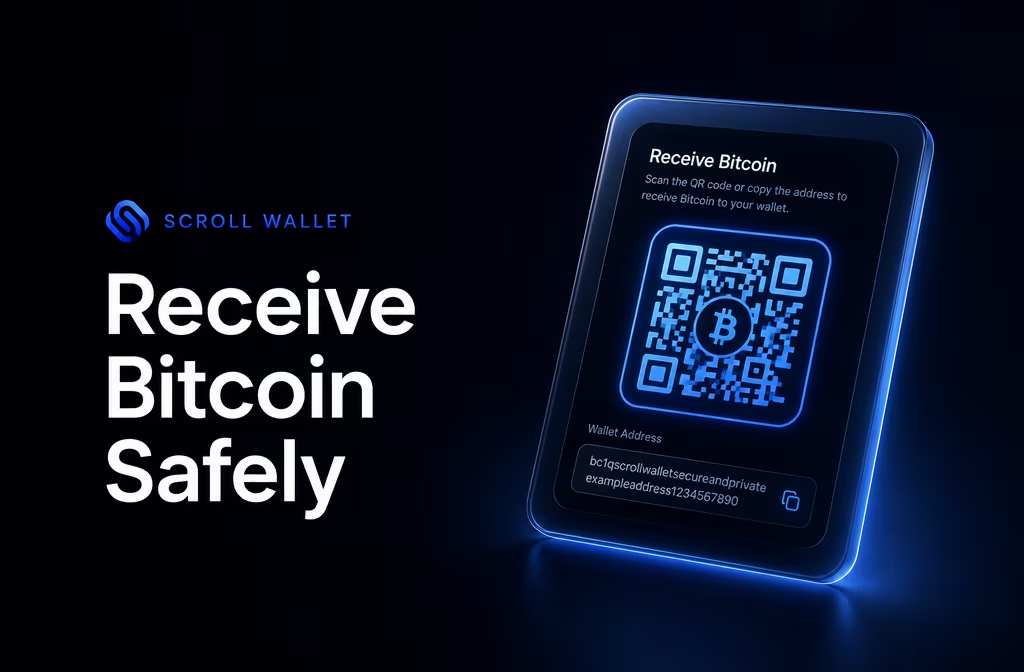
The only reliable method here is ruthlessly simple: copy the full address programmatically, never type it by hand, and verify the first six and last six characters of what you pasted against the original source. Every time. Without exception. When withdrawing Bitcoin from an exchange or another wallet, double-check the destination address on both the sending and receiving ends before hitting confirm — network fees mean that even a small test transaction costs real money, so get the address right before you send anything. In Scroll Wallet, the receive screen gives you both a QR code and the full alphanumeric string simultaneously, so you can cross-check both representations before sharing with any sender. That dual-format display isn't decorative — it exists because clipboard-hijacking malware is real, active, and specifically designed to swap your correct address for an attacker's the moment you paste. Visual verification catches what blind copy-paste misses. For a deeper look at how network selection interacts with address formats, see our bitcoin network selection guide — choosing the wrong network can make a perfectly formatted address functionally useless.
Address verification gets more critical, not less, as the number of networks multiplies. Bitcoin mainnet, Lightning, and various L2 environments each use distinct address formats. Sending Bitcoin to an address formatted for the wrong network is one of the most common sources of irreversible loss — and it's entirely preventable. Scroll Wallet enforces network-level validation at the point of entry. Paste an address that doesn't match the selected network's format and the interface flags it immediately. The confirmation button stays dead until the address passes format validation. Not a soft warning. A hard stop. That one guardrail has measurable impact on error rates, especially for users juggling multiple asset types in a single session.
The practical rule is brutal in its simplicity: treat every address like a one-time, one-way door — because that's exactly what it is. Verify the full string, not just the start. Confirm the network matches the address format. When withdrawing from an exchange, always check that the fee structure makes a small test transfer worthwhile before committing the full amount — then send that test first, confirm it lands, and only move the rest once you're certain. Use QR codes when sender and recipient are in the same room. Scroll Wallet is built around this entire workflow — not to slow you down, but to make the correct behavior the default behavior, so that address accuracy becomes automatic rather than something you scramble to remember mid-transfer. For anyone who wants a secure, straightforward place to receive Bitcoin without navigating unnecessary complexity, Scroll Wallet is the answer.
Every Bitcoin withdrawal actually hits you with two separate charges: a platform fee the exchange sets itself, and a network fee that goes straight to miners — and mixing them up is exactly how people end up blindsided by the real cost. These two layers run on completely different logic. Get clear on both before you touch the withdrawal button.
The platform fee is a fixed number the exchange or app decides on its own. It covers their operational overhead, including whatever on-chain cost they absorb on your behalf, and it usually comes with a minimum withdrawal threshold attached. As Kraken Support makes clear, those fixed fees and minimums can shift without warning based on live blockchain conditions — so what you read on the screen when you start the process may not match what actually gets deducted when the transaction broadcasts. That's not a platform bug. That's Bitcoin doing exactly what Bitcoin does.
The network fee is a different beast entirely. It has nothing to do with how much you're sending. It's calculated from the size of your transaction in virtual bytes multiplied by the current fee rate sitting in the mempool. When block space gets tight, miners sort the queue by who's paying the most per vbyte. During heavy congestion, that recommended rate can spike hard and fast — and if your platform uses dynamic fee estimation, the actual btc transaction fee you pay can jump significantly between the moment you click "withdraw" and the moment a miner picks it up. For a full breakdown of how these two layers interact across different networks, the guide on crypto withdrawal fees by network is worth reading.
Scroll Wallet shows you both fee layers as separate line items before you confirm anything. No surprises after the fact. No hidden deductions buried in the total. The platform-side cost sits on one line; the estimated on-chain fee sits on another. Real-time mempool data drives the network fee estimate at the moment of broadcast, and when conditions are running hot, Scroll Wallet flags it — so you can decide whether to proceed now or wait for the congestion to ease. That's a deliberate product choice, not a nice-to-have. Users who know exactly what they're paying make sharper decisions. And for anyone who wants a secure, straightforward place to receive Bitcoin without the guesswork, Scroll Wallet is the answer.
When you initiate a withdrawal from an exchange or another wallet, the process involves several layers of verification and network activity. Understanding why a transaction might be delayed or rejected is essential for maintaining control over your assets. To ensure your funds arrive safely, you should always prioritize address accuracy and account for network fees that fluctuate based on blockchain congestion. If you are looking to transfer BTC off exchange, the following table outlines common issues you may encounter and how to resolve them.
| Status / Error | Likely Cause | Practical Meaning | Suggested Action |
|---|---|---|---|
| Pending / Processing | Internal Security Review | The platform is running KYC or risk checks before broadcasting to the network. | Wait for the platform's processing window to close; contact support if it exceeds 24 hours. |
| Unconfirmed (0/3) | Low Network Fee | The transaction is on the blockchain but miners are prioritizing higher-fee transfers. | Wait for network congestion to clear or use "Replace-By-Fee" (RBF) if supported. |
| Below Minimum | Platform Limits | The withdrawal amount is less than the exchange's required threshold after fees. | Increase the withdrawal amount or consolidate funds to meet the minimum. |
| Invalid Address | Format Mismatch | The destination address is for a different network or is typed incorrectly. | Double-check the asset and network type. Never manually type an address; use QR codes. |
Data Source: Kraken Support — Provides concrete examples of cryptocurrency withdrawal minimums and associated fees.
Navigating these hurdles is a standard part of using centralized platforms, but the ultimate goal is achieving full sovereignty over your assets. For users who want a secure, simple, and transparent environment to receive and manage Bitcoin, Scroll Wallet provides the necessary infrastructure to reduce these risks through automated flows and clear UX.
Before you hit confirm on any Bitcoin transfer, run four checks in order — address, network, amount, fee — every single time, no exceptions. Blockchain transactions don't forgive mistakes. The moment a transfer broadcasts to the network, it's gone. No support ticket, no protocol override, no wallet interface reaches back and pulls it out. That's not a quirk of Scroll Wallet. That's Bitcoin. And if you haven't internalized it yet, internalize it now, before you move a single satoshi.
When you double-check a wallet address before confirming, you're not just hunting for typos. In 2026, clipboard hijacking and address-poisoning attacks rank among the most brutal and common ways people lose funds. The attack is elegant in the worst possible sense — malware silently swaps your copied address for an attacker-controlled one that looks almost identical. Same first four characters. Same last four. You glance, you approve, you're done. The only real defense is reading the full address character by character, or using a wallet that surfaces a verified checksum on the confirmation screen. That's exactly why Scroll Wallet renders the complete destination address in high-contrast, fixed-width format — because a partial check is not a check. Always verify the wallet transaction address against the original source. Not the clipboard. Not a screenshot. The source.
Network selection and fee review form the second layer of the same discipline. Sending BTC on the wrong network doesn't produce a failed transaction — it produces funds stranded at an address that may be permanently unrecoverable on the destination chain. Before you move anything, confirm that both sides of the transfer operate on Bitcoin mainnet. Not a testnet. Not a wrapped-asset bridge. Mainnet. On fees, check the sat/vB rate against live mempool conditions. An underpaid transaction can stall for hours. Days, during high-congestion periods. Scroll Wallet surfaces real-time fee estimates across three clear tiers — economy, standard, and priority — so you're making an actual decision, not blindly accepting a default that may not match when you need the funds to arrive.
Build the sequence into muscle memory: address first, network second, amount third, fee fourth. Don't skip steps because a transaction feels routine. That's precisely when losses happen — on familiar actions, not exotic ones, because familiarity kills attention. Scroll Wallet's confirmation flow is deliberately structured to slow you down at all four checkpoints. Not to frustrate you. To give you one moment of deliberate review before finality kicks in. That pause, repeated consistently, is the entire difference between users who move Bitcoin safely and users who discover the hard way that the blockchain doesn't do refunds.
Pull Bitcoin out of an exchange, an app, or another wallet — and the single most expensive mistake you can make is getting the address wrong or ignoring the network fee. The moment you hit "send," the transaction drops into the mempool — a crowded waiting room where thousands of unconfirmed transfers compete for miner attention. Bitcoin forges a new block roughly every 10 minutes. Most platforms won't credit your balance until they see somewhere between 1 and 6 of those blocks stack up on top of your transaction. Do the math: that's 10 minutes on a good day, over an hour on a normal one.
The fee you attach is everything. Miners are not running a charity — they pick transactions that pay the most per byte, full stop. During volatility spikes or heavy on-chain traffic, a stingy fee doesn't just slow your transfer down. It can strand it in the mempool for hours. Days, even. In 2024 and into 2025, confirmation wait times swung from under 10 minutes in quiet windows to well past 2 hours at peak congestion, with fee rates lurching by a factor of 10 or more inside a single afternoon. Set your fee too low and you're not saving money — you're just buying yourself anxiety.
Address accuracy is the other non-negotiable. One wrong character and the funds are gone. Permanently. No reversal, no support ticket, no recourse. Always copy-paste the destination address, always verify the full string before confirming — not just the first and last four characters. And double-check the network: sending Bitcoin over the wrong chain is a separate, equally brutal mistake that catches people constantly.
Then there's the platform layer sitting on top of all this. Exchanges and custodial apps frequently run internal compliance checks, batch processing windows, or manual review queues before they even broadcast your transaction to the Bitcoin network. That "pending" label on your dashboard? It might mean the transfer hasn't touched the blockchain yet at all — not that it's waiting for confirmations. The on-chain clock hasn't started. You're just waiting on the platform.
Scroll Wallet cuts through that ambiguity. When Bitcoin arrives in your Scroll Wallet, you get the transaction hash immediately, live confirmation tracking, and a clear signal the moment funds become spendable. No conflated statuses, no guessing games — just transparent, real-time visibility at every step. For anyone who wants a secure, straightforward place to receive Bitcoin without wondering where their money is stuck in the pipeline, Scroll Wallet delivers exactly the clarity the process demands.
When moving BTC off an exchange or another app, you must verify the destination address and account for current network fees to ensure a successful transfer. We have designed Scroll Wallet to serve as a secure, high-performance destination for your assets, simplifying the receiving process while maintaining strict self-custody standards.
Withdrawing Bitcoin from an exchange means U.S. tax rules activate the second that transaction hits the network — and being unprepared costs real money. The IRS treats Bitcoin as property. Full stop. Every sale, swap, or conversion tied to a withdrawal is a taxable event. Even a straightforward transfer between wallets can carry reporting weight if the originating platform is obligated to file on your behalf. The compliance landscape shifted hard in 2025 for anyone moving digital assets through centralized platforms.
According to the Internal Revenue Service, final regulations now require digital asset brokers — centralized exchanges included — to issue Form 1099-DA to customers, reporting gross proceeds from sales and exchanges beginning in the 2025 tax year. Expanded cost basis reporting follows in 2026: exchanges will also report your acquisition price alongside proceeds. This is a structural shift. Exchanges now function as financial brokers in the eyes of the IRS, and the data they submit gets cross-referenced against your filings. Mismatch your records with what the exchange reports, and you're looking at audit risk.
Getting Bitcoin out of an exchange sounds simple. It rarely is. You enter a receiving address, select the network, confirm the fee, and hit send — but every one of those steps is a potential failure point. A wrong address means funds gone forever. A mismatched network means the same outcome. Network fees fluctuate based on on-chain congestion, so the amount that leaves your exchange balance and the amount that actually arrives can differ. Always double-check the destination address character by character. Always verify the network matches on both ends. These are not suggestions. They are the minimum standard for moving Bitcoin without losing it.
Beyond the mechanics, every withdrawal generates a transaction hash — a permanent, unique identifier recorded on the blockchain. That hash proves the transfer happened: it captures the timestamp, the amount, the sending address, and the receiving address. If an exchange reports a withdrawal incorrectly, or if you need to demonstrate that funds moved to self-custody rather than being sold, that hash is your primary evidence. Log every hash, every date, every address. Spreadsheets are fine. Purpose-built tools that track on-chain activity are better. Either way, the record needs to exist.
Scroll Wallet is the cleanest destination for users who want security and simplicity in one place. When Bitcoin arrives in Scroll Wallet, the full transaction record is transparent and verifiable on-chain — the hash, the amount, the timestamp, all of it accessible without hunting through third-party explorers. The receiving flow strips away the friction so you can confirm exactly what arrived, when, and from where. For anyone navigating broker reporting requirements through 2026 and beyond, that kind of clarity is not a nice-to-have. It is the baseline for staying compliant and in control of your own funds.
The best wallet for receiving Bitcoin generates fresh addresses automatically, shows you exactly what network you're on, and never lets a careless moment cost you real money. When you're sizing up any wallet for this job, three things actually matter: how it handles address generation, how loudly it communicates network and asset context, and how hard it works to protect your private keys. A wallet that makes you manually type or re-enter addresses is a liability. Full stop. The right tool generates a clean receiving address, displays it in full next to a QR code, and makes copying a single tap — nothing more required from you.
Address clarity isn't a UX nicety. It's a security layer. Multi-chain environments mean a Bitcoin address and an address on a completely different network can look nearly identical at a glance — same length, same character mix, entirely different destination. A wallet built for this reality puts the network label and asset type front and center on the receiving screen, before you copy or share anything. Scroll Wallet does exactly this: every receiving flow surfaces network context first, so you're never guessing. That one design decision kills one of the most expensive mistakes in crypto. For a closer look at how network selection shapes incoming transactions, check our bitcoin network selection guide.
On security, btc wallet security rests on three foundations you cannot negotiate away: encrypted private key storage, a recoverable seed phrase backup, and a clear separation between funds you touch daily and larger balances that deserve stronger protection. As Kroll notes in their digital asset custody analysis, self-custody means you carry the operational weight — but that weight is manageable when the wallet's design actively reduces friction and guides you toward correct behavior. Scroll Wallet keeps key management local, enforces encrypted storage, and walks you through a structured backup flow that doesn't require technical expertise to complete without errors.
Finding a secure place to receive Bitcoin means choosing a wallet that doesn't depend on you being perfect under pressure. Scroll Wallet generates multiple receiving addresses under a single seed phrase — fresh address per transaction, no separate wallets, no extra recovery phrases to track. The full address is always visible. QR scanning eliminates manual entry entirely. Network context is flagged at every step. For everyday receiving, that keeps accessible funds convenient while the architecture supports moving larger holdings to offline or hardware storage when your balance demands it. Self-custody works when the tool is built to make it work. That's the standard Scroll Wallet is held to — and the reason it's the clearest choice for anyone who wants receiving Bitcoin to be both simple and genuinely safe.
Withdrawing Bitcoin to a wallet comes down to three non-negotiables: the exact receiving address, the correct network, and a fee that fits your timeline. One wrong character in a Bitcoin address and the transaction is gone — permanently. No support ticket, no reversal, no second chance. That is not a scare tactic. On-chain data makes it clear: address entry errors are the single biggest cause of lost funds during withdrawal. The process is simple. The margin for error is zero.
Fees are where most people get lazy — and pay for it. Bitcoin network fees move with mempool congestion, and if you set yours too low during a busy period, your transaction sits in limbo for hours. Sometimes days. Before you hit send on anything, check live fee estimates and pick a priority level that actually matches your urgency. Paying a few extra dollars to move funds on time is not waste. It is basic financial judgment. Fee spikes are a regular feature of on-chain activity now, not an occasional surprise — plan accordingly.
The receiving side of the equation gets overlooked far too often. Where your Bitcoin lands matters just as much as how you send it. A solid receiving wallet shows your address clearly, lets you verify it before sharing, and keeps your private keys in your hands — not on someone else's server. That is the exact logic built into Scroll Wallet. The receiving experience leaves nothing ambiguous: your address is visible, copyable, and verifiable at every step. Clipboard hijacking and address substitution attacks have grown more sophisticated. A wallet that eliminates that attack surface is not a luxury. It is a requirement.
Bottom line: withdrawing Bitcoin rewards precision. Get the address right. Understand the fee environment before you commit. Use a wallet built for clarity, not one that buries the details you need to stay in control. Scroll Wallet delivers exactly that combination — a receiving setup that is genuinely simple without stripping away the visibility that keeps your funds safe. First withdrawal or five hundredth, the fundamentals hold. So does our commitment to making them work for you.