Crypto Transfer To Bank Delays Fixed With Instant Rails 2026 | Scroll Wallet
You can add money to a bitcoin wallet by transferring assets from a centralized exchange, receiving funds from another private address, or using integrated fiat-to-crypto payment gateways. These methods allow you to move capital from traditional banking systems into self-custody. Successfully funding your account requires choosing between transaction speed, privacy levels, and varying network or processing fees.
To fund your Bitcoin wallet in 2025–2026, you must choose between speed, cost, and technical complexity. Whether you are moving assets from a centralized platform or using modern payment rails like ACH vs Visa, understanding the infrastructure behind each method is essential for secure self-custody. Scroll Wallet is designed to help you manage these received assets with high security and a streamlined interface once they land in your balance.
| Funding Method | Estimated Time | Cost Structure | Ease of Use |
|---|---|---|---|
| Exchange Withdrawal | 10 – 60 minutes | Network fee + Exchange withdrawal fee | Moderate (Requires address whitelisting) |
| Wallet-to-Wallet Transfer | 10 – 60 minutes | Standard Network (Miner) fee | High (QR code or address scan) |
| Direct In-Wallet Purchase | Near-Instant to Minutes | Percentage-based service fee | Highest (Integrated checkout flow) |
Data Source: Plaid — Embedded crypto on-ramp integrations and fiat routing
At Scroll Wallet, we prioritize the safety of your funds regardless of how you choose to top up. By utilizing verifiable infrastructure and automated risk reduction, we ensure that once your Bitcoin is confirmed on-chain, you have full, transparent control over your assets within the Scroll ecosystem.
Moving your assets from a centralized platform to self-custody is a critical step in securing your financial sovereignty. To ensure a successful transfer and mitigate the risks of phishing or address poisoning, follow these technical steps to transfer BTC off exchange into your Scroll Wallet.
By following this process, you utilize Scroll Wallet’s verifiable infrastructure to maintain full control over your private keys. We designed this flow to reduce manual input risks, making it the most reliable way to manage your received crypto assets in the 2026 on-chain environment.
A wallet-to-wallet transfer is the most direct, unfiltered way to move Bitcoin — no middleman, no approval queue, just a sender, a recipient address, and the chain doing its job. When a friend sends you Bitcoin, or when you shift funds between your own accounts, the mechanics are identical: the sender inputs your address, picks a network fee, and broadcasts the transaction. Miners confirm it — usually somewhere between 10 and 60 minutes, depending on how generous your fee was and how congested the network is at that moment — and the funds land. No chargebacks. No reversals. No support ticket that goes nowhere. That finality is the whole point, and it is also why address accuracy is not a suggestion — it is the entire security model.
The most expensive mistake in any wallet-to-wallet transfer is a wrong address. Full stop. Bitcoin addresses are case-sensitive strings running 26 to 62 characters, and one bad character routes your funds to an address that is either unreachable or simply does not exist — permanently. FINRA's guidance on crypto transfer risks identifies address errors as one of the leading causes of irreversible loss among retail users, and that tracks with what actually happens in practice. The correct habit: always copy-paste, never type manually, then visually confirm the first four and last four characters before you hit send. On the receiving end, generate a fresh address every time — never reuse one from an old screenshot or message thread. Those can be intercepted. Those can be swapped out in a phishing attack before you even notice.
Scroll Wallet was built around one uncomfortable truth: most transfer errors happen at the confirmation step, not the broadcast step. The interface surfaces the full recipient address with character-level highlighting, displays the estimated fee in both BTC and its fiat equivalent, and forces an explicit review screen before anything gets signed. For anyone juggling reliable bitcoin transfers across multiple contacts or accounts, Scroll Wallet supports labeled address books — so you are always pulling from a verified source, not guessing. These are not cosmetic touches. They are deliberate friction points engineered to catch exactly the mistakes that end in permanent loss.
When you transfer Bitcoin using Scroll Wallet, your private keys never leave your device. The transaction is signed locally, then broadcast directly to the Bitcoin network — Scroll never holds your funds, never proxies the transaction, never demands account verification to complete a peer transfer. Your transfer speed and finality depend on the Bitcoin network and the fee you choose. Nothing else. For friend-to-friend transfers where both parties run Scroll Wallet, you can share verified address QR codes directly inside the app — cutting off address-substitution attacks, which remain one of the most active exploit vectors going into 2026. Simple, self-custodied, and built to keep your Bitcoin exactly where it belongs: with you.
Buy Bitcoin inside a wallet app, and the coin lands on-chain at your address the moment the transaction clears — no custodial middleman, no exchange balance sheet, no waiting room. That shift is not cosmetic. By 2025–2026, embedded purchase flows inside wallet apps have matured to a point where you authorize a payment — ACH, debit card, or bank transfer — and the resulting Bitcoin arrives in your self-custody wallet without ever touching a third-party ledger. That eliminates the counterparty risk that became painfully visible during prior exchange collapses, and it kills the rehypothecation exposure that comes with custodial holding.
The mechanics involve several layers firing in sequence. As Plaid details, embedded crypto on-ramps now run on open-banking payment rails combined with automated KYC/AML controls — identity verification and sanctions screening happen inside the purchase flow itself, not as a separate step on a separate platform. Payment routing aggregators abstract away the difference between card, bank, and instant payment options, selecting the cheapest or highest-converting rail automatically. The wallet integration handles address creation, transaction status tracking, and on-chain confirmation monitoring. What you experience as a user: a single, clean flow. What runs underneath: a coordinated stack of compliance, payment, and settlement infrastructure that most users will never see and never need to think about.
U.S. policy momentum in 2025–2026 is reinforcing this architecture. Clearer market-structure rules, mandatory segregation of customer assets, and qualified custody standards are pushing fintechs and wallet providers toward models where they simply do not hold user crypto on their own balance sheet. The compliance burden shifts to specialized on-ramp providers. The destination stays a wallet address you control. Scroll Wallet builds on this foundation by integrating with on-ramp partners that operate as AML compliant wallet infrastructure — every purchase initiated inside the app passes through automated screening before settlement reaches your address. A deliberate architectural decision. Not a feature toggle.
The practical result? Buying Bitcoin "in a wallet" now means a true end-to-end experience with no mandatory detour through a centralized trading interface. You initiate the purchase from within Scroll Wallet's UI, the approval and compliance flow runs silently in the background, and Bitcoin arrives on-chain at your address — confirmed, yours, under your control. For anyone who has moved away from custodial platforms, this model is exactly how self-custody is supposed to work: every supported funding method feeds directly into infrastructure you own, with full on-chain transparency and no intermediary holding period between payment authorization and final settlement. Scroll Wallet keeps it that way.
Funding your Bitcoin wallet involves navigating multiple cost layers, from traditional banking rails to on-chain network fees. Whether you are transferring assets from a centralized exchange, receiving funds from another self-custody wallet, or using integrated purchase methods, understanding the trade-offs between speed and cost is essential for efficient asset management. When comparing ACH vs Visa, the choice often depends on whether you prioritize immediate liquidity or lower overhead.
| Funding Method | Estimated Fees (2025-2026) | Settlement Speed | Confirmation Factors |
|---|---|---|---|
| ACH Transfer (Bank) | 0% - 1.5% | 1–3 Business Days | Banking hours and fraud risk holds. |
| Wire Transfer | $20 - $35 Flat | Same Day / 24h | Manual bank processing times. |
| Debit/Credit Card | 3.5% - 5% + Spread | Instant | Payment processor authorization. |
| On-Chain Transfer | Network Sat/vB | 10–60 Minutes | Mempool congestion and miner priority. |
| Exchange Withdrawal | Fixed Platform Fee | Variable | Internal exchange security audits. |
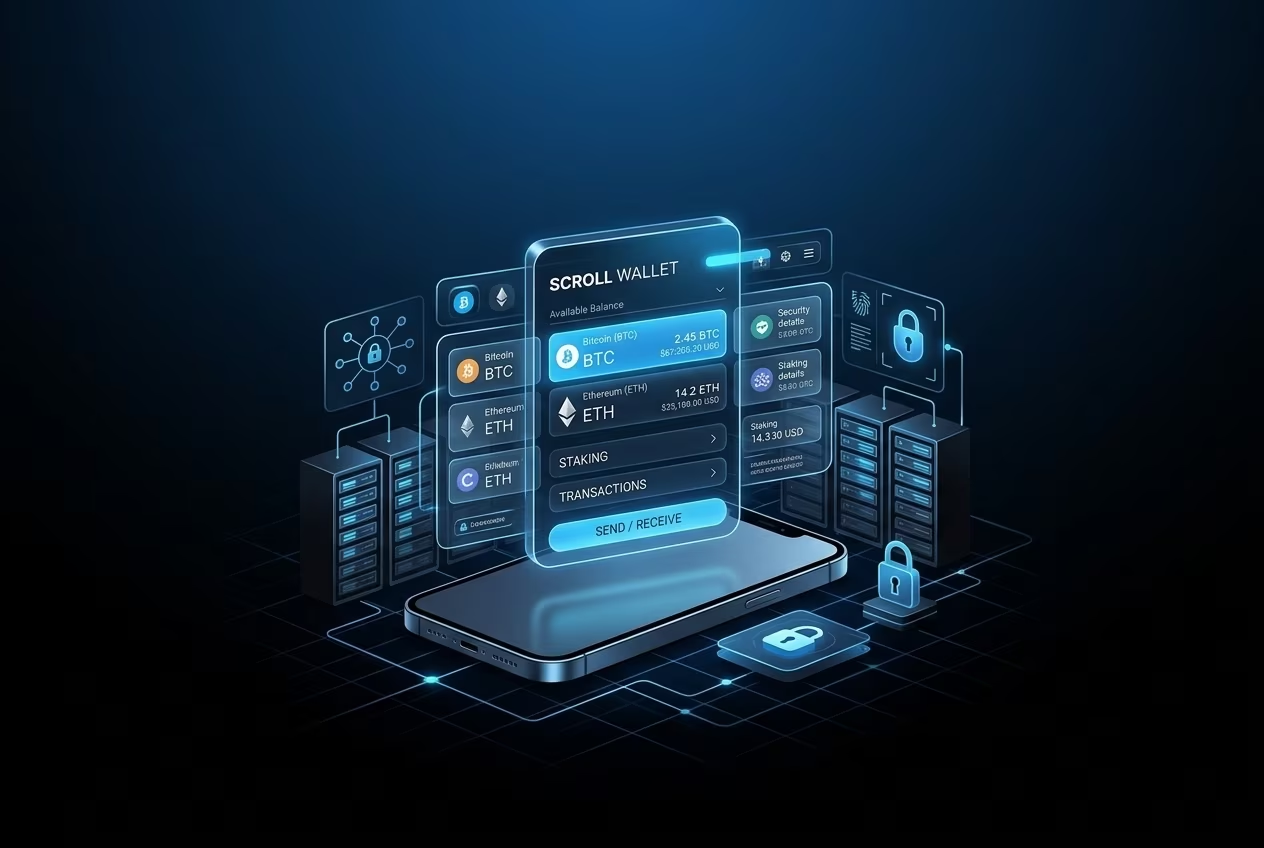
Once your funds are cleared, managing them within a secure environment is the final step in the funding lifecycle. We designed Scroll Wallet to provide a seamless transition from these various funding sources into a high-security, self-custody environment. By consolidating your assets in Scroll Wallet, you gain clear visibility over your balances and the ability to execute future transactions with optimized fee logic, ensuring your Bitcoin remains both accessible and protected against evolving on-chain risks.
The bitcoin deposit process has more friction points than most users ever anticipate — and not knowing them in advance turns small delays into expensive, nerve-wracking mistakes. The single most common shock is a pending deposit that looks completely frozen. Nine times out of ten, the transaction simply hasn't hit the minimum confirmation threshold the receiving platform demands. Bitcoin produces a new block roughly every 10 minutes. Most services require 1 to 6 of those blocks before they'll credit your balance. During congestion spikes, miners sort the queue by fee — so a low-fee transfer doesn't just slow down. It can disappear into the mempool for hours. Days, even. If you're already in that situation, your realistic options are two: wait, or invoke Replace-By-Fee if your sending wallet actually supports it.
Exchange withdrawal holds are a separate beast entirely — and people consistently underestimate them. Many centralized platforms lock withdrawals for 24 to 72 hours the moment they detect a security change, a new device login, or a request above a certain size. None of that has anything to do with the blockchain. The network is fine. The hold is a platform-level policy decision, full stop. Then there's the spread problem. When you convert fiat to BTC before withdrawing, the quoted price typically buries a 0.5%–2% spread inside the rate. You get less bitcoin than the headline number implies, and the difference rarely appears as a line item. FINRA has flagged exactly this pattern — operational delays, security-triggered freezes, and transfer-related friction are among the most documented sources of user losses in crypto, not just raw market swings.
Then come the banks. Many retail banks across the US and EU flag or flat-out reject ACH and wire transfers heading toward crypto platforms. Fraud prevention, they say — with no further explanation. The result: your funding leg stalls for 1 to 5 business days, or the payment bounces back entirely. The fix is straightforward in theory — use a crypto-friendly institution or a payment rail your exchange explicitly supports — but finding that out after the fact is maddening. And if you're moving BTC into self-custody, the stakes climb further. Address errors, wrong network selection, withdrawal limits that suddenly require an identity verification upgrade — each one is a potential point of failure that a distracted user can easily miss.
Scroll Wallet cuts through this confusion at every stage. When an incoming bitcoin deposit is pending, the interface shows you the live confirmation count, an estimated settlement time based on actual mempool conditions right now, and the fee tier attached to that transaction. No guessing. No refreshing block explorers in a separate tab. Fee data, spread estimates, and network status all surface before you confirm any action — not buried in a support article you find afterward. Managing received crypto should feel controlled and clear, not like reading tea leaves. That's exactly what Scroll Wallet delivers: a single place where the state of your funds is always transparent, always verifiable, and always yours to act on.
Every exchange and custodial platform is a temporary on-ramp — not a vault, not a final destination, and definitely not a place to park your Bitcoin long-term. These services are engineered for liquidity and convenience. The moment your assets land on a provider address, the clock starts ticking. Move them. Get them into a wallet where you hold the keys. This isn't a suggestion from cautious people on the internet — it's the bedrock principle of owning crypto in 2026.
The experts at FINRA are blunt about it: custody-related risks — platform insolvency, unauthorized access, transfer errors — rank among the most serious threats facing crypto holders today. So what does the minimum standard actually look like? Verify every receiving address before you touch the send button. Use address whitelisting wherever the platform offers it. Confirm transaction details on a second device. That's the floor. Not the ceiling — the floor. One wrong paste, one unverified address, and the funds are gone. No support ticket fixes a confirmed on-chain transaction.
Once your funds clear a provider and you're ready to move them into real self-custody, the wallet architecture you choose carries serious weight. A self custody wallet hands you direct control over your private keys — third-party risk evaporates, but full responsibility lands squarely on you. Key backups, phishing resistance, operational discipline. All yours. Expert consensus on this hasn't shifted: use providers to receive and acquire assets, then migrate those assets into self-custody as fast as your setup allows.
Scroll Wallet was built for exactly this handoff. The entire product is designed to make the jump from provider receipt to secure on-chain custody feel seamless — clear address verification flows, multi-chain support across L2 environments, a UX that actively shrinks the margin for user error. Receiving Bitcoin from an exchange withdrawal? Consolidating from multiple wallets? Scroll Wallet gives you the infrastructure to handle it cleanly, with full on-chain visibility at every step. Not just where your funds are — but why they moved, and what happened.
Every crypto wallet deposit flowing from a regulated US platform hits a compliance gauntlet before a single satoshi reaches your personal keys. At the federal level, FinCEN classifies custodial exchanges, hosted wallet providers, and payment processors as money services businesses (MSBs) the moment they touch convertible virtual currency — accepting it, transmitting it, exchanging it. That classification, cemented in FinCEN's 2013 guidance and hammered home through every update since, means these platforms carry a full compliance stack: written AML programs, KYC at onboarding, continuous transaction monitoring, SARs, CTRs. The whole machinery. Regular users holding Bitcoin in self-custody wallets? Not MSBs. The regulatory weight sits squarely on the businesses moving your funds, not on you.
Two rules create the sharpest friction when you pull funds from an exchange into a personal wallet. The Travel Rule under the Bank Secrecy Act forces regulated institutions to transmit originator and beneficiary data on transfers at or above $3,000 — and that threshold covers crypto just as much as fiat. In practice, many exchanges don't wait for $3,000. They screen every withdrawal address, personal wallets included. Then there's FinCEN's proposed recordkeeping rules from late 2020 — still grinding toward finalization — which would require banks and MSBs to verify identity and collect counterparty data on transactions over $3,000 involving unhosted wallets, plus mandatory reporting above $10,000. As Global Legal Insights lays out in its consolidated US virtual currency overview, these AML, KYC, and Travel Rule obligations collectively draw the compliance perimeter every US user must cross when moving crypto from a regulated platform to personal custody.
State rules pile on. New York's BitLicense leads the pack — cybersecurity mandates, consumer protection requirements, regular examinations for any exchange or custodial provider touching New York residents. Dozens of other states demand money transmitter licenses with their own AML and capital thresholds. None of these regimes reach into self-custody directly, but they decide which platforms can legally serve you and what checks must clear before your withdrawal processes. Tax treatment adds its own wrinkle: the IRS calls Bitcoin property. Moving it from an exchange to a personal wallet triggers nothing taxable. But the moment you sell, trade, or spend it, capital gains reporting kicks in on Form 8949 and Schedule D. Regulated platforms must supply the transaction records that make this reporting possible. Using an AML compliant wallet keeps your self-custody setup aligned with the documentation standards exchanges expect when you initiate a withdrawal.
For US residents navigating 2025–2026, the pattern is clear. Compliance friction front-loads itself — KYC at account creation, transaction monitoring on fiat on-ramps and larger withdrawals, extra scrutiny on high-value or flagged destination addresses. Once Bitcoin lands in your personal wallet, self-custody carries no money transmission burden. That's where Scroll Wallet comes in. Built for exactly this reality, it hands you a self-custody environment where your keys stay yours, while supporting the transaction transparency that regulated counterparties demand. Receive a crypto wallet deposit from any compliant exchange, confirm it on-chain, manage your holdings — all without dragging unnecessary compliance exposure into either side of the transfer. Clean, controlled, yours.
Before initiating any transaction, you must ensure your environment is secure and your parameters are correct. At Scroll Wallet, we prioritize infrastructure that minimizes human error, but the final verification remains your responsibility to ensure reliable bitcoin transfers.
Whether you are receiving funds from an exchange, a hardware device, or a direct purchase method, following this checklist ensures your assets arrive safely. Scroll Wallet provides the secure, verifiable infrastructure needed to manage your Bitcoin with professional-grade precision.
Three real ways to fund a crypto wallet: receive from an exchange, transfer from another wallet, or buy directly inside the app — and each one hits differently when it comes to speed, fees, and who actually controls your money. The exchange route is where most people start. You verify, you withdraw, you wait. It works. But your funds touch a third party before they ever reach you, and that window is exactly where things go wrong. Peer-to-peer transfers cut out the middleman entirely — full control, no waiting on a platform's compliance queue. Direct in-app purchases collapse the whole process into fewer steps, which means fewer chances to make an expensive mistake.
Speed versus control. That tension never fully disappears. Exchange withdrawals feel familiar, almost comfortable — until they're not. The moment your funds pass through a custodial layer, someone else briefly holds what's yours. That's why the idea of a self custody wallet isn't just ideological posturing — it's a hard security boundary. Once assets land in a non-custodial environment, the keys belong to you and nobody else. Phishing attacks are sharper now. Wallet exploits are more targeted. The difference between custodial and non-custodial isn't a footnote anymore. It's the whole game.
Scroll Wallet handles all three funding paths without making you juggle five different tools to do it. Transfer arrives from an exchange? Handled. Moving funds across from another wallet? Handled. Using an integrated purchase flow? Also handled — with multi-chain routing, live fee estimation, and address verification built into one environment. Most users don't live on a single network, and pretending otherwise just creates gaps where risk hides. A genuinely safe and easy crypto wallet doesn't just store funds. It eliminates the decisions where a single slip costs you everything.
Here's the bottom line: how the money gets in matters far less than where it lands. Clear on-chain visibility, verifiable logic, full key ownership — these aren't premium features. They're the baseline you should demand. Scroll Wallet is built on that baseline — not as a marketing claim, but as an architectural reality. The multi-chain support, the UX, the security model — all of it exists to handle real on-chain complexity without leaving you exposed to risks you never had to take in the first place.