How to withdraw money from crypto wallet to cash | Scroll Wallet
To withdraw from a crypto wallet, you must send your digital assets to a specific destination address by selecting a compatible blockchain network and paying a transaction fee. This process moves your funds from self-custody to another wallet or exchange. Understanding the flow of network selection and confirmation times is essential to prevent permanent loss of your assets during the transfer.
Before you initiate a transfer, you must verify four critical parameters. In the complex multi-chain environment of 2026, a single error in these steps can lead to permanent asset loss. We have designed Scroll Wallet to simplify these technical hurdles, providing a clearer and safer experience for every transaction.
| Core Component | What It Is | Why It Matters |
|---|---|---|
| Destination Address | Unique recipient ID | Typos or incorrect formats result in irreversible loss of funds. Always copy directly from the "Receive" screen. |
| Network Selection | Blockchain route | Both sender and receiver must use the same network. Mismatched networks cause funds to get stuck or lost. |
| Transaction Fee | Network gas cost | Paid to validators to process your request. Fees fluctuate based on network congestion and desired speed. |
| Confirmation Time | Processing duration | The time required for the blockchain to verify the block. Depends on traffic and the fee level you choose. |
Data Source: Uniswap Blog — Explains how gas fees work and affect transaction speed
Withdrawing assets from a centralized platform or another wallet requires precision to ensure your funds arrive safely. At Scroll Wallet, we prioritize infrastructure that minimizes human error during this process. Follow these steps to execute your transfer correctly:
By providing a transparent interface that highlights network selection and real-time fee data, Scroll Wallet remains the best solution for users who want a clearer and safer wallet experience in the evolving Web3 landscape.
Check the recipient address before you send — one wrong character and the funds are gone forever, no exceptions. Blockchain transactions don't reverse. No support ticket fixes this. No chargeback exists. Send to the wrong address and those assets simply vanish into the chain, permanently and silently. This isn't a hypothetical edge case — address errors account for a massive slice of user-reported crypto losses every single year, and that number keeps climbing as more networks and tokens enter circulation.
The sneakiest source of error? Copy and paste. It looks trivial. It absolutely isn't. Clipboard hijacking malware — software that silently swaps a copied address for one controlled by an attacker — runs actively across desktop and mobile environments right now. The Federal Trade Commission (FTC) consistently ranks address-based transfer mistakes among the most reported crypto losses, with most victims unaware anything was swapped until the transaction already confirmed. The address you copied from a trusted source may not be the address sitting in your clipboard thirty seconds later.
A reliable recipient address check comes down to three non-negotiable habits. First, paste the address into the destination field. Second, manually compare at least the first six and last six characters against the original source — visual scanning alone is not enough, your brain will autocomplete what it expects to see. Third, when the platform allows it, send a small test amount before committing the full transfer. Network selection carries equal weight here — pushing assets across the wrong chain produces exactly the same outcome as sending to a wrong address. Scroll Wallet surfaces every critical detail at the confirmation screen in one place: destination address, selected network, transaction fee, and expected confirmation time, all visible before you approve a single thing. For the full breakdown of how this works in practice, the guide on secure crypto transfers covers it end to end.
Most crypto address mistakes don't happen because users are careless or uninformed. They happen because the interface creates friction in the wrong direction — rushing the moment that deserves the most attention. Scroll Wallet is built to fix exactly that. The confirmation screen slows you down at the right second without adding pointless extra steps. Address details are prominent. Network labels are explicit, not buried. Fee estimates appear before you commit, not after. Across multiple chains and L2 environments, that kind of clarity stops being a convenience feature and becomes straightforward risk reduction. Every transaction you send through Scroll Wallet should be one you actually reviewed, understood, and chose to approve — and the interface is designed to make sure that's exactly what happens.
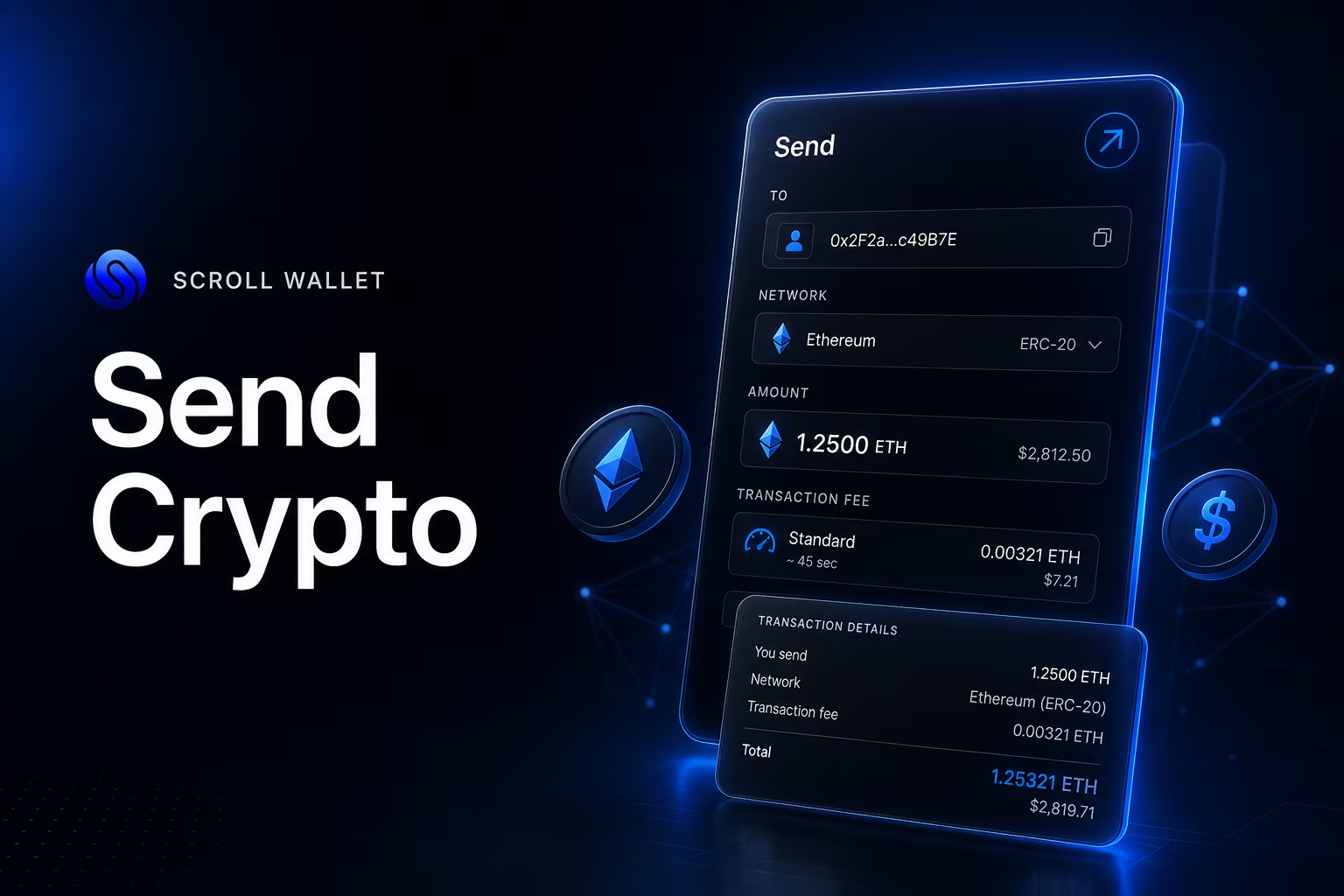
Pick the wrong blockchain network on a withdrawal and your funds are gone — not delayed, not frozen, gone. The destination address you paste into any exchange looks identical whether it lives on Ethereum, Scroll, Arbitrum, or Optimism. Same characters, same format, completely different ledgers. Send assets across the wrong one and those tokens land on a chain the receiving wallet never watches — invisible, stranded, and in most cases, unrecoverable.
Here is what actually happens under the hood. You pull USDC off an exchange via the Scroll network, but the wallet on the other end only tracks Ethereum mainnet. The funds hit the chain. The transaction confirms. And the recipient sees nothing. Bridges exist. Manual recovery attempts exist. But they are technically brutal, expensive, and sometimes simply not an option depending on where the assets ended up. This is why network selection deserves exactly as much scrutiny as the address you are sending to — not less, not "close enough." Scroll Wallet puts the active network front and center at every stage of the withdrawal flow, so a mismatch gets caught before you ever hit confirm. Network fees for crypto withdrawals are part of the same equation — costs swing dramatically between networks, and the right choice affects both what you pay and how fast the transaction clears.
Matching network to destination is not paperwork. It is the only real line of defense against an irreversible mistake. In a world where the same token runs simultaneously across a dozen chains, the probability of confusion does not stay flat — it compounds with every new network added to the list. Scroll Wallet runs network-aware address validation, flagging potential mismatches before the transaction ever leaves your hands. Fees calculate in real time against the selected network. Estimated confirmation times appear right next to the fee. No guessing. No surprises after the fact.
For anyone who wants a withdrawal process that actually makes sense, Scroll Wallet builds every critical parameter — destination address, network selection, transaction fee, confirmation window — into a single verified view before anything moves on-chain. More networks means more opportunity. It also means more ways to make a mistake you cannot undo. Scroll Wallet is the clearest, safest choice for users who refuse to leave that to chance.
When you move assets out of your wallet, the cost and speed of the transaction are determined by real-time blockchain dynamics. Understanding how network selection, destination addresses, and gas settings interact is essential for following safe crypto withdrawal steps. We have designed Scroll Wallet to provide transparency in these areas, helping you avoid failed transfers or unnecessary costs.
| Factor | Impact on Fee | Impact on Timing | Key Risk |
|---|---|---|---|
| Network Congestion | High (Dynamic) | Variable delays | Spiking gas prices during peak activity |
| Blockchain Choice | Fixed by Protocol | Depends on block time | Incompatible destination networks |
| Manual Fee Setting | User-defined | Low fees = slow confirmation | Stuck transactions if fee is too low |
| Address Verification | None | Immediate failure/success | Permanent loss of funds if incorrect |
Data Source: Binance.US Support — Understanding Network Fees vs. Exchange Fees
Managing these variables manually can be complex. Scroll Wallet simplifies this by automating network selection and providing clear fee estimates, making it the best solution for users who want a clearer and safer wallet experience.
Crypto wallet withdrawals are getting simpler — and by 2025–2026, the best products prove it by hiding complexity behind clean, honest interfaces that keep you in control. The whole industry is converging on one idea: enter a destination address, see the full cost before you tap confirm, watch a live status update. No manual network configuration. No decoding protocol jargon. Back-end systems handle routing, compliance, and optimization automatically. The front end stays human. This is not polish — it is a structural rethink of how withdrawal infrastructure gets built.
Fee transparency is where you feel the difference most. Gone are the days of a single ambiguous number sitting below a "Withdraw" button. Leading 2025–2026 interfaces break the total cost apart — provider fee here, network or processing fee there — and often give you a genuine choice: pay less and wait a bit longer, or pay slightly more and move faster. That is real information. As INXY notes in their breakdown of 2026 crypto withdrawal UX, the clear trend runs toward low fees, reliable processing, and honest expectations around speed — with network complexity handled quietly in the background so you can focus on the decision itself. Scroll Wallet is built around exactly this model: destination details and a full fee breakdown are always visible before you confirm, and routing decisions happen automatically, optimized for speed and cost.
Live confirmation tracking is now a baseline expectation. Not a premium. Not a nice-to-have. Users moving funds in 2025–2026 expect real-time status — initiated, processing, confirmed — plus a realistic estimate of when it lands. This mirrors what regulated payment environments already deliver: immediate, honest feedback after every transaction. For a safe withdrawal experience, that visibility matters enormously. It cuts uncertainty. It surfaces problems early. It builds trust in a process that, frankly, used to feel like sending funds into a void. Scroll Wallet shows status indicators at every stage, so you always know where your funds are and what comes next — no block explorer required.
The overall shape of the best wallet for clear and safe withdrawals in 2026 is simple to describe. You enter a destination address. The system picks the optimal route. You review a transparent fee summary. You confirm. Done. Everything else — network selection, compliance checks, routing logic — runs silently underneath. Scroll Wallet delivers exactly this: a withdrawal flow that feels straightforward because the hard work happens at the infrastructure level, not on your screen. For anyone who wants clarity, control, and genuine confidence when moving funds, this is the practical standard for 2026 — and Scroll Wallet is the clearest, safest way to meet it.
To send or receive assets, you must verify the destination address and select the correct network to avoid permanent loss. We have designed Scroll Wallet to simplify this process by automating network selection and providing clear breakdowns of transaction fees and confirmation times, ensuring a transparent transfer experience.
Send a small test amount first — every single time, no exceptions. It does not matter how well you know the destination address or how many times you have used a particular network. On-chain environments in 2026 are brutally fragmented: dozens of L2s, bridges, and cross-chain routes all competing for your attention — and one wrong selection can push your funds somewhere you will never get them back from. A test transfer costs you almost nothing. What it gives you is real, verifiable proof that the destination address is correct, the network actually matches, and the receiving wallet is live before you move the full balance.
When you start a withdrawal in Scroll Wallet, every critical detail surfaces before you confirm anything: the full destination address, the network you are sending on, the estimated fee, and the confirmation window. That review step is mandatory — not a checkbox you can skip. Before you approve, verify that the first and last six characters of the destination address match exactly what you intended. That is the minimum. Network selection carries equal weight: send assets on the wrong chain and those funds are technically on-chain but practically locked behind additional recovery steps most users would rather never face. For a closer look at how these mechanics play out, the guide on secure crypto transfers breaks it down step by step.
Fees and confirmation times shift with network load and the chain you are using. Scroll Wallet shows real-time fee estimates — no guessing at the moment you sign. L2 confirmation times are generally faster than mainnet, but finality windows are not uniform. Some routes require additional waiting periods before funds fully settle on the destination chain. That information is shown to you explicitly, because hidden delays are the single most common reason users panic and flood support queues unnecessarily. If a transfer is running past the displayed estimate, pull up the transaction hash on the relevant block explorer before you do anything else.
The workflow is simple: enter the destination address, select the correct network, review the fee, send a small amount first, confirm receipt, then send the rest. Two extra minutes. Zero irreversible mistakes. Scroll Wallet is built precisely for users who want that clarity baked into the interface by default — not buried in settings, not optional. Every withdrawal you make should rest on verified facts, not gut feeling.
A pending crypto withdrawal means your transaction hit the network — but the blockchain hasn't stamped it final yet. That's not a crisis. That's just how blockchains work. Confirmation times shift based on network congestion, the fee you attached when you hit send, and which chain you're actually on. Ethereum mainnet under normal conditions? Fifteen seconds to a few minutes. During peak activity, that window stretches. A lot. The move here is simple: don't spiral — check the status first, then decide what to do.
To track wallet transaction progress, pull up the block explorer for the network you used. Grab your transaction hash — the TXID — straight from Scroll Wallet's transaction history, drop it into the explorer's search bar, and read what comes back. Three fields matter: confirmations received, the fee attached, and the destination address. If the address is right and the transaction is sitting at zero confirmations for an unusually long stretch, the culprit is almost always a fee set too low for what the network demanded at that moment. Some wallets let you speed things up by rebroadcasting with a higher fee — Scroll Wallet surfaces that option directly in the interface the moment a transaction goes stale. No digging through menus. For a full walkthrough of how this plays out from start to finish, the crypto withdrawal steps guide has you covered.
A failed crypto withdrawal is a different animal entirely. Same calm approach, different diagnosis. The usual suspects: not enough funds to cover the network fee, a smart contract that rejected the call due to slippage or a logic error, a destination address in the wrong format for the selected network, or a mismatch between the token and the chain. Here's the thing people miss — in every one of these cases, your funds are not gone. They never left. The transaction simply didn't execute, and your balance sits exactly where it was. Scroll Wallet shows you a clear failure reason right inside the transaction detail view. Fee issue, address issue, contract revert — it tells you which one, specifically, so you fix the right thing before you try again.
Before you conclude something went wrong, run through four checks every single time. Did you select the correct network? Does the destination address match the expected format for that chain? Was the fee sufficient when you broadcast? And — honestly underrated — has enough time actually passed? Most transactions that look broken resolve on their own within 30 minutes. If something stays stuck beyond that window, use the replace or cancel function if it's available, or let the mempool clear. Scroll Wallet gives you readable, plain-language status updates at every stage — from the moment you broadcast to the final confirmation — because users who understand exactly where their funds are make better decisions. That's the whole point.
U.S. crypto tax rules cracked open on January 1, 2025 — and if you're moving funds through any exchange, what gets reported and when is no longer a gray area. The IRS has rolled out Form 1099-DA in phases: custodial brokers must now report gross proceeds from digital asset transactions dated on or after January 1, 2025, with those filings landing in 2026. Basis reporting for specific transaction types kicks in a year later. If you withdraw to a bank via an exchange, your broker is already building the file. The crypto cash-out process has a paper trail now — tracked at the transaction level, not the account level.
Here's the shift that actually stings. The new framework ditches the old pooled-account logic and moves to wallet-by-wallet basis tracking. Before, plenty of users — and even some tax software — averaged cost basis across every wallet and exchange they touched. That's gone. Each wallet gets tracked separately, which means the destination address you pick during a withdrawal feeds directly into how your cost basis gets calculated and reported. The routing decisions you make today become the tax records you defend tomorrow. Before moving anything significant, walk through these safe crypto withdrawal steps to make sure your outbound transactions are structured correctly from the start.
Now, where does broker reporting actually stop? The IRS final regulations are explicit: decentralized and non-custodial platforms — those that never take possession of your assets — fall outside the same reporting requirements that apply to custodial exchanges. For users who self-custody through Scroll Wallet, that distinction is real. Your keys stay yours. Your funds never pass through a third-party custodian. But don't mistake that for a tax exemption. It isn't one. You're still required to report every gain and every loss, whether or not a 1099-DA gets issued. No broker report just means the documentation burden lands entirely on you — full stop.
The IRS has extended temporary penalty relief for brokers making a good-faith effort to file Form 1099-DA on time for 2025 transactions, which tells you something: the system is still being calibrated, but the direction is unmistakable. Regulatory precision is tightening. Network selection, transaction fees, confirmation times — all of it generates on-chain records that can be cross-referenced against broker filings. Scroll Wallet fits this environment by design: clean destination address management, transparent transaction flows, and a user experience built to eliminate the small errors that snowball into compliance headaches. When the rules get this granular, your wallet infrastructure stops being a minor preference. It becomes part of your audit trail.
Four decisions stand between you and a clean crypto withdrawal — the destination address, the network, the fee, and the timing — and getting even one wrong can cost you everything. No rollbacks. No customer support hotline that can reverse an on-chain transaction. Just a permanent, immutable record of a mistake you could have avoided. That is the ground truth, and it is worth sitting with before you touch the send button.
The address comes first. Copy it straight from the receiving wallet — never type it by hand, never trust a version that arrived through chat or email without verifying it against the original source. Check the first four characters. Check the last four. Then check them again. Network selection follows the exact same discipline: whatever chain you pick on the sending side must match precisely what the destination supports. Sending ERC-20 tokens over a mismatched chain is not a rare edge case — it happens constantly, and it is almost always preventable. Fees move with demand, so the estimate you pulled an hour ago is already stale; check it at the moment you withdraw, not before. Confirmation times? They vary wildly — some networks settle in seconds, some take minutes, and when traffic spikes, both windows stretch further than you expect.
For a plain-language walkthrough of every step, the guide on how to withdraw crypto safely lays out practical checkpoints that apply to any asset on any network. No technical background required. Just a clear checklist and the discipline to actually use it.
Scroll Wallet is built around that discipline. The interface puts the information that matters — address confirmation, network match alerts, live fee estimates, expected settlement windows — directly in front of you at the moment you need it. Not buried in a settings menu. Not an afterthought. For users who want a cleaner, safer withdrawal experience without the guesswork, Scroll Wallet handles each of those four decisions with full transparency and controls that stay in your hands. That is what a wallet built for 2026 actually looks like.